
Classification of hypertension
"hypertension" AND "classification" AND "guidelines"
hypertension blood pressure classification table JNC ACC AHA ESH
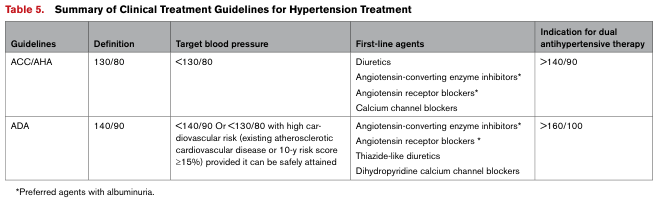
Table 5. Summary of Clinical Treatment Guidelines for Hypertension Treatment <table><thead><tr><th>Guidelines</th><th>Definition</th><th>Target blood pressure</th><th>First-line agents</th><th>Indication for dual antihypertensive therapy</th></tr></thead><tbody><tr><td>ACC/AHA</td><td>130/80</td><td><130/80</td><td>Diuretics<br>Angiotensin-converting enzyme inhibitors*<br>Angiotensin receptor blockers*<br>Calcium channel blockers</td><td>>140/90</td></tr><tr><td>ADA</td><td>140/90</td><td><140/90 Or <130/80 with high cardiovascular risk (existing atherosclerotic cardiovascular disease or 10-y risk score ≥15%) provided it can be safely attained</td><td>Angiotensin-converting enzyme inhibitors*<br>Angiotensin receptor blockers *<br>Thiazide-like diuretics<br>Dihydropyridine calcium channel blockers</td><td>>160/100</td></tr></tbody></table> *Preferred agents with albuminuria.
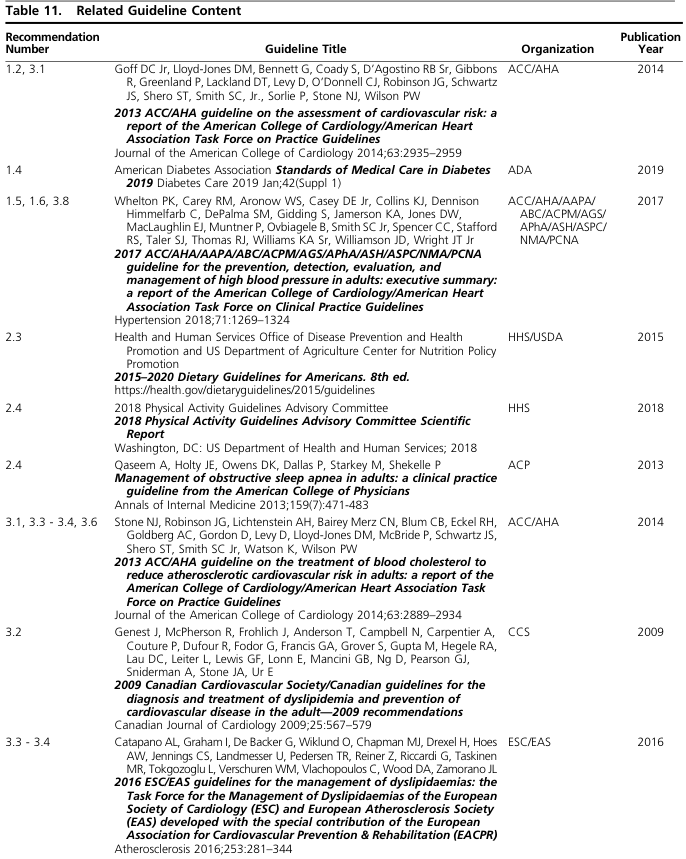
Table 11. Related Guideline Content <table><thead><tr><th>Recommendation Number</th><th>Guideline Title</th><th>Organization</th><th>Publication Year</th></tr></thead><tbody><tr><td>1.2, 3.1</td><td>Goff DC Jr, Lloyd-Jones DM, Bennett G, Coady S, D'Agostino RB Sr, Gibbons R, Greenland P, Lackland DT, Levy D, O'Donnell CJ, Robinson JG, Schwartz JS, Shero ST, Smith SC, Jr., Sorlie P, Stone NJ, Wilson PW 2013 ACC/AHA guideline on the assessment of cardiovascular risk: a report of the American College of Cardiology/American Heart Association Task Force on Practice Guidelines Journal of the American College of Cardiology 2014;63:2935–2959</td><td>ACC/AHA</td><td>2014</td></tr><tr><td>1.4</td><td>American Diabetes Association Standards of Medical Care in Diabetes 2019 Diabetes Care 2019 Jan;42(Suppl 1)</td><td>ADA</td><td>2019</td></tr><tr><td>1.5, 1.6, 3.8</td><td>Whelton PK, Carey RM, Aronow WS, Casey DE Jr, Collins KJ, Dennison Himmelfarb C, DePalma SM, Gidding S, Jamerson KA, Jones DW, MacLaughlin EJ, Muntner P, Ovbiagele B, Smith SC Jr, Spencer CC, Stafford RS, Taler SJ, Thomas RJ, Williams KA Sr, Williamson JD, Wright JT Jr 2017 ACC/AHA/AAPA/ABC/ACPM/AGS/APhA/ASH/ASPC/NMA/PCNA guideline for the prevention, detection, evaluation, and management of high blood pressure in adults: executive summary: a report of the American College of Cardiology/American Heart Association Task Force on Clinical Practice Guidelines Hypertension 2018;71:1269–1324</td><td>ACC/AHA/AAPA/ ABC/ACPM/AGS/ APhA/ASH/ASPC/ NMA/PCNA</td><td>2017</td></tr><tr><td>2.3</td><td>Health and Human Services Office of Disease Prevention and Health Promotion and US Department of Agriculture Center for Nutrition Policy Promotion 2015-2020 Dietary Guidelines for Americans, 8th ed. https://health.gov/dietaryguidelines/2015/guidelines</td><td>HHS/USDA</td><td>2015</td></tr><tr><td>2.4</td><td>2018 Physical Activity Guidelines Advisory Committee 2018 Physical Activity Guidelines Advisory Committee Scientific Report Washington, DC: US Department of Health and Human Services; 2018</td><td>HHS</td><td>2018</td></tr><tr><td>2.4</td><td>Qaseem A, Holty JE, Owens DK, Dallas P, Starkey M, Shekelle P Management of obstructive sleep apnea in adults: a clinical practice guideline from the American College of Physicians Annals of Internal Medicine 2013;159(7):471-483</td><td>ACP</td><td>2013</td></tr><tr><td>3.1, 3.3 - 3.4, 3.6</td><td>Stone NJ, Robinson JG, Lichtenstein AH, Bairey Merz CN, Blum CB, Eckel RH, Goldberg AC, Gordon D, Levy D, Lloyd-Jones DM, McBride P, Schwartz JS, Shero ST, Smith SC Jr, Watson K, Wilson PW 2013 ACC/AHA guideline on the treatment of blood cholesterol to reduce atherosclerotic cardiovascular risk in adults: a report of the American College of Cardiology/American Heart Association Task Force on Practice Guidelines Journal of the American College of Cardiology 2014;63:2889–2934</td><td>ACC/AHA</td><td>2014</td></tr><tr><td>3.2</td><td>Genest J, McPherson R, Frohlich J, Anderson T, Campbell N, Carpentier A, Couture P, Dufour R, Fodor G, Francis GA, Grover S, Gupta M, Hegele RA, Lau DC, Leiter L, Lewis GF, Lonn E, Mancini GB, Ng D, Pearson GJ, Sniderman A, Stone JA, Ur E 2009 Canadian Cardiovascular Society/Canadian guidelines for the diagnosis and treatment of dyslipidemia and prevention of cardiovascular disease in the adult—2009 recommendations Canadian Journal of Cardiology 2009;25:567–579</td><td>CCS</td><td>2009</td></tr><tr><td>3.3 - 3.4</td><td>Catapano AL, Graham I, De Backer G, Wiklund O, Chapman MJ, Drexel H, Hoes AW, Jennings CS, Landmesser U, Pedersen TR, Reiner Ž, Riccardi G, Taskinen MR, Tokgozoglu L, Verschuren WM, Vlachopoulos C, Wood DA, Zamorano JL 2016 ESC/EAS guidelines for the management of dyslipidaemias: The Task Force for the Management of Dyslipidaemias of the European Society of Cardiology (ESC) and European Atherosclerosis Society (EAS) developed with the special contribution of the European Association for Cardiovascular Prevention & Rehabilitation (EACPR) Atherosclerosis 2016;253:281–344</td><td>ESC/EAS</td><td>2016</td></tr></tbody></table>
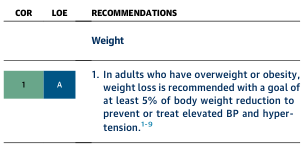
Summary : This figure presents a clinical recommendation regarding weight loss for adults with overweight or obesity, specifically targeting blood pressure and hypertension management. table: Recommendation Overview : • Recommendation is for adults who have overweight or obesity. • Weight loss is recommended with a goal of at least 5% of body weight reduction. • The purpose is to prevent or treat elevated blood pressure (BP) and hypertension. Classification Codes : • COR (Class of Recommendation): 1 • LOE (Level of Evidence): A Reference Notes : • The recommendation is supported by references 1–9. Analysis : • The table provides a high-level, evidence-based clinical guideline emphasizing the importance of modest weight loss (≥5%) in managing or preventing high blood pressure in overweight or obese adults, with a strong recommendation (Class 1, Level A evidence).
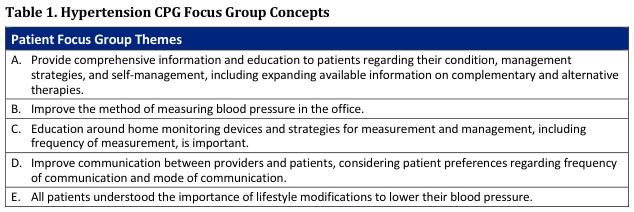
Table 1. Hypertension CPG Focus Group Concepts <table><thead><tr><th colspan="2">Patient Focus Group Themes</th></tr></thead><tbody><tr><td>A.</td><td>Provide comprehensive information and education to patients regarding their condition, management strategies, and self-management, including expanding available information on complementary and alternative therapies.</td></tr><tr><td>B.</td><td>Improve the method of measuring blood pressure in the office.</td></tr><tr><td>C.</td><td>Education around home monitoring devices and strategies for measurement and management, including frequency of measurement, is important.</td></tr><tr><td>D.</td><td>Improve communication between providers and patients, considering patient preferences regarding frequency of communication and mode of communication.</td></tr><tr><td>E.</td><td>All patients understood the importance of lifestyle modifications to lower their blood pressure.</td></tr></tbody></table>
Classification of Hypertension
1. Classification by Etiology (Cause)
A. Primary (Essential) Hypertension
- Accounts for 90-95% of all adult hypertension cases
- No identifiable single cause
- Results from a complex interplay of genetic, environmental, and hemodynamic factors
B. Secondary Hypertension
- Accounts for 5-10% of cases; has an identifiable underlying cause
- More common in younger patients or those with resistant hypertension
| Cause | Examples |
|---|---|
| Renal parenchymal | CKD, polycystic kidney disease, glomerulonephritis |
| Renovascular | Renal artery stenosis (atherosclerotic or fibromuscular dysplasia) |
| Primary aldosteronism | Conn's syndrome, bilateral adrenal hyperplasia |
| Obstructive sleep apnea | Most common identifiable cause in adults |
| Pheochromocytoma | Catecholamine-secreting adrenal tumor |
| Thyroid disorders | Hypothyroidism (raised diastolic), hyperthyroidism (raised systolic) |
| Cushing's syndrome | Excess glucocorticoids |
| Coarctation of aorta | Congenital; typically presents in young patients |
| Drug-induced | NSAIDs, OCP, sympathomimetics, corticosteroids, calcineurin inhibitors |
- Comprehensive Clinical Nephrology, 7th Edition, p. 494
2. Classification by Blood Pressure Level
A. JNC 7 Classification (USA - 2003, still widely referenced)
| Category | Systolic (mmHg) | Diastolic (mmHg) | |
|---|---|---|---|
| Normal | < 120 | and | < 80 |
| Prehypertension | 120-139 | or | 80-89 |
| Stage 1 Hypertension | 140-159 | or | 90-99 |
| Stage 2 Hypertension | ≥ 160 | or | ≥ 100 |
- Comprehensive Clinical Nephrology, 7th Edition, p. 487
B. 2017 ACC/AHA Guidelines (USA - currently in force)
| Category | Systolic (mmHg) | Diastolic (mmHg) | |
|---|---|---|---|
| Normal | < 120 | and | < 80 |
| Elevated BP | 120-129 | and | < 80 |
| Stage 1 Hypertension | 130-139 | or | 80-89 |
| Stage 2 Hypertension | ≥ 140 | or | ≥ 90 |
| Hypertensive Crisis | > 180 | and/or | > 120 |
- Comprehensive Clinical Nephrology, 7th Edition, p. 488
C. 2018 ESC/ESH Guidelines (European - Grades 1-3 system)
| Category | Systolic (mmHg) | Diastolic (mmHg) | |
|---|---|---|---|
| Optimal | < 120 | and | < 80 |
| Normal | 120-129 | and/or | 80-84 |
| High Normal | 130-139 | and/or | 85-89 |
| Grade 1 Hypertension | 140-159 | and/or | 90-99 |
| Grade 2 Hypertension | 160-179 | and/or | 100-109 |
| Grade 3 Hypertension | ≥ 180 | and/or | ≥ 110 |
| Isolated Systolic HTN | ≥ 140 | and | < 90 |
-
Office BP: ≥ 140/90 mmHg
-
Ambulatory - Daytime: ≥ 135/85 mmHg
-
Ambulatory - Nighttime: ≥ 120/70 mmHg
-
Ambulatory - 24-hour: ≥ 130/80 mmHg
-
Home BP monitoring: ≥ 135/85 mmHg
-
Comprehensive Clinical Nephrology, 7th Edition, p. 487-488
D. 2020 International Society of Hypertension (ISH) Guidelines
| Category | Systolic (mmHg) | Diastolic (mmHg) | |
|---|---|---|---|
| Normal BP | < 130 | and | < 85 |
| High-Normal BP | 130-139 | and/or | 85-89 |
| Grade 1 Hypertension | 140-159 | and/or | 90-99 |
| Grade 2 Hypertension | ≥ 160 | and/or | ≥ 100 |
-
Office BP threshold: > 140/90 mmHg
-
Home BP threshold: ≥ 135/85 mmHg
-
Comprehensive Clinical Nephrology, 7th Edition, p. 488
3. Special Forms / Clinical Subtypes
| Subtype | Definition |
|---|---|
| Isolated Systolic Hypertension | SBP ≥ 140 with DBP < 90; common in elderly due to arterial stiffness |
| White Coat Hypertension | Elevated office BP but normal out-of-office readings |
| Masked Hypertension | Normal office BP but elevated ambulatory/home BP |
| Resistant Hypertension | BP above target despite 3 or more antihypertensive agents (one being a diuretic) at optimal doses |
| Refractory Hypertension | Uncontrolled on ≥ 5 agents including a long-acting thiazide diuretic and mineralocorticoid receptor antagonist |
| Hypertensive Urgency | Severely elevated BP (> 180/120) without acute target organ damage |
| Hypertensive Emergency | Severely elevated BP with acute target organ damage (e.g., encephalopathy, AKI, dissection, pulmonary edema) |
- Fuster and Hurst's The Heart, 15th Edition, p. 193-194
4. Classification by Population-Based Percentile (Pediatric)
- Elevated BP: SBP or DBP at the 90th-94th percentile for age, sex, and height
- Stage 1 Hypertension: ≥ 95th percentile up to < 95th percentile + 12 mmHg (or 130/80-139/89 mmHg)
- Stage 2 Hypertension: ≥ 95th percentile + 12 mmHg (or ≥ 140/90 mmHg)
Key Conceptual Points
-
The risk of cardiovascular and renal morbidity is continuous from BP levels as low as 115/75 mmHg - any definition of hypertension is, to some degree, arbitrary
-
Every 20 mmHg rise in SBP (or 10 mmHg in DBP) doubles the risk of death from heart disease or stroke across ages 40-89 years
-
The theoretical minimum risk SBP identified by the Global Burden of Disease study is 110-115 mmHg
-
Comprehensive Clinical Nephrology, 7th Edition, p. 487
Drugs classification
Which drug classification are you asking about?
Classification of Antihypertensive Drugs
I. DIURETICS
A. Thiazide and Thiazide-like Diuretics (First-line)
- Mechanism: Inhibit the Na⁺/Cl⁻ cotransporter (NCC) in the distal convoluted tubule
- Examples: Hydrochlorothiazide (HCTZ), Chlorthalidone, Indapamide
- Note: Chlorthalidone is preferred over HCTZ (half-life 48-72h vs 16-24h - better 24h BP control)
- Side effects: Hypokalemia, hyponatremia, hypomagnesemia, hyperuricemia, dyslipidemia, impaired glucose tolerance, photosensitivity
- Compelling indications: Heart failure, high CAD risk, diabetes, stroke, isolated systolic hypertension
B. Loop Diuretics
- Mechanism: Inhibit Na⁺/K⁺/2Cl⁻ cotransporter (NKCC2) in the thick ascending limb of the loop of Henle
- Examples: Furosemide, Bumetanide, Torsemide
- Use: Preferred in CKD with poor GFR (where thiazides are less effective), heart failure with fluid overload
- Side effects: Hypokalemia (fewer other metabolic effects than thiazides)
C. Potassium-Sparing Diuretics
- Mechanism: Inhibit the epithelial sodium channel (ENaC) in the distal tubule
- Examples: Amiloride, Triamterene
- Use: Often combined with thiazides to prevent hypokalemia
- Side effects: Hyperkalemia
II. RENIN-ANGIOTENSIN-ALDOSTERONE SYSTEM (RAAS) BLOCKERS
A. ACE Inhibitors (ACEi) (First-line)
- Mechanism: Block conversion of angiotensin I → angiotensin II by inhibiting ACE
- Examples: Lisinopril, Enalapril, Ramipril, Captopril, Perindopril
- Side effects: Dry cough (most common - class effect), hyperkalemia, elevated creatinine, angioedema (rare but serious), fetal toxicity (contraindicated in pregnancy)
- Compelling indications: Heart failure, post-MI, high CAD risk, diabetes, CKD with proteinuria, previous stroke, LVH, microalbuminuria
B. Angiotensin Receptor Blockers (ARBs) (First-line)
- Mechanism: Block binding of angiotensin II to the AT₁ receptor
- Examples: Losartan, Valsartan, Candesartan, Irbesartan, Telmisartan, Olmesartan
- Side effects: Similar to ACEi but no cough - use when ACEi cough is intolerable
- Note: ACEi + ARB combination is NOT recommended (increases risk of hyperkalemia and AKI without added benefit)
- Compelling indications: Same as ACEi; preferred in CKD with proteinuria and diabetes
C. Direct Renin Inhibitor (DRI)
- Mechanism: Blocks conversion of angiotensinogen → angiotensin I (acts at the very start of the RAAS cascade)
- Examples: Aliskiren
- Side effects: Similar to ARBs; diarrhea at high doses
- Note: Not first-line; contraindicated with ACEi or ARB in diabetics
III. CALCIUM CHANNEL BLOCKERS (CCBs) (First-line)
A. Dihydropyridines (DHP) - Vasodilators
- Primarily act on vascular smooth muscle
- Examples: Amlodipine, Nifedipine, Felodipine, Lercanidipine, Nicardipine
- Side effects: Dependent (peripheral) edema, reflex tachycardia, flushing, gingival hyperplasia
- Compelling indications: High CAD risk, diabetes, isolated systolic hypertension, Black patients, asymptomatic atherosclerosis, peripheral artery disease
B. Non-Dihydropyridines - Vasodilators + Heart Rate Control
| Agent | Mechanism | Side Effects |
|---|---|---|
| Verapamil | Vasodilation + strong AV nodal blockade | Bradycardia, constipation (most common) |
| Diltiazem | Vasodilation + moderate AV nodal blockade | Bradycardia |
- Compelling indications: Angina, atrial fibrillation rate control
- Contraindicated: With beta-blockers (risk of complete heart block), in heart failure with reduced EF
IV. BETA-BLOCKERS (BB)
A. Non-Selective Beta-Blockers (β₁ + β₂ block)
- Examples: Propranolol, Nadolol, Timolol, Sotalol
- Side effects: More bronchospasm (avoid in asthma/COPD), peripheral vasoconstriction, blunted hypoglycemia symptoms
B. Cardioselective Beta-Blockers (β₁ selective)
- Examples: Atenolol, Metoprolol, Bisoprolol, Nebivolol
- Side effects: Less bronchospasm (still use with caution in reactive airway disease)
C. Combined Alpha- and Beta-Blockers
- Examples: Carvedilol (β₁, β₂, α₁), Labetalol (β₁, β₂, α₁)
- Use: Useful in heart failure and hypertensive urgency (IV labetalol)
V. ALDOSTERONE/MINERALOCORTICOID RECEPTOR ANTAGONISTS (MRA)
| Drug | Notes |
|---|---|
| Spironolactone | Anti-androgenic side effects: gynecomastia, irregular menses, impotence; drug of choice for resistant hypertension (PATHWAY-2 study) |
| Eplerenone | More selective - fewer anti-androgenic side effects; used in post-MI heart failure |
- Compelling indications: Heart failure, post-MI, primary aldosteronism, resistant hypertension
- Side effects: Hyperkalemia (monitor K⁺ and renal function)
VI. SECOND-LINE / ADJUNCT CLASSES
A. Alpha-1 Blockers
- Mechanism: Block postsynaptic α₁ adrenergic receptors → vasodilation
- Examples: Doxazosin, Prazosin, Terazosin
- Use: Add-on for resistant hypertension; also useful in men with BPH
- Caution: ALLHAT trial showed inferior CV outcomes (especially increased heart failure risk) vs. first-line agents - not used as initial therapy
B. Direct Vasodilators
| Drug | Notes |
|---|---|
| Hydralazine | Arteriolar vasodilator; requires 3-4 doses/day; useful in Black patients with heart failure (+ isosorbide dinitrate) |
| Minoxidil | Very potent; causes significant fluid retention (must combine with loop diuretic); causes facial hirsutism; risk of pericardial effusion |
C. Centrally Acting Sympatholytics (Central Alpha-2 Agonists)
| Drug | Notes |
|---|---|
| Clonidine | Reduces sympathetic outflow from CNS; short-acting (2-3x/day); causes dry mouth, lethargy; rebound hypertension if stopped abruptly; transdermal patch preferred |
| Methyldopa | Drug of choice in pregnancy; causes sedation, hepatotoxicity |
| Guanfacine | Better tolerated; once-daily extended-release available; useful in dialysis patients |
| Moxonidine | Selective I₁ imidazoline receptor agonist; used in metabolic syndrome |
VII. SPECIAL SITUATIONS - PREFERRED AGENTS
| Condition | Preferred Drug(s) |
|---|---|
| Diabetes mellitus | ACEi or ARB (especially with proteinuria), CCB, thiazide |
| CKD with proteinuria | ACEi or ARB |
| Heart failure (HFrEF) | ACEi/ARB, BB (bisoprolol/carvedilol/metoprolol), MRA, diuretics |
| Post-MI | ACEi/ARB, BB |
| Angina | BB, CCB |
| Atrial fibrillation (rate control) | BB, non-DHP CCB (verapamil/diltiazem) |
| Left ventricular hypertrophy | ACEi, ARB, CCB |
| Isolated systolic hypertension (elderly) | Thiazide diuretic, CCB |
| Black patients | CCB, thiazide diuretic (ACEi/ARBs less effective as monotherapy) |
| Pregnancy | BB (labetalol), CCB (nifedipine), methyldopa - avoid ACEi/ARBs |
| Primary aldosteronism | Spironolactone/Eplerenone |
| Aortic aneurysm/dissection | Beta-blocker |
| Resistant hypertension | Add spironolactone (best evidence), then doxazosin or minoxidil |
Summary Table
| Class | Examples | Key Mechanism | Key Side Effects |
|---|---|---|---|
| Thiazide diuretics | Chlorthalidone, HCTZ | NCC inhibition (DCT) | Hypokalemia, hyperuricemia |
| Loop diuretics | Furosemide | NKCC2 inhibition | Hypokalemia |
| K-sparing diuretics | Amiloride | ENaC inhibition | Hyperkalemia |
| ACE inhibitors | Lisinopril, Ramipril | Block Ang I→II conversion | Cough, angioedema |
| ARBs | Losartan, Valsartan | Block AT₁ receptor | No cough (vs ACEi) |
| Direct renin inhibitor | Aliskiren | Block renin | Diarrhea |
| DHP-CCBs | Amlodipine | L-type Ca²⁺ channel block | Peripheral edema |
| Non-DHP-CCBs | Verapamil, Diltiazem | Ca²⁺ block + AV node | Bradycardia |
| Beta-blockers | Metoprolol, Carvedilol | Block β-adrenoceptors | Fatigue, bronchospasm |
| MRAs | Spironolactone | Aldosterone block | Gynecomastia, hyperK |
| Alpha-blockers | Doxazosin | Block α₁ receptors | First-dose hypotension |
| Direct vasodilators | Hydralazine, Minoxidil | Arteriolar dilation | Reflex tachycardia |
| Central alpha-2 agonists | Clonidine, Methyldopa | Reduce CNS sympathetic output | Sedation, rebound HTN |