
Myloma in medical terms in detail
Reading File
Now let me search the medical library for comprehensive myeloma content in parallel:
Finding Sources
Finding Sources
Searching PubMed
"multiple myeloma"[MeSH Terms] AND treatment
Now let me read the most comprehensive textbook sources in parallel:
Reading File
Reading File
Reading File
Excellent content. Now let me read the Goldman-Cecil chapter on myeloma and fetch the key images:
Finding Sources
Reading File
Loading Image
Now let me get the Goldman-Cecil dedicated myeloma chapter and search for myeloma histology images:
Finding Sources
Searching Images
multiple myeloma plasma cells bone marrow histology
Now let me read the Henry's Clinical Diagnosis chapter on plasma cell myeloma for staging, diagnosis, and treatment details:
Reading File
Loading Image
Loading Image
I now have comprehensive information to deliver a detailed, well-structured answer. Let me compile everything:
Multiple Myeloma — Comprehensive Medical Overview
Definition
Multiple myeloma (MM) is a malignant neoplasm of plasma cells (terminally differentiated B lymphocytes) that proliferates primarily in the bone marrow. It is the most common primary malignant tumor of bone and accounts for approximately 1.3% of all malignancies and 15% of all hematological malignancies. About 30,000 new cases are diagnosed annually in the United States.
Epidemiology
| Feature | Detail |
|---|---|
| Median age at diagnosis | 62–70 years |
| Sex | Slight male predominance (up to 2:1) |
| Race | More frequent in people of African descent (reason unknown) |
| Age <40 years | Rare (~3% of cases) |
Pathogenesis & Molecular Biology
Myeloma arises from a single clonal plasma cell that undergoes uncontrolled proliferation, driven by several mechanisms:
Chromosomal Abnormalities
- Translocations involving the IgH locus (chromosome 14) fuse it to oncogenes like cyclin D1 (t(11;14)) or cyclin D3 — dysregulation of D cyclins drives cell proliferation
- Hyperdiploidy (trisomies of odd-numbered chromosomes) → associated with better prognosis
- Hypodiploidy → associated with adverse prognosis
- Late-stage: translocations involving MYC — seen in aggressive disease
Key Growth Factor
- Interleukin-6 (IL-6), produced by bone marrow fibroblasts and macrophages, is the principal cytokine supporting myeloma cell proliferation
Bone Destruction Mechanism
- Myeloma cells upregulate RANKL (receptor activator of NF-κB ligand) expression on marrow stromal cells → activates osteoclasts → bone resorption
- Tumor cells simultaneously release inhibitors of osteoblast function
- Net result: uncoupled bone remodeling → lytic lesions, hypercalcemia, pathologic fractures
Immunoglobulin Production (M Protein / Paraprotein)
| Immunoglobulin Type | Frequency |
|---|---|
| IgG | ~60% (most common) |
| IgA | 20–25% |
| Light chains only (κ or λ) | ~20% |
| IgM, IgD, IgE | Rare |
| Non-secretory (no M protein) | ~1% |
Bence Jones proteins = free immunoglobulin light chains excreted in the urine — a hallmark of myeloma.
Clinical Features — The "CRAB" Criteria
The major end-organ damage defining symptomatic myeloma is remembered as CRAB:
| Letter | Feature | Mechanism |
|---|---|---|
| C | Hypercalcemia | Osteoclast activation → bone resorption |
| R | Renal insufficiency | Light chain cast nephropathy, amyloidosis, hypercalcemia |
| A | Anemia | Marrow replacement by plasma cells → normochromic, normocytic anemia |
| B | Bone lesions | Lytic lesions, pathologic fractures, bone pain |
Additional Features
- Bone pain and backache — most common presenting symptom
- Pathologic fractures — especially vertebral column (affects ~50% of patients at some stage) and femur
- Recurrent bacterial infections — due to suppressed normal immunoglobulin production (functional hypogammaglobulinemia despite high total immunoglobulin)
- Neurologic symptoms — spinal cord compression, confusion/lethargy from hypercalcemia
- Rouleaux formation on blood film — due to high paraprotein levels causing red cell aggregation
- Amyloidosis (AL type) — occurs in ~20% of patients; involves kidneys, heart, tongue, peripheral nerves
Morphology & Pathology
Bone Lesions (Gross)
- Punched-out lytic defects 1–4 cm in diameter throughout the skeleton
- Most common sites: vertebral column, ribs, skull, pelvis, femur, clavicle, scapula
- Arise in medullary cavity → erode cancellous bone → destroy cortex
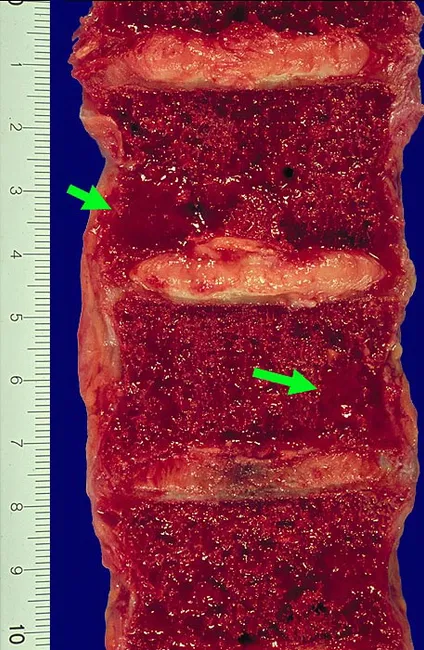
Gross specimen: vertebral bodies showing red-brown, soft-tissue lytic lesions replacing normal bone marrow — characteristic of plasma cell myeloma of the axial skeleton.
Bone Marrow Histology
- Plasma cells >30% of marrow cellularity (diagnostic threshold)
- Cells may resemble normal plasma cells or show abnormal features: prominent nucleoli, cytoplasmic inclusions (Russell bodies = condensed immunoglobulin in dilated ER)
- Late disease: spread to viscera, soft tissue; rarely a leukemic picture
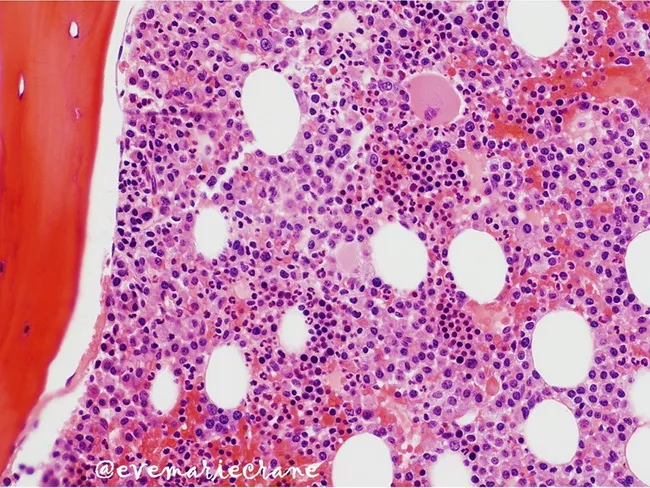
H&E bone marrow biopsy: clonal plasma cells with hyperchromatic nuclei, clumped chromatin, and moderate cytoplasm progressively replacing normal marrow.
Myeloma Kidney
- Obstructive casts (Bence Jones proteins + albumin + tubular proteins) in distal convoluted tubules and collecting ducts → surrounded by multinucleate macrophage giant cells
- AL amyloidosis depositing in glomeruli and vessel walls
- Metastatic calcification from hypercalcemia
- Bacterial pyelonephritis (secondary to hypogammaglobulinemia)
Radiological Features
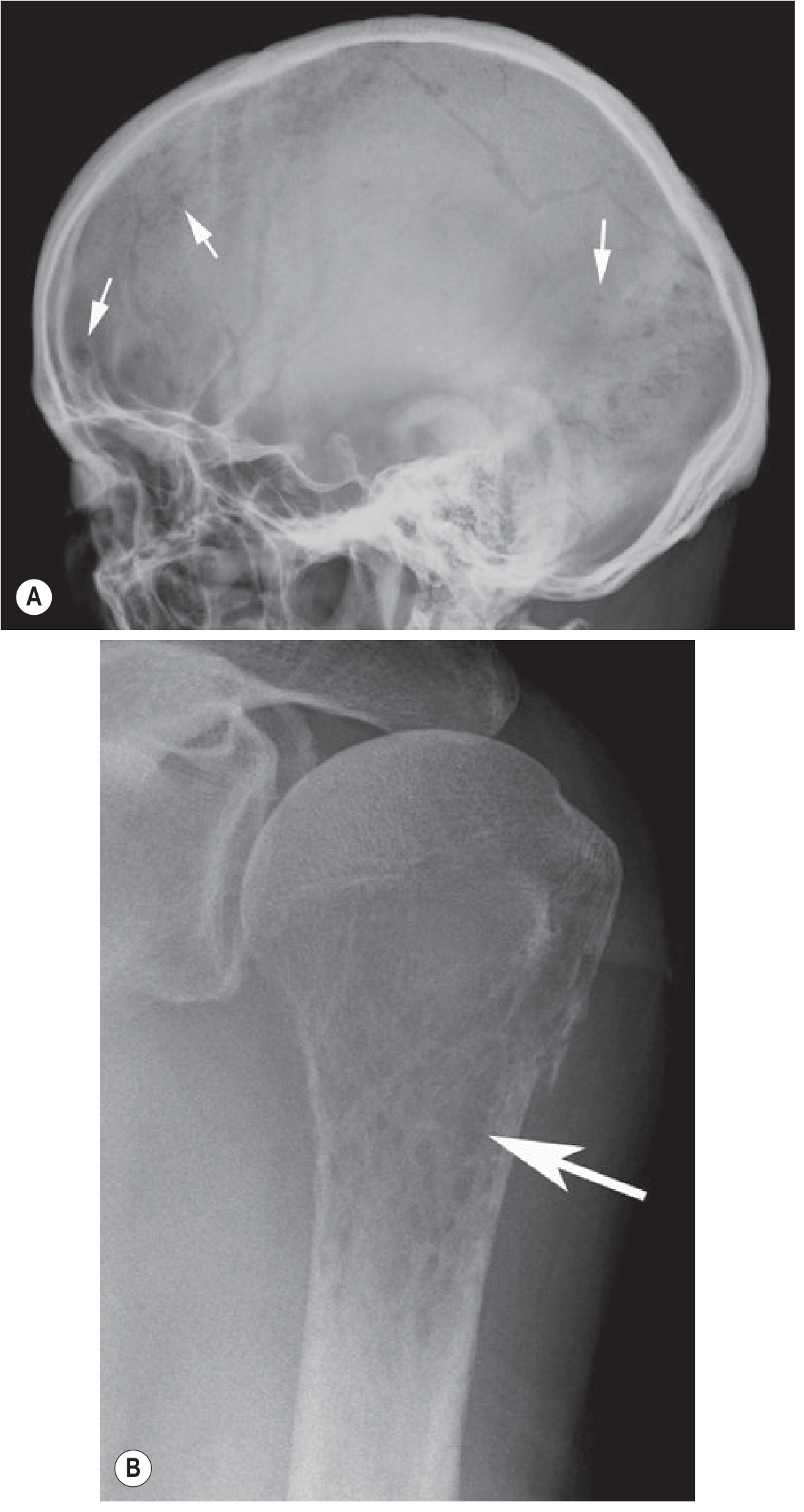
From Grainger & Allison's Diagnostic Radiology. (A) Lateral skull X-ray showing classic "peppered" lytic lesions. (B) Moth-eaten destruction of the proximal humerus.
| Modality | Findings |
|---|---|
| Plain X-ray | Multiple "punched-out" lytic lesions; diffuse osteopenia; vertebral compression fractures |
| CT (whole-body low-dose) | More sensitive than X-ray; focal soft-tissue density lesions; endosteal scalloping; cortical destruction |
| PET/CT | Most sensitive for active lesion detection and treatment response |
| MRI | Best for bone marrow involvement; 5 patterns: normal, focal, diffuse, variegated, combined; discs appear hyperintense compared to vertebral bodies in diffuse disease |
| Sclerotic lesions | Rare; seen in POEMS syndrome (osteosclerotic myeloma) |
Diagnostic Criteria
Spectrum of Plasma Cell Disorders
| Condition | M-protein | Marrow Plasma Cells | End-organ Damage (CRAB) |
|---|---|---|---|
| MGUS (Monoclonal Gammopathy of Undetermined Significance) | <30 g/L | <10% | None |
| Smoldering Myeloma | ≥30 g/L | ≥10% | None |
| Plasma Cell Myeloma (Active) | Present (any level) | Clonal plasma cells present | Present (CRAB + or myeloma-defining events) |
Diagnosis Requires:
- M protein in serum or urine (serum protein electrophoresis + immunofixation)
- Clonal bone marrow plasma cells (biopsy/aspirate)
- End-organ damage (CRAB criteria) OR myeloma-defining events (e.g., marrow plasmacytosis ≥60%, serum FLC ratio ≥100, >1 focal MRI lesion)
Immunophenotype
- Positive: CD38, CD138 (hallmark plasma cell markers)
- Positive (aberrant): CD56, CD117
- Negative (abnormally lost): CD19, CD20
- Light chain restriction (κ or λ) confirms clonality
Laboratory Investigations
| Test | Expected Finding |
|---|---|
| Serum protein electrophoresis (SPEP) | M-spike (monoclonal band) |
| Serum immunofixation | Identifies M-protein isotype (IgG, IgA, etc.) |
| Urine protein electrophoresis (UPEP) | Bence Jones proteinuria |
| Serum free light chains (FLC) | Elevated κ or λ; abnormal κ:λ ratio |
| CBC | Normochromic normocytic anemia; rouleaux on smear |
| Serum calcium | Elevated (hypercalcemia) |
| Creatinine | Elevated (renal insufficiency) |
| Serum β2-microglobulin | Elevated (used for ISS staging) |
| Serum albumin | Decreased (used for ISS staging) |
| LDH | Elevated in aggressive disease (R-ISS staging) |
| Bone marrow biopsy | >10% clonal plasma cells; cytogenetics/FISH |
Staging
International Staging System (ISS)
| Stage | Criteria | Median Survival |
|---|---|---|
| I | β2-microglobulin <3.5 mg/L + Albumin ≥3.5 g/dL | ~62 months |
| II | Neither I nor III | ~44 months |
| III | β2-microglobulin ≥5.5 mg/L | ~29 months |
Revised ISS (R-ISS) also incorporates:
- High-risk cytogenetics: del(17p), t(4;14), t(14;16)
- Elevated LDH
Treatment
Induction Therapy (Transplant-Eligible)
- VRd regimen: Bortezomib (proteasome inhibitor) + Lenalidomide (immunomodulatory agent/IMiD) + Dexamethasone
- Daratumumab (anti-CD38 monoclonal antibody) increasingly added (Dara-VRd)
Autologous Stem Cell Transplantation (ASCT)
- Standard of care for eligible patients (generally age <70, good performance status)
- High-dose melphalan conditioning followed by autologous hematopoietic cell rescue
- Single ASCT standard; tandem ASCT in select cases or at relapse (if prior response >1 year)
Maintenance Therapy
- Lenalidomide post-ASCT is standard
- Bortezomib for high-risk cytogenetics
Non-Transplant Eligible
- VRd or DaraRd (Daratumumab + Lenalidomide + Dexamethasone)
Relapsed/Refractory Myeloma
- Pomalidomide, carfilzomib, ixazomib (next-gen IMiDs and proteasome inhibitors)
- Daratumumab, elotuzumab, isatuximab (monoclonal antibodies)
- CAR-T cell therapy (e.g., Idecabtagene vicleucel targeting BCMA) — approved for late-line therapy
- Bispecific antibodies (e.g., Teclistamab, targeting BCMA × CD3) — recent approvals for third-line and beyond
Recent Evidence Note: A 2024 meta-analysis (PMID 39551604) compared CAR-T vs. bispecific antibodies as third-line+ treatment — both show strong activity; selection depends on patient fitness and logistics.
Mechanism of Proteasome Inhibitors
Myeloma cells accumulate misfolded immunoglobulin chains; proteasome inhibitors (bortezomib, carfilzomib) block degradation of these misfolded proteins → activate apoptotic pathways → selective myeloma cell death.
Supportive Care
- Bisphosphonates (zoledronic acid, pamidronate) — prevent skeletal-related events
- G-CSF, EPO — manage cytopenias
- IVIG — for recurrent infections
- Plasmapheresis — for hyperviscosity syndrome
- Radiation — for localized painful lesions
Prognosis
- Median survival: approximately 5 years with modern therapy
- Untreated patients with multiple bony lesions: survival rarely >6–12 months
- Smoldering myeloma: may not require treatment for many years
- Favorable factors: hyperdiploid cytogenetics, t(11;14), low ISS stage, good performance status
- Adverse factors: del(17p), t(4;14), t(14;16), elevated LDH, high β2-microglobulin, plasmablastic morphology
- Cure has not yet been consistently achieved, but outcomes continue to improve with combination immunotherapy and cellular therapies
Related Plasma Cell Disorders
| Disorder | Key Feature |
|---|---|
| Solitary plasmacytoma | Single bone or extramedullary lesion; no systemic M protein |
| MGUS | Pre-malignant; 1% per year risk of progression to myeloma |
| Waldenström macroglobulinemia | IgM-secreting lymphoplasmacytic lymphoma |
| AL amyloidosis | Light chain deposition in organs (heart, kidney, liver) |
| POEMS syndrome | Polyneuropathy, Organomegaly, Endocrinopathy, M protein, Skin changes; sclerotic bone lesions |
Sources: Robbins & Kumar Basic Pathology, p. 422 | Grainger & Allison's Diagnostic Radiology | Henry's Clinical Diagnosis and Management by Laboratory Methods | Goldman-Cecil Medicine | Robbins, Cotran & Kumar Pathologic Basis of Disease
Serum protein electrophoresis
Reading File
Finding Sources
Finding Sources
You've run out of free credits. Sign up for a free account to continue using Orris.
This is a shared conversation. Sign in to Orris to start your own chat.