
Second Generation Antihistaminics* and Conventional Antihistaminics - compare and contrast; Non-Sedative Antihistaminics - enumerate, advantages, two indications precaution 2. H1 antihistaminics* - uses*, adverse effects* precautions 3. Antihistaminics - classify, moa adv effect uses precautions 2mbbs pharmacology kdt
Reading File
Now let me search the medical library for antihistamines content in parallel:
Finding Sources
Finding Sources
Finding Sources
Finding Sources
Reading File
Reading File
Reading File
Loading Image
Reading File
Reading File
I have enough textbook material. Let me now read the detailed adverse effects and precautions section from Lippincott which was partially truncated:
Reading File
Reading File
I need to read the adverse effects section which was truncated. Let me get it:
Reading File
I now have comprehensive material. Let me compile the complete answer for this 2nd MBBS pharmacology question:
Antihistaminics - Complete 2nd MBBS Pharmacology (KDT-Pattern)
1. CLASSIFICATION OF ANTIHISTAMINICS
H1 Antihistaminics (H1 Blockers)
Generation I - Conventional / First Generation (Sedating)
| Chemical Class | Examples |
|---|---|
| Ethanolamines | Diphenhydramine, Dimenhydrinate, Doxylamine |
| Ethylenediamines | Tripelennamine, Mepyramine |
| Alkylamines | Chlorpheniramine, Brompheniramine |
| Piperazines | Hydroxyzine, Cyclizine, Meclizine |
| Phenothiazines | Promethazine |
| Others | Cyproheptadine, Clemastine |
Generation II - Non-Sedating / Second Generation
| Drug | Notes |
|---|---|
| Loratadine | Truly non-sedating |
| Desloratadine | Active metabolite of loratadine; non-sedating |
| Fexofenadine | Active metabolite of terfenadine; non-sedating |
| Cetirizine | Carboxylated hydroxyzine; mildly sedating |
| Levocetirizine | R-enantiomer of cetirizine; mildly sedating |
| Azelastine | Also topical (nasal/ophthalmic) |
H2 Antihistaminics
- Cimetidine, Ranitidine, Famotidine, Nizatidine (see Chapter 62 - peptic ulcer)
H3 Antihistaminics
- Pitolisant (used in narcolepsy)
2. MECHANISM OF ACTION (MOA)
H1 antihistaminics are competitive (surmountable), reversible antagonists at H1 receptors. They do not block histamine synthesis or release - they block the receptor-mediated response in target tissues.
- They are more effective in preventing than reversing symptoms once established.
- First-generation agents also bind muscarinic-cholinergic, alpha-adrenergic, and serotonin receptors - hence multiple additional effects.
- Second-generation agents are made polar (e.g., by adding carboxyl groups - cetirizine is the carboxylated derivative of hydroxyzine), which prevents BBB penetration and limits CNS effects.
- Some agents (azelastine, ketotifen) also have mast cell-stabilizing effects in addition to H1 blockade.
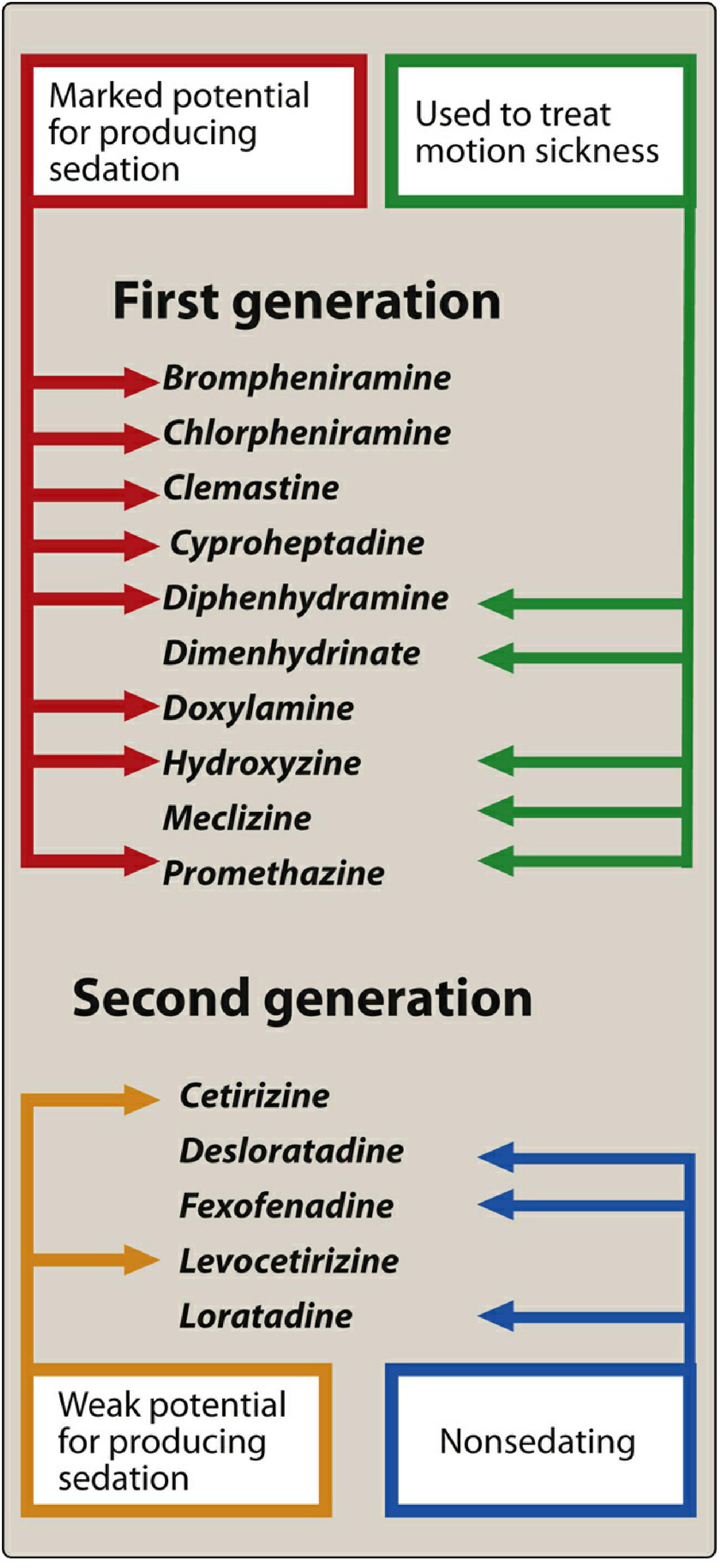
Source: Lippincott Illustrated Reviews: Pharmacology
3. COMPARISON: CONVENTIONAL vs. SECOND GENERATION ANTIHISTAMINICS
| Feature | 1st Gen (Conventional) | 2nd Gen (Non-Sedating) |
|---|---|---|
| CNS penetration | High (lipophilic) | Low (polar/hydrophilic, do not cross BBB) |
| Sedation | Marked | Minimal to none |
| Duration of action | 4-6 hours | 12-24 hours (once daily dosing) |
| Receptor selectivity | Non-selective (also M, alpha, 5-HT) | Selective for peripheral H1 |
| Anticholinergic effects | Yes (dry mouth, urinary retention, blurred vision) | Minimal |
| Motion sickness | Effective (diphenhydramine, promethazine, meclizine) | Not effective |
| Insomnia | Used (diphenhydramine, doxylamine) | No value |
| Cardiotoxicity | Rare | Terfenadine/astemizole (withdrawn) caused QT prolongation; newer ones (fexofenadine, loratadine) safe |
| Drug interactions | Potentiate CNS depressants, alcohol; MAOIs | Fewer interactions |
| Paradoxical excitation | Yes (children) | No |
| Examples | CPM, promethazine, diphenhydramine | Loratadine, fexofenadine, cetirizine |
| Appetite stimulation | Cyproheptadine (also 5-HT antagonist) | Not used for this |
| Cost | Inexpensive | More expensive |
4. NON-SEDATIVE (SECOND GENERATION) ANTIHISTAMINICS
Enumeration
- Fexofenadine - truly non-sedating; active metabolite of terfenadine; excreted unchanged in feces
- Loratadine - truly non-sedating; metabolized by hepatic CYP system
- Desloratadine - active metabolite of loratadine; truly non-sedating
- Cetirizine - partially sedating; carboxylated hydroxyzine; excreted unchanged in urine
- Levocetirizine - active R-enantiomer of cetirizine; partially sedating
- Azelastine - also topical (nasal spray, ophthalmic); mast cell stabilizer
- Olopatadine - topical ophthalmic; mast cell stabilizer
- Acrivastine - short-acting
Advantages over 1st Generation
- No sedation (or minimal) - do not cross the BBB due to polar/carboxylated structure
- Longer duration of action (12-24 hours) - once daily dosing improves compliance
- More selective for peripheral H1 receptors - fewer side effects
- No anticholinergic effects - no dry mouth, no urinary retention, no blurred vision
- No paradoxical excitation in children
- Suitable for daytime use - pilots, drivers, students, skilled workers
- No tolerance development to antiallergic effect (tachyphylaxis does not develop as readily)
Two Key Indications
- Allergic rhinitis - drug of choice; controls sneezing, rhinorrhoea, and itching (though not nasal congestion)
- Chronic urticaria - preferred over first generation for long-term management
Precautions
- Cetirizine/levocetirizine: Dose reduction required in renal impairment (excreted unchanged in urine); may still cause mild sedation
- Loratadine/desloratadine: Dose reduction in hepatic impairment (CYP metabolism)
- Fexofenadine: Avoid taking with grapefruit juice or antacids (reduced absorption)
- Driving/operating machinery: Even "non-sedating" agents can cause mild drowsiness in some individuals - patients should be warned
- Cardiac precaution: Older 2nd-gen agents terfenadine and astemizole (now withdrawn) caused fatal QT prolongation/torsades de pointes with CYP3A4 inhibitors (ketoconazole, erythromycin) - current agents (fexofenadine, loratadine) are safe
5. H1 ANTIHISTAMINICS - USES (HIGH-YIELD)
- Allergic conditions - Allergic rhinitis (drug of choice), urticaria, angioedema, allergic conjunctivitis, drug rashes, atopic dermatitis
- Anaphylaxis - Adjunct only (NOT drug of choice - epinephrine is DOC; antihistamines cannot reverse massive histamine release quickly)
- Motion sickness and vertigo - Diphenhydramine, dimenhydrinate, meclizine, promethazine (taken BEFORE travel; ineffective once symptoms start); meclizine also useful for vestibular vertigo
- Nausea and vomiting - Promethazine, diphenhydramine (block central H1 and M1 receptors in vestibular and chemoreceptor pathways)
- Pruritus - Topical/systemic (chlorpheniramine, hydroxyzine)
- Pre-medication/sedation - Promethazine, hydroxyzine
- Insomnia - Diphenhydramine, doxylamine (OTC sleep aids)
- Appetite stimulation - Cyproheptadine (5-HT antagonist action; used in children with poor appetite)
- Cough - Promethazine (combination cough syrups)
- Common cold - Reduce rhinorrhoea, sneezing, itching; no evidence for reducing cold duration
- Blood transfusion reactions - Premedication with chlorpheniramine
- Serotonin syndrome - Cyproheptadine (5-HT antagonist)
Note: H1 antihistaminics are NOT indicated in bronchial asthma - histamine is only one of several mediators causing bronchoconstriction; leukotrienes, prostaglandins also contribute. Epinephrine is DOC in systemic anaphylaxis.
6. ADVERSE EFFECTS
CNS Effects (mainly 1st generation)
- Sedation - most common; chlorpheniramine, diphenhydramine, promethazine, hydroxyzine
- Fatigue, dizziness, lack of coordination, tremors
- Paradoxical CNS stimulation in children - hyperactivity, insomnia, convulsions (diphenhydramine)
- Elderly more sensitive to CNS effects
Anticholinergic Effects (1st generation)
- Dry mouth, dry nasal passages
- Blurred vision (cycloplegia)
- Urinary retention (especially in elderly males with BPH)
- Constipation
- Tachycardia
Cardiovascular
- Terfenadine, astemizole (withdrawn): QT prolongation, torsades de pointes
- Current agents: generally safe
GI Effects
- Nausea, vomiting, epigastric distress, anorexia (or increased appetite - cyproheptadine)
Topical
- Contact dermatitis with topical diphenhydramine
Overdose (especially children)
- Hallucinations, excitement, ataxia, convulsions, deep coma, cardiorespiratory collapse
Drug Interactions
- CNS depressants + alcohol: potentiation of sedation
- MAOIs: exacerbate sedative and anticholinergic effects - AVOID combination
- CYP inhibitors (ketoconazole, erythromycin) + terfenadine/astemizole: QT prolongation (reason for withdrawal)
- Cholinesterase inhibitors (donepezil): anticholinergic H1 blockers may reduce efficacy in Alzheimer's treatment
7. PRECAUTIONS
| Condition | Reason |
|---|---|
| Prostatic hypertrophy | Anticholinergic effects worsen urinary retention |
| Narrow-angle glaucoma | Mydriasis worsens intraocular pressure |
| Epilepsy | Lowers seizure threshold (especially in overdose) |
| Driving/operating machinery | Sedation risk with 1st gen |
| Elderly | More sensitive to CNS and anticholinergic effects |
| Pregnancy | Doxylamine + pyridoxine (Diclegis) - safe for morning sickness; general caution with others |
| Renal failure | Reduce dose of cetirizine/levocetirizine |
| Hepatic failure | Reduce dose of loratadine/desloratadine |
| Concurrent CNS depressants | Additive sedation |
| MAO inhibitors | Contraindicated with antihistamines |
| Children | Paradoxical excitation; risk of overdose toxicity |
Quick Summary Table for Exam
| Drug | Generation | Sedation | Special Feature |
|---|---|---|---|
| Chlorpheniramine | 1st | ++ | Most used; least sedating among 1st gen |
| Promethazine | 1st | +++ | Antiemetic, preanesthetic |
| Diphenhydramine | 1st | +++ | Motion sickness, insomnia |
| Cyproheptadine | 1st | + | 5-HT antagonist; appetite stimulant |
| Hydroxyzine | 1st | ++ | Anxiety, pruritus |
| Meclizine | 1st | + | Vertigo, motion sickness |
| Loratadine | 2nd | 0 | Truly non-sedating |
| Fexofenadine | 2nd | 0 | Truly non-sedating; excreted in feces |
| Desloratadine | 2nd | 0 | Active metabolite of loratadine |
| Cetirizine | 2nd | +/- | Mildly sedating; renally excreted |
| Levocetirizine | 2nd | +/- | R-enantiomer of cetirizine |
| Azelastine | 2nd | +/- | Topical + mast cell stabilizer |
Sources: Lippincott Illustrated Reviews: Pharmacology (Fig. 39.4, 39.5, 39.6, 39.7); Katzung's Basic and Clinical Pharmacology, 16th ed.; Scott-Brown's Otorhinolaryngology (Antihistamines section)
This is a shared conversation. Sign in to Orris to start your own chat.