
Answer the following question according to bds 3rd year oriented for the subject general medicine : Define Hypertension. Classify, clinical features, complications & management. Add dental considerations.
Reading File
Now let me search the medical library for hypertension content across multiple angles simultaneously.
Finding Sources
Finding Sources
Finding Sources
Finding Sources
Finding Sources
Good - I found key sources. Now let me read the most relevant sections from Harrison's (hypertension definition/classification), Lippincott Pharmacology (antihypertensive drugs), and search for dental considerations specifically.
Reading File
Reading File
Finding Sources
Reading File
Finding Sources
Reading File
Finding Sources
Reading File
Reading File
I now have comprehensive data from the textbooks. Let me also fetch the key diagrams/images and get the Harrison's section on clinical features and complications.
Reading File
Loading Image
I now have comprehensive content from multiple authoritative textbooks. Let me compile the full, well-structured BDS 3rd year answer.
HYPERTENSION
General Medicine - BDS 3rd Year
DEFINITION
Hypertension is defined as a persistent elevation of arterial blood pressure above the accepted normal range. According to the ACC/AHA 2017 guidelines, hypertension is diagnosed when:
- Systolic BP (SBP) ≥ 130 mmHg, and/or
- Diastolic BP (DBP) ≥ 80 mmHg
...on two or more separate occasions, using two or more readings averaged together.
The WHO/JNC 7 definition (still widely used in clinical practice internationally) defines hypertension as BP ≥ 140/90 mmHg. Correct classification requires accurate BP measurement; when SBP and DBP fall in different categories, the higher category is chosen.
- Harrison's Principles of Internal Medicine, 22e, p. 2177
- Lippincott Illustrated Reviews: Pharmacology, p. 288
CLASSIFICATION
ACC/AHA 2017 Classification (most current)
| Category | Systolic (mmHg) | Diastolic (mmHg) | |
|---|---|---|---|
| Normal | < 120 | and | < 80 |
| Elevated | 120-129 | and | < 80 |
| Stage 1 Hypertension | 130-139 | or | 80-89 |
| Stage 2 Hypertension | ≥ 140 | or | ≥ 90 |
JNC 7 / WHO Classification (older, still widely used)
| Category | Systolic (mmHg) | Diastolic (mmHg) | |
|---|---|---|---|
| Normal | < 120 | and | < 80 |
| Pre-hypertension | 120-139 | or | 80-89 |
| Stage 1 HTN | 140-159 | or | 90-99 |
| Stage 2 HTN | ≥ 160 | or | ≥ 100 |
| Hypertensive Crisis | > 180 | or | > 120 |
Etiological Classification
1. Primary (Essential) Hypertension (~90-95% of cases)
- No identifiable underlying cause
- Multifactorial: genetic predisposition + environmental factors
- Risk factors: high dietary sodium, obesity, physical inactivity, excessive alcohol, stress, positive family history, advancing age
2. Secondary Hypertension (~5-10% of cases)
Caused by an identifiable underlying condition:
- Renal: Chronic kidney disease, renovascular disease (renal artery stenosis), polycystic kidney disease
- Endocrine: Primary hyperaldosteronism, Cushing's syndrome, phaeochromocytoma, hyperthyroidism
- Vascular: Coarctation of the aorta
- Drugs: OCP, NSAIDs, corticosteroids, decongestants, cocaine
Suspect secondary HTN in: treatment-resistant hypertension, abrupt onset, age < 30, unprovoked hypokalemia, disproportionate target organ damage.
- Harrison's Principles of Internal Medicine, 22e, p. 2178-2180
PATHOPHYSIOLOGY
Blood Pressure = Cardiac Output × Peripheral Vascular Resistance
Cardiac output depends on: heart rate, myocardial contractility, filling pressure, and blood volume.
Peripheral resistance depends on: arteriolar tone.
Two main regulatory mechanisms are disrupted in hypertension:
- Sympathetic nervous system overactivity - increases heart rate, contractility, and vasoconstriction via baroreceptor dysregulation.
- Renin-Angiotensin-Aldosterone System (RAAS) overactivation - angiotensin II causes vasoconstriction and aldosterone-mediated sodium/water retention, increasing blood volume.
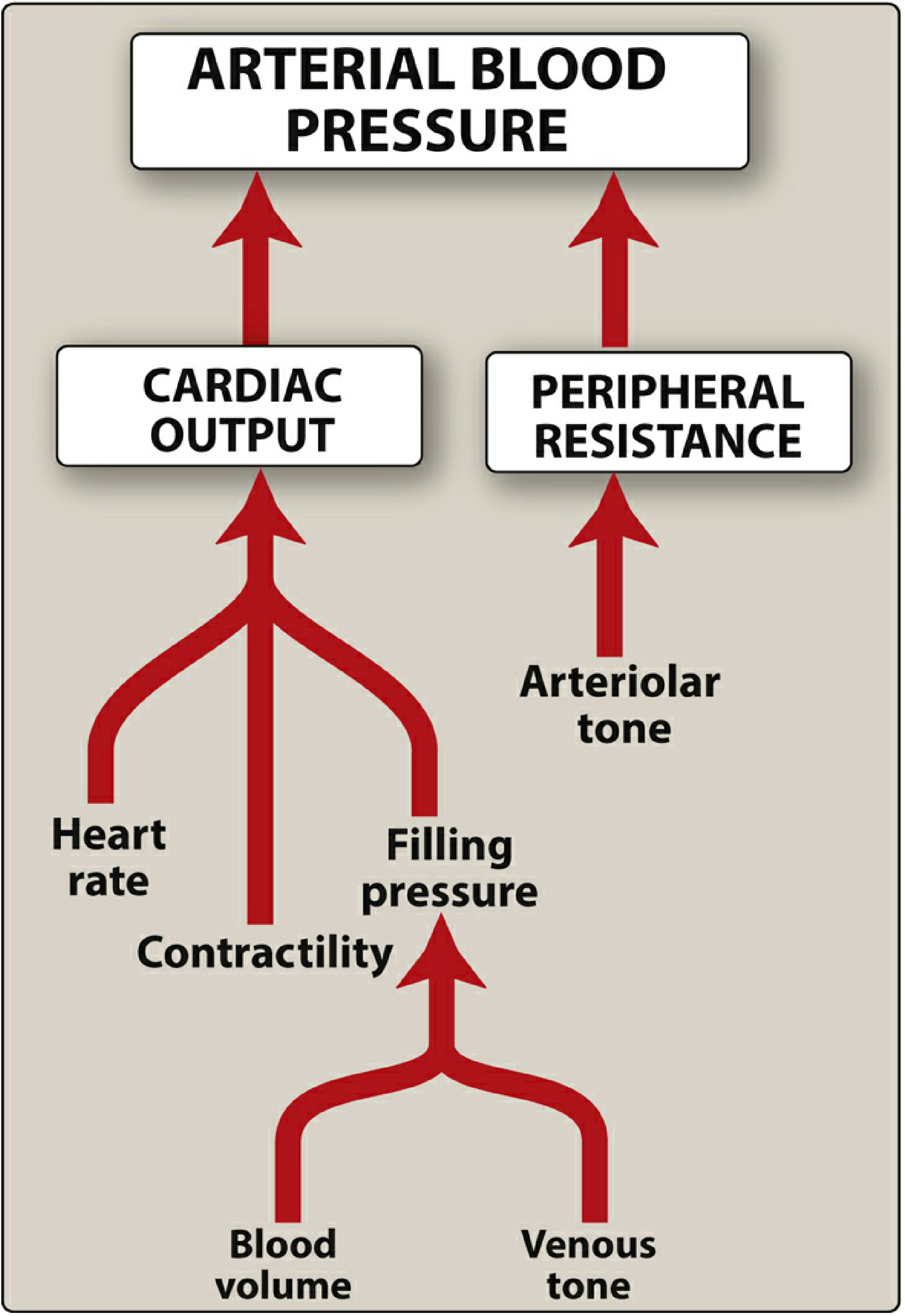
- Lippincott Illustrated Reviews: Pharmacology, p. 290-292
CLINICAL FEATURES
Symptoms
Hypertension is often called the "silent killer" because most patients are asymptomatic for years.
When symptoms occur, they include:
- Headache - typically occipital, worse in the morning (most common symptom)
- Dizziness / vertigo
- Tinnitus (ringing in ears)
- Palpitations (awareness of heartbeat)
- Epistaxis (nosebleeds)
- Visual disturbances - blurring of vision (due to hypertensive retinopathy)
- Fatigue and breathlessness (if cardiac involvement)
- Chest pain (if associated angina or CAD)
- Facial flushing
Signs on Examination
- Elevated BP on repeated readings
- Cardiovascular: Forceful apex beat, left ventricular heave (LV hypertrophy), accentuated aortic component of S2 (A2), S4 gallop
- Eyes (Fundoscopy): Keith-Wagener-Barker grading of hypertensive retinopathy:
- Grade I: Arteriolar narrowing, increased light reflex ("silver wiring")
- Grade II: AV nipping/nicking (crossing changes)
- Grade III: Flame-shaped haemorrhages and cotton-wool spots (soft exudates)
- Grade IV: Papilledema (optic disc swelling) - indicates malignant hypertension
- Kidneys: Nocturia, proteinuria (early indicator of renal damage)
- Neurological: Hypertensive encephalopathy - headache, confusion, seizures
- Harrison's Principles of Internal Medicine, 22e
COMPLICATIONS
Sustained hypertension causes damage to "target organs":
1. Cardiac Complications
- Left Ventricular Hypertrophy (LVH) - compensatory response to increased afterload
- Coronary Artery Disease (CAD) - accelerated atherosclerosis
- Myocardial Infarction (MI)
- Heart Failure - initially diastolic dysfunction, later systolic failure
- Cardiac arrhythmias including AF
2. Cerebrovascular Complications
- Haemorrhagic stroke - rupture of Charcot-Bouchard microaneurysms in small perforating arteries
- Ischaemic stroke / TIA - thromboembolism from hypertensive vascular disease
- Hypertensive encephalopathy - acute severe HTN causing cerebral edema
- Vascular dementia - chronic ischaemic white matter damage
3. Renal Complications
- Hypertensive nephrosclerosis - glomerular ischaemia and nephron loss
- Proteinuria and haematuria (early signs)
- Chronic Kidney Disease (CKD)
- End-stage renal disease (ESRD)
4. Ophthalmic Complications
- Hypertensive retinopathy (grades I-IV as above)
- Central retinal artery/vein occlusion
- Visual loss
5. Vascular Complications
- Aortic aneurysm (especially abdominal aortic aneurysm)
- Aortic dissection
- Peripheral arterial disease (PAD)
- Accelerated atherosclerosis throughout the vasculature
6. Hypertensive Crisis
- Hypertensive Urgency: BP > 180/120 mmHg WITHOUT acute target organ damage
- Hypertensive Emergency: BP > 180/120 mmHg WITH acute target organ damage (stroke, MI, aortic dissection, renal failure, pulmonary oedema, hypertensive encephalopathy)
- Harrison's Principles of Internal Medicine, 22e; Park's Preventive & Social Medicine
MANAGEMENT
Non-Pharmacological (Lifestyle Modifications)
These are first-line for all patients (especially Stage 1) and adjunct for all pharmacological therapy:
| Intervention | Expected SBP Reduction |
|---|---|
| DASH diet (low Na, high K, high fruits/vegetables) | ~5 mmHg |
| Weight loss (~10 lb / 4.5 kg) | ~5 mmHg |
| Sodium restriction (< 2.4 g/day) | 2-8 mmHg |
| Regular aerobic exercise (≥150 min/week) | 4-9 mmHg |
| Alcohol limitation (≤2 drinks/day men, ≤1 women) | 2-4 mmHg |
| Smoking cessation (reduces cardiovascular risk) | Variable |
| Stress reduction / relaxation techniques | Variable |
Pharmacological Management
First-line drug classes (for most patients):
1. Thiazide Diuretics
- Examples: Hydrochlorothiazide, Chlorthalidone, Indapamide
- Mechanism: Initially reduce blood volume via natriuresis; long-term reduce peripheral vascular resistance
- Side effects: Hypokalaemia, hyperuricaemia, hyperglycaemia, hyponatraemia
- Use: First-line; useful in combination therapy
2. ACE Inhibitors (ACEI)
- Examples: Enalapril, Lisinopril, Captopril, Ramipril
- Mechanism: Block ACE → reduce angiotensin II → reduce vasoconstriction + reduce aldosterone → vasodilation + reduced sodium retention; also increase bradykinin (vasodilator)
- Compelling indications: Diabetes, CKD, heart failure, post-MI, LVH
- Side effects: Dry cough (bradykinin-mediated - most common), hyperkalaemia, angioedema, teratogenic (avoid in pregnancy)
3. Angiotensin Receptor Blockers (ARBs)
- Examples: Losartan, Valsartan, Telmisartan, Candesartan
- Mechanism: Block AT1 receptors → same haemodynamic effects as ACEI but no bradykinin accumulation
- Advantage over ACEI: No dry cough, lower risk of angioedema
- Use: Alternative to ACEI; same compelling indications; preferred if ACEI-intolerant
4. Calcium Channel Blockers (CCBs)
- Dihydropyridines: Amlodipine, Nifedipine, Felodipine
- Primarily vascular smooth muscle → vasodilation → reduce peripheral resistance
- Side effects: Peripheral oedema, flushing, reflex tachycardia
- Nifedipine causes gingival hyperplasia (important dental consideration)
- Non-dihydropyridines: Verapamil, Diltiazem
- Cardiac + vascular effects → reduce heart rate and contractility
- Avoid in heart failure with reduced EF; cause bradycardia
5. Beta-Blockers (β-Blockers)
- Examples: Atenolol, Metoprolol, Bisoprolol (cardioselective); Propranolol (non-selective)
- Mechanism: Block β1 receptors → reduce heart rate and cardiac output; also reduce renin release
- Compelling indications: Post-MI, angina, heart failure, rate control in AF, thyrotoxicosis
- Side effects: Bradycardia, bronchospasm (avoid in asthma), fatigue, cold extremities, sexual dysfunction, mask hypoglycaemia in diabetics
- No longer first-line unless compelling indication exists
Step-up Approach to Pharmacotherapy
Step 1: Lifestyle modification alone (Stage 1 without high CVD risk)
           ↓ (if target not achieved in 3-6 months)
Step 2: Monotherapy - Thiazide OR ACEI/ARB OR CCB
           ↓ (if target not achieved)
Step 3: Combination of 2 drugs (e.g., ACEI + CCB or ACEI + Thiazide)
           ↓ (if target not achieved)
Step 4: Triple therapy (ACEI + CCB + Thiazide)
           ↓ (Resistant HTN)
Step 5: Add aldosterone antagonist (Spironolactone) or α-blocker or β-blocker
BP Target: < 130/80 mmHg for most patients (ACC/AHA 2017). < 140/90 mmHg acceptable by many international guidelines.
Management of Hypertensive Emergency
- Immediate IV therapy: IV Labetalol, IV Sodium Nitroprusside, IV Nitroglycerin, IV Nicardipine
- Goal: Reduce MAP by no more than 25% in first hour; then gradually to 160/100 over next 2-6 hours
- Avoid over-rapid reduction (risk of cerebral/cardiac ischaemia)
- Lippincott Illustrated Reviews: Pharmacology, 22e, p. 288-306
- Harrison's Principles of Internal Medicine, 22e, p. 2183-2192
DENTAL CONSIDERATIONS
Hypertension has numerous important implications in dental practice. Every dentist must be aware of these to ensure patient safety.
1. Pre-operative Assessment
- Measure BP at every dental appointment - the dental chair is an ideal screening point; many patients are undiagnosed.
- Defer elective treatment if BP is ≥ 180/110 mmHg (hypertensive urgency level); refer for medical management first.
- Elective surgery can generally proceed if BP is < 160/100 mmHg with close monitoring.
- Review the patient's medical history, current antihypertensive medications, and compliance.
2. Stress and Anxiety Management
- Dental anxiety raises BP significantly via sympathetic activation; this is especially dangerous in hypertensive patients.
- Use adequate pre-operative sedation / anxiolysis (e.g., oral benzodiazepines the night before and morning of procedure).
- Short appointments, morning scheduling (BP is lower), calm and reassuring environment.
- Minimize waiting time in the clinic.
3. Local Anaesthesia and Vasoconstrictors
This is one of the most clinically significant considerations:
- Epinephrine (adrenaline) in local anaesthetics is a sympathomimetic that can raise BP and heart rate.
- However, adequate pain control is more important - inadequately controlled pain from an insufficient block releases endogenous catecholamines (in greater amounts than epinephrine in the LA cartridge).
- Safe limits: Use 2 cartridges (3.6 mL) of 1:100,000 epinephrine (= 0.036 mg total) - this is generally safe in controlled hypertensives.
- Avoid high concentrations of epinephrine (1:50,000) in hypertensive patients.
- Avoid gingival retraction cords soaked in epinephrine.
- Non-epinephrine-containing vasoconstrictors (e.g., felypressin) are alternatives but also cause vasoconstriction and can increase BP.
- Patients on non-selective beta-blockers (propranolol): epinephrine can cause unopposed alpha-stimulation → sudden marked rise in BP → reflex bradycardia. Use minimal epinephrine and aspirate carefully.
4. Drug Interactions with Antihypertensives
| Antihypertensive Drug | Dental Drug Interaction |
|---|---|
| ACE inhibitors | NSAIDs (e.g., ibuprofen) reduce antihypertensive effect - limit NSAID use |
| Beta-blockers | Epinephrine - risk of hypertensive crisis (esp. non-selective); NSAIDs blunt BP control |
| Calcium channel blockers (Nifedipine, Verapamil, Diltiazem) | Erythromycin, azithromycin, fluconazole - inhibit CYP3A4 → toxicity risk |
| Thiazide diuretics | NSAIDs reduce diuretic effect; risk of orthostatic hypotension |
| All antihypertensives | NSAIDs broadly antagonize BP control - prefer paracetamol for analgesia |
5. Oral Manifestations of Antihypertensive Drugs
These are high-yield for BDS exams:
-
Nifedipine (CCB) → Gingival Enlargement/Hyperplasia
- Affects ~20% of patients on nifedipine
- Mechanism: Inhibition of Ca²⁺-dependent collagen degradation → fibroblast proliferation → gingival overgrowth
- Starts in the interdental papillae; may involve attached gingiva
- Exacerbated by poor oral hygiene and plaque
- Management: Drug substitution (switch to amlodipine, which has lower incidence); improved oral hygiene; surgical gingivectomy if severe
- Also seen with: Cyclosporine, phenytoin
-
ACE Inhibitors (Captopril, Enalapril) → Lichenoid Reactions and altered taste (dysgeusia)
- Dry mouth (xerostomia) is a less common side effect
-
Beta-blockers → Xerostomia (dry mouth)
- Reduce salivary flow via anticholinergic-like effects
- Dry mouth → increased caries risk, oral candidiasis, difficulty swallowing/speaking
-
Thiazide diuretics → Xerostomia
- Reduce salivary gland secretion; patients may present with increased caries
-
Calcium channel blockers → Peripheral oedema that may include the face/lips
6. Postural (Orthostatic) Hypotension
- Patients on antihypertensives (especially alpha-blockers, thiazides, calcium channel blockers) may experience sudden dizziness/faintness when raised quickly from a supine or reclined position.
- Precaution: Raise the dental chair slowly; let the patient sit upright for 1-2 minutes before standing; support them while standing.
7. Haemostasis and Bleeding
- Hypertensive patients may have fragile, atheromatous vessels that bleed more readily.
- Some antihypertensive medications (e.g., aspirin used as antiplatelet therapy alongside antihypertensives) impair platelet function.
- Check INR if patient is on anticoagulants (warfarin) for associated conditions (AF, DVT).
8. Hypertensive Emergency in the Dental Chair
If a patient develops severely elevated BP (> 180/120 mmHg) with symptoms during dental treatment:
- Stop dental procedure immediately
- Place patient in semi-recumbent position
- Loosen tight clothing
- Monitor vital signs every 5 minutes
- Administer sublingual nifedipine 5-10 mg (bite the capsule and swallow) or sublingual captopril 25 mg for urgent BP reduction (Note: sublingual nifedipine is controversial in many guidelines - refer to emergency protocol)
- Call emergency services if symptoms of stroke/MI/encephalopathy develop
- Arrange urgent medical referral
SUMMARY TABLE
| Aspect | Key Points |
|---|---|
| Definition | Persistent BP ≥ 130/80 (ACC/AHA) or ≥ 140/90 (JNC7/WHO) |
| Most common type | Primary (essential) - 90-95% |
| Most common symptom | Asymptomatic ("silent killer"); headache when symptomatic |
| Target organs | Heart, brain, kidney, eyes, blood vessels |
| 1st line drugs | Thiazide, ACEI/ARB, CCB |
| Most dental-relevant oral SE | Gingival hyperplasia (nifedipine), xerostomia (beta-blockers, thiazides) |
| Vasoconstrictor in LA | Safe up to 2 cartridges (1:100,000 epi); avoid in uncontrolled HTN |
| Defer elective dentistry | If BP ≥ 180/110 mmHg |
Sources:
- Harrison's Principles of Internal Medicine, 22e (McGraw-Hill, 2025) - Chapter on Hypertension
- Lippincott Illustrated Reviews: Pharmacology - Chapter 8: Antihypertensive Drugs
- Park's Textbook of Preventive and Social Medicine - Cardiovascular Disease Section
- Comprehensive Clinical Nephrology, 7th Edition - Chapter on Hypertension Classification
This is a shared conversation. Sign in to Orris to start your own chat.