
Post partum cardiomyopathy complete guide
Reading File
Now let me run parallel searches across the medical library and PubMed simultaneously.
Finding Sources
Searching PubMed
"peripartum cardiomyopathy"[MeSH Terms] AND management
Searching the Web
postpartum peripartum cardiomyopathy 2025 guidelines diagnosis treatment
Excellent results. Now let me read the key textbook sections in parallel - Harrison's (most comprehensive), Braunwald's, Creasy & Resnik's (maternal-fetal), and the Lancet 2025 review.
Reading File
Reading File
Reading File
Reading Web Page
https://www.pascar.org/uploads/files/PPCM_Lancet_Sliwa2025.p…
Excellent. Now let me get deeper content - more of Harrison's and Goldman-Cecil, plus Fuster's Heart and more from Braunwald's to cover prognosis, imaging, and advanced management:
Reading File
Reading File
Reading File
Finding Sources
Let me get the Fuster's Heart chapter content which has a detailed PPCM section, and also the Goldman-Cecil section on treatment:
Reading File
Reading File
I found a central illustration image. Let me fetch that and also read the detailed Fuster's content on management/prognosis:
Loading Image
Reading File
I now have comprehensive material from multiple authoritative textbooks plus PubMed. Let me compile the complete guide.
Peripartum (Postpartum) Cardiomyopathy - Complete Guide
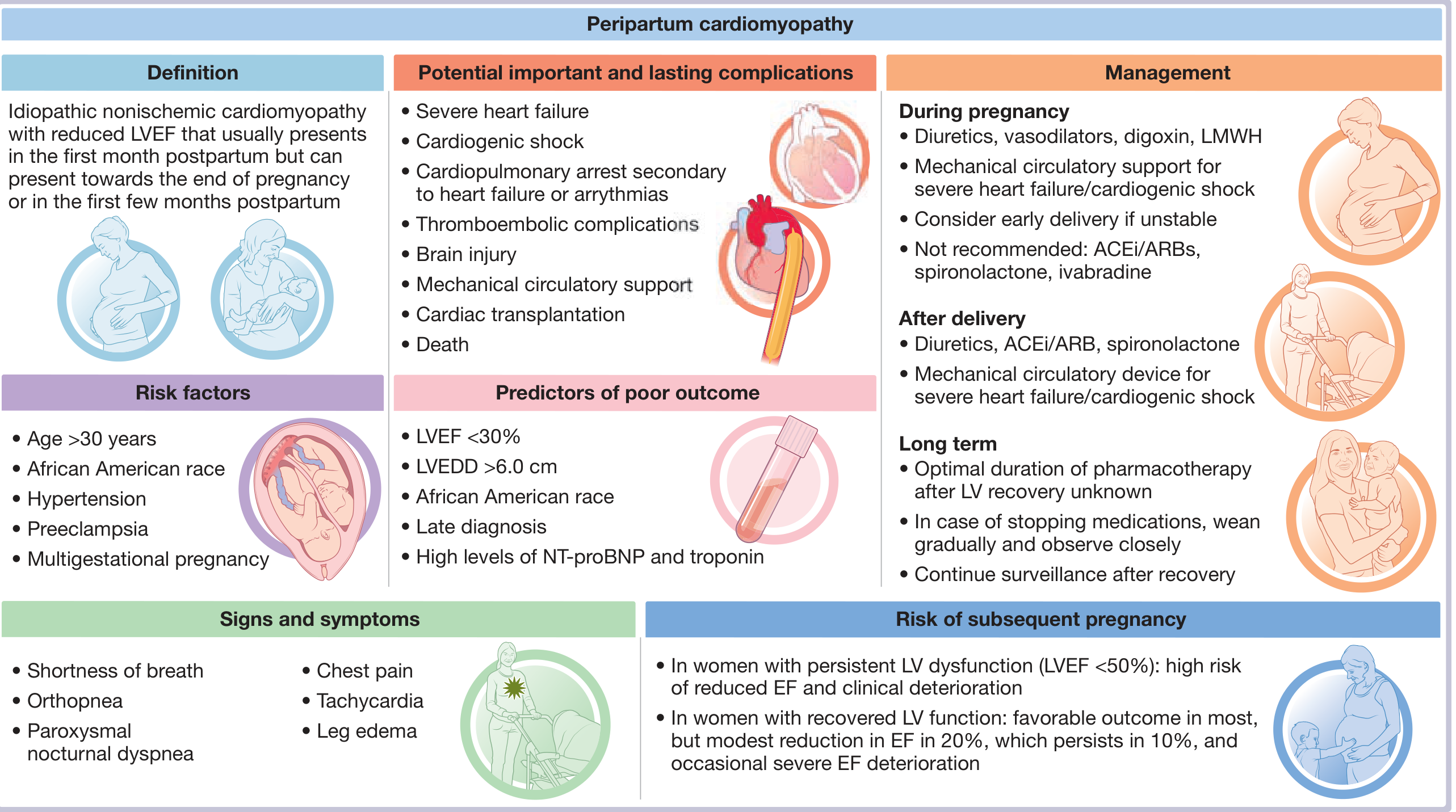
1. Definition
Peripartum cardiomyopathy (PPCM) is an idiopathic, nonischemic cardiomyopathy presenting with heart failure (HF) secondary to left ventricular (LV) systolic dysfunction, developing toward the end of pregnancy or within the first several months postpartum, where no other cause of HF is found. It is therefore a diagnosis of exclusion.
Diagnostic criteria:
- LVEF < 45% (some criteria also specify M-mode fractional shortening < 30%, or LV end-diastolic dimension > 2.7 cm/m²)
- Onset in the last month of pregnancy or up to 5 months postpartum
- Absence of pre-existing cardiac disease
- No other identifiable cause of HF (no valvular, ischemic, pericardial, or other cause)
Most cases present within the first 2 weeks after delivery; prepartum diagnoses are most common in the last month of pregnancy.
(Harrison's Principles of Internal Medicine 22E, p. 2061; Goldman-Cecil Medicine; Fuster and Hurst's The Heart, 15th Ed.)
2. Epidemiology
| Region | Approximate Incidence |
|---|---|
| United States | 1:1,000 - 1:4,000 live births (average ~1:3,000) |
| Africa | 1:100 live births |
| Haiti | 1:300 live births |
| Japan | 1:20,000 live births |
The US incidence has been rising - from ~1:4,350 births in the early 1990s to ~1:2,230 births more recently - likely due to older maternal age, more multifetal pregnancies, assisted reproduction, obesity, and better diagnostic awareness.
Racial disparity: Non-Hispanic Black women have a 5-15 fold higher risk than other ethnic groups in the United States. They also experience more severe disease, lower rates of LVEF recovery, and longer time to recovery.
(Goldman-Cecil Medicine, p. 2588; Fuster and Hurst's The Heart, 15th Ed., p. 1579)
3. Risk Factors
- Older maternal age (> 30 years)
- African American / Black ethnicity
- Hypertensive disorders of pregnancy, including preeclampsia (~25% of PPCM cases have preeclampsia, vs. 5% background rate)
- Multifetal (twin or higher-order) pregnancies
- Increased parity (multiparity)
- Malnutrition
- Tocolytic therapy (particularly beta-mimetic agents like terbutaline)
- Obesity
- Fertility-assisted treatments
Up to half of all cases occur in the setting of hypertensive disorders.
(Harrison's 22E; Creasy & Resnik's Maternal-Fetal Medicine)
4. Pathophysiology
PPCM is best understood as a multifactorial vasculohormonal disease occurring in genetically susceptible women:
4a. Genetic Predisposition
- ~15% of PPCM cases carry TTN truncating variants (TTNtvs) - the same frequency seen in dilated cardiomyopathy (DCM)
- Variants also identified in TTNC1 and STAT3 genes
- TTN truncating mutations are associated with lower rates of LVEF recovery and a lower EF at 1-year follow-up
- PPCM may represent pregnancy acting as an environmental trigger for accelerated phenotypic expression of underlying genetic cardiomyopathy
- Genetic testing is recommended, as results impact both the mother and first-degree relatives
4b. Prolactin Pathway (Vasoinhibin Hypothesis)
- During late pregnancy, oxidative stress causes proteolytic cleavage of the 23-kDa nursing hormone prolactin into a 16-kDa proinflammatory fragment (vasoinhibin)
- This fragment impairs endothelial and cardiomyocyte function, reduces capillary density, and induces apoptosis
- This underpins the rationale for bromocriptine (a prolactin inhibitor) as a disease-specific therapy
4c. Antiangiogenic Imbalance
- The placenta secretes high levels of soluble fms-like tyrosine kinase 1 (sFlt-1), an inhibitor of VEGF
- sFlt-1 causes angiogenic imbalance and endothelial dysfunction
- High sFlt-1 levels predict worse clinical outcomes
- This mechanism is also shared with preeclampsia, explaining their co-occurrence
4d. Physiological Context
Normal pregnancy causes: increased blood volume, stroke volume, heart rate, and cardiac output. These hemodynamic demands, combined with the above hormonal insults, precipitate clinical HF in susceptible women.
(Harrison's 22E, p. 2061; Creasy & Resnik's p. 1263; Goldman-Cecil, p. 2588; Braunwald's Heart Disease)
5. Clinical Presentation
Symptoms of PPCM mirror those of any patient with systolic HF:
Symptoms:
- Dyspnea (especially exertional, orthopnea, paroxysmal nocturnal dyspnea)
- Leg edema - may be mistakenly attributed to normal pregnancy
- Fatigue and reduced exercise tolerance
- Chest discomfort or chest pain
- Palpitations (atrial and ventricular arrhythmias can occur)
- Tachycardia
Signs:
- S3 gallop, elevated JVP, pulmonary crackles
- Peripheral edema
- Signs of low cardiac output (cold peripheries, hypotension in severe cases)
Pitfall: Edema and dyspnea are common in normal pregnancy, leading to delayed or missed diagnosis. The key clue is that PPCM typically presents when the fluid mobilised postpartum is not adequately excreted, causing acute decompensation in the first postpartum week.
Complications:
- Left ventricular thrombus and systemic embolism (stroke, limb ischemia) - especially with LVEF < 35%
- Ventricular arrhythmias and sudden cardiac death
- Cardiogenic shock
- Cardiopulmonary arrest
- Need for mechanical circulatory support or cardiac transplantation
(Fuster and Hurst's The Heart; Harrison's 22E)
6. Diagnosis
PPCM is a diagnosis of exclusion. The following workup is standard:
6a. Biomarkers
- BNP / NT-proBNP: Elevated levels strongly suggest cardiac dysfunction; if elevated, always proceed to echocardiography
- Troponin: Elevation indicates myocardial injury and predicts poor prognosis
- Both elevated NT-proBNP and troponin are predictors of poor outcome
6b. Electrocardiogram
- Non-specific; may show sinus tachycardia, ST-T changes, arrhythmias, or conduction abnormalities
- Important to rule out ischemia or arrhythmia
6c. Echocardiography (Diagnostic Standard)
Usually sufficient for diagnosis. Criteria for PPCM:
- Diffuse LV systolic dysfunction with LVEF < 45%
- M-mode fractional shortening < 30%
- LV end-diastolic dimension > 2.7 cm/m²
- Absence of other structural causes (valvular disease, wall motion abnormalities suggesting ischemia)
Also assess for:
- Right ventricular function
- Pulmonary pressures
- LV thrombus
- Pericardial effusion
6d. Cardiac MRI
- Useful in complex or uncertain cases
- Provides detailed assessment of both RV and LV function and dimensions
- Can differentiate PPCM from myocarditis, peripartum MI, or infiltrative disease
- Gadolinium is contraindicated during pregnancy; used only postpartum
- No pathognomonic MRI pattern exists for PPCM
6e. Coronary Evaluation
- Consider to exclude spontaneous coronary artery dissection (SCAD) - an important differential in peripartum women presenting with chest pain/HF
6f. Key Differentials to Exclude
- Pulmonary embolism
- Preeclampsia/eclampsia with pulmonary edema
- Valvular heart disease
- Myocarditis
- SCAD
- Tocolytic (terbutaline)-induced cardiomyopathy
- Pre-existing undiagnosed DCM
(Goldman-Cecil, p. 2588; Harrison's 22E, p. 2061; Lancet 2025 - Sliwa et al.)
7. Management
7a. During Pregnancy (Antepartum)
Treatment must balance maternal stabilization and fetal safety:
| Drug | Notes |
|---|---|
| Loop diuretics (furosemide) | Used with caution; risk of reduced placental perfusion |
| Beta-blockers (metoprolol preferred over carvedilol) | Safe; treat HF and arrhythmias |
| Digoxin | Safe for arrhythmias |
| Hydralazine + isosorbide dinitrate | Preferred vasodilators in pregnancy (replaces ACEi/ARB) |
| LMWH | For anticoagulation (preferred over warfarin) |
| Mechanical circulatory support | For severe HF/cardiogenic shock |
Contraindicated in pregnancy:
- ACE inhibitors and ARBs - teratogenic (fetal renal toxicity, oligohydramnios)
- Sacubitril/valsartan - contraindicated
- Spironolactone - avoid (anti-androgenic effects); eplerenone also avoided
- Ivabradine - not recommended
Hemodynamic instability may require ongoing invasive monitoring. Plans for emergency delivery should be in place if the mother cannot be stabilized.
7b. After Delivery (Postpartum) - Standard HF Therapy
Full guideline-directed medical therapy (GDMT) can be initiated:
| Drug | Notes |
|---|---|
| ACE inhibitors (enalapril) | First-line; compatible with breastfeeding |
| Beta-blockers (metoprolol tartrate) | Compatible with breastfeeding |
| Spironolactone | Compatible with breastfeeding |
| Loop diuretics | For volume overload |
| Anticoagulation (LMWH/warfarin) | For LVEF < 35% or marked dilation; typically 6 weeks until obstetric bleeding resolves |
7c. Bromocriptine (Disease-Specific Therapy)
- Targets the 16-kDa prolactin fragment (vasoinhibin) pathway
- Small trials, particularly from South Africa (Sliwa et al.), showed improved LVEF recovery
- A multicenter randomized trial (Eur Heart J 2017) showed benefit, particularly with 8-week vs. 1-week dosing
- The EORP PPCM registry 2025 (van der Meer et al., Eur Heart J 2025) reported improved outcomes with bromocriptine treatment
- Dose: 2.5 mg twice daily for 2 weeks, then 2.5 mg once daily for 6 weeks (standard protocol); or 1.25-2.5 mg once daily
- Requires concurrent anticoagulation (due to pro-thrombotic risk of prolactin suppression)
- 2025 ESC guidelines recommend considering it; still controversial per Braunwald's
- If not breastfeeding, bromocriptine is more easily used; a large randomized trial was ongoing as of Harrison's 22E
7d. Breastfeeding
- Previously prohibited (due to metabolic demand and prolactin stimulation)
- Currently generally encouraged in stable patients who can maintain fluid balance
- 2025 ESC guidelines suggest prevention of lactation should be considered in severe HF to reduce metabolic demand and enable safe use of standard HF medications
7e. Advanced/Refractory Heart Failure
- Intra-aortic balloon pump (IABP)
- Ventricular assist devices (VAD) - LVAD or biventricular
- Extracorporeal membrane oxygenation (ECMO) for cardiogenic shock
- Cardiac transplantation: PPCM accounts for ~5% of all female cardiac transplants in the US; it is the 4th most common cause of transplant in women; post-transplant outcomes are similar to other indications
7f. Arrhythmia Management
- Wearable cardioverter-defibrillator (WCD): Recommended for those with LVEF < 35% who are at risk for sudden death; ICD implantation is generally deferred until reassessment at 3-6 months (given potential for recovery)
- Implantable cardioverter-defibrillator (ICD): For persistent severe LV dysfunction after optimization
(Harrison's 22E; Creasy & Resnik's; Goldman-Cecil; Fuster and Hurst's; Lancet 2025 - Sliwa et al.)
8. Predictors of Poor Outcome
| Factor | Implication |
|---|---|
| LVEF < 30% at presentation | Worse prognosis |
| LV end-diastolic diameter > 6.0 cm | Worse prognosis |
| African American / Black race | Less likely to recover; longer recovery |
| Delayed diagnosis | Worse prognosis |
| High NT-proBNP and troponin | Predictors of adverse outcome |
| TTN truncating mutations | Lower rate of LVEF recovery |
| sFlt-1 elevation | Predicts worse outcome |
9. Prognosis and Recovery
- 50-80% of patients in the US recover LVEF to ≥ 50% (Harrison's 22E cites 50-80%; Goldman-Cecil ~2/3)
- Most recovery occurs within 2-6 months of diagnosis; long-term trajectory is usually clear by 6 months postpartum
- ~1/3 have persistent LV dysfunction (LVEF < 45%) beyond 6 months
- Serial echocardiography is recommended at 1-3 month intervals
- Even patients with recovered LVEF remain at risk for recurrence and should continue surveillance
- The optimal duration of pharmacotherapy after LV recovery is unknown; medications should be weaned gradually with close monitoring
10. Subsequent Pregnancy
This is a high-stakes counseling issue:
| LVEF Status Before Next Pregnancy | Risk |
|---|---|
| Normalized LVEF | HF recurrence ~20%; modest EF reduction in ~20%, persistent in ~10%; occasional severe deterioration |
| Persistent LV dysfunction (LVEF < 45%) | HF recurrence ~40%; maternal mortality ~19% |
- 2025 ESC guidelines state that LVEF < 40% before a new pregnancy increases risk of LVEF deterioration, and subsequent pregnancy is discouraged in women with PPCM or DCM if LV function does not normalize
- Genetic testing should inform counseling - TTN mutation carriers have lower recovery rates and higher recurrence risk
- All women with a history of PPCM considering subsequent pregnancy should be managed by a multidisciplinary Pregnancy Heart Team
- Reliable contraception is essential until recovery is assessed
(Creasy & Resnik's, p. 1263; Fuster and Hurst's; 2025 ESC Guidelines)
11. Genetic Counseling and Family Screening
- Genetic testing is now recommended in all PPCM cases - results impact both the mother and other family members
- Common findings: TTN truncating variants (~15%), STAT3, TTNC1 mutations
- A positive genetic test predicts less recovery and should prompt screening of first-degree relatives for subclinical DCM
- Among 90 DCM families, ~6% had at least one member with PPCM; genetic screening of PPCM relatives revealed undiagnosed DCM in multiple families
(Braunwald's Heart Disease; Fuster and Hurst's)
12. Labor and Delivery Considerations
- For women diagnosed before delivery: prompt delivery is typically recommended after maternal stabilization
- Delivery mode depends on obstetric indications; vaginal delivery is generally preferred if hemodynamically stable (reduced blood loss compared to cesarean)
- Neuraxial anesthesia is preferred - reduces afterload and sympathetic activation
- A Pregnancy Heart Team (cardiologist, maternal-fetal medicine, anesthesiologist) should be involved
- Hemodynamic monitoring and availability of mechanical support should be planned
- Perimortem cesarean may be required if the patient arrests
13. Prevention
There is no proven primary prevention strategy. Key measures:
- Optimize blood pressure and underlying cardiovascular disease before pregnancy
- Early vigilance for HF symptoms near term and postpartum
- Earlier diagnosis allows earlier treatment before severe deterioration
- In women with prior PPCM, careful preconception assessment is mandatory
14. Recent Evidence (2025)
| Study | Findings |
|---|---|
| Sliwa K et al., Lancet 2025 [PMID: 41173010] | Comprehensive review; novel recovery prediction score; emphasizes multidisciplinary care and 2025 ESC guidelines |
| van der Meer P et al., Eur Heart J 2025 (EORP PPCM registry) | Bromocriptine associated with improved outcomes; supports its use in clinical practice |
| Wang X et al., Heart Lung Circ 2025 [PMID: 40701904] | Systematic review and meta-analysis of PPCM risk factors |
| 2025 ESC Cardiovascular Guidelines in Pregnancy | Recommend multidisciplinary Pregnancy Heart Team for mWHO class II-III and above; genetic testing for PPCM; discourage subsequent pregnancy if LVEF < 40%; consider lactation suppression in severe HF |
Quick Reference Summary
| Feature | Key Points |
|---|---|
| Definition | LVEF < 45%, last month pregnancy to 5 months postpartum, no other cause |
| Incidence | 1:1,000-4,000 (US); highest in Black women |
| Pathophysiology | Vasoinhibin (16-kDa prolactin), sFlt-1 antiangiogenic, genetic (TTN ~15%) |
| Diagnosis | Echocardiography (first-line); cardiac MRI for complex cases; BNP/troponin |
| Treatment (antepartum) | Diuretics, metoprolol, hydralazine/nitrate, LMWH; NO ACEi/ARB |
| Treatment (postpartum) | ACEi, beta-blocker, spironolactone, diuretics; consider bromocriptine |
| Bromocriptine | 2.5 mg BD x 2 weeks then 2.5 mg OD x 6 weeks; use with anticoagulation |
| Recovery | 50-80% normalize LVEF; mostly within 6 months |
| Poor prognosis | LVEF < 30%, LV > 6 cm, Black race, late diagnosis, high BNP/troponin |
| Subsequent pregnancy | ~20% recurrence if LVEF normalized; ~40% + 19% mortality if persistent dysfunction |
Sources:
- Harrison's Principles of Internal Medicine 22E (2025), pp. 2061-2062
- Fuster and Hurst's The Heart, 15th Edition, Chapter 51 (Elkayam & Pizula)
- Braunwald's Heart Disease, 12th Ed., Chapter 52
- Creasy & Resnik's Maternal-Fetal Medicine, Chapter 52
- Goldman-Cecil Medicine, Chapter 221
- Sliwa K et al. Peripartum cardiomyopathy. Lancet. 2025 [PMID: 41173010]
- Wang X et al. Risk Factors for PPCM: Systematic Review & Meta-Analysis. Heart Lung Circ. 2025 [PMID: 40701904]
- 2025 ESC Guidelines on Cardiovascular Diseases in Pregnancy
This is a shared conversation. Sign in to Orris to start your own chat.