
Can you teach me cvs drugs from basic
Reading File
Before diving in, let me ask a quick clarifying question to tailor this properly for you.
Asking for Preferences
What is your current level of medical/pharmacology knowledge? · Which CVS drug categories do you want to cover?
Great! Starting from the very basics with antihypertensives. Let me pull comprehensive textbook content for you.
Searching sources...
Finding Sources
Finding Sources
Finding Sources
Reading File
Reading File
Reading File
Reading File
Reading File
Reading File
Loading Image
I now have everything I need to write a thorough, beginner-friendly lesson. Here it is:
Antihypertensive Drugs - A Beginner's Guide
First, the Basics: What is Blood Pressure?
Blood pressure (BP) is the force your blood exerts on artery walls. It is written as two numbers:
- Systolic (top number) - pressure when your heart contracts
- Diastolic (bottom number) - pressure between beats
| Category | Reading (mm Hg) |
|---|---|
| Normal | 90-120 / 60-80 |
| Elevated | 120-129 / <80 |
| Stage 1 Hypertension | 130-139 / 80-89 |
| Stage 2 Hypertension | ≥140 / ≥90 |
Hypertension affects 45% of American adults. When left untreated, it damages the kidneys, heart, and brain - leading to stroke, heart failure, and kidney disease. The risk doubles with every 20/10 mm Hg rise starting from 115/75. That is why treatment matters so much.
The Big Picture: How Do These Drugs Work?
Your blood pressure is controlled by 4 main sites in the body. Antihypertensive drugs target one or more of these sites. This diagram from Katzung's Pharmacology shows it perfectly:
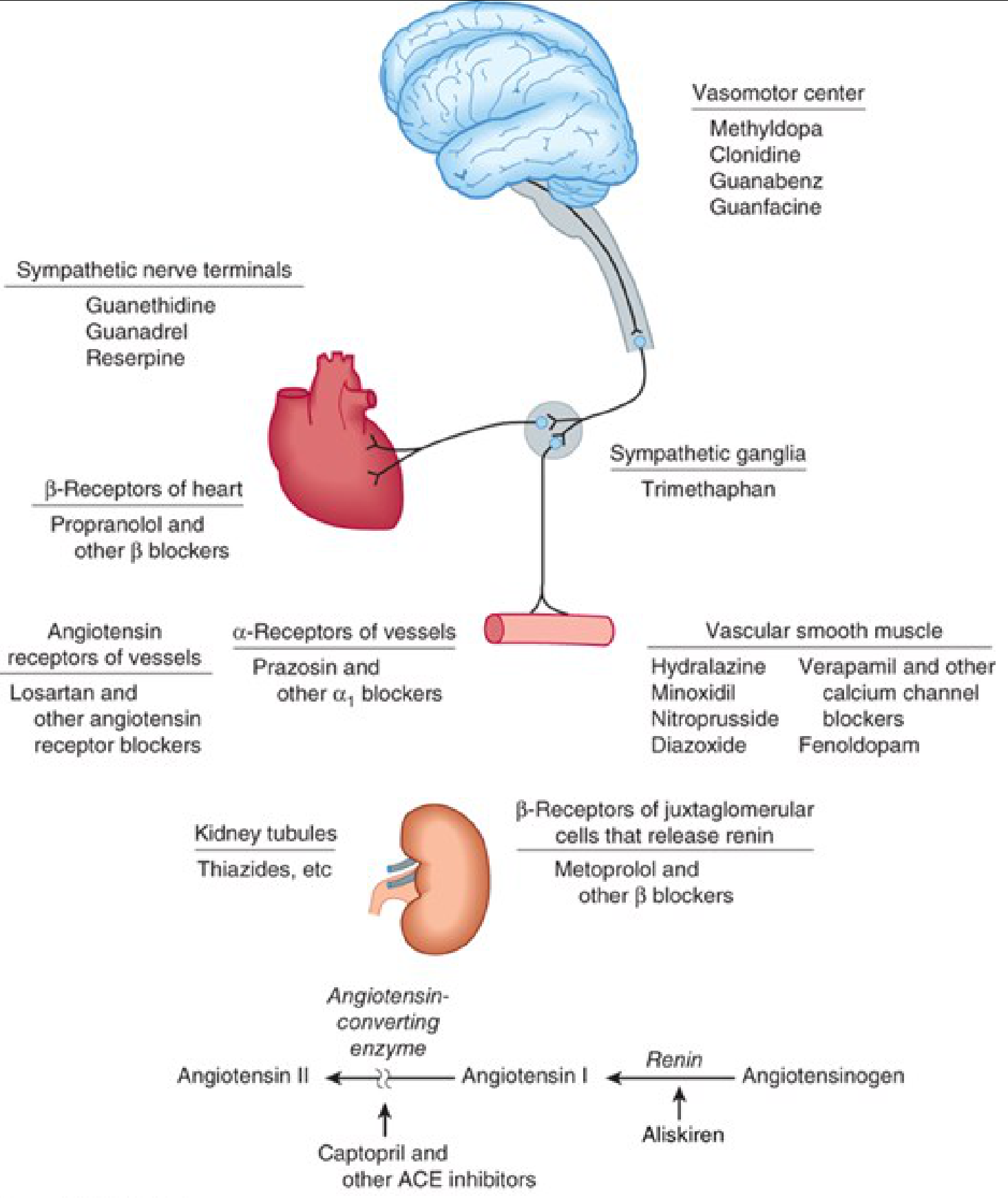
Think of it simply:
- Brain - signals the nervous system to raise/lower BP
- Heart - pumps harder or softer
- Blood vessels - dilate (widen) or constrict (narrow)
- Kidneys - control salt and water volume
The 5 Major Classes of Antihypertensive Drugs
1. Diuretics ("Water Pills")
The simplest concept: Remove excess salt and water from the body → blood volume goes down → BP goes down.
How they work:
- Initially: reduce blood volume and cardiac output
- After 6-8 weeks: also reduce peripheral vascular resistance (how stiff the vessels are)
- Can lower BP by 10-15 mm Hg on their own
Main types:
| Type | Drug Examples | Best Used In |
|---|---|---|
| Thiazides | Hydrochlorothiazide, Chlorthalidone | Mild-moderate hypertension (first choice) |
| Loop diuretics | Furosemide, Bumetanide | Severe HTN, kidney failure, heart failure |
| Potassium-sparing | Spironolactone, Amiloride | Resistant HTN, to prevent K+ loss |
Key side effects of thiazides: Low potassium (hypokalemia), high blood sugar (hyperglycemia), high uric acid (gout). These matter especially in diabetics and elderly patients.
2. ACE Inhibitors (Angiotensin-Converting Enzyme Inhibitors)
The concept: Your kidney releases a hormone called renin when BP drops. Renin eventually forms angiotensin II, a powerful vasoconstrictor (vessel-tightener). ACE inhibitors block the enzyme that makes angiotensin II.
Angiotensinogen → (Renin) → Angiotensin I → (ACE) → Angiotensin II [BLOCKED HERE]
Result: Blood vessels relax, BP drops. Also reduces fluid retention by the kidneys.
Drug examples: Captopril, Enalapril, Lisinopril, Ramipril (all end in "-pril")
Extra benefits beyond BP lowering:
- Protect the kidneys in diabetes (slow progression of kidney disease)
- Reduce mortality in heart failure
- Prevent cardiac remodeling after heart attack
Key side effects:
- Dry cough (very common - due to buildup of bradykinin) - most common reason people switch drugs
- Angioedema (dangerous swelling of lips/throat - rare but serious)
- Hyperkalemia (high potassium)
- Contraindicated in pregnancy (can cause fetal kidney damage)
- Avoid in bilateral renal artery stenosis
3. ARBs (Angiotensin Receptor Blockers)
The concept: Instead of blocking the enzyme that makes angiotensin II, these drugs block the receptor that angiotensin II binds to (AT1 receptor). Same end result - blood vessels relax.
Drug examples: Losartan, Valsartan, Irbesartan, Olmesartan, Candesartan, Telmisartan (mostly end in "-sartan")
Why choose an ARB over an ACE inhibitor?
- No cough (since bradykinin is NOT affected)
- Angioedema is rare
- Same benefits in heart failure and diabetic kidney disease
Key side effects:
- Same as ACE inhibitors EXCEPT no cough
- Still contraindicated in pregnancy
- Still risk of hyperkalemia
Important: Do NOT combine ACE inhibitor + ARB together - clinical trials showed increased toxicity with no extra benefit.
4. Calcium Channel Blockers (CCBs)
The concept: Calcium entering smooth muscle cells makes blood vessels contract. These drugs block calcium channels → vessels relax → BP drops.
Two main subgroups:
| Group | Drugs | Primary Effect |
|---|---|---|
| Dihydropyridines (DHP) | Amlodipine, Nifedipine, Felodipine | Mostly vasodilation (vessel relaxation) |
| Non-DHP | Verapamil, Diltiazem | Also slow heart rate & reduce heart's pumping force |
Key points:
- Amlodipine is one of the most widely used antihypertensive drugs worldwide - long-acting, once daily
- Verapamil has the strongest heart-slowing effect (use with caution if heart rate is already slow)
- Avoid short-acting nifedipine for chronic hypertension (rapid BP drops can increase heart attack risk) - use long-acting forms only
- CCBs are especially good for elderly patients and those with angina
Side effects of DHP CCBs: Ankle swelling (pedal edema), flushing, headache, reflex fast heart rate
Side effects of Verapamil: Constipation, bradycardia (slow heart rate), heart block
5. Beta-Blockers (β-Blockers)
The concept: Your sympathetic nervous system uses adrenaline (epinephrine/norepinephrine) to speed up and strengthen the heart. Beta-blockers block beta-adrenergic receptors → heart beats slower and less forcefully → cardiac output falls → BP drops.
They also reduce renin release from the kidney (another mechanism to lower BP).
Drug examples: Propranolol, Metoprolol, Atenolol, Carvedilol, Bisoprolol (many end in "-olol")
Key points:
- Especially useful if HTN is combined with angina or heart failure or after a heart attack
- Metoprolol and bisoprolol are cardioselective (primarily block β1 in heart, safer in mild asthma)
- Propranolol is non-selective (blocks both β1 and β2)
Side effects:
- Bradycardia (heart rate too slow)
- Fatigue, cold hands/feet
- Bronchospasm - avoid in asthma/COPD (due to β2 blockade)
- Mask hypoglycemia symptoms in diabetics
- Sexual dysfunction
Bonus Classes (Good to Know)
Alpha-1 Blockers
- Examples: Prazosin, Doxazosin, Terazosin
- Block alpha-1 receptors on blood vessels → vasodilation
- Often used in men with BPH (enlarged prostate) as dual benefit
- Risk: First-dose hypotension (dizziness/fainting on standing - orthostatic hypotension)
Central Sympatholytics
- Examples: Methyldopa, Clonidine
- Act in the brain's vasomotor center to reduce sympathetic outflow
- Methyldopa is the drug of choice in pregnancy-related hypertension (very safe)
- Clonidine: do NOT stop abruptly - causes rebound hypertension
Direct Vasodilators
- Examples: Hydralazine, Minoxidil
- Directly relax blood vessel smooth muscle
- Cause reflex tachycardia and fluid retention → must be combined with a beta-blocker and diuretic
- Minoxidil: side effect is hypertrichosis (hair growth - this is how Rogaine/minoxidil topical was discovered!)
Memory Aid: First-Line Drug Choices
A handy way to remember first-line choices (from the JNC guidelines):
| Patient Type | Preferred Drug(s) |
|---|---|
| Most patients | Thiazide diuretic, CCB, ACE inhibitor, or ARB |
| Diabetes + HTN | ACE inhibitor or ARB (protect kidneys) |
| Heart failure + HTN | ACE inhibitor/ARB + Beta-blocker + Aldosterone antagonist |
| Post heart attack | Beta-blocker + ACE inhibitor |
| Elderly patients | CCB or Thiazide (beta-blockers less preferred) |
| Pregnancy | Methyldopa, Nifedipine, Labetalol |
| Asthma + HTN | Avoid beta-blockers; use CCB or ACE inhibitor |
| BPH + HTN | Alpha-1 blocker (dual benefit) |
Why Combination Therapy?
Most patients with moderate-severe hypertension need 2 or more drugs. Here is the logic:
- When one drug lowers BP, the body compensates (e.g., vasodilators → body retains salt and speeds up heart rate)
- Adding a beta-blocker blocks the reflex fast heart rate
- Adding a diuretic blocks the salt retention
- Different drug classes attack BP from different angles simultaneously
Up to 40% of patients may need 3 or more drugs ("resistant hypertension"). This is normal and expected.
Quick Summary Table
| Class | Mechanism | Key Drug Example | Key Side Effect |
|---|---|---|---|
| Thiazide Diuretics | Reduce blood volume | Hydrochlorothiazide | Low K+, high sugar |
| Loop Diuretics | Reduce blood volume (powerful) | Furosemide | Low K+, dehydration |
| ACE Inhibitors | Block angiotensin II production | Lisinopril | Dry cough, hyperkalemia |
| ARBs | Block angiotensin II receptor | Losartan | Hyperkalemia (no cough) |
| CCB (DHP) | Block Ca2+ in vessels | Amlodipine | Ankle swelling, flushing |
| CCB (non-DHP) | Block Ca2+ in heart + vessels | Verapamil | Bradycardia, constipation |
| Beta-blockers | Block sympathetic stimulation of heart | Metoprolol | Bradycardia, avoid in asthma |
| Alpha-1 blockers | Vasodilation | Doxazosin | First-dose hypotension |
| Central agents | Reduce brain's sympathetic output | Methyldopa | Sedation, rebound HTN |
| Direct vasodilators | Directly relax vessels | Hydralazine | Reflex tachycardia |
Source: Katzung's Basic and Clinical Pharmacology, 16th Edition, Chapter 11
This is your foundation. Once you are comfortable with this, we can go deeper into any category - mechanisms of individual drugs, specific doses, drug interactions, or move on to the next CVS category (antiarrhythmics, heart failure drugs, etc.). Just say the word!
You are great is there any app available for you or I can find you in Google
Thank you, that's kind of you!
I'm Orris, an AI assistant. Here's what I can tell you about finding me:
- I'm not available as a standalone app on the App Store or Google Play Store.
- You won't find me by searching "Orris" on Google as a public product - I'm deployed through a specific platform or service that you're already using right now to chat with me.
My honest suggestion: The best way to access me is through whatever platform or link you used to open this chat. Bookmark that page or save the link - that is your direct access point.
If you're looking for similar AI assistants that are publicly available, you could explore:
- ChatGPT (chat.openai.com)
- Claude (claude.ai)
- Gemini (gemini.google.com)
But none of those have the specialized medical textbook library I use to give you detailed, textbook-backed answers like the CVS drug lesson we just did.
So my advice - save the link you used to get here and come back anytime! I'm happy to continue teaching you the rest of CVS pharmacology or any other topic. 😊
Can you now teach me cardiac heart failure
Asking for Preferences
What aspect of heart failure do you want to cover?
Heart failure drugs - pulling the best textbook content for you now!
Searching sources...
Finding Sources
Finding Sources
Reading File
Reading File
Reading File
Reading File
Reading File
Reading File
I have all the content I need. Here is your complete lesson:
Drugs Used in Heart Failure - A Beginner's Guide
What is Heart Failure? (Quick Context)
Heart failure (HF) is when the heart cannot pump enough blood to meet the body's oxygen needs. It has a 5-year mortality of ~50% - making it one of the most serious chronic conditions. The most common causes are coronary artery disease and hypertension.
Two types:
- HFrEF (Heart Failure with Reduced Ejection Fraction) - the heart muscle is weak and contracts poorly. EF < 40% (normal is ~60%)
- HFpEF (Heart Failure with Preserved Ejection Fraction) - the heart muscle is stiff and doesn't relax/fill properly. EF is normal but stroke volume is reduced
Why does EF matter? Because many drugs are proven to help HFrEF specifically.
The 4 Things a Drug Can Target in Heart Failure
To understand WHY each drug is used, you need to know 4 key concepts:
| Concept | What It Means | Goal of Treatment |
|---|---|---|
| Preload | How much blood fills the heart before it contracts | Reduce (less filling = less strain) |
| Afterload | The resistance the heart pumps against (BP, vessel stiffness) | Reduce (easier pumping) |
| Contractility | How strongly the heart squeezes | Increase (in weak hearts) |
| Heart rate | How fast the heart beats | Slow down slightly (more filling time) |
Most HF drugs work by reducing preload, reducing afterload, or both. Only a few increase contractility (and those are used carefully).
FIRST-LINE DRUGS (The "DAMN" Pillars of Chronic HFrEF)
The 4 drug classes with proven mortality benefit in chronic HFrEF are nicknamed "DAMN":
- D - Diuretics (specifically aldosterone antagonists)
- A - ACE inhibitors / ARBs / ARNI
- M - Beta-blockers (Metoprolol, etc.)
- N - SGLT2 inhibitors (the newest addition)
1. Diuretics - "Remove the Fluid Overload"
When the heart fails, the kidneys retain salt and water as a compensatory mechanism. This causes the classic symptoms: swollen ankles, breathlessness, and pulmonary congestion.
Diuretics remove this excess fluid. They reduce preload (less fluid returning to the heart) and afterload (less vascular congestion).
a) Loop Diuretics - Mainstay for symptoms
- Drug: Furosemide (most common), Bumetanide, Torsemide
- Mechanism: Block sodium/chloride reabsorption in the Loop of Henle (kidney)
- Very powerful - used in both acute and chronic HF
- Given IV in acute emergencies, orally in chronic HF
- Side effects: Low potassium (hypokalemia), dehydration, low BP, hearing damage at high doses (ototoxicity)
b) Thiazide Diuretics - For mild failure only
- Drug: Hydrochlorothiazide
- Weaker than loop diuretics
- Side effects: Low sodium, low potassium, high blood sugar, high uric acid
c) Aldosterone Antagonists (Potassium-Sparing) - Reduce mortality!
- Drugs: Spironolactone, Eplerenone
- Mechanism: Block aldosterone receptors in the kidney → lose salt but keep potassium
- Extra benefit: Reduce cardiac remodeling (the harmful structural changes in a failing heart)
- Proven to reduce mortality in heart failure
- Side effects of Spironolactone: High potassium (hyperkalemia), gynecomastia (breast growth in men) due to anti-androgen effect
- Eplerenone is more selective - same benefit without the hormonal side effects
2. ACE Inhibitors / ARBs / ARNI - "Suppress the RAAS"
The failing heart triggers the Renin-Angiotensin-Aldosterone System (RAAS) as a compensation. This raises BP, causes salt retention, and promotes harmful cardiac remodeling. These drugs shut down this harmful system.
ACE Inhibitors (e.g., Lisinopril, Enalapril, Captopril)
- Block conversion of Angiotensin I → Angiotensin II
- Cause vasodilation (reduce afterload) + reduce aldosterone (less salt retention)
- Reduce cardiac remodeling (the structural damage over time)
- Proven to reduce mortality - always use unless contraindicated
- Side effects: Dry cough (most common reason to switch), angioedema, hyperkalemia
- Contraindicated in pregnancy
ARBs (e.g., Valsartan, Losartan)
- Block the Angiotensin II receptor directly
- Same benefits as ACE inhibitors, but NO cough
- Used when ACE inhibitors not tolerated
ARNI - Angiotensin Receptor + Neprilysin Inhibitor
- Drug: Sacubitril/Valsartan (Entresto) - a combination pill
- Sacubitril inhibits neprilysin (an enzyme that breaks down beneficial natriuretic peptides)
- Valsartan blocks the Angiotensin II receptor
- Net result: Vasodilation + reduced sodium retention + less remodeling
- Superior to ACE inhibitors alone in reducing mortality in HFrEF
- Replaces ACE inhibitor/ARB in patients who can tolerate it
- Do NOT combine with ACE inhibitor (risk of angioedema)
3. Beta-Blockers - "Protect the Heart from Overwork"
In heart failure, the sympathetic nervous system goes into overdrive trying to compensate (releasing more adrenaline to speed up the heart). This initially helps but long-term kills the heart by causing:
- Arrhythmias
- Further remodeling
- Apoptosis (cell death) of heart muscle cells
Beta-blockers protect the heart from this chronic adrenaline overactivation.
- Drugs used in HF: Carvedilol, Metoprolol succinate (extended-release), Bisoprolol
- Proven to reduce mortality, hospitalizations, and sudden cardiac death
- Critical point for beginners: Start at LOW dose and increase slowly. Starting a beta-blocker during acute decompensated HF can worsen the condition - they are for stable chronic HF.
- Side effects: Bradycardia, fatigue, hypotension, avoid in severe asthma
Why use a drug that reduces heart pumping in heart failure? Because the long-term harm from adrenaline overdrive outweighs the short-term benefit. Beta-blockers have been repeatedly shown to save lives in HFrEF.
4. SGLT2 Inhibitors - "The Newest Pillar"
Originally developed for Type 2 Diabetes, these drugs were found to dramatically reduce heart failure hospitalizations and deaths - even in non-diabetic patients.
- Drugs: Empagliflozin (Jardiance), Dapagliflozin (Farxiga)
- Mechanism: Block sodium-glucose co-transporter 2 in the kidney → glucose and sodium excreted in urine → acts like a gentle diuretic, reduces cardiac stress
- Also appear to directly benefit the heart muscle (reduce cardiac sodium-hydrogen exchange, reduce inflammation, reduce cardiac fibrosis)
- Now recommended for ALL HFrEF patients regardless of diabetes
- Side effects: Genital yeast infections, urinary tract infections, mild dehydration
- Contraindicated in Type 1 diabetes
SECOND-LINE / ADD-ON DRUGS
5. Digoxin (Cardiac Glycoside) - "The Old Workhorse"
- Source: Foxglove plant (Digitalis lanata) - used since 1785!
- Mechanism: Inhibits Na+/K+ ATPase (the sodium pump) in heart cells → raises intracellular calcium → stronger contractions
- Also slows heart rate (useful in atrial fibrillation with HF)
- Does NOT reduce mortality, but reduces hospitalizations and controls symptoms
- Narrow therapeutic window - the dose that helps is close to the dose that harms
- Toxicity (Digoxin toxicity): Nausea, vomiting, yellow-green visual disturbances, arrhythmias (dangerous). More toxic if patient has low potassium (hypokalemia)
- Dose must be reduced in kidney disease (excreted by kidneys)
- Therapeutic serum level: 0.5-1.0 ng/mL (keep LOW)
6. Hydralazine + Nitrates (Direct Vasodilators)
- Hydralazine reduces afterload (relaxes arteries)
- Nitrates (isosorbide dinitrate) reduce preload (dilate veins)
- Together they mimic much of what ACE inhibitors do
- Particularly beneficial in African American patients with HFrEF (shown in A-HeFT trial)
- Used when ACE inhibitors/ARBs/ARNI cannot be used (e.g., severe kidney disease)
- Side effect of hydralazine: Reflex tachycardia, headache, lupus-like syndrome with long use
DRUGS FOR ACUTE DECOMPENSATED HEART FAILURE
When a patient comes in with severe acute HF (can't breathe, lungs flooded with fluid):
| Drug | Type | Role |
|---|---|---|
| IV Furosemide | Loop diuretic | Remove fluid rapidly |
| IV Nitroglycerin | Nitrate vasodilator | Reduce preload quickly |
| IV Dobutamine | Beta-1 agonist | Temporarily boost heart pumping |
| IV Milrinone | Phosphodiesterase-3 inhibitor | Boosts contractility + vasodilation |
| IV Nesiritide | BNP (natriuretic peptide) | Vasodilation + diuresis |
| Dopamine | Catecholamine | Raise BP when there is shock |
Dobutamine is the most commonly used inotrope in acute HF. It directly stimulates beta-1 receptors in the heart to increase output. Side effect: tachycardia and risk of arrhythmia.
Milrinone inhibits PDE-3 → increases cAMP → increases calcium entry → stronger contractions AND vasodilation. Used IV only. Can cause arrhythmias.
Staging & What Drug to Use When
| ACC/AHA Stage | NYHA Class | What the Patient Feels | Drugs |
|---|---|---|---|
| A | Pre-failure | No symptoms, has risk factors | Control HTN, diabetes, obesity |
| B | I | Symptoms only with severe exercise | Diuretic + ACE inhibitor/ARB + Beta-blocker |
| C | II/III | Symptoms with ordinary or mild activity | Add SGLT2 inhibitor + Aldosterone antagonist + Consider ARNI, Digoxin |
| D | IV | Symptoms at rest | Max medical therapy + Transplant/LVAD |
Quick Summary Table
| Drug Class | Key Drug Example | Main Mechanism | Main Benefit | Key Side Effect |
|---|---|---|---|---|
| Loop Diuretic | Furosemide | Remove Na/water via loop of Henle | Symptom relief (fluid) | Low K+, dehydration |
| Aldosterone Antagonist | Spironolactone | Block aldosterone receptor | Reduces mortality + remodeling | High K+, gynecomastia |
| SGLT2 Inhibitor | Empagliflozin | Block glucose/Na reabsorption | Reduces mortality + hospitalization | Genital infections |
| ACE Inhibitor | Lisinopril | Block angiotensin II production | Reduces mortality + remodeling | Dry cough, high K+ |
| ARB | Valsartan | Block angiotensin II receptor | Same as ACEi without cough | High K+ |
| ARNI | Sacubitril/Valsartan | Block AT1 + neprilysin | Superior mortality benefit | Hypotension, angioedema |
| Beta-Blocker | Carvedilol | Block beta-adrenergic receptors | Reduces mortality + arrhythmia | Bradycardia, fatigue |
| Digoxin | Digoxin | Inhibit Na+/K+ ATPase | Controls symptoms + rate | Narrow window - arrhythmias |
| Vasodilators | Hydralazine + Nitrate | Reduce preload + afterload | African Americans, ACEi intolerance | Headache, tachycardia |
| IV Inotropes | Dobutamine | Beta-1 stimulation | Acute HF only | Tachycardia, arrhythmia |
Key Things to Remember as a Beginner
- DAMN drugs (Diuretics/aldosterone, ACE-i/ARB/ARNI, beta-blockers, SGLT2i) are the cornerstone - all reduce mortality in HFrEF
- Diuretics treat the symptoms (fluid); the other three treat the underlying disease progression
- Digoxin helps symptoms but does NOT save lives
- ARNI (Sacubitril/Valsartan) is now preferred over ACE inhibitor alone in HFrEF when tolerated
- NEVER start a beta-blocker in acute decompensated HF - only in stable chronic HF
- Low potassium worsens heart failure and makes digoxin more toxic - always monitor electrolytes
Source: Katzung's Basic and Clinical Pharmacology, 16th Edition, Chapter 13
You now have a solid foundation in heart failure pharmacology! Next we could cover antiarrhythmics, antianginals, or go deeper into any of these drug classes. What would you like to tackle next?
This is a shared conversation. Sign in to Orris to start your own chat.