
BRAINSTEM PHYSIOLOGY FROM GUYTON AND HALL
Reading File
Now let me search the library for brainstem physiology content from Guyton and Hall.
Finding Sources
Finding Sources
Finding Sources
Finding Sources
Finding Sources
Reading File
The file is very large with rich content. Let me read the key brainstem-specific sections systematically.
Reading File
Reading File
Excellent content. Now let me read more — the vestibular system section, the inhibitory area, and the autonomic/cardiovascular brainstem control sections.
Reading File
Reading File
I now have very rich content. Let me read a bit more on the neurohormonal section and brainstem autonomic control, then compile the full answer.
Reading File
Reading File
I now have comprehensive content from Guyton and Hall to compile a thorough answer. Let me now write up the complete brainstem physiology overview.
Brainstem Physiology — Guyton and Hall Textbook of Medical Physiology
1. Overview and Structure
The brainstem consists of three divisions: the medulla oblongata, the pons, and the mesencephalon (midbrain). In one sense it is an upward extension of the spinal cord — it contains motor and sensory nuclei that handle motor and sensory functions for the face and head, just as the spinal cord does for the neck downward. In another sense, however, it is its own master, providing several critical control functions:
- Control of respiration
- Control of the cardiovascular system
- Partial control of gastrointestinal function
- Control of many stereotyped body movements
- Control of equilibrium
- Control of eye movements
The brainstem also serves as a way station for command signals descending from higher neural centers. Especially important for posture and movement are the reticular nuclei and vestibular nuclei.
Guyton and Hall Textbook of Medical Physiology, Chapter 56
2. Reticular and Vestibular Nuclei — Support Against Gravity
2a. Reticular Nuclei
The reticular nuclei fall into two functionally antagonistic groups:
| Nucleus Group | Location | Action |
|---|---|---|
| Pontine reticular nuclei | Posterior/lateral pons extending into mesencephalon | Excitatory — excite antigravity muscles |
| Medullary reticular nuclei | Ventromedially through medulla near midline | Inhibitory — relax antigravity muscles |
Pontine Reticular System (Excitatory): Transmits excitatory signals downward via the pontine reticulospinal tract (in the anterior column of the cord), synapsing on medial anterior motor neurons that excite axial muscles (vertebral column + extensor muscles of limbs). The pontine reticular nuclei have high intrinsic excitability and receive strong excitatory input from the vestibular nuclei and deep cerebellar nuclei. When the medullary inhibitory system is disrupted (e.g., in decerebrate rigidity), unchecked pontine excitation leads to extreme extensor posturing.
Medullary Reticular System (Inhibitory): Normally provides tonic inhibition to balance the pontine system. It is itself driven by corticospinal and rubrospinal tracts from higher motor centers. Loss of these higher-center inputs (as in decortication) removes inhibitory drive → pontine excitation predominates → decerebrate rigidity.
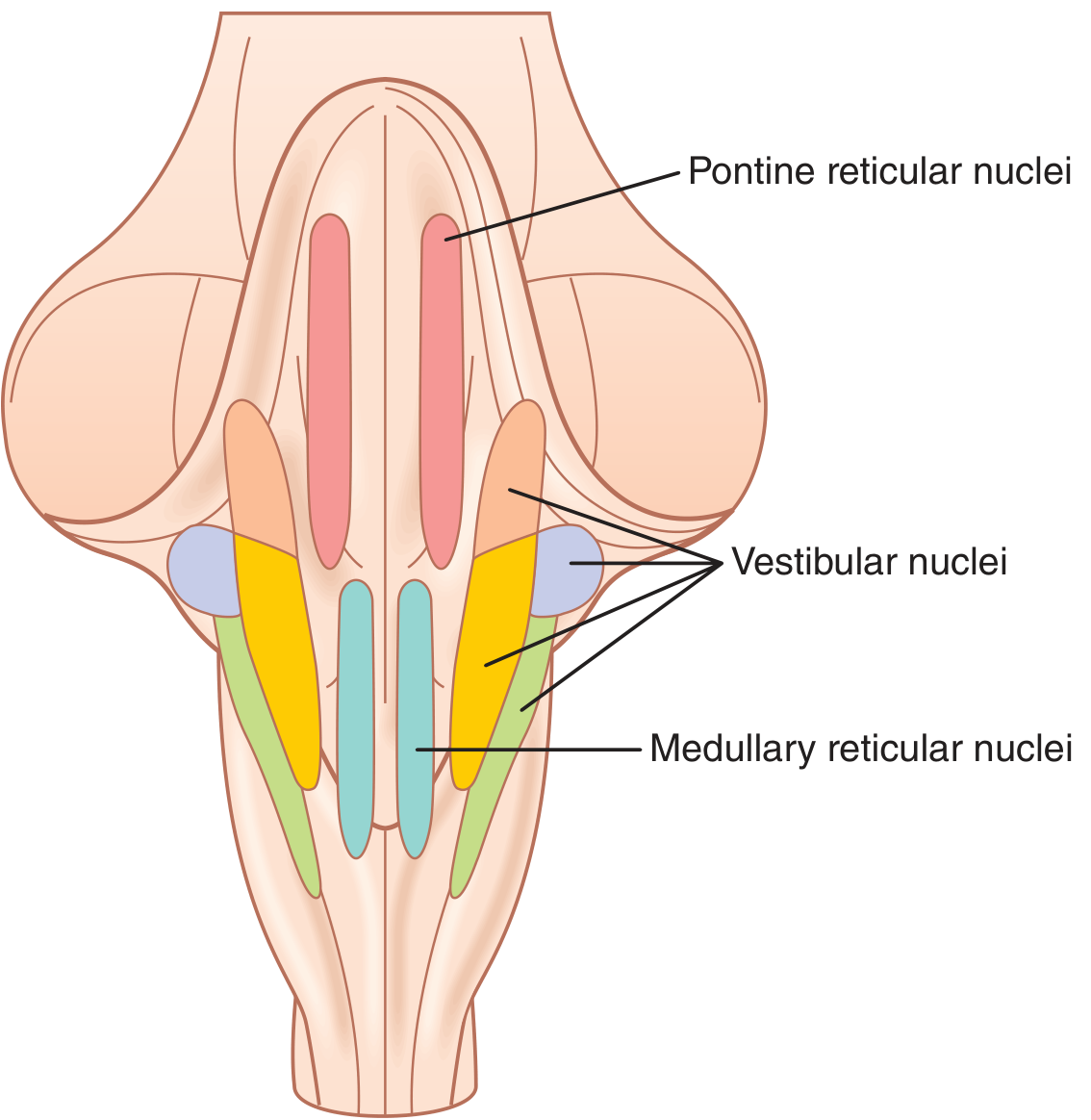
Figure 56.7 — Locations of the reticular and vestibular nuclei in the brainstem.
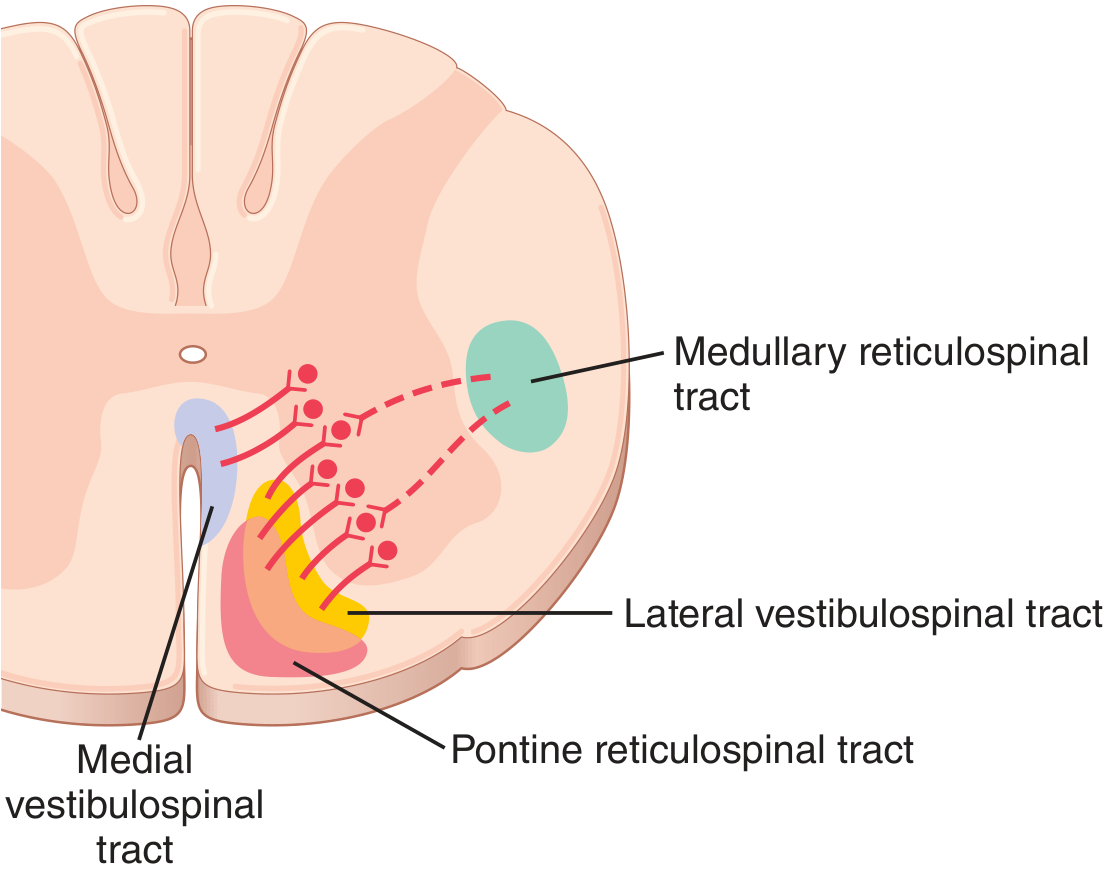
Figure 56.8 — Vestibulospinal and reticulospinal tracts exciting (solid) or inhibiting (dashed) anterior motor neurons for axial musculature.
2b. Vestibular Nuclei and Equilibrium
The vestibular apparatus sits in the membranous labyrinth, enclosed in the petrous temporal bone. Its key equilibrium structures include:
- Semicircular canals — detect rotational (angular) acceleration
- Utricle — macula lies in horizontal plane; signals head orientation when upright
- Saccule — macula lies in vertical plane; signals head orientation when lying down
Maculae and Statoconia: Each macula is covered by a gelatinous layer embedded with calcium carbonate crystals (statoconia) with a specific gravity 2–3× that of surrounding tissue. Gravity bends the cilia of underlying hair cells in the direction of pull.
Hair Cell Mechanism:
- Each hair cell has ~100 short stereocilia + 1 large kinocilium (always on one side)
- Stereocilia are connected tip-to-tip by filamentous links; when they bend toward the kinocilium, these links pull open cation channels → positive ion influx → depolarization → increased vestibular nerve firing
- Bending away from kinocilium → channels close → hyperpolarization → decreased firing
Semicircular Canals:
The three canals (anterior, posterior, horizontal) are oriented in three mutually perpendicular planes. Each canal has an ampulla containing a crista (a ridge of hair cells). Angular acceleration moves endolymph relative to the canal → deflects the cupula (gelatinous structure overlying the crista) → bends hair cells → signals rotational movement.
Vestibular Reflexes:
- Vestibular signals project to the vestibular nuclei in the brainstem, which relay via:
- Lateral vestibulospinal tract → extensor motor neurons of the ipsilateral limbs (support against gravity)
- Medial vestibulospinal tract → cervical cord anterior motor neurons → neck muscles (stabilize head)
- Medial longitudinal fasciculus (MLF) → oculomotor nuclei → stabilize eyes during head movements (vestibulo-ocular reflex, VOR)
3. Brainstem Control of Stereotyped Movements
Infants born with anencephaly (no brain above the mesencephalon) demonstrate the critical role of the brainstem in stereotyped movements. These babies can:
- Suckle and reject unpleasant food
- Move hands to mouth
- Yawn and stretch
- Cry and follow objects with eyes and head
- Respond to pressure on legs by moving toward a sitting position
This confirms that many fundamental motor behaviors are integrated at the brainstem level.
4. Reticular Activating System — Brain Activity Control
4a. Excitatory Reticular Area (Bulboreticular Facilitatory Area)
Located in the reticular substance of the pons and mesencephalon, this area sends signals both:
- Downward → spinal cord (antigravity tone, reflex control)
- Upward → thalamus → cerebral cortex and subcortical areas (consciousness/arousal)
Two types of upward excitatory signals:
- Fast signals (large cell bodies, release acetylcholine) — brief excitation lasting milliseconds, destroyed by acetylcholinesterase
- Slow signals (small neurons, slow-conducting fibers, synapse in intralaminar thalamic nuclei and reticular thalamic nuclei) — excitation builds up over many seconds to minutes → controls background excitability of the brain
Activation of the Excitatory Area:
- Peripheral sensory signals (especially pain) are the strongest drivers
- Cutting the brainstem above the entry of CN V (trigeminal nerve) eliminates most somatosensory input → rapid decline in brain activity → permanent coma. Cutting below CN V spares facial/oral input and averts coma.
- Cortical feedback: The cerebral cortex sends return excitatory signals to the reticular area, creating self-sustaining arousal loops.
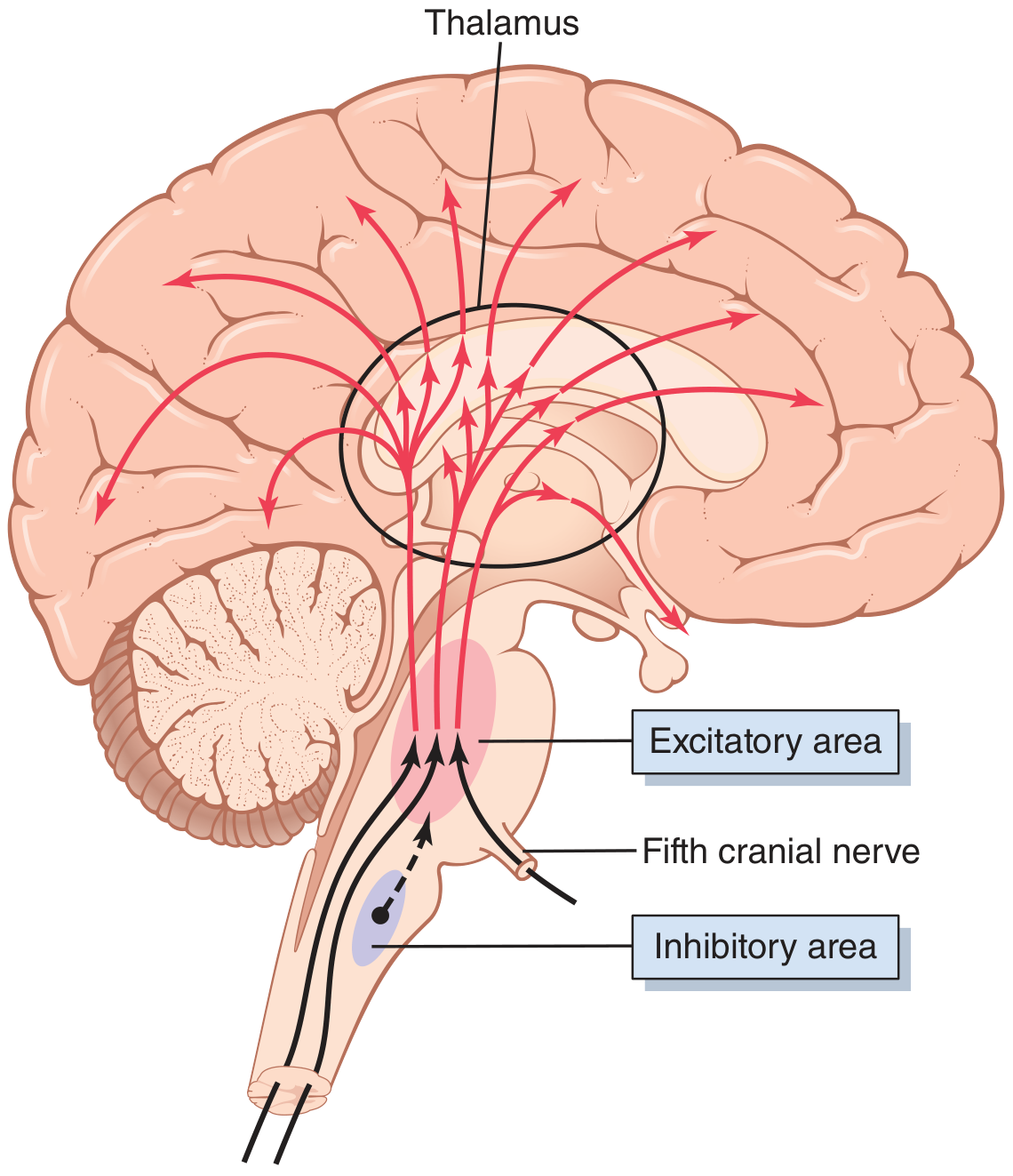
Figure 59.1 — The excitatory-activating system of the brain, showing also the inhibitory area in the medulla.
4b. Reticular Inhibitory Area
Located medially and ventrally in the medulla. It can:
- Inhibit the pontine/mesencephalic facilitatory area
- Decrease overall brain activity
- Acts partly by exciting serotonergic neurons, which secrete serotonin at inhibitory synapses
5. Neurohormonal Control from the Brainstem
Four major neurohormonal systems originate in brainstem nuclei and modulate widespread brain activity:
| System | Origin | Neurotransmitter | Effect |
|---|---|---|---|
| Norepinephrine | Locus ceruleus (pons-mesencephalon junction, posterior) | Norepinephrine | Generally excitatory; spreads to virtually every brain area; increases alertness, attention |
| Dopamine | Substantia nigra and ventral tegmental area (mesencephalon) | Dopamine | Excitatory in some areas, inhibitory in others; primarily directs signals to basal ganglia |
| Serotonin | Raphe nuclei (midline medulla and pons) | Serotonin | Generally inhibitory; directed mainly to midline structures; inhibits pain, induces sleep |
| Acetylcholine | Nucleus basalis of Meynert + brainstem cholinergic areas | Acetylcholine | Excitatory arousal; short-lived (destroyed by acetylcholinesterase) |
The norepinephrine system (locus ceruleus) spreads to virtually every area of the brain, making it the most globally influential brainstem neurohormonal projection. The serotonin system (raphe nuclei) is more midline-specific and is important in sleep, mood, and pain modulation.
6. Brainstem Autonomic Centers and Higher Control
Multiple vital autonomic centers reside in the brainstem:
- Cardiovascular control center (medulla) — regulates heart rate and arterial pressure
- Respiratory center (medulla and pons) — controls rhythm and depth of breathing
- Gastrointestinal center (medulla) — partial control of GI motility and secretion
- Salivatory nuclei — control salivation
These centers receive command signals from higher centers, especially the hypothalamus, acting as relay stations:
- Stimulation of the posterior hypothalamus can drive medullary cardiovascular centers to raise arterial pressure to more than twice normal
- Other hypothalamic areas control body temperature, salivation, GI activity, and bladder emptying via brainstem autonomic relay nuclei
Signals also descend from the cerebral cortex → hypothalamus → brainstem reticular areas → ANS, mediating many behavioral/emotional cardiovascular and visceral responses. This pathway can even cause autonomic-induced diseases such as severe constipation, palpitation, or myocardial infarction in response to extreme psychological stress.
Summary Table — Key Brainstem Physiological Functions
| Function | Structure | Key Pathway/Mechanism |
|---|---|---|
| Extensor muscle tone (support against gravity) | Pontine reticular nuclei | Pontine reticulospinal tract → medial anterior motor neurons |
| Relaxation of antigravity muscles | Medullary reticular nuclei | Medullary reticulospinal tract (driven by corticospinal input) |
| Equilibrium — linear acceleration/gravity | Utricle & saccule maculae | Statoconia → hair cell deflection → vestibular nerve |
| Equilibrium — rotational/angular acceleration | Semicircular canal cristae | Endolymph → cupula deflection → hair cells |
| Eye stabilization during head movement | Vestibular nuclei → MLF | Vestibulo-ocular reflex (VOR) |
| Arousal/consciousness | Pontomesencephalic ARAS | Brainstem → thalamus → cortex (ACh & slow fibers) |
| Global excitation/alertness | Locus ceruleus | Norepinephrine → diffuse cortical/subcortical projection |
| Sleep/pain inhibition | Raphe nuclei | Serotonin → midline structures |
| Stereotyped motor patterns | Brainstem nuclei (overall) | Suckling, yawning, postural adjustments |
| Cardiovascular/respiratory/GI autonomic control | Medullary centers | Direct + via hypothalamic relay |
All content from: Guyton and Hall Textbook of Medical Physiology (ISBN 9780443111013), Chapters 56 & 59
This is a shared conversation. Sign in to Orris to start your own chat.