
how does smoking causes foot gangerin
Reading File
Smoking causes foot gangrene primarily through progressive damage to blood vessels (peripheral arterial disease), which starves foot tissues of oxygen. Nicotine causes vasoconstriction, carbon monoxide reduces oxygen-carrying capacity, and tobacco toxins accelerate atherosclerosis - all leading to ischemia and eventual tissue death.
Searching sources...
Finding Sources
Finding Sources
Searching PubMed
smoking peripheral arterial disease gangrene ischemia
Now let me read the most relevant textbook sections for detailed mechanisms:
Reading File
Reading File
Reading File
Now let me get more detail on the specific mechanisms - nicotine vasoconstriction, platelet effects, and ischemia/gangrene pathway:
Finding Sources
Finding Sources
Reading File
Reading File
I now have excellent textbook content. Let me also fetch the Buerger disease image and get data on the specific smoking mechanisms (platelet aggregation, CO, endothelial damage):
Loading Image
Finding Sources
I now have comprehensive information to give a detailed, well-sourced answer.
How Smoking Causes Foot Gangrene
Smoking causes foot gangrene through two main pathways: peripheral arterial disease (PAD) from atherosclerosis, and a distinct condition called Buerger disease (thromboangiitis obliterans). Both result in critically reduced blood flow to foot tissues, ultimately causing tissue death (gangrene).
1. Atherosclerosis and Peripheral Arterial Disease (PAD)
This is the most common pathway. Tobacco smoke causes progressive arterial narrowing through several mechanisms acting together:
A. Endothelial Damage and Atherosclerosis
- Smoking directly injures the endothelium (inner lining of arteries), triggering an inflammatory response
- Oxidized LDL, reactive oxygen species, and inflammatory cytokines drive plaque formation in artery walls
- Approximately 90% of peripheral vascular disease in non-diabetic patients is directly attributable to cigarette smoking - Harrison's Principles of Internal Medicine, 22E
B. Nicotine - Vasoconstriction and Catecholamine Release
- Nicotine stimulates release of adrenaline (epinephrine) and noradrenaline, causing acute vasoconstriction
- This chronically reduces blood flow to the lower extremities
- Even 1-2 cigarettes per day is enough to sustain arterial disease activity
C. Platelet Aggregation and Thrombosis
- Platelets from smokers show significantly increased spontaneous and stimulated aggregation compared to non-smokers
- Smoking decreases endothelial nitric oxide (NO) production, diminishes platelet-derived NO bioavailability, and decreases platelet sensitivity to NO
- This pro-thrombotic state increases risk of acute arterial occlusion on top of chronic plaque - Fuster and Hurst's The Heart, 15th Edition
- Smoking also promotes plaque destabilization and increases atherogenesis - Textbook of Family Medicine, 9e
D. Carbon Monoxide (CO) - Reduced Oxygen Delivery
- CO in cigarette smoke binds haemoglobin ~200x more avidly than oxygen, forming carboxyhaemoglobin
- This directly reduces the oxygen-carrying capacity of blood, worsening tissue hypoxia in already poorly perfused feet
E. Multiplicative Risk with Other Factors
- Smoking multiplies the risk when combined with hypertension, hyperlipidaemia, or diabetes - the increment in risk is substantially greater than any single factor alone
2. The PAD Progression to Gangrene (Fontaine Classification)
The progression follows a predictable stepwise course:
| Stage | Symptoms |
|---|---|
| I | Asymptomatic (vessel narrowing present but compensated) |
| IIa/IIb | Claudication (leg pain on walking, relieved by rest) |
| III | Ischemic rest pain, predominantly in the feet |
| IV | Necrosis and/or gangrene of the limb |
Once blood flow falls below the critical threshold needed to maintain resting tissue metabolism, tissues die. The foot is most vulnerable because it is the furthest from the heart, at the end of the arterial supply chain. - Current Surgical Therapy, 14e
The severity of PAD symptoms directly correlates with the extent of the patient's smoking history.
3. Buerger Disease (Thromboangiitis Obliterans) - A Smoking-Specific Condition
This is a separate, distinct disease caused exclusively by smoking (and rarely smokeless tobacco). It is NOT atherosclerosis-based.
- Affects young men (ages 20-40) who smoke heavily
- Causes non-atherosclerotic, segmental, inflammatory occlusion of small and medium arteries of the extremities - specifically the infrapopliteal vessels (below the knee, including foot arteries)
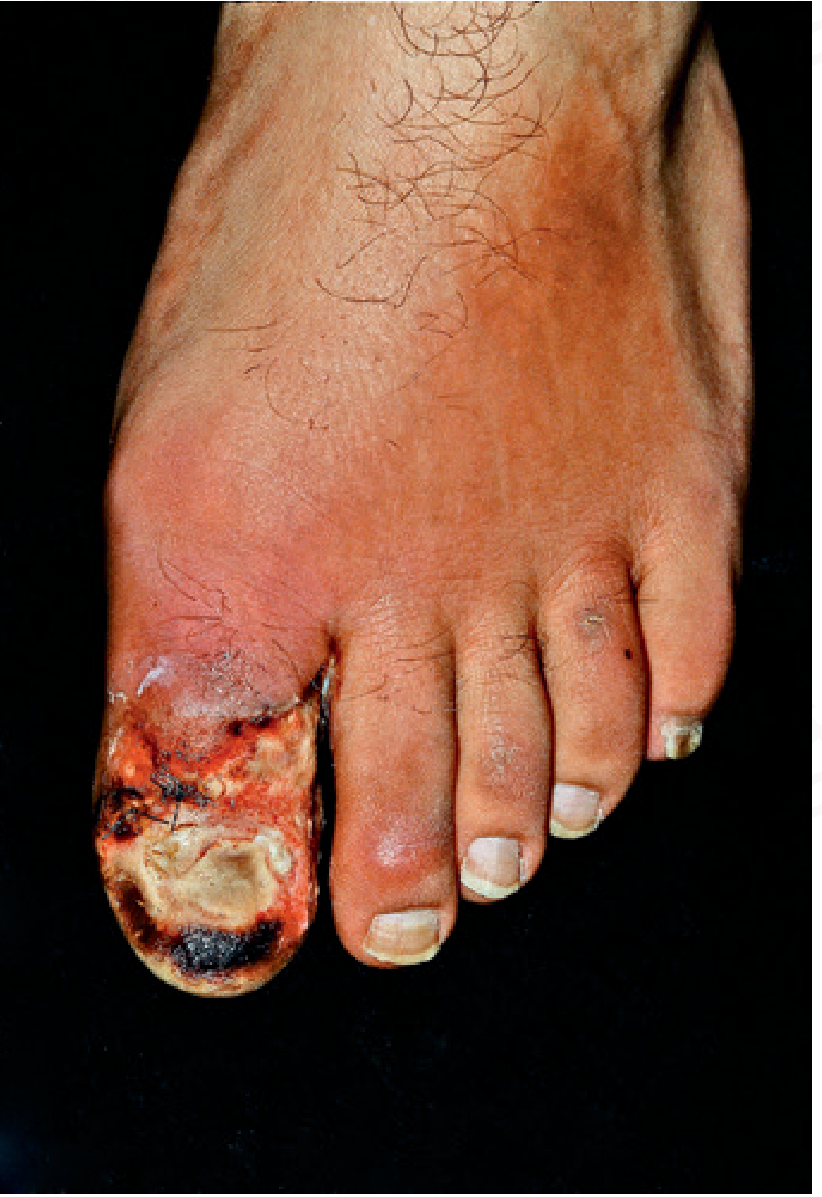
- Features include: loss of foot pulses (dorsalis pedis, posterior tibial), instep/foot claudication, superficial thrombophlebitis, Raynaud phenomenon, and colour changes (red when dependent, white when elevated)
- As arterioles become occluded: skin breaks down with central necrosis, ulceration, and eventual gangrene
- Angiography shows characteristic "corkscrew" collateral arteries
- Even 1-2 cigarettes/day or nicotine replacement therapy can keep Buerger disease active - complete cessation is the only effective treatment - Andrews' Diseases of the Skin, 5e
Here is what foot gangrene from Buerger disease looks like (clinical photo from Andrews' Diseases of the Skin):
Summary of Mechanisms
| Mechanism | Agent | Effect |
|---|---|---|
| Endothelial injury + atherosclerosis | Oxidants, acrolein, PAHs | Plaque buildup, arterial narrowing |
| Vasoconstriction | Nicotine (catecholamine release) | Reduced blood flow |
| Pro-thrombotic state | Nicotine (reduces NO, activates platelets) | Acute vessel occlusion |
| Reduced O₂ delivery | Carbon monoxide | Worsens tissue hypoxia |
| Inflammatory arteritis | Unknown (Buerger disease) | Direct vessel wall destruction |
| Final outcome | All of the above | Chronic limb-threatening ischemia → gangrene |
Key clinical points:
- ~90% of non-diabetic PAD is caused by smoking - Harrison's Principles of Internal Medicine, 22E
- 1-year mortality after critical limb ischemia onset is 25%; up to 25% of survivors require amputation - Tintinalli's Emergency Medicine
- Smoking cessation reduces progression to amputation, heart attack, stroke, and bypass graft failure, even in advanced disease
- In Buerger disease, complete smoking cessation is the only way to halt progression; patients who stop and have no gangrene can avoid major amputation in most cases
This is a shared conversation. Sign in to Orris to start your own chat.