
cell structure and differentiation
Reading File
Finding Sources
Finding Sources
Finding Sources
Finding Sources
Finding Sources
Finding Sources
Reading File
Reading File
Finding Sources
Reading File
Reading File
Reading File
Loading Image
Loading Image
Loading Image
Here is a comprehensive overview of Cell Structure and Differentiation drawn from authoritative medical textbooks.
Cell Structure and Differentiation
1. Overview of Cell Compartments
Every human cell is divided into two major compartments:
- Cytoplasm — everything outside the nucleus; contains organelles, cytoskeleton, and the aqueous cytoplasmic matrix (ions, metabolites, proteins, RNA)
- Nucleus — the largest organelle; houses the genome and the machinery for DNA replication and RNA transcription
"The cytoplasm and nucleus not only play distinct functional roles but also work in concert to maintain the cell's viability." — Histology: A Text and Atlas with Correlated Cell and Molecular Biology
2. Cellular Diversity Through Specialization
Although all cells share the same fundamental organelles, individual cells develop certain structures to exceptional degrees, giving rise to distinct morphologies. Examples:
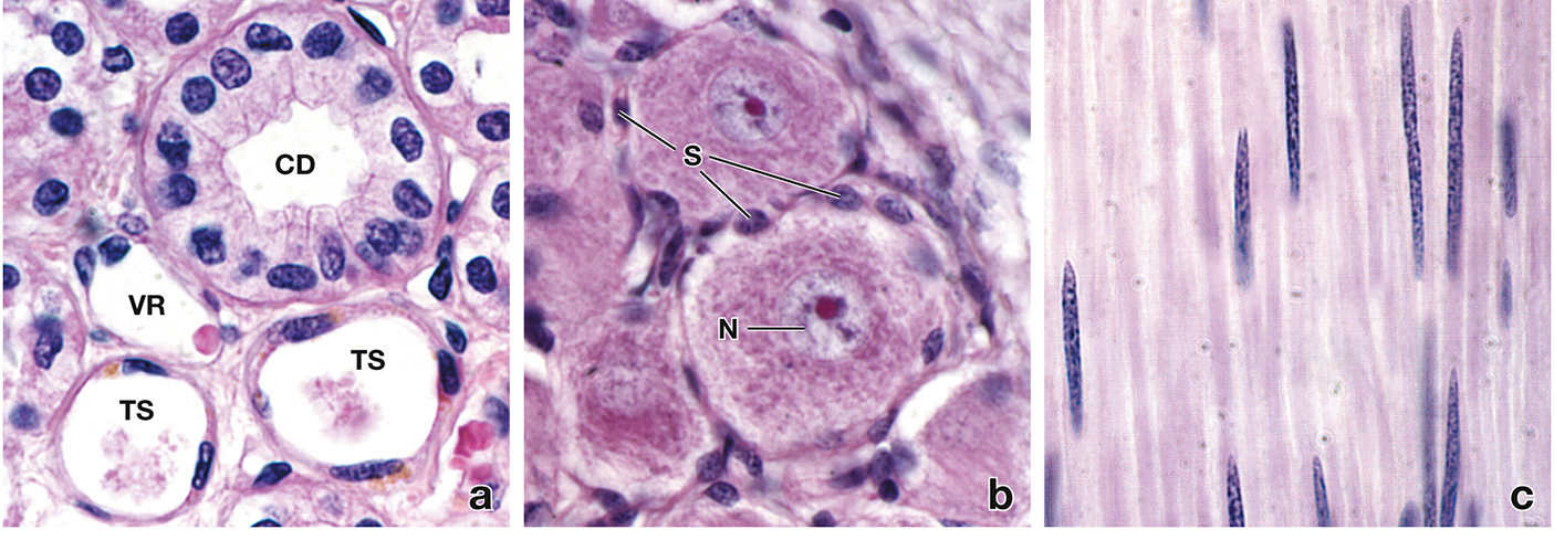
- Muscle cells — huge quantities of contractile filaments (actin/myosin)
- Neurons — large euchromatic nuclei and extensive rough ER (Nissl bodies) for axonal protein synthesis
- Secretory cells — prominent Golgi apparatus and vesicles
- Shape, nuclear morphology, and cytoplasmic content all reflect functional specialization.
3. Key Organelles and Their Functions
| Organelle / Structure | Function |
|---|---|
| Plasma membrane | Lipid bilayer; selectively permeable barrier; houses receptors, transport proteins, channels |
| Nucleus | DNA replication, transcription; genetic control |
| Endoplasmic reticulum (RER/SER) | RER: synthesis of secretory/membrane proteins; SER: lipid synthesis, Ca²⁺ storage |
| Golgi apparatus | Protein sorting and packaging; vesicle formation for secretion and membrane delivery |
| Mitochondria | ATP synthesis via oxidative phosphorylation |
| Lysosomes | Hydrolytic degradation of proteins and macromolecules |
| Peroxisomes | Reactions using/producing H₂O₂; fatty acid oxidation |
| Cytoskeleton | Actin microfilaments, intermediate filaments, tubulin microtubules — maintains shape, anchors organelles, enables motility |
The Plasma Membrane — Fluid Mosaic Model
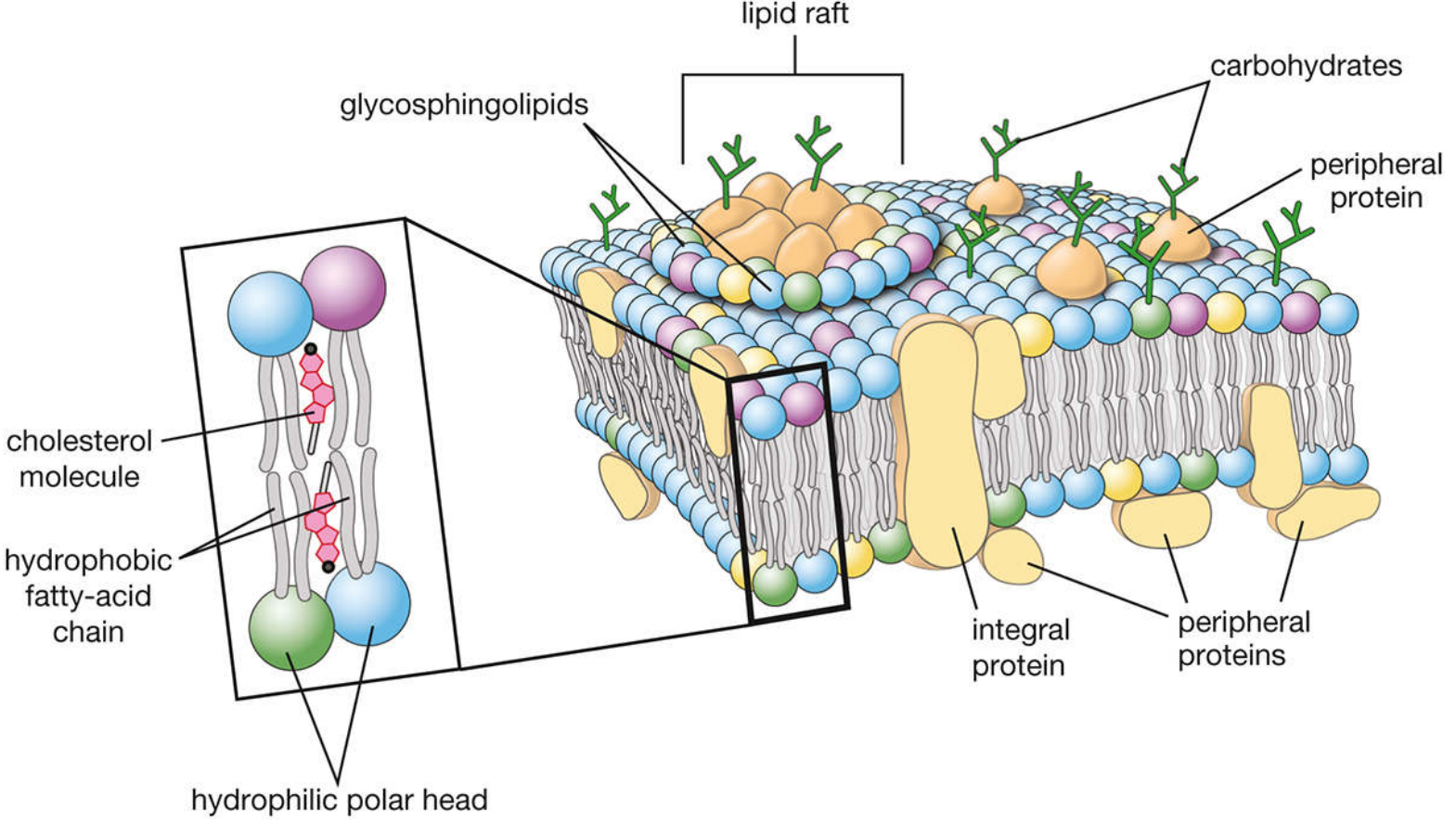
The membrane is a phospholipid bilayer (~8–10 nm thick) with:
- Hydrophobic fatty acid chains facing inward
- Hydrophilic polar heads forming inner/outer surfaces
- Integral proteins spanning the bilayer (transport, receptors)
- Peripheral proteins attached to surfaces (structural, signaling)
- Cholesterol modulating fluidity
- Lipid rafts — microdomains enriched in glycosphingolipids and cholesterol, concentrating signaling proteins
- Glycocalyx — carbohydrate chains on the extracellular surface for cell recognition and adhesion
Transport across the membrane occurs via active transport, facilitated diffusion, or pores/gated channels.
4. Cell Signaling and Chemical Messengers
Differentiated cells integrate signals from their environment. Chemical messengers include:
| Type | Example | Range |
|---|---|---|
| Endocrine | Hormones | Bloodstream (long-range) |
| Paracrine | Growth factors, cytokines | Neighboring cells |
| Juxtacrine | Notch ligands | Direct cell-cell contact |
| Autocrine | Some cytokines | Same cell |
Signals ultimately alter metabolic enzymes, gene regulatory proteins, ion channels, or cytoskeletal proteins in the target cell.
5. Cell Differentiation
General Principle
In most tissues, only primitive undifferentiated (stem) cells are capable of proliferating. As cells differentiate and acquire specialized functions, they progressively lose the ability to divide. This trade-off between proliferative capacity and functional specialization is fundamental to tissue organization.
"Normal cells have a large number of safeguards against uncontrolled proliferation, and cells lose the capacity to proliferate as they differentiate and acquire functional capabilities." — Harrison's Principles of Internal Medicine, 22nd Ed.
Mechanisms Driving Differentiation
- Intrinsic gene expression changes — transcription factors activate lineage-specific programs
- Niche-directed signals — local microenvironment provides adhesion molecules, cytokines, and matrix cues
- Epigenetic regulation — chromatin remodeling silences pluripotency genes and activates lineage genes
- Notch, STING, and other pathways — maintain quiescence or promote transition through the cell cycle
- Cyclin-dependent kinase inhibitors (e.g., p57/CDKN1c) — block G1→S transition, enforcing stem cell quiescence
Progressive Loss of Plasticity
As cells mature: Stem cell → Progenitor → Precursor → Mature effector cell
- Multipotent stem cells give rise to all lineages
- Progenitors are restricted to a narrower set of fates
- Precursors are committed to a single lineage but still proliferate
- Mature cells are terminally differentiated — they perform specialized functions but typically cannot divide
6. Hematopoietic Differentiation — A Model System
The blood system provides the best-characterized example of differentiation in the human body:
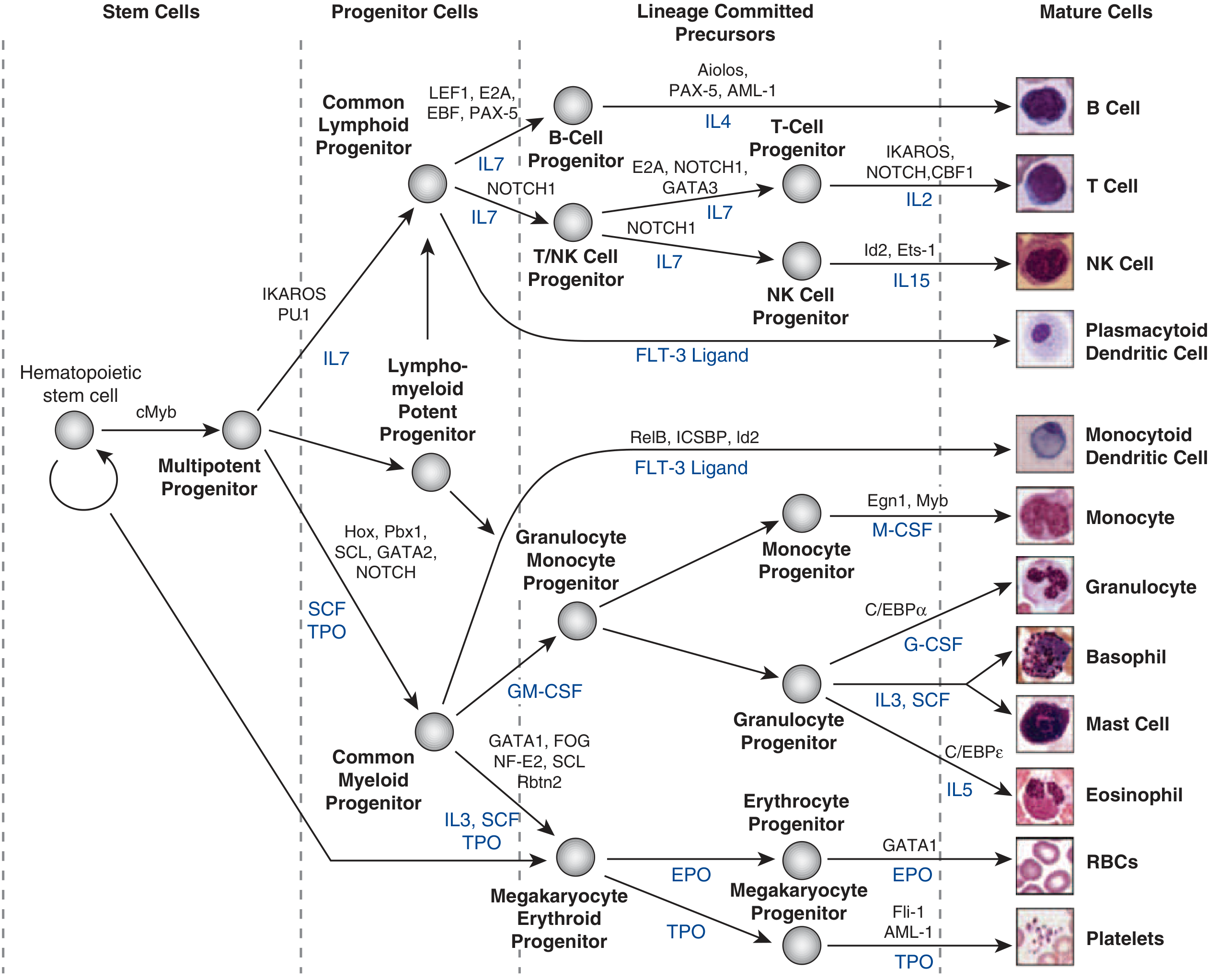
A hematopoietic stem cell (HSC) gives rise to all blood and immune cells through a branching hierarchy:
- HSC → Multipotent Progenitor (driven by cMyb)
- → Common Lymphoid Progenitor (IKAROS, PU.1) → B cells (PAX-5), T cells (NOTCH1, GATA3), NK cells
- → Common Myeloid Progenitor (GATA1, SCL) → Granulocytes (C/EBPα, G-CSF), Monocytes (M-CSF), RBCs (EPO, GATA1), Platelets (TPO)
Key cytokines driving lineage commitment include:
- IL-7 → lymphoid lineages
- EPO (erythropoietin) → red blood cells
- G-CSF → granulocytes
- M-CSF → monocytes
- TPO (thrombopoietin) → megakaryocytes/platelets
- SCF (stem cell factor) → broad HSC maintenance
Mature granulocytes cannot proliferate — numbers increase only by enhanced progenitor production. Lymphocytes retain proliferative capacity, but it is tightly linked to antigen recognition.
7. Differentiation and Cancer
Loss of normal differentiation control is central to cancer. Genetic and epigenetic alterations disrupt the balance between proliferation and differentiation, causing:
- Failure to exit the cell cycle upon differentiation cues
- Reactivation of stem cell programs in mature cells
- Clonal expansion of cells with growth advantage
The multi-step progression — hyperplasia → dysplasia → carcinoma in situ → invasive cancer — reflects accumulating defects in both cell cycle control and differentiation programs.
Sources:
- Histology: A Text and Atlas with Correlated Cell and Molecular Biology, Wolters Kluwer
- Basic Medical Biochemistry: A Clinical Approach, 6th Ed., Wolters Kluwer
- Harrison's Principles of Internal Medicine, 22nd Ed. (2025), McGraw Hill Medical
create its powerpoint pdf start with the meaning of cell
Reading File
Reading File
Reading File
Running Command
ls -la /home/daytona/workspace/ && mkdir -p /home/daytona/workspace/cell-structure-pptx
Running Command
mkdir -p /home/daytona/workspace/cell-structure-pptx && ls /home/daytona/workspace/
Writing File
~/cell-structure-pptx/create_presentation.js
const pptxgen = require("pptxgenjs");
const pres = new pptxgen();
pres.layout = "LAYOUT_16x9";
pres.title = "Cell Structure and Differentiation";
pres.author = "Orris Medical";
// ── Color palette ──────────────────────────────────────────────
const C = {
bg: "0A1628", // deep navy (dominant)
bgLight: "0D2040", // slightly lighter navy
accent: "00C6FF", // electric cyan
accentAlt: "3DD68C", // mint green
gold: "F5A623", // amber
white: "FFFFFF",
offWhite: "D8E8F5",
subtle: "7FA8C9",
red: "FF5E7A",
};
// ── Helper: slide header bar ────────────────────────────────────
function headerBar(slide, title) {
slide.addShape(pres.shapes.RECTANGLE, {
x: 0, y: 0, w: 10, h: 0.75,
fill: { color: C.accent },
line: { color: C.accent }
});
slide.addText(title.toUpperCase(), {
x: 0.3, y: 0, w: 9.4, h: 0.75,
fontSize: 15, bold: true, color: C.bg,
valign: "middle", charSpacing: 3, margin: 0
});
}
// ── Helper: slide background ───────────────────────────────────
function bgFill(slide) {
slide.background = { color: C.bg };
}
// ── Helper: accent left bar ────────────────────────────────────
function leftBar(slide, color) {
slide.addShape(pres.shapes.RECTANGLE, {
x: 0, y: 0, w: 0.12, h: 5.625,
fill: { color: color || C.accent },
line: { color: color || C.accent }
});
}
// ═══════════════════════════════════════════════════════════════
// SLIDE 1 — Title Slide
// ═══════════════════════════════════════════════════════════════
{
const s = pres.addSlide();
bgFill(s);
// Background decorative circle
s.addShape(pres.shapes.ELLIPSE, {
x: 6.5, y: -1.2, w: 5.5, h: 5.5,
fill: { color: "0D2A50", transparency: 0 },
line: { color: "0D2A50" }
});
s.addShape(pres.shapes.ELLIPSE, {
x: 7.2, y: -0.5, w: 3.5, h: 3.5,
fill: { color: "00C6FF", transparency: 80 },
line: { color: "00C6FF", transparency: 80 }
});
// Cyan accent line
s.addShape(pres.shapes.RECTANGLE, {
x: 0.5, y: 2.05, w: 1.8, h: 0.06,
fill: { color: C.accent }, line: { color: C.accent }
});
s.addText("CELL STRUCTURE", {
x: 0.5, y: 1.0, w: 8, h: 0.9,
fontSize: 44, bold: true, color: C.white,
charSpacing: 4
});
s.addText("& DIFFERENTIATION", {
x: 0.5, y: 1.85, w: 8, h: 0.9,
fontSize: 44, bold: true, color: C.accent,
charSpacing: 4
});
s.addText("From cellular anatomy to lineage commitment", {
x: 0.5, y: 2.85, w: 8, h: 0.5,
fontSize: 16, color: C.offWhite, italic: true
});
// Tag line box
s.addShape(pres.shapes.RECTANGLE, {
x: 0.5, y: 4.6, w: 4.0, h: 0.55,
fill: { color: C.accentAlt, transparency: 20 },
line: { color: C.accentAlt }
});
s.addText("Medical Cell Biology", {
x: 0.5, y: 4.6, w: 4.0, h: 0.55,
fontSize: 13, bold: true, color: C.bg,
align: "center", valign: "middle", margin: 0
});
}
// ═══════════════════════════════════════════════════════════════
// SLIDE 2 — What is a Cell?
// ═══════════════════════════════════════════════════════════════
{
const s = pres.addSlide();
bgFill(s);
headerBar(s, "What is a Cell?");
leftBar(s, C.accentAlt);
// Definition box
s.addShape(pres.shapes.RECTANGLE, {
x: 0.3, y: 0.95, w: 9.4, h: 1.3,
fill: { color: C.bgLight }, line: { color: C.accent, pt: 1.5 }
});
s.addText([
{ text: "DEFINITION ", options: { bold: true, color: C.accent, fontSize: 14 } },
{ text: "A cell is the smallest structural and functional unit of all living organisms, capable of independent existence and self-replication.", options: { color: C.offWhite, fontSize: 14 } }
], { x: 0.5, y: 0.95, w: 9.0, h: 1.3, valign: "middle" });
// Etymology
s.addText("Etymology", {
x: 0.3, y: 2.5, w: 9.4, h: 0.4,
fontSize: 13, bold: true, color: C.gold
});
s.addText([
{ text: 'Latin: ', options: { color: C.subtle, fontSize: 13 } },
{ text: '"cella"', options: { bold: true, color: C.gold, fontSize: 13 } },
{ text: ' — meaning a small room or compartment. First described by Robert Hooke in 1665 observing cork under a microscope.', options: { color: C.offWhite, fontSize: 13 } }
], { x: 0.3, y: 2.85, w: 9.4, h: 0.6 });
// Three key points
const pts = [
{ icon: "◉", color: C.accent, title: "Structural Unit", body: "Every tissue and organ is built from cells arranged in functional patterns." },
{ icon: "◉", color: C.accentAlt, title: "Functional Unit", body: "All metabolic processes — respiration, synthesis, signaling — occur within cells." },
{ icon: "◉", color: C.gold, title: "Hereditary Unit", body: "Cells carry DNA and pass genetic information to daughter cells through division." },
];
pts.forEach((p, i) => {
const x = 0.3 + i * 3.2;
s.addShape(pres.shapes.RECTANGLE, {
x, y: 3.65, w: 3.0, h: 1.55,
fill: { color: C.bgLight }, line: { color: p.color, pt: 1.5 }
});
s.addText(p.icon, { x, y: 3.7, w: 0.5, h: 0.5, fontSize: 14, color: p.color, margin: 0 });
s.addText(p.title, { x: x + 0.45, y: 3.7, w: 2.5, h: 0.4, fontSize: 12, bold: true, color: p.color, margin: 0 });
s.addText(p.body, { x, y: 4.1, w: 3.0, h: 1.05, fontSize: 10.5, color: C.offWhite, margin: 5 });
});
}
// ═══════════════════════════════════════════════════════════════
// SLIDE 3 — Cell Theory
// ═══════════════════════════════════════════════════════════════
{
const s = pres.addSlide();
bgFill(s);
headerBar(s, "Cell Theory");
leftBar(s, C.gold);
s.addText("The Three Pillars of Cell Theory", {
x: 0.3, y: 0.9, w: 9.4, h: 0.45,
fontSize: 16, bold: true, color: C.white
});
const pillars = [
{ num: "01", title: "All Living Things Are Made of Cells", body: "From bacteria to humans, every organism is composed of one or more cells — the basic units of life.", color: C.accent },
{ num: "02", title: "The Cell Is the Basic Unit of Life", body: "All structural organization and physiological function in living organisms can be traced to the cellular level.", color: C.accentAlt },
{ num: "03", title: "All Cells Arise from Pre-existing Cells", body: "\"Omnis cellula e cellula\" — Rudolf Virchow (1855). New cells form only through division of existing cells.", color: C.gold },
];
pillars.forEach((p, i) => {
const y = 1.5 + i * 1.3;
s.addShape(pres.shapes.RECTANGLE, {
x: 0.3, y, w: 9.4, h: 1.15,
fill: { color: C.bgLight }, line: { color: p.color, pt: 1 }
});
s.addShape(pres.shapes.RECTANGLE, {
x: 0.3, y, w: 0.7, h: 1.15,
fill: { color: p.color }, line: { color: p.color }
});
s.addText(p.num, {
x: 0.3, y, w: 0.7, h: 1.15,
fontSize: 18, bold: true, color: C.bg,
align: "center", valign: "middle", margin: 0
});
s.addText(p.title, {
x: 1.15, y: y + 0.08, w: 8.4, h: 0.4,
fontSize: 13, bold: true, color: p.color, margin: 0
});
s.addText(p.body, {
x: 1.15, y: y + 0.48, w: 8.4, h: 0.6,
fontSize: 11, color: C.offWhite, margin: 0
});
});
}
// ═══════════════════════════════════════════════════════════════
// SLIDE 4 — Types of Cells
// ═══════════════════════════════════════════════════════════════
{
const s = pres.addSlide();
bgFill(s);
headerBar(s, "Types of Cells: Prokaryotic vs Eukaryotic");
// Prokaryotic column
s.addShape(pres.shapes.RECTANGLE, {
x: 0.2, y: 0.85, w: 4.5, h: 4.4,
fill: { color: C.bgLight }, line: { color: C.gold, pt: 2 }
});
s.addText("PROKARYOTIC", {
x: 0.2, y: 0.85, w: 4.5, h: 0.5,
fontSize: 14, bold: true, color: C.bg,
align: "center", valign: "middle", margin: 0,
fill: { color: C.gold }
});
// Overwrite header fill with shape
s.addShape(pres.shapes.RECTANGLE, {
x: 0.2, y: 0.85, w: 4.5, h: 0.5,
fill: { color: C.gold }, line: { color: C.gold }
});
s.addText("PROKARYOTIC", {
x: 0.2, y: 0.85, w: 4.5, h: 0.5,
fontSize: 14, bold: true, color: C.bg,
align: "center", valign: "middle", margin: 0
});
const prokItems = [
"No membrane-bound nucleus",
"Circular DNA (nucleoid region)",
"No membrane-bound organelles",
"70S ribosomes",
"Cell wall (peptidoglycan in bacteria)",
"Size: 1–10 µm",
"Examples: Bacteria, Archaea",
];
s.addText(prokItems.map((t, i) => ({
text: "▸ " + t,
options: { breakLine: i < prokItems.length - 1, color: i === prokItems.length - 1 ? C.gold : C.offWhite, bold: i === prokItems.length - 1 }
})), { x: 0.35, y: 1.5, w: 4.2, h: 3.6, fontSize: 12 });
// Eukaryotic column
s.addShape(pres.shapes.RECTANGLE, {
x: 5.3, y: 0.85, w: 4.5, h: 4.4,
fill: { color: C.bgLight }, line: { color: C.accent, pt: 2 }
});
s.addShape(pres.shapes.RECTANGLE, {
x: 5.3, y: 0.85, w: 4.5, h: 0.5,
fill: { color: C.accent }, line: { color: C.accent }
});
s.addText("EUKARYOTIC", {
x: 5.3, y: 0.85, w: 4.5, h: 0.5,
fontSize: 14, bold: true, color: C.bg,
align: "center", valign: "middle", margin: 0
});
const eukItems = [
"True membrane-bound nucleus",
"Linear chromosomal DNA",
"Membrane-bound organelles",
"80S ribosomes",
"Cytoskeleton present",
"Size: 10–100 µm",
"Examples: Human cells, yeast, plants",
];
s.addText(eukItems.map((t, i) => ({
text: "▸ " + t,
options: { breakLine: i < eukItems.length - 1, color: i === eukItems.length - 1 ? C.accent : C.offWhite, bold: i === eukItems.length - 1 }
})), { x: 5.45, y: 1.5, w: 4.2, h: 3.6, fontSize: 12 });
// VS badge
s.addShape(pres.shapes.ELLIPSE, {
x: 4.55, y: 2.5, w: 0.7, h: 0.7,
fill: { color: C.red }, line: { color: C.red }
});
s.addText("VS", {
x: 4.55, y: 2.5, w: 0.7, h: 0.7,
fontSize: 12, bold: true, color: C.white,
align: "center", valign: "middle", margin: 0
});
}
// ═══════════════════════════════════════════════════════════════
// SLIDE 5 — Cell Compartments
// ═══════════════════════════════════════════════════════════════
{
const s = pres.addSlide();
bgFill(s);
headerBar(s, "Two Major Cell Compartments");
leftBar(s, C.accent);
// Nucleus card
s.addShape(pres.shapes.RECTANGLE, {
x: 0.25, y: 0.9, w: 4.55, h: 4.3,
fill: { color: C.bgLight }, line: { color: C.accent, pt: 2 }
});
s.addShape(pres.shapes.RECTANGLE, {
x: 0.25, y: 0.9, w: 4.55, h: 0.55,
fill: { color: C.accent }, line: { color: C.accent }
});
s.addText("🔵 NUCLEUS", {
x: 0.25, y: 0.9, w: 4.55, h: 0.55,
fontSize: 14, bold: true, color: C.bg,
align: "center", valign: "middle", margin: 0
});
const nucleusPoints = [
["Largest organelle", "Contains the entire genome (DNA)"],
["Function", "DNA replication + RNA transcription"],
["Nuclear envelope", "Double-membrane with nuclear pores for mRNA export"],
["Nucleolus", "Site of rRNA synthesis and ribosome assembly"],
["Chromatin", "DNA wound around histone proteins; condenses to chromosomes during division"],
];
nucleusPoints.forEach(([label, body], i) => {
s.addText([
{ text: label + ": ", options: { bold: true, color: C.accent, fontSize: 11 } },
{ text: body, options: { color: C.offWhite, fontSize: 11 } }
], { x: 0.35, y: 1.6 + i * 0.68, w: 4.3, h: 0.62 });
});
// Cytoplasm card
s.addShape(pres.shapes.RECTANGLE, {
x: 5.2, y: 0.9, w: 4.55, h: 4.3,
fill: { color: C.bgLight }, line: { color: C.accentAlt, pt: 2 }
});
s.addShape(pres.shapes.RECTANGLE, {
x: 5.2, y: 0.9, w: 4.55, h: 0.55,
fill: { color: C.accentAlt }, line: { color: C.accentAlt }
});
s.addText("🟢 CYTOPLASM", {
x: 5.2, y: 0.9, w: 4.55, h: 0.55,
fontSize: 14, bold: true, color: C.bg,
align: "center", valign: "middle", margin: 0
});
const cytoPoints = [
["Cytoplasmic matrix", "Aqueous gel with ions (Na⁺, K⁺, Ca²⁺), metabolites, proteins, RNA"],
["Organelles", "Membranous & non-membranous structures with specialized functions"],
["Cytoskeleton", "Actin filaments, intermediate filaments, microtubules — shape & movement"],
["Inclusions", "Non-membrane-bound particles: glycogen, lipid droplets, pigments"],
["Ribosomes", "Free (cytosolic) or membrane-bound (RER); site of protein synthesis"],
];
cytoPoints.forEach(([label, body], i) => {
s.addText([
{ text: label + ": ", options: { bold: true, color: C.accentAlt, fontSize: 11 } },
{ text: body, options: { color: C.offWhite, fontSize: 11 } }
], { x: 5.3, y: 1.6 + i * 0.68, w: 4.3, h: 0.62 });
});
}
// ═══════════════════════════════════════════════════════════════
// SLIDE 6 — Plasma Membrane
// ═══════════════════════════════════════════════════════════════
{
const s = pres.addSlide();
bgFill(s);
headerBar(s, "Plasma Membrane — Fluid Mosaic Model");
leftBar(s, C.gold);
s.addText("Structure", {
x: 0.3, y: 0.9, w: 4.0, h: 0.4,
fontSize: 14, bold: true, color: C.gold
});
const structPts = [
["Lipid bilayer", "Phospholipids with hydrophobic tails facing inward; ~8–10 nm thick"],
["Cholesterol", "Modulates fluidity and mechanical stability"],
["Lipid rafts", "Microdomains rich in glycosphingolipids — concentrate signaling proteins"],
["Glycocalyx", "Carbohydrate chains on outer surface — cell recognition & adhesion"],
];
structPts.forEach(([label, body], i) => {
s.addText([
{ text: "● " + label + " — ", options: { bold: true, color: C.gold, fontSize: 12 } },
{ text: body, options: { color: C.offWhite, fontSize: 12 } }
], { x: 0.3, y: 1.35 + i * 0.55, w: 4.4, h: 0.52 });
});
s.addText("Proteins", {
x: 0.3, y: 3.6, w: 4.0, h: 0.4,
fontSize: 14, bold: true, color: C.accent
});
const proteinPts = [
["Integral proteins", "Span bilayer; transport channels, receptors"],
["Peripheral proteins", "Surface-attached; structural scaffolding"],
];
proteinPts.forEach(([label, body], i) => {
s.addText([
{ text: "● " + label + " — ", options: { bold: true, color: C.accent, fontSize: 12 } },
{ text: body, options: { color: C.offWhite, fontSize: 12 } }
], { x: 0.3, y: 4.05 + i * 0.55, w: 4.4, h: 0.52 });
});
// Transport table
s.addText("Membrane Transport", {
x: 5.1, y: 0.9, w: 4.7, h: 0.4,
fontSize: 14, bold: true, color: C.accentAlt
});
const rows = [
["Type", "Energy", "Example"],
["Active transport", "ATP required", "Na⁺/K⁺-ATPase"],
["Facilitated diffusion", "None (gradient)", "GLUT transporters"],
["Ion channels", "None (gated)", "Voltage-gated Na⁺"],
["Osmosis", "None (gradient)", "Aquaporins"],
["Endocytosis", "ATP required", "Receptor-mediated"],
];
rows.forEach((row, ri) => {
const y = 1.35 + ri * 0.62;
const isHeader = ri === 0;
const bgCol = isHeader ? C.accentAlt : (ri % 2 === 0 ? C.bgLight : "0B1F3A");
row.forEach((cell, ci) => {
const x = 5.1 + ci * 1.57;
s.addShape(pres.shapes.RECTANGLE, {
x, y, w: 1.57, h: 0.6,
fill: { color: bgCol }, line: { color: "1A3A6A", pt: 0.5 }
});
s.addText(cell, {
x, y, w: 1.57, h: 0.6,
fontSize: isHeader ? 10.5 : 10, bold: isHeader,
color: isHeader ? C.bg : C.offWhite,
align: "center", valign: "middle", margin: 0
});
});
});
}
// ═══════════════════════════════════════════════════════════════
// SLIDE 7 — Key Organelles
// ═══════════════════════════════════════════════════════════════
{
const s = pres.addSlide();
bgFill(s);
headerBar(s, "Key Organelles and Their Functions");
const organelles = [
{ name: "Mitochondria", color: C.red, icon: "⚡", fn: "ATP synthesis (oxidative phosphorylation); apoptosis regulation" },
{ name: "Rough ER (RER)", color: C.accent, icon: "🔷", fn: "Synthesis of secretory & membrane proteins via ribosomes" },
{ name: "Smooth ER (SER)", color: C.accentAlt,icon: "🔷", fn: "Lipid synthesis; Ca²⁺ storage; drug detoxification" },
{ name: "Golgi Apparatus", color: C.gold, icon: "📦", fn: "Post-translational modification; vesicle sorting & secretion" },
{ name: "Lysosomes", color: C.red, icon: "🗑", fn: "Hydrolytic degradation of proteins, carbohydrates, lipids" },
{ name: "Peroxisomes", color: C.gold, icon: "💧", fn: "Fatty acid β-oxidation; H₂O₂ metabolism (catalase)" },
{ name: "Ribosomes", color: C.accent, icon: "•", fn: "Protein synthesis (free = cytosolic; bound = secretory)" },
{ name: "Cytoskeleton", color: C.accentAlt,icon: "🕸", fn: "Shape, motility, organelle anchoring (actin/IF/microtubules)" },
];
organelles.forEach((org, i) => {
const col = i < 4 ? 0 : 1;
const row = i % 4;
const x = 0.2 + col * 5.0;
const y = 0.85 + row * 1.17;
s.addShape(pres.shapes.RECTANGLE, {
x, y, w: 4.7, h: 1.05,
fill: { color: C.bgLight }, line: { color: org.color, pt: 1 }
});
s.addShape(pres.shapes.RECTANGLE, {
x, y, w: 0.55, h: 1.05,
fill: { color: org.color }, line: { color: org.color }
});
s.addText(org.icon, {
x, y, w: 0.55, h: 1.05,
fontSize: 18, align: "center", valign: "middle", margin: 0
});
s.addText(org.name, {
x: x + 0.62, y: y + 0.06, w: 4.0, h: 0.38,
fontSize: 12, bold: true, color: org.color, margin: 0
});
s.addText(org.fn, {
x: x + 0.62, y: y + 0.44, w: 4.0, h: 0.56,
fontSize: 10.5, color: C.offWhite, margin: 0
});
});
}
// ═══════════════════════════════════════════════════════════════
// SLIDE 8 — Cytoskeleton
// ═══════════════════════════════════════════════════════════════
{
const s = pres.addSlide();
bgFill(s);
headerBar(s, "The Cytoskeleton");
leftBar(s, C.accentAlt);
s.addText("A dynamic protein framework that maintains cell geometry, positions organelles, and drives movement.", {
x: 0.3, y: 0.9, w: 9.4, h: 0.65,
fontSize: 13, color: C.offWhite, italic: true
});
const components = [
{
title: "Actin Microfilaments",
color: C.accent,
diam: "7 nm",
protein: "G-actin → F-actin",
roles: ["Cell cortex & shape", "Lamellipodia / filopodia (motility)", "Muscle contraction (with myosin)", "Cytokinesis contractile ring"],
},
{
title: "Intermediate Filaments",
color: C.gold,
diam: "10 nm",
protein: "Keratins, vimentin, lamins, neurofilaments",
roles: ["Mechanical strength", "Nuclear lamina (lamins)", "Epithelial integrity (keratins)", "Neuronal axon support"],
},
{
title: "Microtubules",
color: C.accentAlt,
diam: "25 nm",
protein: "α/β-tubulin dimers",
roles: ["Mitotic spindle (chromosome segregation)", "Intracellular transport (kinesin/dynein)", "Cilia & flagella (axoneme)", "Centrosome — microtubule organizing center"],
},
];
components.forEach((c, i) => {
const x = 0.3 + i * 3.2;
s.addShape(pres.shapes.RECTANGLE, {
x, y: 1.7, w: 3.0, h: 3.6,
fill: { color: C.bgLight }, line: { color: c.color, pt: 1.5 }
});
s.addShape(pres.shapes.RECTANGLE, {
x, y: 1.7, w: 3.0, h: 0.48,
fill: { color: c.color }, line: { color: c.color }
});
s.addText(c.title, {
x, y: 1.7, w: 3.0, h: 0.48,
fontSize: 11, bold: true, color: C.bg,
align: "center", valign: "middle", margin: 0
});
s.addText([
{ text: "Diameter: ", options: { bold: true, color: c.color } },
{ text: c.diam + "\n", options: { color: C.offWhite } },
{ text: "Protein: ", options: { bold: true, color: c.color } },
{ text: c.protein + "\n\n", options: { color: C.offWhite } },
{ text: "Functions:\n", options: { bold: true, color: c.color } },
], { x: x + 0.1, y: 2.2, w: 2.8, h: 1.0, fontSize: 11 });
s.addText(c.roles.map((r, ri) => ({
text: "▸ " + r,
options: { breakLine: ri < c.roles.length - 1, color: C.offWhite, fontSize: 10.5 }
})), { x: x + 0.1, y: 3.2, w: 2.8, h: 2.0 });
});
}
// ═══════════════════════════════════════════════════════════════
// SLIDE 9 — Cell Signaling
// ═══════════════════════════════════════════════════════════════
{
const s = pres.addSlide();
bgFill(s);
headerBar(s, "Cell Signaling and Chemical Messengers");
s.addText("Differentiated cells integrate extracellular signals that alter metabolic enzymes, gene regulatory proteins, ion channels, or cytoskeletal proteins.", {
x: 0.3, y: 0.85, w: 9.4, h: 0.55,
fontSize: 12, color: C.offWhite, italic: true
});
// Signal types table
const sigTypes = [
["Signal Type", "Distance", "Carrier", "Example"],
["Endocrine", "Long-range", "Bloodstream", "Insulin, cortisol"],
["Paracrine", "Short-range", "Interstitial fluid", "Growth factors, cytokines"],
["Juxtacrine", "Direct contact", "Cell-cell touch", "Notch–Delta signaling"],
["Autocrine", "Same cell", "Self-secretion", "IL-2 in activated T cells"],
["Synaptic", "Synapse gap", "Synaptic cleft", "Acetylcholine, dopamine"],
];
sigTypes.forEach((row, ri) => {
const y = 1.55 + ri * 0.58;
const isHeader = ri === 0;
const bgCol = isHeader ? C.accent : (ri % 2 === 0 ? C.bgLight : "0B1F3A");
row.forEach((cell, ci) => {
const x = 0.25 + ci * 2.38;
s.addShape(pres.shapes.RECTANGLE, {
x, y, w: 2.38, h: 0.55,
fill: { color: bgCol }, line: { color: "1A3A6A", pt: 0.5 }
});
s.addText(cell, {
x, y, w: 2.38, h: 0.55,
fontSize: isHeader ? 11.5 : 11, bold: isHeader,
color: isHeader ? C.bg : C.offWhite,
align: "center", valign: "middle", margin: 0
});
});
});
// Receptor types
s.addText("Receptor Categories", {
x: 0.3, y: 5.0, w: 9.4, h: 0.35,
fontSize: 13, bold: true, color: C.gold
});
const recTypes = [
{ t: "Cell-surface receptors", b: "G-protein coupled (GPCR), receptor tyrosine kinases (RTK), ion channel receptors", c: C.accent },
{ t: "Intracellular receptors", b: "Nuclear receptors (steroid, thyroid hormones) — bind lipophilic ligands that cross membrane", c: C.accentAlt },
];
recTypes.forEach((r, i) => {
s.addText([
{ text: r.t + ": ", options: { bold: true, color: r.c, fontSize: 11 } },
{ text: r.b, options: { color: C.offWhite, fontSize: 11 } }
], { x: 0.3, y: 5.35 + i * 0.43, w: 9.4, h: 0.42 });
});
}
// ═══════════════════════════════════════════════════════════════
// SLIDE 10 — Cell Differentiation Concept
// ═══════════════════════════════════════════════════════════════
{
const s = pres.addSlide();
bgFill(s);
headerBar(s, "Cell Differentiation — Core Concept");
leftBar(s, C.accentAlt);
// Definition
s.addShape(pres.shapes.RECTANGLE, {
x: 0.25, y: 0.88, w: 9.5, h: 1.05,
fill: { color: C.bgLight }, line: { color: C.accentAlt, pt: 1.5 }
});
s.addText([
{ text: "DEFINITION ", options: { bold: true, color: C.accentAlt, fontSize: 13 } },
{ text: "Cell differentiation is the process by which a less specialized cell becomes a more specialized cell type, acquiring distinct morphology, gene expression, and function while retaining the same DNA sequence.", options: { color: C.offWhite, fontSize: 13 } }
], { x: 0.4, y: 0.88, w: 9.2, h: 1.05, valign: "middle" });
// Key principle
s.addText("Fundamental Principle", {
x: 0.3, y: 2.1, w: 5.0, h: 0.38, fontSize: 13, bold: true, color: C.gold
});
s.addText("In most organs, only primitive undifferentiated (stem) cells are capable of proliferating. As cells differentiate and acquire specialized functions, they progressively LOSE the capacity to divide. This proliferation-differentiation trade-off is essential for tissue homeostasis.", {
x: 0.3, y: 2.5, w: 5.6, h: 1.4, fontSize: 11.5, color: C.offWhite
});
// Mechanisms box
s.addShape(pres.shapes.RECTANGLE, {
x: 6.2, y: 2.0, w: 3.6, h: 3.3,
fill: { color: C.bgLight }, line: { color: C.gold, pt: 1.5 }
});
s.addText("Mechanisms", {
x: 6.2, y: 2.0, w: 3.6, h: 0.45,
fontSize: 13, bold: true, color: C.bg,
align: "center", valign: "middle", margin: 0,
});
s.addShape(pres.shapes.RECTANGLE, {
x: 6.2, y: 2.0, w: 3.6, h: 0.45,
fill: { color: C.gold }, line: { color: C.gold }
});
s.addText("Mechanisms", {
x: 6.2, y: 2.0, w: 3.6, h: 0.45,
fontSize: 13, bold: true, color: C.bg,
align: "center", valign: "middle", margin: 0
});
const mechs = [
"Transcription factor activation",
"Epigenetic chromatin remodeling",
"Niche-directed cytokine signals",
"CDK inhibitors (e.g., p57/CDKN1c)",
"Notch, Wnt, Hedgehog pathways",
"Post-transcriptional regulation",
];
s.addText(mechs.map((m, i) => ({
text: "▸ " + m,
options: { breakLine: i < mechs.length - 1, color: C.offWhite, fontSize: 11 }
})), { x: 6.3, y: 2.55, w: 3.4, h: 2.6 });
// Outcomes
s.addText("Outcomes of Differentiation", {
x: 0.3, y: 4.0, w: 5.7, h: 0.38, fontSize: 13, bold: true, color: C.accent
});
const outcomes = [
"Specialized morphology (e.g., axons, microvilli)",
"Lineage-specific protein expression (hemoglobin, keratin)",
"Loss of pluripotency gene expression",
"Acquisition of specialized metabolic programs",
];
s.addText(outcomes.map((o, i) => ({
text: "● " + o,
options: { breakLine: i < outcomes.length - 1, color: C.offWhite, fontSize: 11 }
})), { x: 0.3, y: 4.42, w: 5.6, h: 1.15 });
}
// ═══════════════════════════════════════════════════════════════
// SLIDE 11 — Stem Cells & Potency
// ═══════════════════════════════════════════════════════════════
{
const s = pres.addSlide();
bgFill(s);
headerBar(s, "Stem Cells and Potency Spectrum");
leftBar(s, C.accent);
// Potency spectrum bar
const potencies = [
{ label: "Totipotent", sub: "Zygote + 1st divisions", color: "9B59B6", w: 1.7 },
{ label: "Pluripotent", sub: "Embryonic stem cells (ESC)", color: C.accent, w: 1.8 },
{ label: "Multipotent", sub: "Hematopoietic, MSC", color: C.accentAlt, w: 1.9 },
{ label: "Oligopotent", sub: "Lymphoid progenitor", color: C.gold, w: 1.8 },
{ label: "Unipotent", sub: "Muscle satellite cells", color: C.red, w: 1.65 },
];
let px = 0.2;
potencies.forEach((p) => {
s.addShape(pres.shapes.RECTANGLE, {
x: px, y: 0.9, w: p.w, h: 0.85,
fill: { color: p.color }, line: { color: p.color }
});
s.addText(p.label, {
x: px, y: 0.9, w: p.w, h: 0.45,
fontSize: 11, bold: true, color: C.bg,
align: "center", valign: "middle", margin: 0
});
s.addText(p.sub, {
x: px, y: 1.32, w: p.w, h: 0.4,
fontSize: 8.5, color: C.bg,
align: "center", margin: 0
});
px += p.w + 0.05;
});
// Arrow label
s.addShape(pres.shapes.RECTANGLE, {
x: 0.2, y: 1.82, w: 9.5, h: 0.08,
fill: { color: C.subtle }, line: { color: C.subtle }
});
s.addText("← DECREASING DEVELOPMENTAL POTENTIAL INCREASING COMMITMENT →", {
x: 0.2, y: 1.9, w: 9.5, h: 0.35,
fontSize: 9, color: C.subtle, align: "center"
});
// Stem cell properties
s.addText("Properties of Stem Cells", {
x: 0.3, y: 2.4, w: 4.5, h: 0.4, fontSize: 13, bold: true, color: C.accent
});
const props = [
["Self-renewal", "Ability to divide and produce identical daughter stem cells"],
["Multipotency", "Potential to differentiate into multiple cell lineages"],
["Quiescence", "Resting state (G0); activated by injury or physiological need"],
["Niche dependence", "Microenvironment provides adhesion, cytokine, and metabolic cues"],
];
props.forEach(([label, body], i) => {
s.addText([
{ text: "◈ " + label + ": ", options: { bold: true, color: C.accent, fontSize: 11.5 } },
{ text: body, options: { color: C.offWhite, fontSize: 11.5 } }
], { x: 0.3, y: 2.9 + i * 0.6, w: 4.5, h: 0.55 });
});
// iPSC box
s.addShape(pres.shapes.RECTANGLE, {
x: 5.3, y: 2.35, w: 4.45, h: 3.0,
fill: { color: C.bgLight }, line: { color: "9B59B6", pt: 1.5 }
});
s.addShape(pres.shapes.RECTANGLE, {
x: 5.3, y: 2.35, w: 4.45, h: 0.48,
fill: { color: "9B59B6" }, line: { color: "9B59B6" }
});
s.addText("Induced Pluripotent Stem Cells (iPSC)", {
x: 5.3, y: 2.35, w: 4.45, h: 0.48,
fontSize: 11, bold: true, color: C.white,
align: "center", valign: "middle", margin: 0
});
s.addText([
{ text: "Yamanaka Factors (2006 Nobel Prize):\n", options: { bold: true, color: "CE93D8", fontSize: 11.5 } },
{ text: "OCT4, SOX2, KLF4, c-MYC\n\n", options: { color: C.offWhite, fontSize: 11.5, italic: true } },
{ text: "Adult somatic cells reprogrammed back to pluripotency — bypassing embryo use. Applications: disease modeling, drug testing, regenerative therapy.", options: { color: C.offWhite, fontSize: 11 } }
], { x: 5.4, y: 2.9, w: 4.2, h: 2.35 });
}
// ═══════════════════════════════════════════════════════════════
// SLIDE 12 — Hematopoietic Differentiation
// ═══════════════════════════════════════════════════════════════
{
const s = pres.addSlide();
bgFill(s);
headerBar(s, "Hematopoietic Differentiation — Model of Cell Lineage");
leftBar(s, C.accent);
s.addText("The blood-forming system provides the most detailed model of differentiation in the human body.", {
x: 0.3, y: 0.82, w: 9.4, h: 0.45, fontSize: 12, color: C.offWhite, italic: true
});
// Hierarchy boxes
const stages = [
{ label: "Hematopoietic\nStem Cell (HSC)", color: "9B59B6", x: 0.2, y: 1.45, w: 1.7, h: 1.0 },
{ label: "Multipotent\nProgenitor", color: C.accent, x: 2.2, y: 1.45, w: 1.7, h: 1.0 },
{ label: "Common Lymphoid\nProgenitor (CLP)", color: C.accentAlt, x: 4.2, y: 0.95, w: 1.9, h: 0.9 },
{ label: "Common Myeloid\nProgenitor (CMP)", color: C.gold, x: 4.2, y: 2.05, w: 1.9, h: 0.9 },
{ label: "B / T / NK\nCells", color: C.accentAlt, x: 6.45, y: 0.9, w: 1.55, h: 0.85 },
{ label: "Granulocytes\nMonocytes RBCs", color: C.gold, x: 6.45, y: 1.9, w: 1.55, h: 0.85 },
{ label: "Platelets", color: C.red, x: 6.45, y: 2.9, w: 1.55, h: 0.75 },
];
stages.forEach((st) => {
s.addShape(pres.shapes.ROUNDED_RECTANGLE, {
x: st.x, y: st.y, w: st.w, h: st.h,
fill: { color: st.color, transparency: 15 },
line: { color: st.color, pt: 1.5 },
rectRadius: 0.08
});
s.addText(st.label, {
x: st.x, y: st.y, w: st.w, h: st.h,
fontSize: 10, bold: true, color: C.white,
align: "center", valign: "middle"
});
});
// Arrows (simplified lines)
const arrows = [
{ x: 1.9, y: 1.93, w: 0.3, h: 0.01 },
{ x: 3.9, y: 1.93, w: 0.3, h: 0.01 },
{ x: 6.15, y: 1.38, w: 0.3, h: 0.01 },
{ x: 6.15, y: 2.48, w: 0.3, h: 0.01 },
{ x: 8.0, y: 3.27, w: 0.3, h: 0.01 },
];
// Driving factors
s.addText("Key Driving Factors", {
x: 0.3, y: 3.45, w: 9.4, h: 0.38, fontSize: 13, bold: true, color: C.gold
});
const factors = [
{ f: "SCF + TPO", r: "HSC maintenance & megakaryocyte/platelet lineage", c: C.accent },
{ f: "IL-7", r: "Lymphoid commitment (B, T, NK cells)", c: C.accentAlt },
{ f: "EPO", r: "Erythropoiesis — red blood cell production", c: C.red },
{ f: "G-CSF", r: "Granulocyte production; C/EBPα transcription factor", c: C.gold },
{ f: "M-CSF", r: "Monocyte/macrophage lineage", c: "9B59B6" },
];
factors.forEach((f, i) => {
const col = i < 3 ? 0 : 1;
const row = i < 3 ? i : i - 3;
const x = 0.3 + col * 5.0;
const y = 3.9 + row * 0.42;
s.addText([
{ text: f.f + " ", options: { bold: true, color: f.c, fontSize: 11 } },
{ text: "→ " + f.r, options: { color: C.offWhite, fontSize: 11 } }
], { x, y, w: 4.7, h: 0.4 });
});
}
// ═══════════════════════════════════════════════════════════════
// SLIDE 13 — Differentiation vs Cancer
// ═══════════════════════════════════════════════════════════════
{
const s = pres.addSlide();
bgFill(s);
headerBar(s, "Differentiation Failure and Cancer");
leftBar(s, C.red);
s.addText("Cancer arises when genetic/epigenetic alterations disrupt the balance between proliferation and differentiation, causing cells to retain stem-cell-like characteristics while losing normal function.", {
x: 0.3, y: 0.88, w: 9.4, h: 0.72, fontSize: 12, color: C.offWhite, italic: true
});
// Normal vs Malignant columns
s.addText("Normal Differentiation", {
x: 0.25, y: 1.75, w: 4.5, h: 0.42,
fontSize: 13, bold: true, color: C.accentAlt, align: "center"
});
s.addText("Cancer (Differentiation Failure)", {
x: 5.25, y: 1.75, w: 4.5, h: 0.42,
fontSize: 13, bold: true, color: C.red, align: "center"
});
const normPts = [
"Controlled proliferation linked to functional need",
"Acquisition of specialized morphology & function",
"Progressive loss of self-renewal",
"Cells enter quiescence when growth signals absent",
"DNA damage → cell cycle arrest or apoptosis",
];
const cancPts = [
"Unregulated proliferation regardless of signals",
"Failure to differentiate — cells remain immature",
"Reactivation of self-renewal pathways",
"Resistance to apoptotic signals",
"Invasion, angiogenesis, metastasis",
];
normPts.forEach((p, i) => {
s.addShape(pres.shapes.RECTANGLE, {
x: 0.25, y: 2.25 + i * 0.58, w: 4.5, h: 0.52,
fill: { color: C.bgLight }, line: { color: C.accentAlt, pt: 0.8 }
});
s.addText("✓ " + p, {
x: 0.35, y: 2.25 + i * 0.58, w: 4.3, h: 0.52,
fontSize: 11, color: C.offWhite, valign: "middle"
});
});
cancPts.forEach((p, i) => {
s.addShape(pres.shapes.RECTANGLE, {
x: 5.25, y: 2.25 + i * 0.58, w: 4.5, h: 0.52,
fill: { color: C.bgLight }, line: { color: C.red, pt: 0.8 }
});
s.addText("✗ " + p, {
x: 5.35, y: 2.25 + i * 0.58, w: 4.3, h: 0.52,
fontSize: 11, color: C.offWhite, valign: "middle"
});
});
// Progression
s.addText("Cancer Progression Steps:", {
x: 0.3, y: 5.18, w: 3.0, h: 0.32, fontSize: 12, bold: true, color: C.gold
});
const steps = ["Hyperplasia", "→", "Dysplasia", "→", "CIS", "→", "Invasive Cancer", "→", "Metastasis"];
const stepColors = [C.accentAlt, C.subtle, C.gold, C.subtle, C.gold, C.subtle, C.red, C.subtle, C.red];
let sx = 3.4;
steps.forEach((st, i) => {
s.addText(st, {
x: sx, y: 5.18, w: st === "→" ? 0.25 : 1.0, h: 0.32,
fontSize: 11, bold: st !== "→", color: stepColors[i],
align: "center"
});
sx += st === "→" ? 0.25 : 1.0;
});
}
// ═══════════════════════════════════════════════════════════════
// SLIDE 14 — Summary
// ═══════════════════════════════════════════════════════════════
{
const s = pres.addSlide();
bgFill(s);
headerBar(s, "Summary");
// Big picture boxes
const summaries = [
{ num: "1", title: "The Cell", body: "Smallest living unit; two major compartments — nucleus (genetic control) and cytoplasm (metabolic work). Prokaryotes lack a nucleus; eukaryotes have full organelle complement.", color: C.accent },
{ num: "2", title: "Organelles", body: "Each membrane-bound compartment performs a specialized role: mitochondria (energy), RER (protein synthesis), Golgi (sorting), lysosomes (degradation), peroxisomes (oxidation).", color: C.accentAlt },
{ num: "3", title: "Plasma Membrane", body: "Fluid mosaic of phospholipids + cholesterol + integral/peripheral proteins. Transport occurs via active pumps, channels, and facilitated diffusion. Lipid rafts concentrate signaling.", color: C.gold },
{ num: "4", title: "Differentiation", body: "Stem cells → committed progenitors → mature effectors. Driven by transcription factors, epigenetics, cytokines, and niche signals. Proliferative capacity is traded for function.", color: "9B59B6" },
{ num: "5", title: "Hematopoiesis", body: "Classic model: HSC → lymphoid/myeloid lineages. Governed by IL-7, EPO, G-CSF, M-CSF, TPO. Mature granulocytes cannot divide — numbers increase via progenitor output.", color: C.red },
{ num: "6", title: "Cancer Connection", body: "Disrupted differentiation + uncontrolled proliferation. Oncogenes and lost tumor suppressors drive progression: hyperplasia → dysplasia → carcinoma in situ → invasion → metastasis.", color: C.subtle },
];
summaries.forEach((item, i) => {
const col = i % 2;
const row = Math.floor(i / 2);
const x = 0.2 + col * 4.95;
const y = 0.85 + row * 1.55;
s.addShape(pres.shapes.RECTANGLE, {
x, y, w: 4.7, h: 1.4,
fill: { color: C.bgLight }, line: { color: item.color, pt: 1.2 }
});
s.addShape(pres.shapes.RECTANGLE, {
x, y, w: 0.5, h: 1.4,
fill: { color: item.color }, line: { color: item.color }
});
s.addText(item.num, {
x, y, w: 0.5, h: 1.4,
fontSize: 18, bold: true, color: C.bg,
align: "center", valign: "middle", margin: 0
});
s.addText(item.title, {
x: x + 0.58, y: y + 0.08, w: 4.0, h: 0.38,
fontSize: 12, bold: true, color: item.color, margin: 0
});
s.addText(item.body, {
x: x + 0.58, y: y + 0.46, w: 4.0, h: 0.88,
fontSize: 10, color: C.offWhite, margin: 0
});
});
}
// ── Write file ─────────────────────────────────────────────────
const outPath = "/home/daytona/workspace/cell-structure-pptx/Cell_Structure_and_Differentiation.pptx";
pres.writeFile({ fileName: outPath }).then(() => {
console.log("DONE: " + outPath);
}).catch(err => {
console.error("ERROR:", err);
process.exit(1);
});
You've run out of free credits. Sign up for a free account to continue using Orris.
This is a shared conversation. Sign in to Orris to start your own chat.