
Classification of nerve fibres [Erlanger Gasser Classification]
Reading File
The Erlanger-Gasser classification groups nerve fibres by diameter, conduction velocity, and myelination into A (alpha, beta, gamma, delta), B, and C types. A-alpha fibres are the fastest (motor/proprioception), while C fibres are unmyelinated and slowest (pain/temperature).
Searching sources...
Finding Sources
Finding Sources
Good results. Let me read the most relevant sections from Costanzo Physiology and Medical Physiology.
Reading File
Reading File
Reading File
Excellent data. Now let me also fetch the nerve architecture image and check if there's a classification table image available.
Finding Sources
Loading Image
I now have all the information needed for a thorough answer. Here is the complete classification:
Erlanger-Gasser Classification of Nerve Fibres
Joseph Erlanger and Herbert Gasser introduced this classification, for which they received the 1944 Nobel Prize in Medicine/Physiology. They described the relationship among axon diameter, conduction velocity, and function in peripheral nerves. The system uses letter nomenclature (A, B, C) and applies to both sensory (afferent) and motor (efferent) fibres.
Key principle: Larger diameter = faster conduction velocity. Myelination further increases conduction speed. Therefore, large myelinated fibres are fastest and small unmyelinated fibres are slowest.
- Costanzo Physiology 7th Edition, p. 80
The Classification Table
| Fibre Type | Sub-type | Diameter (µm) | Conduction Velocity (m/s) | Myelination | Function |
|---|---|---|---|---|---|
| A | Aα (A-alpha) | 13-20 | 80-120 | Yes (thick) | Proprioception (muscle spindle Ia afferents), alpha motor neurons to skeletal muscle |
| A | Aβ (A-beta) | 6-12 | 35-75 | Yes | Touch, pressure (mechanoreceptors of skin) |
| A | Aγ (A-gamma) | 3-6 | 12-30 | Yes | Gamma motor neurons to intrafusal fibres of muscle spindles |
| A | Aδ (A-delta) | 1-5 | 5-30 | Yes (thin) | Touch, pressure, temperature, fast (sharp) pain |
| B | - | <3 | 3-15 | Yes (lightly) | Preganglionic autonomic nervous system (ANS) fibres |
| C | - | 0.2-1.5 | 0.5-2.5 | No | Slow (dull/burning) pain, temperature, itch, olfaction; postganglionic autonomic fibres |
(Data from Medical Physiology, Boron & Boulpaep; Costanzo Physiology 7th Ed.)
Key Points to Remember
Group A Fibres
- All are myelinated
- Subdivided into alpha, beta, gamma, delta based on decreasing size
- Aα = fastest, thickest - somatic motor + proprioception (Ia afferents from muscle spindles, Ib from Golgi tendon organs)
- Aβ = touch and pressure from skin
- Aγ = only motor, goes to muscle spindle intrafusal fibres (fusimotor fibres) - important in muscle tone regulation
- Aδ = first pain (sharp, well-localized), also called "fast pain" or "epicritic pain"
Group B Fibres
- Small, lightly myelinated
- Exclusively preganglionic autonomic fibres (both sympathetic and parasympathetic)
- Conduct at 3-15 m/s
Group C Fibres
- Unmyelinated - the only unmyelinated group in this classification
- Slowest conduction (0.5-2.5 m/s)
- Carry slow/burning/dull pain (second pain), temperature, itch
- Also carry postganglionic autonomic signals
- Numerically the most abundant fibres in peripheral nerves
Comparison with Lloyd-Hunt Classification
The Lloyd-Hunt classification applies only to sensory (afferent) fibres, using Roman numerals:
| Lloyd-Hunt | Erlanger-Gasser Equivalent | Source |
|---|---|---|
| Ia | Aα | Primary afferents from muscle spindles |
| Ib | Aα | Golgi tendon organ afferents |
| II | Aβ | Secondary spindle afferents; skin touch/pressure |
| III | Aδ | Touch, pressure, fast pain, temperature |
| IV | C | Slow pain, temperature, olfaction |
(Medical Physiology; Costanzo Physiology 7th Ed.)
Mnemonic for Fibre Types
"All Bears Growl During Bad Cold weather"
- All = A fibres (α, β, γ, δ)
- Bears = B fibres (preganglionic autonomic)
- Cold = C fibres (pain, unmyelinated)
For A-fibre functions (Aα → Aδ):
- Aα = Motor + Proprioception ("Muscle Power")
- Aβ = Touch/Pressure
- Aγ = Muscle spindle (gamma motor)
- Aδ = Fast pain + Temperature
Nerve Architecture (for context)
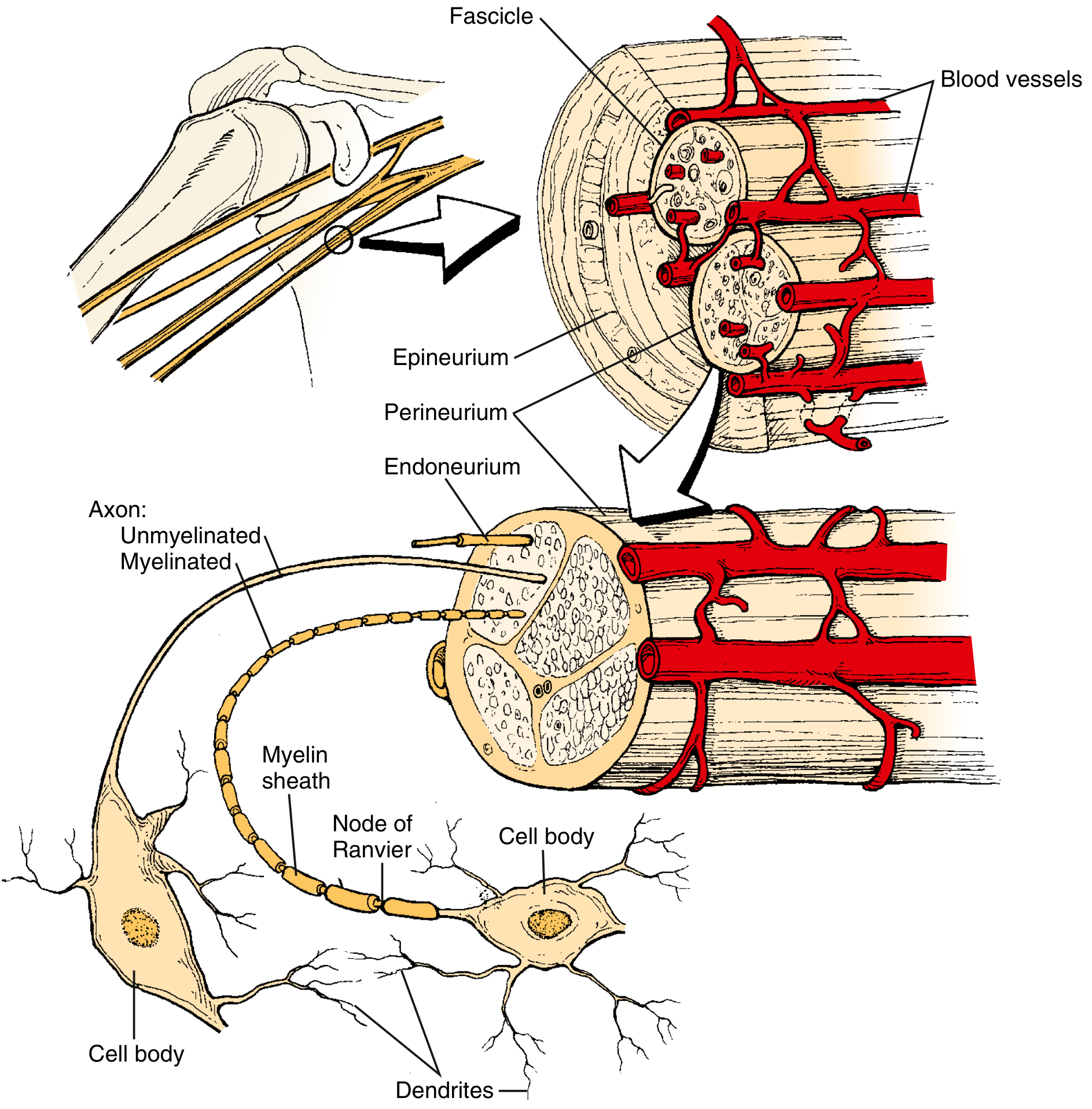
Peripheral nerve architecture - myelinated axons (segmented) vs. unmyelinated axons within fascicles. From Miller's Review of Orthopaedics.
Clinical Relevance
- Local anaesthetics (e.g., cocaine) block small fibres preferentially - C and Aδ fibres are blocked before Aα. This explains why pain sensation is lost before motor function during nerve block. (Goodman & Gilman's Pharmacological Basis of Therapeutics)
- Pressure on a nerve also blocks in order of increasing fibre size: C > B > Aδ > Aγ > Aβ > Aα
- Demyelinating diseases (e.g., multiple sclerosis, Guillain-Barre) affect A and B fibres (myelinated) - C fibres are spared since they have no myelin to lose
- Aδ vs. C pain: Aδ = first, sharp, well-localized pain; C = second, burning, poorly localized pain - this is why you first feel a sharp sensation followed by a dull throbbing after an injury
Saltatory conduction in 4 marks
Saltatory conduction is the mode of impulse propagation in myelinated nerve fibres where the action potential "jumps" from one node of Ranvier to the next, rather than traveling continuously along the entire axon membrane.
Searching sources...
Finding Sources
Reading File
Finding Sources
Reading File
Reading File
Loading Image
Loading Image
Saltatory Conduction
Definition
Saltatory conduction is the mode of action potential propagation in myelinated nerve fibres where the impulse "jumps" from one node of Ranvier to the next, rather than traveling continuously along the entire axon membrane. The term comes from the Latin saltare - "to leap."
- Guyton & Hall Textbook of Medical Physiology
Structural Basis
The myelinated axon has two distinct regions:
| Structure | Length | Function |
|---|---|---|
| Internode (myelin-covered) | 0.2-2.0 mm | Electrical insulation; no ion channels |
| Node of Ranvier | 1-2 µm | Dense voltage-gated Na⁺ channels; site of AP generation |
- The myelin sheath (made by Schwann cells in PNS, oligodendrocytes in CNS) is a multilayered lipid membrane containing sphingomyelin - an excellent electrical insulator that reduces ion flow through the membrane ~5000-fold
- Voltage-gated Na⁺ channels are highly concentrated at nodes and essentially absent under the myelin
Mechanism
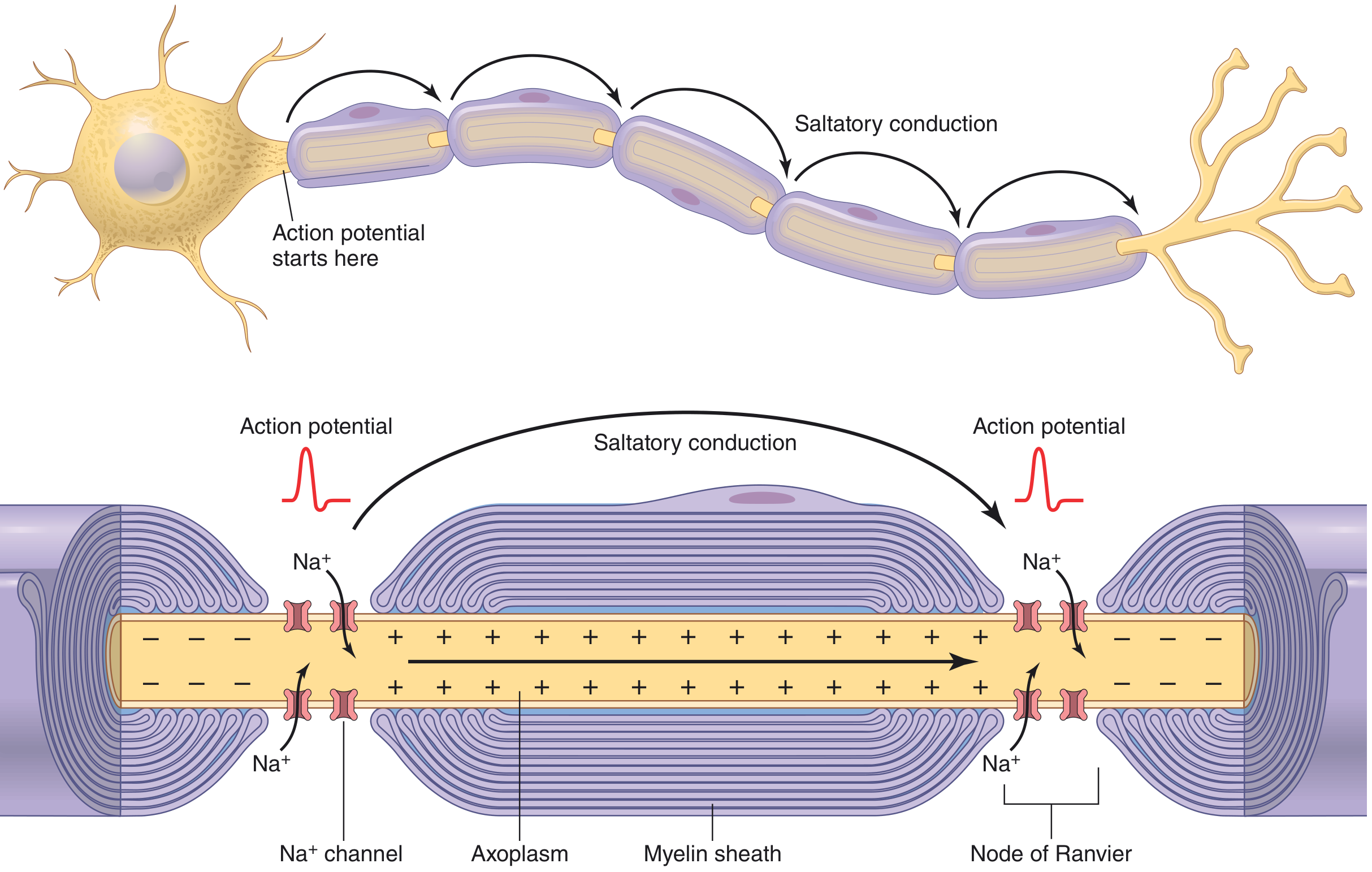
Fig. 5.17 - Saltatory conduction along a myelinated nerve fibre. Guyton & Hall.
Step-by-step:
- An action potential is generated at Node 1 - Na⁺ rushes in through voltage-gated channels, depolarising that node
- The inward current flows longitudinally through the axoplasm under the myelin sheath (not through the insulated membrane)
- This current reaches Node 2 and depolarises it to threshold, generating a new AP
- The AP thus "jumps" from node to node
- The previous node repolarises (K⁺ efflux) while the next one depolarises
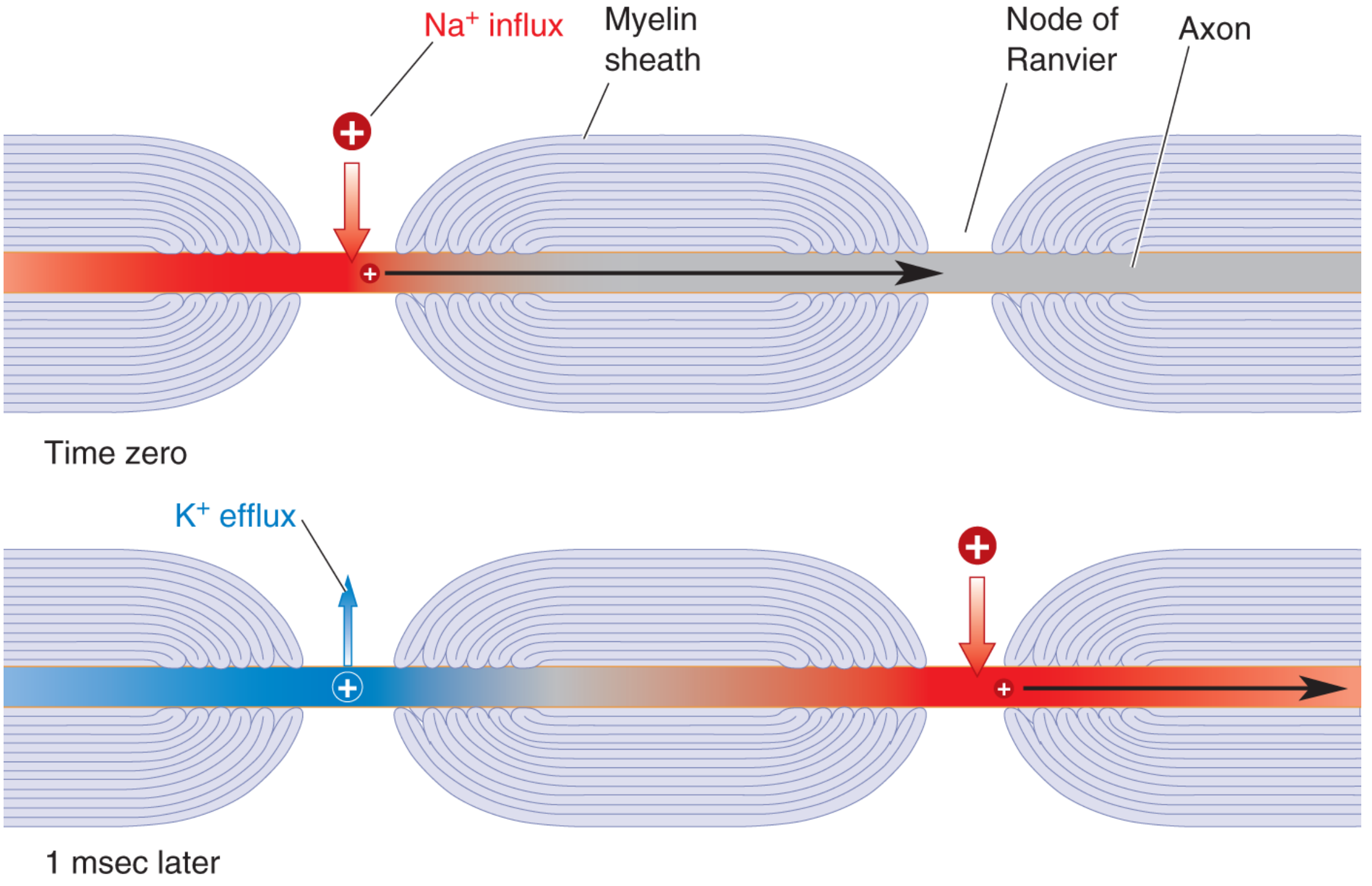
Time sequence of saltatory conduction - Na⁺ influx at Node 1 (time zero), then K⁺ efflux at Node 1 and Na⁺ influx at Node 2 (1 ms later). Neuroscience: Exploring the Brain, 5th Ed.
Advantages of Saltatory Conduction
Saltatory conduction has two major advantages over continuous conduction in unmyelinated fibres:
1. Increased conduction velocity
- Jumping long internodal distances (up to 2 mm) is far faster than slow, step-by-step conduction
- Velocity increases 5 to 50 times compared to an unmyelinated fibre of the same diameter
- In myelinated human peripheral nerves, velocity ranges from 5 m/s (1 µm fibre) to 120 m/s (20 µm fibre)
- A squid giant axon (1000 µm, unmyelinated) conducts at only 25 m/s - a 20 µm myelinated fibre is 5× faster using 2500× less space
2. Energy conservation (metabolic efficiency)
- Only the nodes depolarise - the internode membrane does not expend energy on ion exchange
- This results in approximately 100 times less ion loss (Na⁺ in, K⁺ out) per impulse
- Less Na⁺/K⁺-ATPase pump activity is needed to restore resting membrane potential
Clinical Significance
- Demyelinating diseases (Multiple Sclerosis, Guillain-Barré syndrome) destroy the myelin sheath, abolishing saltatory conduction
- The bare, demyelinated axon conducts slowly (continuous conduction) or fails entirely - producing the weakness, sensory loss and coordination defects seen in MS
- Local anaesthetics block nodes of Ranvier preferentially, disrupting saltatory conduction in small fibres first
"The unique anatomy of myelinated axons results in a mode of impulse propagation known as saltatory conduction. Current flow initiated at an excited node flows directly to adjacent nodes with little loss of transmembrane current through the internode." - Medical Physiology, Boron & Boulpaep
Wallerian degeneration
Your credits are exhausted. You can purchase a top-up or subscribe to a plan to continue using Orris. If you're already subscribed, your daily credits will reset tomorrow.
This is a shared conversation. Sign in to Orris to start your own chat.