
Deltoid ligament
deltoid ligament anatomy function layers clinical significance
Deltoid Ligament (Medial Ligament of the Ankle)
Overview
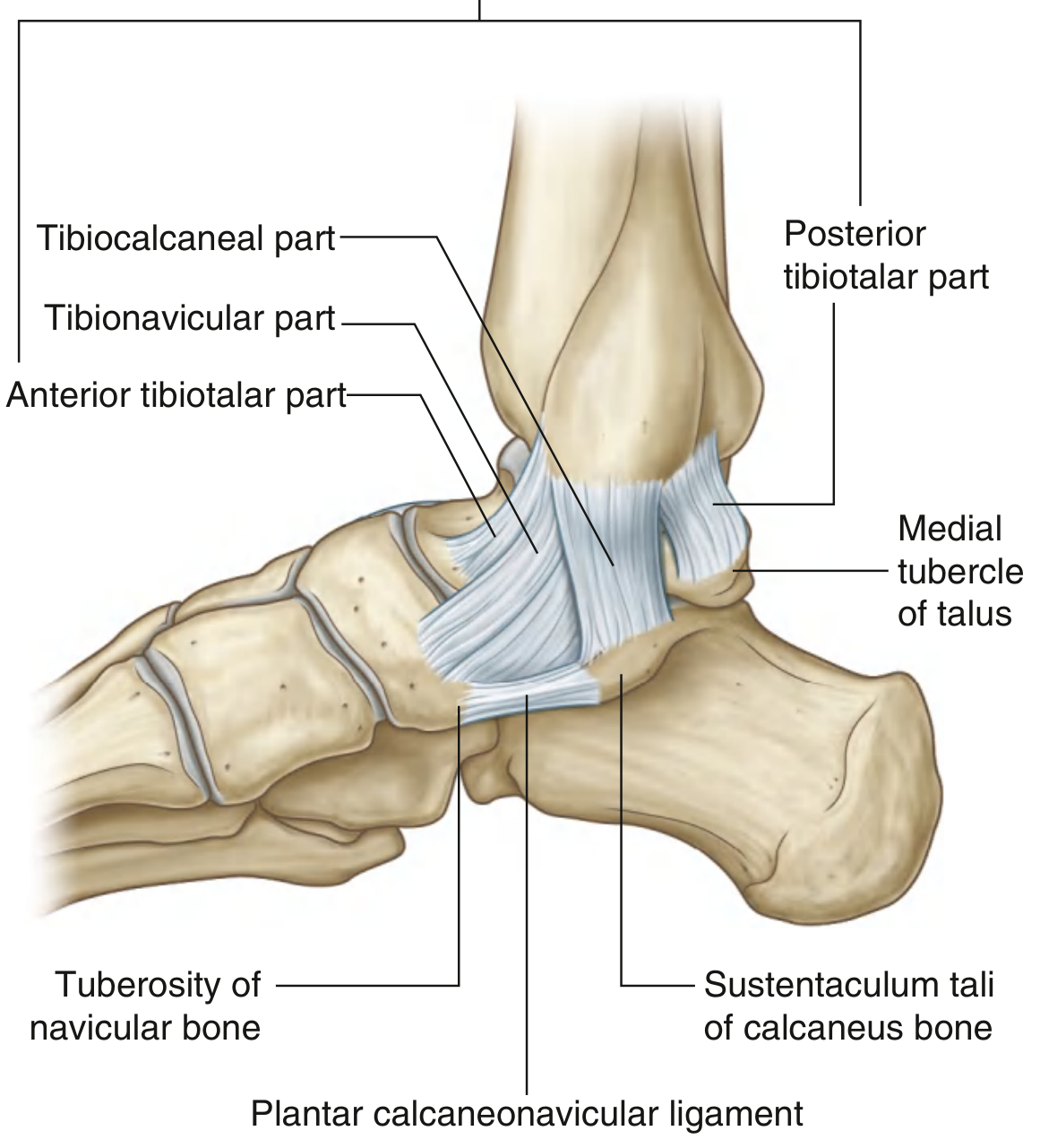
Layers and Components
Deep Layer (intraarticular, extrasynovial - bridges tibiotalar joint only)
| Component | Origin | Insertion | Function |
|---|---|---|---|
| Deep anterior tibiotalar | Intercollicular groove + anterior colliculus | Medial surface of talus | Resists anterior talar translation |
| Deep posterior tibiotalar | Posterior colliculus + intercollicular groove | Medial surface of talus (posterolateral course) | Primary stabilizer - resists lateral talar translation and external rotation |
Superficial Layer (bridges both tibiotalar and subtalar joints)
| Component | Origin | Insertion | Function |
|---|---|---|---|
| Tibionavicular | Anterior colliculus of medial malleolus | Dorsomedial navicular + spring ligament | Resists valgus/eversion |
| Tibiocalcaneal | Medial malleolus (middle portion) | Sustentaculum tali of calcaneus | Resists valgus tilt |
| Superficial posterior tibiotalar | Distal medial malleolus | Medial tubercle of talus | Resists valgus and external rotation |
Key Functions
- Primary role: Stabilizes the medial ankle during the stance phase of gait
- Deep layer: Primarily resists lateral talar translation and external rotation of the talus
- Superficial layer: Primarily resists valgus/eversion forces (talar tilt)
- Both layers act as secondary restraints against anterior talar translation
- The deltoid works in concert with the spring (plantar calcaneonavicular) ligament to support the talar head and maintain the medial longitudinal arch
Clinical Relevance
Injury Patterns
- Isolated deltoid ligament ruptures are rare - they far more commonly occur alongside lateral malleolar fractures, syndesmotic injuries, or lateral ligament tears
- Of patients with lateral ankle instability, 72% have a concurrent deltoid injury, and 43% have injury to both deep and superficial components - Campbell's Operative Orthopaedics 15th Ed, p. 5242
- Incidence of deltoid lesions increases significantly when the ATFL is completely ruptured
- An avulsed deltoid ligament can become entrapped between the medial malleolus and the talus, blocking fracture reduction
Diagnosis
- Medial ankle tenderness and swelling after inversion/external rotation injury
- Stress X-rays (valgus/varus, anterior drawer): widening of the medial clear space on mortise view suggests deep deltoid incompetence
- MRI: gold standard for determining extent - distinguishes partial from complete tears and identifies which layers are involved
- The medial clear space on mortise view should be ≤4 mm and equal to the superior tibiotalar joint space when the deltoid is intact
Treatment
- Conservative - immobilization in below-knee non-weight-bearing cast, then functional rehabilitation (prolonged compared to lateral sprains)
- Below-knee non-weight-bearing cast for 6 weeks, then progressive weight-bearing
- Surgical repair is generally recommended in active patients, especially when MRI confirms complete disruption or mortise imaging shows talar shift
- Primary repair uses suture anchor re-attachment to the medial malleolus, imbrication of tibionavicular and tibiocalcaneal bands
- Note: lateral malleolar fixation alone may restore mortise stability even if the deltoid is not repaired in some cases
- Ligament reconstruction techniques (analogous to Brostrom for the lateral side) are indicated when primary repair is no longer possible
- Post-operative protocol involves short-leg casting in plantarflexion/inversion for 5 weeks, then boot with arch support, physical therapy at 8 weeks, return to impact activity at 16 weeks
Key Points Summary
| Feature | Detail |
|---|---|
| Shape | Triangular, broad-based fan |
| Proximal attachment | Medial malleolus (both colliculi, intercollicular groove) |
| Distal attachments | Navicular, spring ligament, sustentaculum tali, medial talus |
| Layers | Superficial (3 bands) + Deep (2 bands) |
| Strongest component | Deep posterior tibiotalar |
| Primary function | Resist lateral talar translation + eversion/valgus |
| Most common injury context | Associated with fibular fracture or syndesmotic injury |
| Imaging of choice | MRI for ligament; mortise X-ray for instability |
Give in this format for all pg answers
What do you mean by 'pg answers'?
deltoid ligament injury classification recent advances 2024 2025
https://radiopaedia.org/articles/deltoid-ligament-injury?lan…
DELTOID LIGAMENT
1. Introduction
2. History
- Described as early as the 19th century as part of classical ankle anatomy
- Lauge-Hansen (1950) - classified ankle ligament injuries based on mechanism; described deltoid involvement in supination-external rotation (SER) and pronation-abduction (PA) patterns
- Danis-Weber classification - indirectly accounts for deltoid status through fracture level
- Milner and Soames - provided the most widely used modern sub-component naming of the deltoid (tibionavicular, tibiospring, tibiocalcaneal, superficial + deep posterior tibiotalar)
- Deland - described peroneus longus autograft reconstruction for chronic deltoid insufficiency
- Jeng, Bluman, Myerson (2011) - described minimally invasive deltoid reconstruction for Stage IV flatfoot
3. Anatomy
Shape and Attachments
- Shape: Triangular, broad-based fan
- Proximal attachment: Apex to the medial malleolus (both anterior and posterior colliculi and the intercollicular groove)
- Distal attachments: Tuberosity of the navicular, plantar calcaneonavicular (spring) ligament, sustentaculum tali of calcaneus, medial surface of talus (anterior and posterior)
Two-Layer Structure (5 components total)
| Component | Origin | Insertion |
|---|---|---|
| Deep anterior tibiotalar | Intercollicular groove + anterior colliculus | Medial surface of talus |
| Deep posterior tibiotalar | Posterior colliculus + intercollicular groove | Medial surface of talus (posterolateral course) |
- The deep posterior tibiotalar ligament is the strongest component of the entire deltoid complex and the principal stabilizer of the talus in the mortise
| Component | Origin | Insertion |
|---|---|---|
| Tibionavicular | Anterior colliculus | Dorsomedial navicular + spring ligament |
| Tibiocalcaneal | Distal medial malleolus | Sustentaculum tali of calcaneus |
| Superficial posterior tibiotalar | Distal medial malleolus | Medial tubercle of talus |
Functions
- Deep layer: Primarily resists lateral talar translation and external rotation of the talus
- Superficial layer: Primarily resists valgus/eversion forces (talar tilt)
- Both layers: Secondary restraints against anterior talar translation
- Works in concert with the spring ligament to support the talar head and medial longitudinal arch
4. Etiology (of Injury)
- Eversion injury - most common mechanism (forced eversion/pronation-abduction)
- External rotation - supination-external rotation (SER) pattern per Lauge-Hansen; the sequence involves anterior capsule tear then deltoid disruption
- Associated fractures - fibular fracture, bimalleolar / trimalleolar fractures
- Syndesmotic injury - frequently co-existent
- Chronic insufficiency - Stage IV adult-acquired flatfoot deformity (posterior tibial tendon dysfunction with valgus talar tilt)
- Iatrogenic - excessive eversion in ankle arthroplasty or hindfoot reconstruction
5. Mechanism of Injury
Lauge-Hansen Framework (relevant patterns):
- Stage 1: Anterior inferior tibiofibular ligament rupture
- Stage 2: Spiral/oblique fibular fracture at/above syndesmosis
- Stage 3: Posterior tibiofibular ligament or posterior malleolus
- Stage 4: Deltoid ligament rupture (or medial malleolus fracture = bimalleolar equivalent)
- Stage 1: Deltoid ligament torn first (or medial malleolus avulsion)
- Subsequent stages: syndesmotic injury, high fibular fracture
Biomechanical consequence:
- A 1 mm lateral talar shift reduces the effective tibiotalar weight-bearing area by 20-40%
- A 5 mm lateral shift reduces it by 80%
- This explains why even apparently minor deltoid incompetence has profound biomechanical implications
6. Pathology
- Partial tear (more common) - disruption of individual bands, usually superficial layer
- Complete rupture (rare in isolation) - full thickness disruption of both layers; commonly with fibular fracture or syndesmotic injury
- Avulsion - ligament torn from medial malleolus (proximal) or from tarsal bone attachments (distal); avulsed stump can become entrapped between medial malleolus and talus, blocking mortise reduction
- Chronic attenuation - seen in Stage IV PTTD flatfoot; the deltoid is incompetent, allowing valgus talar tilt even with structurally intact fibrous tissue
7. Clinical Features
Symptoms
- Medial ankle pain and swelling after eversion/external rotation injury
- Difficulty or inability to bear weight
- Sense of instability (giving way)
Signs
- Tenderness over the medial malleolus and medial ligament complex
- Swelling and ecchymosis medially (hematoma suggests significant tear)
- Note: Medial tenderness alone does NOT reliably predict deep deltoid rupture - no statistically significant relationship has been demonstrated between medial tenderness and deep deltoid disruption in the setting of lateral malleolar fracture
- In chronic insufficiency: valgus hindfoot alignment, medial arch collapse, forefoot abduction
Special Tests
- Eversion stress test: Pain and gapping medially
- External rotation stress test: Pain with widening of medial clear space
- Always palpate the full length of the fibula to rule out a Maisonneuve fracture (proximal fibular fracture) when medial tenderness is present
8. Investigations
- Plain X-ray (weight-bearing AP, lateral, mortise views) - first line
- Gravity stress radiograph / manual eversion stress - to unmask occult instability
- MRI - gold standard for ligament assessment
- Ultrasound - dynamic assessment, useful for superficial bands
- CT scan - for bony injury characterization, syndesmosis assessment
9. Radiograph
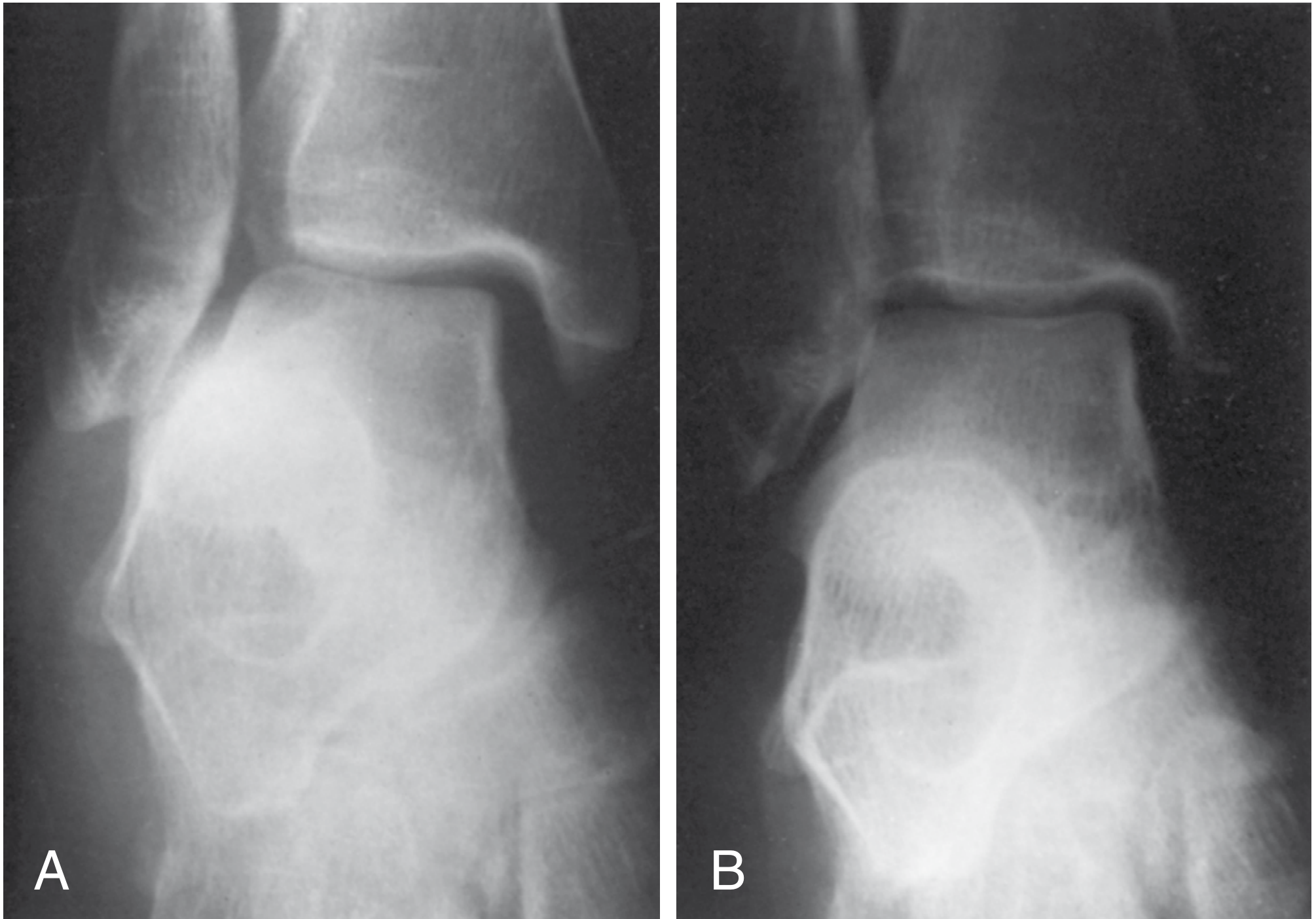
Key Measurements (Mortise View - ankle in neutral dorsiflexion):
- Medial clear space (between medial talus and medial malleolus): Normal ≤ 4 mm
- Medial clear space = Superior joint space: If medial clear space > superior space, suggests deltoid incompetence
- Tibiofibular clear space (on AP view): < 6 mm normal
- Tibiofibular overlap: > 6 mm on AP, > 1 mm on mortise view
Important: Measurement must be on mortise view with ankle in neutral position - plantarflexion allows the narrow part of the talar dome into the mortise, giving a spuriously wide medial space even in a normal ankle.
10. CT Scan
- Not routinely needed for isolated deltoid injury
- Indicated when:
- Syndesmosis injury is suspected (3D CT for tibiofibular relationship)
- Complex fracture pattern with deltoid involvement (trimalleolar, pilon)
- Pre-operative planning for reconstruction
- Assessing for osteochondral lesions of the talus (common co-injury)
- CT may show tibiofibular diastasis not apparent on plain films
11. MRI
- Most accurate investigation for assessing the deltoid ligament
- Axial sequences (with local gradient): Best for deep layers and tibionavicular component
- Coronal sequences: Best for tibiocalcaneal, posterior tibiotalar, and calcaneofibular ligaments; allows complete view and differentiation of superficial vs deep layers
- 3T MRI with 3D reconstruction: High-spatial resolution protocol can produce high-quality images of all ligament components in < 10 minutes (Campbell's, p. 5239-5240)
- MRI findings: Ligament discontinuity, increased T2 signal within the substance (partial tear), fluid surrounding torn ends (complete rupture), periligamentous edema
- MRI is more specific than sensitive for ankle ligament injuries (particularly the CFL)
- Bone bruises occur in significant proportion of ankle sprains; multiple bone bruises suggest multiple ligament injury
12. Classification
A. Sprain Grading (Universal - applied to all ankle ligaments including deltoid)
| Grade | Pathology | Clinical |
|---|---|---|
| Grade I | Ligament stretch, microscopic tears, intact | Mild pain, minimal swelling, full weight-bearing |
| Grade II | Partial macroscopic tear | Moderate pain, swelling, difficulty walking |
| Grade III | Complete rupture | Severe pain, swelling, instability, unable to bear weight |
B. Anatomic Location Classification (Radiopaedia / anatomic):
| Type | Description |
|---|---|
| Type 1 | Proximal tear or avulsion from medial malleolus |
| Type 2 | Mid-substance (interstitial) tear |
| Type 3 | Distal tear or avulsion from tarsal attachment |
C. Lauge-Hansen Classification (mechanism-based, relevant to deltoid stage)
- Describes deltoid injury within the staged sequence of ankle fracture-ligament injuries (SER Stage 4, PA Stage 1, PER Stage 1)
D. In context of Flatfoot (PTTD) - Johnson & Strom / Myerson Staging:
- Stage IV: Deltoid ligament insufficiency with valgus talar tilt added to Stage III deformity - requires deltoid reconstruction as part of treatment
13. Treatment
A. Non-Operative
- Grade I and II isolated sprains
- Isolated complete rupture (Grade III) in low-demand patients
- Deltoid tear with lateral malleolar fracture where mortise remains congruent after fibular fixation
- Acute phase (0-2 weeks): RICE (Rest, Ice, Compression, Elevation); non-weight-bearing below-knee cast or boot
- Sub-acute (2-6 weeks): Progressive weight-bearing in boot with arch support; physiotherapy
- Rehabilitation: Proprioceptive training, peroneal strengthening, range of motion; time course longer than lateral sprains
- Serial radiographic monitoring to confirm no loss of mortise congruence
B. Operative
i. Acute Repair - Indications:
- Complete rupture in active/high-demand patient (Grade III)
- Deltoid tear with lateral malleolar fracture + talar shift in mortise (MRI confirmed or stress-positive)
- Deltoid avulsion interposed in joint (blocking reduction)
- Bimalleolar equivalent fractures with confirmed instability
ii. Acute Repair - Technique:
- Curvilinear medial incision over medial malleolus extending to navicular
- Identify disrupted deltoid ligament (usually avulsed from medial malleolus)
- Debride torn edges; create shallow trough on medial malleolus with rongeur to enhance healing
- Place suture anchor in distal medial malleolus
- Repair deltoid in imbricated fashion - approximating tibionavicular and tibiocalcaneal bands to native attachment
- Protect with below-knee cast in 5-10° plantarflexion and inversion
- ORIF of lateral malleolus is performed concurrently
- Note: Many surgeons do NOT routinely repair the deltoid; fibular fixation alone often restores mortise congruence; medial exploration is reserved for cases with persistent wide medial clear space or blocked reduction
iii. Chronic Reconstruction - Indications:
- Chronic deltoid instability with pain/functional limitation
- Stage IV adult-acquired flatfoot (PTTD with deltoid insufficiency)
- Failed conservative management of chronic medial instability
iv. Reconstruction Techniques:
- Primary repair with imbrication + suture tape (InternalBrace-type) from medial malleolus to sustentaculum tali
- Guide pin into sustentaculum tali angled 15° plantar to avoid subtalar joint violation
- Suture tape anchored in sustentaculum + medial malleolus; deltoid repaired over the tape
- Peroneus longus preferred over peroneus brevis - longer and inserts medially
- Difficult to harvest on plantar surface; requires cadaver practice
- Tibial tunnel: Guidewire parallel to joint surface at physeal scar level; 6.5 mm tunnel, 25 mm deep
- Tendon graft (semitendinosus/hamstring allograft) fixed in tibial tunnel with biotenodesis screw
- Subcutaneous tunnel from tibia to medial malleolus tip
- Talar tunnel: From medial center of tibiotalar rotation to lateral talar neck junction - 5 mm tunnel
- Graft passed medial to lateral through talar tunnel; fixed with interference screw in maximal inversion
- Calcaneal (sustentaculum) arm fixed with biotenodesis screw
- Often combined with medial displacement calcaneal osteotomy and spring ligament repair
- Sutures removed at 2 weeks
- Short leg cast in 5° plantarflexion + inversion x 5 weeks
- Boot with orthotic arch support at 5 weeks; weight-bearing as tolerated
- Physiotherapy at 8 weeks; transition to stiff-soled shoe with orthotic
- Impact activity (running) from 16 weeks with carbon insert protection
14. Recent Advances
-
High-resolution 3T MRI with AI-based reconstruction - acceleration protocols producing high-quality ligament and tendon images in < 10 minutes; may lead to more routine MRI use and improved accuracy of deltoid assessment (Campbell's 15th Ed, 2026)
-
Suture tape augmentation (InternalBrace) - biomechanically superior to primary repair alone; allows immediate protected weight-bearing; now the preferred adjunct for both acute repair and chronic reconstruction
-
Arthroscopic-assisted deltoid repair - diagnostic arthroscopy before open repair to assess osteochondral lesions (common co-injury) and confirm ligament pathology; combined arthroscopy + open repair recommended
-
Recognition of deltoid injury prevalence - recent evidence shows deltoid injuries are far more common than previously thought; 72% of lateral ankle instability cases have concurrent deltoid involvement; systematic MRI assessment is being advocated
-
Minimally invasive reconstruction techniques - evolving graft-based reconstructions (allograft semitendinosus, peroneus longus) now allow anatomic restoration of both deep and superficial components; superior to non-anatomic tenodesis procedures
-
Deltoid repair vs. syndesmotic fixation debate - comparative studies (2015 onwards) show similar functional outcomes with deltoid repair + PITFL repair versus trans-syndesmotic fixation in bimalleolar equivalent fractures; this is shifting practice toward deltoid repair in selected cases
-
Role in flatfoot surgery - increased recognition that Stage IV PTTD requires deltoid reconstruction rather than ignoring medial instability; failure to address deltoid in flatfoot correction leads to recurrent valgus tilt
Create a summary document with anatomy diagrams and classification tables
mkdir -p /home/daytona/workspace/deltoid-ligament/images && cd /home/daytona/workspace/deltoid-ligament/images && curl -s -o anatomy_medial.png "https://cdn.orris.care/cdss_images/ae0b892c92802e5a1250cd03a95cf40f4582613459986f911daa299f33bbf318.png" && curl -s -o xray_tear.png "https://cdn.orris.care/cdss_images/eb2144f42ad459fab23c25dd1e7f495f271e145c95f99e7346bad385bddf3ced.png" && curl -s -o mri_deltoid.png "https://cdn.orris.care/cdss_images/32b059c456e07a373d7543ceeece7e7ae4dc7e429f8dd820d68351982a62c81f.png" && ls -lh
~/deltoid-ligament/build.js
const {
  Document, Packer, Paragraph, TextRun, Table, TableRow, TableCell,
  ImageRun, HeadingLevel, AlignmentType, BorderStyle, WidthType,
  ShadingType, VerticalAlign, PageNumber, Header, Footer, PageBreak,
  UnderlineType
} = require('docx');
const fs = require('fs');
const path = require('path');

const IMAGES_DIR = path.join(__dirname, 'images');

// ── colour palette ──────────────────────────────────────────────────────────
const DARK_BLUE  = '1B3A6B';
const MID_BLUE   = '2E5FA3';
const LIGHT_BLUE = 'D6E4F7';
const ACCENT     = 'E8F1FB';
const HEADER_BG  = '1B3A6B';
const WHITE      = 'FFFFFF';
const TEXT_DARK  = '1A1A2E';
const GREY_LINE  = 'B0BEC5';

// ── helper: shading ─────────────────────────────────────────────────────────
function shade(hex) {
  return { type: ShadingType.SOLID, color: hex, fill: hex };
}

// ── helper: thin border set ─────────────────────────────────────────────────
function thinBorder(color = GREY_LINE) {
  const b = { style: BorderStyle.SINGLE, size: 4, color };
  return { top: b, bottom: b, left: b, right: b };
}

// ── helper: no border ───────────────────────────────────────────────────────
function noBorder() {
  const b = { style: BorderStyle.NONE, size: 0, color: 'FFFFFF' };
  return { top: b, bottom: b, left: b, right: b };
}

// ── helper: section title bar ───────────────────────────────────────────────
function sectionTitle(text) {
  return new Paragraph({
    spacing: { before: 320, after: 120 },
    shading: shade(DARK_BLUE),
    border: { bottom: { style: BorderStyle.SINGLE, size: 8, color: MID_BLUE } },
    children: [
      new TextRun({
        text: `  ${text}`,
        bold: true, size: 26, color: WHITE, font: 'Calibri'
      })
    ]
  });
}

// ── helper: sub-section heading ─────────────────────────────────────────────
function subHeading(text) {
  return new Paragraph({
    spacing: { before: 220, after: 80 },
    border: { left: { style: BorderStyle.SINGLE, size: 16, color: MID_BLUE } },
    children: [
      new TextRun({
        text: `  ${text}`,
        bold: true, size: 22, color: MID_BLUE, font: 'Calibri'
      })
    ]
  });
}

// ── helper: body text ───────────────────────────────────────────────────────
function body(text, opts = {}) {
  return new Paragraph({
    spacing: { before: 60, after: 60 },
    children: [
      new TextRun({
        text,
        size: 20, font: 'Calibri', color: TEXT_DARK,
        bold: opts.bold || false,
        italics: opts.italic || false
      })
    ]
  });
}

// ── helper: bullet ──────────────────────────────────────────────────────────
function bullet(text, level = 0) {
  return new Paragraph({
    bullet: { level },
    spacing: { before: 40, after: 40 },
    children: [
      new TextRun({ text, size: 20, font: 'Calibri', color: TEXT_DARK })
    ]
  });
}

// ── helper: bold+normal mixed bullet ────────────────────────────────────────
function boldBullet(boldPart, normalPart, level = 0) {
  return new Paragraph({
    bullet: { level },
    spacing: { before: 40, after: 40 },
    children: [
      new TextRun({ text: boldPart, bold: true, size: 20, font: 'Calibri', color: TEXT_DARK }),
      new TextRun({ text: normalPart, size: 20, font: 'Calibri', color: TEXT_DARK })
    ]
  });
}

// ── helper: caption ─────────────────────────────────────────────────────────
function caption(text) {
  return new Paragraph({
    alignment: AlignmentType.CENTER,
    spacing: { before: 60, after: 160 },
    children: [
      new TextRun({ text, italics: true, size: 18, color: '555555', font: 'Calibri' })
    ]
  });
}

// ── helper: spacer ──────────────────────────────────────────────────────────
function spacer(pts = 120) {
  return new Paragraph({ spacing: { before: 0, after: pts }, children: [] });
}

// ── helper: image para ──────────────────────────────────────────────────────
function imagePara(filename, widthEmu, heightEmu) {
  const data = fs.readFileSync(path.join(IMAGES_DIR, filename));
  return new Paragraph({
    alignment: AlignmentType.CENTER,
    spacing: { before: 120, after: 60 },
    children: [
      new ImageRun({
        data,
        transformation: { width: Math.round(widthEmu / 9144), height: Math.round(heightEmu / 9144) }
      })
    ]
  });
}

// ── helper: highlighted note box (single-cell table) ────────────────────────
function noteBox(text, bgHex = ACCENT) {
  return new Table({
    width: { size: 100, type: WidthType.PERCENTAGE },
    rows: [
      new TableRow({
        children: [
          new TableCell({
            shading: shade(bgHex),
            borders: { left: { style: BorderStyle.SINGLE, size: 20, color: MID_BLUE }, top: { style: BorderStyle.NONE }, bottom: { style: BorderStyle.NONE }, right: { style: BorderStyle.NONE } },
            margins: { top: 80, bottom: 80, left: 160, right: 160 },
            children: [
              new Paragraph({
                children: [
                  new TextRun({ text: '📌  ' }),
                  new TextRun({ text, size: 20, font: 'Calibri', color: TEXT_DARK })
                ]
              })
            ]
          })
        ]
      })
    ]
  });
}

// ══════════════════════════════════════════════════════════════════════════════
// TABLE BUILDERS
// ══════════════════════════════════════════════════════════════════════════════

function headerCell(text, widthPct) {
  return new TableCell({
    width: { size: widthPct, type: WidthType.PERCENTAGE },
    shading: shade(HEADER_BG),
    borders: thinBorder(MID_BLUE),
    margins: { top: 80, bottom: 80, left: 120, right: 120 },
    verticalAlign: VerticalAlign.CENTER,
    children: [
      new Paragraph({
        alignment: AlignmentType.CENTER,
        children: [
          new TextRun({ text, bold: true, size: 19, color: WHITE, font: 'Calibri' })
        ]
      })
    ]
  });
}

function dataCell(text, widthPct, opts = {}) {
  return new TableCell({
    width: { size: widthPct, type: WidthType.PERCENTAGE },
    shading: opts.shading ? shade(opts.shading) : undefined,
    borders: thinBorder(),
    margins: { top: 60, bottom: 60, left: 100, right: 100 },
    verticalAlign: VerticalAlign.CENTER,
    children: [
      new Paragraph({
        alignment: opts.center ? AlignmentType.CENTER : AlignmentType.LEFT,
        children: [
          new TextRun({ text, size: 19, font: 'Calibri', color: TEXT_DARK, bold: opts.bold || false })
        ]
      })
    ]
  });
}

// ── Table: Deltoid Components ────────────────────────────────────────────────
function tableComponents() {
  const rows = [
    new TableRow({ children: [headerCell('Layer', 15), headerCell('Component', 30), headerCell('Origin', 28), headerCell('Insertion', 27)] }),
    // Deep layer
    new TableRow({ children: [dataCell('Deep', 15, { shading: 'E3EDF9', bold: true }), dataCell('Deep Anterior Tibiotalar', 30), dataCell('Intercollicular groove + anterior colliculus', 28), dataCell('Medial surface of talus', 27)] }),
    new TableRow({ children: [dataCell('Deep', 15, { shading: 'E3EDF9', bold: true }), dataCell('Deep Posterior Tibiotalar ★', 30, { bold: true }), dataCell('Posterior colliculus + intercollicular groove', 28), dataCell('Medial talus (posterolateral course)', 27)] }),
    // Superficial layer
    new TableRow({ children: [dataCell('Superficial', 15, { shading: 'F0F7FF' }), dataCell('Tibionavicular', 30), dataCell('Anterior colliculus', 28), dataCell('Dorsomedial navicular + spring ligament', 27)] }),
    new TableRow({ children: [dataCell('Superficial', 15, { shading: 'F0F7FF' }), dataCell('Tibiocalcaneal', 30), dataCell('Distal medial malleolus', 28), dataCell('Sustentaculum tali', 27)] }),
    new TableRow({ children: [dataCell('Superficial', 15, { shading: 'F0F7FF' }), dataCell('Superficial Posterior Tibiotalar', 30), dataCell('Distal medial malleolus', 28), dataCell('Medial tubercle of talus', 27)] }),
  ];
  return new Table({ width: { size: 100, type: WidthType.PERCENTAGE }, rows });
}

// ── Table: Layer Functions ───────────────────────────────────────────────────
function tableFunctions() {
  const rows = [
    new TableRow({ children: [headerCell('Layer', 25), headerCell('Primary Function', 50), headerCell('Secondary Function', 25)] }),
    new TableRow({ children: [dataCell('Deep (intraarticular, extrasynovial)', 25, { shading: 'E3EDF9' }), dataCell('Resist lateral talar translation & external rotation', 50), dataCell('Secondary restraint to anterior translation', 25)] }),
    new TableRow({ children: [dataCell('Superficial (bridges tibiotalar + subtalar)', 25, { shading: 'F0F7FF' }), dataCell('Resist valgus/eversion (talar tilt)', 50), dataCell('Secondary restraint to anterior translation', 25)] }),
  ];
  return new Table({ width: { size: 100, type: WidthType.PERCENTAGE }, rows });
}

// ── Table: Sprain Grading ────────────────────────────────────────────────────
function tableGrading() {
  const rows = [
    new TableRow({ children: [headerCell('Grade', 12), headerCell('Pathology', 35), headerCell('Clinical Features', 30), headerCell('Management', 23)] }),
    new TableRow({ children: [dataCell('I', 12, { center: true, shading: 'EBF5EB' }), dataCell('Microscopic tears; intact ligament', 35), dataCell('Mild pain, minimal swelling, full weight-bearing', 30), dataCell('RICE, functional rehab', 23)] }),
    new TableRow({ children: [dataCell('II', 12, { center: true, shading: 'FFF8E1' }), dataCell('Partial macroscopic tear', 35), dataCell('Moderate pain, swelling, difficulty walking', 30), dataCell('Boot, physio, protected WB', 23)] }),
    new TableRow({ children: [dataCell('III', 12, { center: true, shading: 'FFEBEE' }), dataCell('Complete rupture', 35), dataCell('Severe pain, instability, unable to weight-bear', 30), dataCell('NWB cast / surgical repair', 23)] }),
  ];
  return new Table({ width: { size: 100, type: WidthType.PERCENTAGE }, rows });
}

// ── Table: Anatomic Location Classification ──────────────────────────────────
function tableLocation() {
  const rows = [
    new TableRow({ children: [headerCell('Type', 15), headerCell('Description', 50), headerCell('Clinical Note', 35)] }),
    new TableRow({ children: [dataCell('Type 1', 15, { shading: 'E3EDF9', bold: true }), dataCell('Proximal avulsion from medial malleolus', 50), dataCell('Most common; amenable to suture anchor repair', 35)] }),
    new TableRow({ children: [dataCell('Type 2', 15, { shading: 'EDF4FF', bold: true }), dataCell('Mid-substance (interstitial) tear', 50), dataCell('End-to-end repair / imbrication', 35)] }),
    new TableRow({ children: [dataCell('Type 3', 15, { shading: 'F5F9FF', bold: true }), dataCell('Distal avulsion from tarsal attachment', 50), dataCell('Suture anchor at navicular / sustentaculum', 35)] }),
  ];
  return new Table({ width: { size: 100, type: WidthType.PERCENTAGE }, rows });
}

// ── Table: Lauge-Hansen (SER) ─────────────────────────────────────────────────
function tableLaugeHansen() {
  const rows = [
    new TableRow({ children: [headerCell('SER Stage', 20), headerCell('Structure Injured', 55), headerCell('Deltoid?', 25)] }),
    new TableRow({ children: [dataCell('I', 20, { center: true }), dataCell('Anterior inferior tibiofibular ligament', 55), dataCell('No', 25, { center: true })] }),
    new TableRow({ children: [dataCell('II', 20, { center: true }), dataCell('Spiral/oblique fibular fracture at/above syndesmosis', 55), dataCell('No', 25, { center: true })] }),
    new TableRow({ children: [dataCell('III', 20, { center: true }), dataCell('Posterior tibiofibular ligament / posterior malleolus', 55), dataCell('No', 25, { center: true })] }),
    new TableRow({ children: [dataCell('IV', 20, { center: true, shading: 'FFEBEE' }), dataCell('Deltoid ligament OR medial malleolus fracture', 55, { shading: 'FFEBEE', bold: true }), dataCell('YES ★', 25, { center: true, shading: 'FFEBEE', bold: true })] }),
  ];
  return new Table({ width: { size: 100, type: WidthType.PERCENTAGE }, rows });
}

// ── Table: Radiological Measurements ────────────────────────────────────────
function tableRadiology() {
  const rows = [
    new TableRow({ children: [headerCell('Parameter', 35), headerCell('Normal Value', 30), headerCell('Significance if Abnormal', 35)] }),
    new TableRow({ children: [dataCell('Medial clear space', 35), dataCell('≤ 4 mm (mortise view, neutral)', 30), dataCell('Deep deltoid incompetence', 35)] }),
    new TableRow({ children: [dataCell('MCS = Superior joint space', 35), dataCell('Equal', 30), dataCell('MCS > superior space → deltoid injury', 35)] }),
    new TableRow({ children: [dataCell('Tibiofibular clear space', 35), dataCell('< 6 mm (AP view)', 30), dataCell('Syndesmotic diastasis', 35)] }),
    new TableRow({ children: [dataCell('Tibiofibular overlap', 35), dataCell('> 6 mm (AP); > 1 mm (mortise)', 30), dataCell('Syndesmotic injury if reduced', 35)] }),
    new TableRow({ children: [dataCell('Lateral talar shift 1 mm', 35), dataCell('N/A', 30), dataCell('Reduces tibiotalar contact area 20-40%', 35)] }),
    new TableRow({ children: [dataCell('Lateral talar shift 5 mm', 35), dataCell('N/A', 30), dataCell('Reduces tibiotalar contact area 80%', 35)] }),
  ];
  return new Table({ width: { size: 100, type: WidthType.PERCENTAGE }, rows });
}

// ── Table: Treatment Summary ─────────────────────────────────────────────────
function tableTreatment() {
  const rows = [
    new TableRow({ children: [headerCell('Scenario', 40), headerCell('Treatment', 35), headerCell('Key Points', 25)] }),
    new TableRow({ children: [dataCell('Isolated Grade I–II sprain', 40), dataCell('RICE → boot → physio', 35), dataCell('Rehab prolonged vs lateral sprain', 25)] }),
    new TableRow({ children: [dataCell('Isolated Grade III (low-demand)', 40), dataCell('NWB below-knee cast 6 weeks', 35), dataCell('Serial X-ray monitoring', 25)] }),
    new TableRow({ children: [dataCell('Grade III active patient / talar shift', 40), dataCell('Primary repair + suture anchor', 35), dataCell('+ ORIF fibula if fracture', 25)] }),
    new TableRow({ children: [dataCell('Fibular fracture + deltoid tear (bimalleolar equivalent)', 40), dataCell('ORIF fibula ± deltoid repair', 35), dataCell('Repair if mortise not restored by fibular fixation', 25)] }),
    new TableRow({ children: [dataCell('Chronic instability / Stage IV flatfoot', 40), dataCell('Reconstruction (tape augmentation / graft)', 35), dataCell('± Calcaneal osteotomy + spring repair', 25)] }),
  ];
  return new Table({ width: { size: 100, type: WidthType.PERCENTAGE }, rows });
}

// ── Table: Recent Advances ───────────────────────────────────────────────────
function tableRecent() {
  const rows = [
    new TableRow({ children: [headerCell('#', 8), headerCell('Advance', 40), headerCell('Significance', 52)] }),
    new TableRow({ children: [dataCell('1', 8, { center: true }), dataCell('3T MRI + AI reconstruction', 40), dataCell('< 10 min high-resolution imaging; more routine use expected', 52)] }),
    new TableRow({ children: [dataCell('2', 8, { center: true }), dataCell('Suture tape augmentation (InternalBrace)', 40), dataCell('Biomechanically superior; early protected WB; now preferred', 52)] }),
    new TableRow({ children: [dataCell('3', 8, { center: true }), dataCell('Arthroscopic-assisted repair', 40), dataCell('Detects OCD + confirms ligament pathology before open repair', 52)] }),
    new TableRow({ children: [dataCell('4', 8, { center: true }), dataCell('Deltoid repair vs syndesmotic fixation', 40), dataCell('Equivalent outcomes shown; shifting practice toward deltoid repair', 52)] }),
    new TableRow({ children: [dataCell('5', 8, { center: true }), dataCell('Minimally invasive allograft reconstruction', 40), dataCell('Anatomic restoration of both layers; superior to tenodesis', 52)] }),
    new TableRow({ children: [dataCell('6', 8, { center: true }), dataCell('Prevalence re-evaluation', 40), dataCell('72% of lateral instability cases have deltoid injury; MRI advocated routinely', 52)] }),
  ];
  return new Table({ width: { size: 100, type: WidthType.PERCENTAGE }, rows });
}

// ══════════════════════════════════════════════════════════════════════════════
// COVER PAGE
// ══════════════════════════════════════════════════════════════════════════════
function coverPage() {
  return [
    spacer(800),
    new Paragraph({
      alignment: AlignmentType.CENTER,
      children: [
        new TextRun({ text: 'DELTOID LIGAMENT', bold: true, size: 64, color: DARK_BLUE, font: 'Calibri' })
      ]
    }),
    new Paragraph({
      alignment: AlignmentType.CENTER,
      spacing: { before: 120, after: 120 },
      children: [
        new TextRun({ text: 'Medial Ligament of the Ankle', size: 36, color: MID_BLUE, font: 'Calibri', italics: true })
      ]
    }),
    new Paragraph({
      alignment: AlignmentType.CENTER,
      border: { top: { style: BorderStyle.SINGLE, size: 8, color: MID_BLUE }, bottom: { style: BorderStyle.SINGLE, size: 8, color: MID_BLUE } },
      spacing: { before: 160, after: 160 },
      children: [
        new TextRun({ text: 'PG Summary  •  Anatomy  •  Classification  •  Imaging  •  Treatment  •  Recent Advances', size: 24, color: MID_BLUE, font: 'Calibri' })
      ]
    }),
    spacer(400),
    imagePara('anatomy_medial.png', 4276800, 4276800),   // ~468 px square
    caption('Fig. 1 – Medial (Deltoid) Ligament of the Right Ankle (Gray\'s Anatomy for Students)'),
    spacer(200),
    new Paragraph({
      alignment: AlignmentType.CENTER,
      children: [
        new TextRun({ text: 'Sources: Campbell\'s Operative Orthopaedics 15th Ed 2026  •  Rockwood & Green\'s Fractures in Adults 10th Ed 2025', size: 16, color: '888888', font: 'Calibri', italics: true })
      ]
    }),
    new Paragraph({
      alignment: AlignmentType.CENTER,
      children: [
        new TextRun({ text: 'Gray\'s Anatomy for Students  •  Miller\'s Review of Orthopaedics 9th Ed  •  Imaging Anatomy Vol. 3', size: 16, color: '888888', font: 'Calibri', italics: true })
      ]
    }),
    new Paragraph({ children: [new PageBreak()] })
  ];
}

// ══════════════════════════════════════════════════════════════════════════════
// DOCUMENT BODY
// ══════════════════════════════════════════════════════════════════════════════
function buildDocument() {
  const children = [
    ...coverPage(),

    // ── 1. INTRODUCTION ────────────────────────────────────────────────────
    sectionTitle('1.  Introduction'),
    body('The deltoid ligament (medial ligament of the ankle) is the primary stabilizing structure on the medial side of the talocrural joint. It is large, flat, strong, and triangular. Its apex attaches to the medial malleolus; its broad base fans inferiorly to span multiple tarsal bones. It functions as the primary ankle stabilizer during stance phase and prevents lateral talar translation, external rotation, and valgus tilt.'),
    spacer(),

    // ── 2. ANATOMY ─────────────────────────────────────────────────────────
    sectionTitle('2.  Anatomy'),
    subHeading('Bony Attachments'),
    boldBullet('Proximal: ', 'Apex to medial malleolus — anterior colliculus, posterior colliculus, intercollicular groove'),
    boldBullet('Distal: ', 'Tuberosity of navicular, spring (plantar calcaneonavicular) ligament, sustentaculum tali of calcaneus, medial surface of talus (anterior + posterior)'),
    spacer(80),

    subHeading('Component Structure'),
    body('The deltoid has 5 named components arranged in 2 layers:'),
    spacer(60),
    tableComponents(),
    spacer(80),
    noteBox('★ Deep Posterior Tibiotalar ligament = STRONGEST component of the entire deltoid complex. It is the principal stabilizer of the talus in the ankle mortise.'),
    spacer(120),

    subHeading('Functional Layer Summary'),
    tableFunctions(),
    spacer(120),

    subHeading('Anatomy Diagrams'),
    imagePara('anatomy_medial.png', 4276800, 4276800),
    caption('Fig. 2 – Medial Ligament of the Ankle: Tibionavicular, Tibiocalcaneal, Anterior Tibiotalar, Posterior Tibiotalar parts  (Gray\'s Anatomy for Students)'),
    spacer(80),

    // ── 3. MECHANISM OF INJURY ─────────────────────────────────────────────
    sectionTitle('3.  Mechanism of Injury'),
    subHeading('Common Mechanisms'),
    boldBullet('Eversion injury: ', 'Forced pronation-abduction — most common'),
    boldBullet('External rotation: ', 'Supination-external rotation (SER) pattern — deltoid torn at Stage IV'),
    boldBullet('Pronation-Abduction / PER: ', 'Deltoid is the FIRST structure torn (Stage I)'),
    boldBullet('Chronic attenuation: ', 'Stage IV PTTD flatfoot — progressive valgus talar tilt'),
    spacer(80),

    subHeading('Lauge-Hansen Classification — SER Pattern (Most Common)'),
    tableLaugeHansen(),
    spacer(80),
    noteBox('Biomechanical fact: A 1 mm lateral talar shift reduces effective tibiotalar weight-bearing area by 20-40%. A 5 mm shift reduces it by 80%.'),
    spacer(120),

    // ── 4. CLINICAL FEATURES ───────────────────────────────────────────────
    sectionTitle('4.  Clinical Features'),
    subHeading('Symptoms'),
    bullet('Medial ankle pain after eversion / external rotation injury'),
    bullet('Swelling and ecchymosis medially'),
    bullet('Difficulty or inability to bear weight (Grade II–III)'),
    bullet('Sense of instability / giving way in chronic cases'),
    spacer(80),
    subHeading('Signs'),
    bullet('Tenderness over medial malleolus and medial ligament complex'),
    bullet('Hematoma on medial side suggests significant tear'),
    bullet('Eversion / external rotation stress — pain with medial gapping'),
    bullet('Valgus hindfoot + arch collapse in chronic Stage IV flatfoot'),
    spacer(80),
    noteBox('Important: Medial tenderness alone does NOT reliably predict deep deltoid rupture. No statistically significant relationship exists between medial tenderness and deep deltoid disruption with a lateral malleolar fracture. Palpate the full fibula to exclude Maisonneuve fracture.'),
    spacer(120),

    // ── 5. CLASSIFICATION ──────────────────────────────────────────────────
    sectionTitle('5.  Classification'),
    subHeading('A.  Sprain Grading (Universal)'),
    tableGrading(),
    spacer(120),

    subHeading('B.  Anatomic Location Classification'),
    tableLocation(),
    spacer(120),

    subHeading('C.  Lauge-Hansen (Mechanism-Based — see Section 3)'),
    body('Deltoid involvement occurs at Stage IV in SER and Stage I in PA/PER patterns.'),
    spacer(80),

    subHeading('D.  Johnson & Strom / Myerson Staging (Flatfoot / PTTD)'),
    boldBullet('Stage IV: ', 'Deltoid ligament insufficiency with valgus talar tilt added to Stage III deformity → deltoid reconstruction required as part of flatfoot correction'),
    spacer(120),

    // ── 6. INVESTIGATIONS ──────────────────────────────────────────────────
    sectionTitle('6.  Investigations'),
    subHeading('Plain Radiograph (First Line)'),
    tableRadiology(),
    spacer(80),
    body('Stress views: Gravity external rotation stress OR manual eversion stress. Obtain with ankle in neutral (NOT plantarflexion).', { italic: true }),
    spacer(120),

    subHeading('Radiograph — Clinical Example'),
    imagePara('xray_tear.png', 4276800, 2400480),
    caption('Fig. 3 – A: Acute deltoid ligament tear with oblique fibular fracture and lateral talar shift. B: After repair of deltoid ligament and fibular ORIF.  (Campbell\'s Operative Orthopaedics 15th Ed)'),
    spacer(120),

    // ── 7. MRI ─────────────────────────────────────────────────────────────
    sectionTitle('7.  MRI'),
    bullet('Gold standard for deltoid ligament assessment'),
    boldBullet('Axial sequences: ', 'Optimal for deep layers and tibionavicular component; also shows ATFL, PTFL'),
    boldBullet('Coronal sequences: ', 'Best for tibiocalcaneal, posterior tibiotalar, CFL; allows complete differentiation of superficial vs deep layers'),
    boldBullet('3T MRI + AI reconstruction: ', '< 10 min high-quality imaging of all ligament components (Recent advance)'),
    spacer(60),
    bullet('MRI is more SPECIFIC than sensitive (especially for CFL)'),
    bullet('Bone bruises occur in significant proportion of sprains; multiple bone bruises → multiple ligament injury'),
    bullet('Bone bruise-like lesions may persist > 1 year after injury'),
    spacer(80),

    imagePara('mri_deltoid.png', 3200400, 2400480),
    caption('Fig. 4 – Coronal T1-weighted fat-suppressed MRI showing deltoid ligament tear  (Imaging Anatomy Vol. 3)'),
    spacer(120),

    // ── 8. TREATMENT ───────────────────────────────────────────────────────
    sectionTitle('8.  Treatment'),
    subHeading('Overview'),
    tableTreatment(),
    spacer(120),

    subHeading('A.  Non-Operative'),
    boldBullet('Acute phase (0–2 weeks): ', 'RICE; non-weight-bearing below-knee cast or boot'),
    boldBullet('Sub-acute (2–6 weeks): ', 'Progressive weight-bearing in boot with orthotic arch support; physiotherapy'),
    boldBullet('Rehabilitation: ', 'Proprioceptive training, peroneal strengthening, ROM; rehabilitation is prolonged compared to lateral sprains'),
    bullet('Serial radiographic monitoring to confirm mortise congruence is maintained'),
    spacer(80),

    subHeading('B.  Operative — Acute Repair'),
    body('Indications:', { bold: true }),
    bullet('Complete rupture (Grade III) in active / high-demand patient'),
    bullet('Deltoid tear with lateral malleolar fracture + talar shift or positive stress test'),
    bullet('Deltoid avulsion interposed in joint (blocking reduction)'),
    bullet('Bimalleolar equivalent fractures with confirmed mortise instability'),
    spacer(60),
    body('Technique:', { bold: true }),
    boldBullet('1. ', 'Curvilinear medial incision over medial malleolus extending toward navicular'),
    boldBullet('2. ', 'Identify disrupted ligament (usually avulsed from medial malleolus)'),
    boldBullet('3. ', 'Debride torn edges; create shallow bony trough on medial malleolus with rongeur'),
    boldBullet('4. ', 'Insert suture anchor in distal medial malleolus'),
    boldBullet('5. ', 'Repair deltoid in imbricated fashion — tibionavicular + tibiocalcaneal bands to native attachment'),
    boldBullet('6. ', 'Below-knee cast in 5–10° plantarflexion + inversion; concurrent ORIF of fibula if fractured'),
    spacer(60),
    noteBox('Fibular ORIF alone often restores mortise congruence. Medial exploration reserved for persistent wide medial clear space or blocked reduction. Routine deltoid repair is NOT performed by all surgeons.'),
    spacer(80),

    subHeading('C.  Operative — Chronic Reconstruction'),
    body('Indications:', { bold: true }),
    bullet('Chronic deltoid instability with pain or functional limitation after failed conservative management'),
    bullet('Stage IV PTTD flatfoot with valgus talar tilt'),
    spacer(60),
    body('Techniques:', { bold: true }),
    boldBullet('1. Suture tape augmentation (preferred): ', 'Primary imbrication repair + suture tape from medial malleolus to sustentaculum tali (InternalBrace-type). Guide pin 15° plantar to avoid subtalar joint.'),
    boldBullet('2. Peroneus longus autograft (Deland): ', 'Peroneus longus preferred over brevis — longer and inserts medially.'),
    boldBullet('3. Minimally invasive allograft (Jeng/Myerson 2011): ', 'Semitendinosus allograft through tibial tunnel (6.5 mm) → talar tunnel (5 mm) → sustentaculum tali tunnel. Combined with medial displacement calcaneal osteotomy and spring ligament repair.'),
    boldBullet('4. Hamstring allograft: ', 'Alternative to autograft for reconstruction.'),
    spacer(60),
    body('Postoperative Protocol:', { bold: true }),
    bullet('Sutures out at 2 weeks'),
    bullet('Short leg cast in 5° plantarflexion + inversion for 5 weeks'),
    bullet('Boot with orthotic at 5 weeks; weight-bearing as tolerated'),
    bullet('Physiotherapy at 8 weeks; stiff-soled shoe + orthotic'),
    bullet('Impact activities (running) from 16 weeks with carbon insert protection'),
    spacer(120),

    // ── 9. RECENT ADVANCES ─────────────────────────────────────────────────
    sectionTitle('9.  Recent Advances'),
    tableRecent(),
    spacer(160),

    // ── SOURCES ────────────────────────────────────────────────────────────
    new Paragraph({
      spacing: { before: 200, after: 60 },
      border: { top: { style: BorderStyle.SINGLE, size: 4, color: GREY_LINE } },
      children: [
        new TextRun({ text: 'Sources', bold: true, size: 20, color: MID_BLUE, font: 'Calibri' })
      ]
    }),
    body("Campbell's Operative Orthopaedics 15th Ed 2026  |  Rockwood & Green's Fractures in Adults 10th Ed 2025", { italic: true }),
    body("Gray's Anatomy for Students  |  Miller's Review of Orthopaedics 9th Ed  |  Imaging Anatomy Vol. 3: Bones, Joints, Vessels and Nerves", { italic: true }),
  ];

  return new Document({
    styles: {
      default: {
        document: {
          run: { font: 'Calibri', size: 20, color: TEXT_DARK }
        }
      }
    },
    sections: [{
      properties: {
        page: {
          margin: { top: 720, bottom: 720, left: 900, right: 900 }
        }
      },
      headers: {
        default: new Header({
          children: [
            new Paragraph({
              border: { bottom: { style: BorderStyle.SINGLE, size: 4, color: MID_BLUE } },
              children: [
                new TextRun({ text: 'DELTOID LIGAMENT — PG Summary', bold: true, size: 18, color: MID_BLUE, font: 'Calibri' }),
                new TextRun({ text: '                                                                                                      ', size: 18 }),
                new TextRun({ text: 'Orris Medical Library', size: 18, color: '888888', italics: true, font: 'Calibri' })
              ]
            })
          ]
        })
      },
      footers: {
        default: new Footer({
          children: [
            new Paragraph({
              border: { top: { style: BorderStyle.SINGLE, size: 4, color: GREY_LINE } },
              alignment: AlignmentType.CENTER,
              children: [
                new TextRun({ children: [PageNumber.CURRENT], size: 18, color: '888888', font: 'Calibri' }),
                new TextRun({ text: ' / ', size: 18, color: '888888', font: 'Calibri' }),
                new TextRun({ children: [PageNumber.TOTAL_PAGES], size: 18, color: '888888', font: 'Calibri' })
              ]
            })
          ]
        })
      },
      children
    }]
  });
}

// ── Write file ───────────────────────────────────────────────────────────────
const doc = buildDocument();
Packer.toBuffer(doc).then(buf => {
  const outPath = path.join(__dirname, 'Deltoid_Ligament_PG_Summary.docx');
  fs.writeFileSync(outPath, buf);
  console.log('Written:', outPath, '| Size:', Math.round(buf.length / 1024), 'KB');
}).catch(err => { console.error(err); process.exit(1); });
Create a summary document with anatomy diagrams and classification tables
mkdir -p /home/daytona/workspace/deltoid-ligament/images && cd /home/daytona/workspace/deltoid-ligament/images && curl -s -o anatomy_medial.png "https://cdn.orris.care/cdss_images/ae0b892c92802e5a1250cd03a95cf40f4582613459986f911daa299f33bbf318.png" && curl -s -o xray_tear.png "https://cdn.orris.care/cdss_images/eb2144f42ad459fab23c25dd1e7f495f271e145c95f99e7346bad385bddf3ced.png" && curl -s -o mri_tear.png "https://cdn.orris.care/cdss_images/32b059c456e07a373d7543ceeece7e7ae4dc7e429f8dd820d68351982a62c81f.png" && python3 -c "from PIL import Image; imgs = ['anatomy_medial.png','xray_tear.png','mri_tear.png']; [print(f, Image.open(f).size) for f in imgs]"
~/deltoid-ligament/build.js
"use strict";
const {
  Document, Packer, Paragraph, TextRun, Table, TableRow, TableCell,
  ImageRun, HeadingLevel, AlignmentType, BorderStyle, WidthType,
  ShadingType, VerticalAlign, PageNumber, Header, Footer, PageBreak
} = require("docx");
const fs   = require("fs");
const path = require("path");

const IMG = path.join(__dirname, "images");

// ── palette ────────────────────────────────────────────────────────────────
const DARK_BLUE  = "1B3A6B";
const MID_BLUE   = "2E5FA3";
const LIGHT_BLUE = "D6E4F7";
const ACCENT     = "EBF3FF";
const WHITE      = "FFFFFF";
const DARK_TEXT  = "1A1A2E";
const GREY       = "B0BEC5";
const GREEN_BG   = "EBF5EB";
const YELLOW_BG  = "FFF8E1";
const RED_BG     = "FFEBEE";
const DEEP_BG    = "E3EDF9";
const SURF_BG    = "F0F7FF";

// ── border helpers ─────────────────────────────────────────────────────────
function solidBorder(color = GREY, sz = 4) {
  const b = { style: BorderStyle.SINGLE, size: sz, color };
  return { top: b, bottom: b, left: b, right: b };
}
function noBorder() {
  const b = { style: BorderStyle.NONE, size: 0, color: "FFFFFF" };
  return { top: b, bottom: b, left: b, right: b };
}
function leftAccentBorder(color = MID_BLUE) {
  const none = { style: BorderStyle.NONE, size: 0, color: "FFFFFF" };
  return { top: none, bottom: none, right: none,
           left: { style: BorderStyle.SINGLE, size: 20, color } };
}

// ── shading ────────────────────────────────────────────────────────────────
function shade(fill) {
  return { type: ShadingType.SOLID, color: fill, fill };
}

// ── image helper ───────────────────────────────────────────────────────────
function imgPara(filename, wPx, hPx) {
  const buf = fs.readFileSync(path.join(IMG, filename));
  return new Paragraph({
    alignment: AlignmentType.CENTER,
    spacing: { before: 100, after: 60 },
    children: [new ImageRun({ data: buf, transformation: { width: wPx, height: hPx } })]
  });
}

// ── text helpers ───────────────────────────────────────────────────────────
function run(text, opts = {}) {
  return new TextRun({ text, font: "Calibri", size: opts.size || 20,
    color: opts.color || DARK_TEXT, bold: !!opts.bold, italics: !!opts.italic });
}
function caption(text) {
  return new Paragraph({
    alignment: AlignmentType.CENTER,
    spacing: { before: 40, after: 160 },
    children: [run(text, { size: 17, italic: true, color: "555555" })]
  });
}
function spacer(after = 120) {
  return new Paragraph({ spacing: { before: 0, after }, children: [] });
}
function body(text, opts = {}) {
  return new Paragraph({
    spacing: { before: 60, after: 60 },
    children: [run(text, opts)]
  });
}
function bullet(text, level = 0) {
  return new Paragraph({
    bullet: { level },
    spacing: { before: 40, after: 40 },
    children: [run(text)]
  });
}
function boldBullet(b, n, level = 0) {
  return new Paragraph({
    bullet: { level },
    spacing: { before: 40, after: 40 },
    children: [run(b, { bold: true }), run(n)]
  });
}

// ── section title bar ──────────────────────────────────────────────────────
function secTitle(text) {
  return new Paragraph({
    spacing: { before: 300, after: 120 },
    shading: shade(DARK_BLUE),
    children: [run(`  ${text}`, { bold: true, size: 26, color: WHITE })]
  });
}

// ── sub-heading ────────────────────────────────────────────────────────────
function subHead(text) {
  return new Paragraph({
    spacing: { before: 200, after: 80 },
    border: { left: { style: BorderStyle.SINGLE, size: 16, color: MID_BLUE },
               top: { style: BorderStyle.NONE, size: 0, color: "FFFFFF" },
               bottom: { style: BorderStyle.NONE, size: 0, color: "FFFFFF" },
               right: { style: BorderStyle.NONE, size: 0, color: "FFFFFF" } },
    children: [run(`  ${text}`, { bold: true, size: 22, color: MID_BLUE })]
  });
}

// ── note box (single-cell table) ───────────────────────────────────────────
function noteBox(text) {
  return new Table({
    width: { size: 100, type: WidthType.PERCENTAGE },
    rows: [new TableRow({ children: [new TableCell({
      shading: shade(ACCENT),
      borders: { left: { style: BorderStyle.SINGLE, size: 24, color: MID_BLUE },
                  top: noBorder().top, bottom: noBorder().bottom, right: noBorder().right },
      margins: { top: 80, bottom: 80, left: 160, right: 160 },
      children: [new Paragraph({ children: [run("📌  " + text, { size: 19 })] })]
    })]})],
  });
}

// ── TABLE BUILDERS ─────────────────────────────────────────────────────────

function hCell(text, pct) {
  return new TableCell({
    width: { size: pct, type: WidthType.PERCENTAGE },
    shading: shade(DARK_BLUE),
    borders: solidBorder(MID_BLUE, 6),
    margins: { top: 80, bottom: 80, left: 100, right: 100 },
    verticalAlign: VerticalAlign.CENTER,
    children: [new Paragraph({
      alignment: AlignmentType.CENTER,
      children: [run(text, { bold: true, size: 19, color: WHITE })]
    })]
  });
}

function dCell(text, pct, opts = {}) {
  return new TableCell({
    width: { size: pct, type: WidthType.PERCENTAGE },
    shading: opts.bg ? shade(opts.bg) : undefined,
    borders: solidBorder(),
    margins: { top: 60, bottom: 60, left: 100, right: 100 },
    verticalAlign: VerticalAlign.CENTER,
    children: [new Paragraph({
      alignment: opts.center ? AlignmentType.CENTER : AlignmentType.LEFT,
      children: [run(text, { size: 19, bold: !!opts.bold })]
    })]
  });
}

// Table 1 – Components
function tComponents() {
  return new Table({
    width: { size: 100, type: WidthType.PERCENTAGE },
    rows: [
      new TableRow({ children: [hCell("Layer",14), hCell("Component",30), hCell("Origin",30), hCell("Insertion",26)] }),
      new TableRow({ children: [dCell("DEEP",14,{bg:DEEP_BG,bold:true}),  dCell("Deep Anterior Tibiotalar",30,{bg:DEEP_BG}),    dCell("Intercollicular groove + anterior colliculus",30,{bg:DEEP_BG}),  dCell("Medial surface of talus",26,{bg:DEEP_BG})] }),
      new TableRow({ children: [dCell("DEEP",14,{bg:DEEP_BG,bold:true}),  dCell("Deep Posterior Tibiotalar ★",30,{bg:DEEP_BG,bold:true}), dCell("Posterior colliculus + intercollicular groove",30,{bg:DEEP_BG}), dCell("Medial talus — posterolateral course",26,{bg:DEEP_BG})] }),
      new TableRow({ children: [dCell("SUPERFICIAL",14,{bg:SURF_BG}),     dCell("Tibionavicular",30,{bg:SURF_BG}),               dCell("Anterior colliculus",30,{bg:SURF_BG}),                          dCell("Dorsomedial navicular + spring ligament",26,{bg:SURF_BG})] }),
      new TableRow({ children: [dCell("SUPERFICIAL",14,{bg:SURF_BG}),     dCell("Tibiocalcaneal",30,{bg:SURF_BG}),               dCell("Distal medial malleolus",30,{bg:SURF_BG}),                     dCell("Sustentaculum tali of calcaneus",26,{bg:SURF_BG})] }),
      new TableRow({ children: [dCell("SUPERFICIAL",14,{bg:SURF_BG}),     dCell("Superficial Posterior Tibiotalar",30,{bg:SURF_BG}), dCell("Distal medial malleolus",30,{bg:SURF_BG}),                  dCell("Medial tubercle of talus",26,{bg:SURF_BG})] }),
    ]
  });
}

// Table 2 – Functions
function tFunctions() {
  return new Table({
    width: { size: 100, type: WidthType.PERCENTAGE },
    rows: [
      new TableRow({ children: [hCell("Layer",28), hCell("Primary Function",45), hCell("Secondary",27)] }),
      new TableRow({ children: [dCell("Deep (intraarticular, extrasynovial)",28,{bg:DEEP_BG}), dCell("Resist lateral talar translation & external rotation",45,{bg:DEEP_BG}), dCell("Secondary restraint to anterior talar translation",27,{bg:DEEP_BG})] }),
      new TableRow({ children: [dCell("Superficial (tibiotalar + subtalar joints)",28,{bg:SURF_BG}), dCell("Resist valgus / eversion forces (talar tilt)",45,{bg:SURF_BG}), dCell("Secondary restraint to anterior talar translation",27,{bg:SURF_BG})] }),
    ]
  });
}

// Table 3 – Sprain grading
function tGrading() {
  return new Table({
    width: { size: 100, type: WidthType.PERCENTAGE },
    rows: [
      new TableRow({ children: [hCell("Grade",12), hCell("Pathology",34), hCell("Clinical Features",29), hCell("Management",25)] }),
      new TableRow({ children: [dCell("I",12,{center:true,bg:GREEN_BG}),  dCell("Microscopic tears; intact ligament",34,{bg:GREEN_BG}),  dCell("Mild pain, minimal swelling, full WB",29,{bg:GREEN_BG}),        dCell("RICE, functional rehab",25,{bg:GREEN_BG})] }),
      new TableRow({ children: [dCell("II",12,{center:true,bg:YELLOW_BG}), dCell("Partial macroscopic tear",34,{bg:YELLOW_BG}),            dCell("Moderate pain, swelling, difficulty walking",29,{bg:YELLOW_BG}), dCell("Boot, physio, protected WB",25,{bg:YELLOW_BG})] }),
      new TableRow({ children: [dCell("III",12,{center:true,bg:RED_BG}),   dCell("Complete rupture",34,{bg:RED_BG,bold:true}),             dCell("Severe pain, instability, unable to WB",29,{bg:RED_BG}),        dCell("NWB cast / surgical repair",25,{bg:RED_BG})] }),
    ]
  });
}

// Table 4 – Location type
function tLocation() {
  return new Table({
    width: { size: 100, type: WidthType.PERCENTAGE },
    rows: [
      new TableRow({ children: [hCell("Type",14), hCell("Description",46), hCell("Clinical Note",40)] }),
      new TableRow({ children: [dCell("Type 1",14,{bg:DEEP_BG,bold:true}),  dCell("Proximal avulsion from medial malleolus",46,{bg:DEEP_BG}), dCell("Most common; suture anchor repair",40,{bg:DEEP_BG})] }),
      new TableRow({ children: [dCell("Type 2",14,{bg:"EDF4FF",bold:true}), dCell("Mid-substance (interstitial) tear",46),                    dCell("End-to-end repair / imbrication",40)] }),
      new TableRow({ children: [dCell("Type 3",14,{bg:SURF_BG,bold:true}),  dCell("Distal avulsion from tarsal attachment",46,{bg:SURF_BG}), dCell("Suture anchor at navicular / sustentaculum",40,{bg:SURF_BG})] }),
    ]
  });
}

// Table 5 – Lauge-Hansen SER
function tLH() {
  return new Table({
    width: { size: 100, type: WidthType.PERCENTAGE },
    rows: [
      new TableRow({ children: [hCell("SER Stage",18), hCell("Structure Injured",58), hCell("Deltoid?",24)] }),
      new TableRow({ children: [dCell("I",18,{center:true}),    dCell("Anterior inferior tibiofibular ligament (AITFL)",58),          dCell("No",24,{center:true})] }),
      new TableRow({ children: [dCell("II",18,{center:true}),   dCell("Spiral / oblique fibular fracture at or above syndesmosis",58), dCell("No",24,{center:true})] }),
      new TableRow({ children: [dCell("III",18,{center:true}),  dCell("Posterior tibiofibular ligament / posterior malleolus",58),     dCell("No",24,{center:true})] }),
      new TableRow({ children: [dCell("IV",18,{center:true,bg:RED_BG}), dCell("Deltoid ligament OR medial malleolus fracture",58,{bg:RED_BG,bold:true}), dCell("YES ★",24,{center:true,bg:RED_BG,bold:true})] }),
    ]
  });
}

// Table 6 – Radiology
function tRadiology() {
  return new Table({
    width: { size: 100, type: WidthType.PERCENTAGE },
    rows: [
      new TableRow({ children: [hCell("Parameter",36), hCell("Normal Value",28), hCell("If Abnormal",36)] }),
      new TableRow({ children: [dCell("Medial clear space (MCS)",36),                       dCell("≤ 4 mm — mortise view, neutral",28), dCell("Deep deltoid incompetence",36)] }),
      new TableRow({ children: [dCell("MCS vs. superior tibiotalar joint space",36),         dCell("Equal",28),                         dCell("MCS > superior space → deltoid injury",36)] }),
      new TableRow({ children: [dCell("Tibiofibular clear space",36),                        dCell("< 6 mm (AP view)",28),              dCell("Syndesmotic diastasis",36)] }),
      new TableRow({ children: [dCell("Tibiofibular overlap",36),                            dCell("> 6 mm AP; > 1 mm mortise",28),     dCell("Syndesmotic injury if reduced",36)] }),
      new TableRow({ children: [dCell("Lateral talar shift 1 mm",36,{bg:YELLOW_BG}),        dCell("— ",28,{bg:YELLOW_BG}),             dCell("Reduces tibiotalar contact area 20–40%",36,{bg:YELLOW_BG})] }),
      new TableRow({ children: [dCell("Lateral talar shift 5 mm",36,{bg:RED_BG}),           dCell("— ",28,{bg:RED_BG}),                dCell("Reduces tibiotalar contact area 80%",36,{bg:RED_BG,bold:true})] }),
    ]
  });
}

// Table 7 – Treatment summary
function tTreatment() {
  return new Table({
    width: { size: 100, type: WidthType.PERCENTAGE },
    rows: [
      new TableRow({ children: [hCell("Scenario",40), hCell("Treatment",35), hCell("Key Points",25)] }),
      new TableRow({ children: [dCell("Isolated Grade I–II sprain",40),                           dCell("RICE → boot → physio",35),                  dCell("Rehab prolonged vs lateral sprains",25)] }),
      new TableRow({ children: [dCell("Isolated Grade III — low demand",40),                      dCell("NWB below-knee cast 6 weeks",35),            dCell("Serial X-ray monitoring",25)] }),
      new TableRow({ children: [dCell("Grade III — active / talar shift",40,{bg:YELLOW_BG}),     dCell("Primary repair + suture anchor",35,{bg:YELLOW_BG}), dCell("+ ORIF fibula if fractured",25,{bg:YELLOW_BG})] }),
      new TableRow({ children: [dCell("Bimalleolar equivalent fracture",40,{bg:YELLOW_BG}),       dCell("ORIF fibula ± deltoid repair",35,{bg:YELLOW_BG}),   dCell("Repair if mortise not restored by fibular fixation",25,{bg:YELLOW_BG})] }),
      new TableRow({ children: [dCell("Chronic instability / Stage IV flatfoot",40,{bg:RED_BG}), dCell("Reconstruction (tape + graft)",35,{bg:RED_BG}),      dCell("± Calcaneal osteotomy + spring repair",25,{bg:RED_BG})] }),
    ]
  });
}

// Table 8 – Recent advances
function tRecent() {
  return new Table({
    width: { size: 100, type: WidthType.PERCENTAGE },
    rows: [
      new TableRow({ children: [hCell("#",7), hCell("Advance",40), hCell("Significance",53)] }),
      new TableRow({ children: [dCell("1",7,{center:true}), dCell("3T MRI + AI-based reconstruction",40),              dCell("< 10 min high-quality imaging of all ligament components",53)] }),
      new TableRow({ children: [dCell("2",7,{center:true}), dCell("Suture tape augmentation (InternalBrace)",40,{bg:ACCENT}), dCell("Biomechanically superior; early WB; now preferred adjunct",53,{bg:ACCENT})] }),
      new TableRow({ children: [dCell("3",7,{center:true}), dCell("Arthroscopic-assisted repair",40),                  dCell("Identifies OCD + confirms ligament pathology pre-open repair",53)] }),
      new TableRow({ children: [dCell("4",7,{center:true}), dCell("Deltoid repair vs. syndesmotic fixation",40,{bg:ACCENT}), dCell("Equivalent outcomes shown; shifting toward deltoid repair in selected cases",53,{bg:ACCENT})] }),
      new TableRow({ children: [dCell("5",7,{center:true}), dCell("Minimally invasive allograft reconstruction",40),   dCell("Anatomic restoration of both layers; superior to non-anatomic tenodesis",53)] }),
      new TableRow({ children: [dCell("6",7,{center:true}), dCell("Revised prevalence data",40,{bg:ACCENT}),           dCell("72% of lateral instability cases have deltoid injury; routine MRI now advocated",53,{bg:ACCENT})] }),
    ]
  });
}

// ══════════════════════════════════════════════════════════════════════════════
// COVER PAGE
// ══════════════════════════════════════════════════════════════════════════════
function cover() {
  return [
    spacer(600),
    new Paragraph({
      alignment: AlignmentType.CENTER,
      children: [run("DELTOID LIGAMENT", { bold: true, size: 64, color: DARK_BLUE })]
    }),
    new Paragraph({
      alignment: AlignmentType.CENTER,
      spacing: { before: 100, after: 100 },
      children: [run("Medial Ligament of the Ankle", { size: 36, color: MID_BLUE, italic: true })]
    }),
    new Paragraph({
      alignment: AlignmentType.CENTER,
      spacing: { before: 160, after: 160 },
      border: {
        top:    { style: BorderStyle.SINGLE, size: 8, color: MID_BLUE },
        bottom: { style: BorderStyle.SINGLE, size: 8, color: MID_BLUE },
        left:   { style: BorderStyle.NONE, size: 0, color: "FFFFFF" },
        right:  { style: BorderStyle.NONE, size: 0, color: "FFFFFF" }
      },
      children: [run("PG Summary  •  Anatomy  •  Classification  •  Imaging  •  Treatment  •  Recent Advances",
                     { size: 22, color: MID_BLUE })]
    }),
    spacer(300),
    imgPara("anatomy_medial.png", 370, 408),
    caption("Fig. 1 – Medial (Deltoid) Ligament of the Right Ankle  (Gray's Anatomy for Students)"),
    spacer(200),
    new Paragraph({
      alignment: AlignmentType.CENTER,
      children: [run("Sources: Campbell's Operative Orthopaedics 15th Ed 2026  •  Rockwood & Green's Fractures 10th Ed 2025",
                     { size: 16, color: "888888", italic: true })]
    }),
    new Paragraph({
      alignment: AlignmentType.CENTER,
      children: [run("Gray's Anatomy for Students  •  Miller's Review of Orthopaedics 9th Ed  •  Imaging Anatomy Vol. 3",
                     { size: 16, color: "888888", italic: true })]
    }),
    new Paragraph({ children: [new PageBreak()] })
  ];
}

// ══════════════════════════════════════════════════════════════════════════════
// FULL BODY
// ══════════════════════════════════════════════════════════════════════════════
function buildBody() {
  return [
    ...cover(),

    // 1. INTRODUCTION ────────────────────────────────────────────────────────
    secTitle("1.  Introduction"),
    body("The deltoid ligament is the primary stabilizing structure on the medial side of the talocrural (ankle) joint. It is large, flat, strong, and triangular — its apex attaches to the medial malleolus and its broad base fans inferiorly across multiple tarsal bones. It is the primary ankle stabilizer during stance phase and resists lateral talar translation, external rotation, and valgus tilt. Unlike the three-band lateral complex, the deltoid is a continuous but multi-component structure."),
    spacer(),

    // 2. ANATOMY ─────────────────────────────────────────────────────────────
    secTitle("2.  Anatomy"),
    subHead("Bony Attachments"),
    boldBullet("Proximal (apex): ", "Medial malleolus — anterior colliculus, posterior colliculus, intercollicular groove"),
    boldBullet("Distal (base): ", "Tuberosity of navicular, plantar calcaneonavicular (spring) ligament, sustentaculum tali of calcaneus, medial surface of talus (anterior + posterior)"),
    spacer(80),

    subHead("Five-Component Structure"),
    body("The deltoid has 5 named components in 2 layers:"),
    spacer(60),
    tComponents(),
    spacer(80),
    noteBox("★ Deep Posterior Tibiotalar ligament = STRONGEST component of the entire deltoid complex. It is intraarticular but extrasynovial, and is the principal stabilizer of the talus in the mortise."),
    spacer(120),

    subHead("Functional Summary by Layer"),
    tFunctions(),
    spacer(120),

    subHead("Anatomy Diagram"),
    imgPara("anatomy_medial.png", 420, 463),
    caption("Fig. 2 – Medial Ligament of the Ankle: Tibionavicular, Tibiocalcaneal, Anterior Tibiotalar and Posterior Tibiotalar parts  (Gray's Anatomy for Students)"),
    spacer(80),

    // 3. ETIOLOGY ────────────────────────────────────────────────────────────
    secTitle("3.  Etiology of Injury"),
    boldBullet("Eversion injury: ", "Forced pronation-abduction — most common"),
    boldBullet("External rotation: ", "Supination-external rotation (SER) — deltoid torn at Stage IV"),
    boldBullet("Pronation-Abduction / PER: ", "Deltoid is torn FIRST (Stage I)"),
    boldBullet("Chronic attenuation: ", "Stage IV PTTD flatfoot — progressive valgus talar tilt from posterior tibial tendon dysfunction"),
    boldBullet("Iatrogenic: ", "Excessive eversion during ankle arthroplasty or hindfoot reconstruction"),
    spacer(120),

    // 4. MECHANISM ───────────────────────────────────────────────────────────
    secTitle("4.  Mechanism of Injury"),
    subHead("Lauge-Hansen Classification — SER Pattern (most common, 60–70% of ankle fractures)"),
    tLH(),
    spacer(80),
    noteBox("In Pronation-Abduction (PA) and Pronation-External Rotation (PER) patterns, the deltoid or medial malleolus is the FIRST structure injured (Stage I)."),
    spacer(80),
    body("Key biomechanical consequences of talar shift:", { bold: true }),
    bullet("1 mm lateral talar shift → reduces tibiotalar contact area by 20–40%"),
    bullet("5 mm lateral talar shift → reduces tibiotalar contact area by 80%"),
    spacer(120),

    // 5. PATHOLOGY ───────────────────────────────────────────────────────────
    secTitle("5.  Pathology"),
    boldBullet("Partial tear: ", "More common; disruption of individual bands, usually superficial layer"),
    boldBullet("Complete rupture: ", "Rare in isolation; usually with fibular fracture or syndesmotic injury"),
    boldBullet("Avulsion: ", "Ligament torn from medial malleolus (proximal, most common) or from tarsal insertions (distal)"),
    boldBullet("Entrapment: ", "Avulsed stump can become interposed between medial malleolus and talus, blocking mortise reduction"),
    boldBullet("Chronic attenuation: ", "Seen in Stage IV PTTD — ligament is incompetent, allowing valgus talar tilt"),
    spacer(80),
    noteBox("Of patients with lateral ankle instability: 72% have concurrent deltoid injury; 43% have injuries to BOTH deep and superficial components.  (Campbell's 15th Ed, 2026)"),
    spacer(120),

    // 6. CLINICAL FEATURES ───────────────────────────────────────────────────
    secTitle("6.  Clinical Features"),
    subHead("Symptoms"),
    bullet("Medial ankle pain after eversion or external rotation injury"),
    bullet("Swelling and ecchymosis medially"),
    bullet("Difficulty or inability to bear weight (Grade II–III)"),
    bullet("Sense of instability / giving way in chronic cases"),
    spacer(80),
    subHead("Signs"),
    bullet("Tenderness over the medial malleolus and medial ligament complex"),
    bullet("Hematoma on medial side — suggests significant tear"),
    bullet("Eversion / external rotation stress — pain with medial gapping"),
    bullet("Valgus hindfoot + medial arch collapse in chronic Stage IV flatfoot"),
    spacer(80),
    noteBox("Medial tenderness alone does NOT reliably predict deep deltoid rupture (no statistically significant correlation). Always palpate the full fibula to exclude a Maisonneuve fracture."),
    spacer(120),

    // 7. INVESTIGATIONS ──────────────────────────────────────────────────────
    secTitle("7.  Investigations"),
    subHead("Plain Radiograph — Mortise View (First Line)"),
    tRadiology(),
    spacer(80),
    body("Stress views: Gravity external rotation stress or manual eversion stress. MUST be obtained with ankle in neutral — plantarflexion allows the narrower part of the talar dome into the mortise and gives a spuriously wide medial clear space.", { italic: true }),
    spacer(120),

    subHead("Radiograph — Clinical Example"),
    imgPara("xray_tear.png", 500, 350),
    caption("Fig. 3 – A: Acute deltoid tear with oblique fibular fracture and lateral talar shift. B: After deltoid repair and fibular ORIF.  (Campbell's Operative Orthopaedics 15th Ed)"),
    spacer(80),

    // 8. CT ──────────────────────────────────────────────────────────────────
    secTitle("8.  CT Scan"),
    bullet("Not routinely needed for isolated deltoid injury"),
    bullet("Indicated for: complex fracture patterns (trimalleolar, pilon), syndesmotic 3D assessment, pre-operative planning for reconstruction, associated osteochondral lesions"),
    bullet("CT may reveal tibiofibular diastasis not visible on plain films"),
    spacer(120),

    // 9. MRI ─────────────────────────────────────────────────────────────────
    secTitle("9.  MRI"),
    boldBullet("Gold standard ", "for deltoid ligament assessment"),
    boldBullet("Axial sequences: ", "Optimal for deep layers and tibionavicular component"),
    boldBullet("Coronal sequences: ", "Best for tibiocalcaneal, posterior tibiotalar, and CFL; allows complete differentiation of superficial vs deep layers"),
    boldBullet("3T + AI reconstruction: ", "< 10 minutes for high-resolution imaging of all components (Recent advance)"),
    bullet("MRI is more specific than sensitive (especially for CFL)"),
    bullet("Bone bruises seen in significant proportion of sprains; multiple bruises → multiple ligament injury"),
    bullet("Bone bruise-like lesions may persist > 1 year after injury"),
    spacer(80),
    imgPara("mri_tear.png", 380, 393),
    caption("Fig. 4 – Coronal T1 fat-suppressed MRI showing deltoid ligament tear  (Imaging Anatomy Vol. 3)"),
    spacer(120),

    // 10. CLASSIFICATION ─────────────────────────────────────────────────────
    secTitle("10.  Classification"),
    subHead("A.  Sprain Grading (Universal)"),
    tGrading(),
    spacer(120),
    subHead("B.  Anatomic Location Classification"),
    tLocation(),
    spacer(120),
    subHead("C.  Lauge-Hansen (Mechanism-Based) — see Section 4"),
    body("Deltoid injury occurs at Stage IV in SER pattern and at Stage I in Pronation-Abduction (PA) and Pronation-External Rotation (PER) patterns."),
    spacer(80),
    subHead("D.  Johnson & Strom / Myerson (Flatfoot / PTTD)"),
    boldBullet("Stage IV: ", "Deltoid insufficiency with valgus talar tilt superimposed on Stage III deformity. Deltoid reconstruction is required as part of flatfoot correction at this stage."),
    spacer(120),

    // 11. TREATMENT ──────────────────────────────────────────────────────────
    secTitle("11.  Treatment"),
    subHead("Overview"),
    tTreatment(),
    spacer(120),

    subHead("A.  Non-Operative"),
    boldBullet("Acute (0–2 wks): ", "RICE; non-weight-bearing (NWB) below-knee cast or boot"),
    boldBullet("Sub-acute (2–6 wks): ", "Progressive WB in boot with orthotic arch support; physiotherapy"),
    boldBullet("Rehab: ", "Proprioceptive training, peroneal strengthening, ROM — prolonged vs lateral sprains"),
    bullet("Serial radiographic monitoring to confirm mortise congruence"),
    spacer(80),

    subHead("B.  Operative — Acute Primary Repair"),
    body("Indications:", { bold: true }),
    bullet("Grade III in active / high-demand patient"),
    bullet("Deltoid tear + fibular fracture with talar shift or positive stress test"),
    bullet("Avulsed deltoid interposed in joint (blocking reduction)"),
    bullet("Bimalleolar equivalent fracture with confirmed mortise instability"),
    spacer(60),
    body("Technique:", { bold: true }),
    boldBullet("1. ", "Curvilinear medial incision over medial malleolus extending toward navicular"),
    boldBullet("2. ", "Identify disrupted ligament (usually avulsed from medial malleolus)"),
    boldBullet("3. ", "Debride torn edges; create shallow bony trough on medial malleolus with rongeur"),
    boldBullet("4. ", "Insert suture anchor in distal medial malleolus"),
    boldBullet("5. ", "Repair deltoid in imbricated fashion — approximate tibionavicular + tibiocalcaneal bands to native attachment"),
    boldBullet("6. ", "Below-knee cast in 5–10° plantarflexion + inversion; concurrent ORIF of fibula if fractured"),
    spacer(60),
    noteBox("Many surgeons do NOT routinely repair the deltoid — fibular ORIF alone often restores mortise congruence. Medial exploration reserved for persistent wide medial clear space or blocked reduction."),
    spacer(80),

    subHead("C.  Operative — Chronic Reconstruction"),
    body("Indications:", { bold: true }),
    bullet("Chronic deltoid instability after failed conservative management"),
    bullet("Stage IV PTTD flatfoot with valgus talar tilt"),
    spacer(60),
    body("Techniques:", { bold: true }),
    boldBullet("1. Suture tape augmentation (preferred): ", "Primary imbrication repair + suture tape from medial malleolus to sustentaculum tali. Guide pin 15° plantar to avoid subtalar joint violation."),
    boldBullet("2. Peroneus longus autograft (Deland): ", "Peroneus longus preferred over brevis — longer and inserts medially."),
    boldBullet("3. Minimally invasive allograft — Jeng / Myerson 2011: ", "Semitendinosus allograft through tibial tunnel (6.5 mm) → talar tunnel (5 mm) → sustentaculum tali. Combined with medial displacement calcaneal osteotomy + spring ligament repair."),
    boldBullet("4. Hamstring allograft: ", "Alternative to autograft."),
    spacer(60),
    body("Postoperative Protocol:", { bold: true }),
    bullet("Sutures out at 2 weeks"),
    bullet("Short leg cast — 5° plantarflexion + inversion — for 5 weeks"),
    bullet("Boot with orthotic arch support at 5 weeks; WB as tolerated"),
    bullet("Physiotherapy at 8 weeks; stiff-soled shoe + carbon orthotic"),
    bullet("Impact activity (running) from 16 weeks with carbon insert protection"),
    spacer(120),

    // 12. RECENT ADVANCES ────────────────────────────────────────────────────
    secTitle("12.  Recent Advances"),
    tRecent(),
    spacer(200),

    // SOURCES ────────────────────────────────────────────────────────────────
    new Paragraph({
      spacing: { before: 200, after: 60 },
      border: { top: { style: BorderStyle.SINGLE, size: 4, color: GREY },
                bottom: noBorder().bottom, left: noBorder().left, right: noBorder().right },
      children: [run("Sources", { bold: true, size: 20, color: MID_BLUE })]
    }),
    body("Campbell's Operative Orthopaedics 15th Ed 2026  |  Rockwood & Green's Fractures in Adults 10th Ed 2025", { italic: true }),
    body("Gray's Anatomy for Students  |  Miller's Review of Orthopaedics 9th Ed  |  Imaging Anatomy Vol. 3: Bones, Joints, Vessels and Nerves", { italic: true }),
  ];
}

// ══════════════════════════════════════════════════════════════════════════════
// ASSEMBLE DOCUMENT
// ══════════════════════════════════════════════════════════════════════════════
const doc = new Document({
  styles: {
    default: {
      document: { run: { font: "Calibri", size: 20, color: DARK_TEXT } }
    }
  },
  sections: [{
    properties: {
      page: { margin: { top: 720, bottom: 720, left: 900, right: 900 } }
    },
    headers: {
      default: new Header({
        children: [new Paragraph({
          border: { bottom: { style: BorderStyle.SINGLE, size: 4, color: MID_BLUE },
                    top: noBorder().top, left: noBorder().left, right: noBorder().right },
          children: [
            run("DELTOID LIGAMENT — PG Summary", { bold: true, size: 18, color: MID_BLUE }),
            run("                                                                                            ", { size: 18 }),
            run("Orris Medical Library", { size: 17, color: "888888", italic: true })
          ]
        })]
      })
    },
    footers: {
      default: new Footer({
        children: [new Paragraph({
          alignment: AlignmentType.CENTER,
          border: { top: { style: BorderStyle.SINGLE, size: 4, color: GREY },
                    bottom: noBorder().bottom, left: noBorder().left, right: noBorder().right },
          children: [
            new TextRun({ children: [PageNumber.CURRENT], size: 18, color: "888888", font: "Calibri" }),
            run(" / ", { size: 18, color: "888888" }),
            new TextRun({ children: [PageNumber.TOTAL_PAGES], size: 18, color: "888888", font: "Calibri" })
          ]
        })]
      })
    },
    children: buildBody()
  }]
});

Packer.toBuffer(doc).then(buf => {
  const out = path.join(__dirname, "Deltoid_Ligament_PG_Summary.docx");
  fs.writeFileSync(out, buf);
  console.log("OK:", out, "— size:", Math.round(buf.length / 1024), "KB");
}).catch(e => { console.error(e); process.exit(1); });
rm /home/daytona/workspace/deltoid-ligament/build.js
~/deltoid-ligament/build.js
"use strict";
const {
  Document, Packer, Paragraph, TextRun, Table, TableRow, TableCell,
  ImageRun, AlignmentType, BorderStyle, WidthType,
  ShadingType, VerticalAlign, PageNumber, Header, Footer, PageBreak
} = require("docx");
const fs   = require("fs");
const path = require("path");

const IMG = path.join(__dirname, "images");

// palette
const DARK_BLUE  = "1B3A6B";
const MID_BLUE   = "2E5FA3";
const ACCENT     = "EBF3FF";
const WHITE      = "FFFFFF";
const DARK_TEXT  = "1A1A2E";
const GREY       = "B0BEC5";
const GREEN_BG   = "EBF5EB";
const YELLOW_BG  = "FFF8E1";
const RED_BG     = "FFEBEE";
const DEEP_BG    = "E3EDF9";
const SURF_BG    = "F0F7FF";

function shade(fill) { return { type: ShadingType.SOLID, color: fill, fill }; }

function solidBorder(color, sz) {
  const b = { style: BorderStyle.SINGLE, size: sz||4, color: color||GREY };
  return { top:b, bottom:b, left:b, right:b };
}
function noBorder() {
  const b = { style: BorderStyle.NONE, size:0, color:"FFFFFF" };
  return { top:b, bottom:b, left:b, right:b };
}

function imgPara(filename, wPx, hPx) {
  const buf = fs.readFileSync(path.join(IMG, filename));
  return new Paragraph({
    alignment: AlignmentType.CENTER,
    spacing: { before:100, after:60 },
    children: [new ImageRun({ data:buf, transformation:{ width:wPx, height:hPx } })]
  });
}

function run(text, opts) {
  opts = opts||{};
  return new TextRun({ text, font:"Calibri", size:opts.size||20,
    color:opts.color||DARK_TEXT, bold:!!opts.bold, italics:!!opts.italic });
}
function caption(text) {
  return new Paragraph({
    alignment:AlignmentType.CENTER, spacing:{before:40,after:160},
    children:[run(text,{size:17,italic:true,color:"555555"})]
  });
}
function spacer(after) {
  return new Paragraph({ spacing:{before:0,after:after||120}, children:[] });
}
function body(text, opts) {
  return new Paragraph({
    spacing:{before:60,after:60},
    children:[run(text,opts||{})]
  });
}
function bullet(text, level) {
  return new Paragraph({
    bullet:{level:level||0}, spacing:{before:40,after:40},
    children:[run(text)]
  });
}
function boldBullet(b, n, level) {
  return new Paragraph({
    bullet:{level:level||0}, spacing:{before:40,after:40},
    children:[run(b,{bold:true}), run(n)]
  });
}
function secTitle(text) {
  return new Paragraph({
    spacing:{before:300,after:120},
    shading:shade(DARK_BLUE),
    children:[run("  "+text,{bold:true,size:26,color:WHITE})]
  });
}
function subHead(text) {
  return new Paragraph({
    spacing:{before:200,after:80},
    border:{
      left:{style:BorderStyle.SINGLE,size:16,color:MID_BLUE},
      top:noBorder().top, bottom:noBorder().bottom, right:noBorder().right
    },
    children:[run("  "+text,{bold:true,size:22,color:MID_BLUE})]
  });
}
function noteBox(text) {
  return new Table({
    width:{size:100,type:WidthType.PERCENTAGE},
    rows:[new TableRow({ children:[new TableCell({
      shading:shade(ACCENT),
      borders:{
        left:{style:BorderStyle.SINGLE,size:24,color:MID_BLUE},
        top:noBorder().top, bottom:noBorder().bottom, right:noBorder().right
      },
      margins:{top:80,bottom:80,left:160,right:160},
      children:[new Paragraph({ children:[run("📌  "+text,{size:19})] })]
    })]})],
  });
}

// table cell helpers
function hCell(text, pct) {
  return new TableCell({
    width:{size:pct,type:WidthType.PERCENTAGE},
    shading:shade(DARK_BLUE),
    borders:solidBorder(MID_BLUE,6),
    margins:{top:80,bottom:80,left:100,right:100},
    verticalAlign:VerticalAlign.CENTER,
    children:[new Paragraph({
      alignment:AlignmentType.CENTER,
      children:[run(text,{bold:true,size:19,color:WHITE})]
    })]
  });
}
function dCell(text, pct, opts) {
  opts = opts||{};
  return new TableCell({
    width:{size:pct,type:WidthType.PERCENTAGE},
    shading:opts.bg ? shade(opts.bg) : undefined,
    borders:solidBorder(),
    margins:{top:60,bottom:60,left:100,right:100},
    verticalAlign:VerticalAlign.CENTER,
    children:[new Paragraph({
      alignment:opts.center ? AlignmentType.CENTER : AlignmentType.LEFT,
      children:[run(text,{size:19,bold:!!opts.bold})]
    })]
  });
}

// ── Tables ──────────────────────────────────────────────────────────────────
function tComponents() {
  return new Table({ width:{size:100,type:WidthType.PERCENTAGE}, rows:[
    new TableRow({ children:[hCell("Layer",14),hCell("Component",30),hCell("Origin",30),hCell("Insertion",26)] }),
    new TableRow({ children:[dCell("DEEP",14,{bg:DEEP_BG,bold:true}),dCell("Deep Anterior Tibiotalar",30,{bg:DEEP_BG}),dCell("Intercollicular groove + anterior colliculus",30,{bg:DEEP_BG}),dCell("Medial surface of talus",26,{bg:DEEP_BG})] }),
    new TableRow({ children:[dCell("DEEP",14,{bg:DEEP_BG,bold:true}),dCell("Deep Posterior Tibiotalar ★",30,{bg:DEEP_BG,bold:true}),dCell("Posterior colliculus + intercollicular groove",30,{bg:DEEP_BG}),dCell("Medial talus — posterolateral course",26,{bg:DEEP_BG})] }),
    new TableRow({ children:[dCell("SUPERFICIAL",14,{bg:SURF_BG}),dCell("Tibionavicular",30,{bg:SURF_BG}),dCell("Anterior colliculus",30,{bg:SURF_BG}),dCell("Dorsomedial navicular + spring ligament",26,{bg:SURF_BG})] }),
    new TableRow({ children:[dCell("SUPERFICIAL",14,{bg:SURF_BG}),dCell("Tibiocalcaneal",30,{bg:SURF_BG}),dCell("Distal medial malleolus",30,{bg:SURF_BG}),dCell("Sustentaculum tali of calcaneus",26,{bg:SURF_BG})] }),
    new TableRow({ children:[dCell("SUPERFICIAL",14,{bg:SURF_BG}),dCell("Superficial Post. Tibiotalar",30,{bg:SURF_BG}),dCell("Distal medial malleolus",30,{bg:SURF_BG}),dCell("Medial tubercle of talus",26,{bg:SURF_BG})] }),
  ]});
}
function tFunctions() {
  return new Table({ width:{size:100,type:WidthType.PERCENTAGE}, rows:[
    new TableRow({ children:[hCell("Layer",28),hCell("Primary Function",45),hCell("Secondary Function",27)] }),
    new TableRow({ children:[dCell("Deep (intraarticular, extrasynovial)",28,{bg:DEEP_BG}),dCell("Resist lateral talar translation & external rotation",45,{bg:DEEP_BG}),dCell("Secondary restraint to anterior talar translation",27,{bg:DEEP_BG})] }),
    new TableRow({ children:[dCell("Superficial (tibiotalar + subtalar)",28,{bg:SURF_BG}),dCell("Resist valgus / eversion forces (talar tilt)",45,{bg:SURF_BG}),dCell("Secondary restraint to anterior talar translation",27,{bg:SURF_BG})] }),
  ]});
}
function tGrading() {
  return new Table({ width:{size:100,type:WidthType.PERCENTAGE}, rows:[
    new TableRow({ children:[hCell("Grade",12),hCell("Pathology",34),hCell("Clinical Features",29),hCell("Management",25)] }),
    new TableRow({ children:[dCell("I",12,{center:true,bg:GREEN_BG}),dCell("Microscopic tears; intact ligament",34,{bg:GREEN_BG}),dCell("Mild pain, minimal swelling, full WB",29,{bg:GREEN_BG}),dCell("RICE, functional rehab",25,{bg:GREEN_BG})] }),
    new TableRow({ children:[dCell("II",12,{center:true,bg:YELLOW_BG}),dCell("Partial macroscopic tear",34,{bg:YELLOW_BG}),dCell("Moderate pain, swelling, difficulty walking",29,{bg:YELLOW_BG}),dCell("Boot, physio, protected WB",25,{bg:YELLOW_BG})] }),
    new TableRow({ children:[dCell("III",12,{center:true,bg:RED_BG}),dCell("Complete rupture",34,{bg:RED_BG,bold:true}),dCell("Severe pain, instability, unable to WB",29,{bg:RED_BG}),dCell("NWB cast / surgical repair",25,{bg:RED_BG})] }),
  ]});
}
function tLocation() {
  return new Table({ width:{size:100,type:WidthType.PERCENTAGE}, rows:[
    new TableRow({ children:[hCell("Type",14),hCell("Description",46),hCell("Clinical Note",40)] }),
    new TableRow({ children:[dCell("Type 1",14,{bg:DEEP_BG,bold:true}),dCell("Proximal avulsion from medial malleolus",46,{bg:DEEP_BG}),dCell("Most common; suture anchor repair",40,{bg:DEEP_BG})] }),
    new TableRow({ children:[dCell("Type 2",14,{bold:true}),dCell("Mid-substance (interstitial) tear",46),dCell("End-to-end repair / imbrication",40)] }),
    new TableRow({ children:[dCell("Type 3",14,{bg:SURF_BG,bold:true}),dCell("Distal avulsion from tarsal attachment",46,{bg:SURF_BG}),dCell("Suture anchor at navicular / sustentaculum",40,{bg:SURF_BG})] }),
  ]});
}
function tLH() {
  return new Table({ width:{size:100,type:WidthType.PERCENTAGE}, rows:[
    new TableRow({ children:[hCell("SER Stage",18),hCell("Structure Injured",58),hCell("Deltoid?",24)] }),
    new TableRow({ children:[dCell("I",18,{center:true}),dCell("Anterior inferior tibiofibular ligament (AITFL)",58),dCell("No",24,{center:true})] }),
    new TableRow({ children:[dCell("II",18,{center:true}),dCell("Spiral / oblique fibular fracture at or above syndesmosis",58),dCell("No",24,{center:true})] }),
    new TableRow({ children:[dCell("III",18,{center:true}),dCell("Posterior tibiofibular ligament / posterior malleolus",58),dCell("No",24,{center:true})] }),
    new TableRow({ children:[dCell("IV",18,{center:true,bg:RED_BG}),dCell("Deltoid ligament OR medial malleolus fracture",58,{bg:RED_BG,bold:true}),dCell("YES ★",24,{center:true,bg:RED_BG,bold:true})] }),
  ]});
}
function tRadiology() {
  return new Table({ width:{size:100,type:WidthType.PERCENTAGE}, rows:[
    new TableRow({ children:[hCell("Parameter",36),hCell("Normal",28),hCell("If Abnormal",36)] }),
    new TableRow({ children:[dCell("Medial clear space (MCS)",36),dCell("≤ 4 mm (mortise, neutral)",28),dCell("Deep deltoid incompetence",36)] }),
    new TableRow({ children:[dCell("MCS vs superior tibiotalar space",36),dCell("Equal",28),dCell("MCS > superior space → deltoid injury",36)] }),
    new TableRow({ children:[dCell("Tibiofibular clear space",36),dCell("< 6 mm (AP view)",28),dCell("Syndesmotic diastasis",36)] }),
    new TableRow({ children:[dCell("Tibiofibular overlap",36),dCell("> 6 mm AP; > 1 mm mortise",28),dCell("Syndesmotic injury if reduced",36)] }),
    new TableRow({ children:[dCell("Lateral talar shift 1 mm",36,{bg:YELLOW_BG}),dCell("—",28,{bg:YELLOW_BG}),dCell("Tibiotalar contact area reduced 20–40%",36,{bg:YELLOW_BG})] }),
    new TableRow({ children:[dCell("Lateral talar shift 5 mm",36,{bg:RED_BG}),dCell("—",28,{bg:RED_BG}),dCell("Tibiotalar contact area reduced 80%",36,{bg:RED_BG,bold:true})] }),
  ]});
}
function tTreatment() {
  return new Table({ width:{size:100,type:WidthType.PERCENTAGE}, rows:[
    new TableRow({ children:[hCell("Scenario",40),hCell("Treatment",35),hCell("Key Points",25)] }),
    new TableRow({ children:[dCell("Isolated Grade I–II sprain",40),dCell("RICE → boot → physio",35),dCell("Rehab prolonged vs lateral sprain",25)] }),
    new TableRow({ children:[dCell("Isolated Grade III — low demand",40),dCell("NWB below-knee cast 6 weeks",35),dCell("Serial X-ray monitoring",25)] }),
    new TableRow({ children:[dCell("Grade III — active / talar shift",40,{bg:YELLOW_BG}),dCell("Primary repair + suture anchor",35,{bg:YELLOW_BG}),dCell("+ ORIF fibula if fractured",25,{bg:YELLOW_BG})] }),
    new TableRow({ children:[dCell("Bimalleolar equivalent fracture",40,{bg:YELLOW_BG}),dCell("ORIF fibula ± deltoid repair",35,{bg:YELLOW_BG}),dCell("Repair if mortise not restored by fibular fixation",25,{bg:YELLOW_BG})] }),
    new TableRow({ children:[dCell("Chronic instability / Stage IV flatfoot",40,{bg:RED_BG}),dCell("Reconstruction (tape augmentation/graft)",35,{bg:RED_BG}),dCell("± Calcaneal osteotomy + spring repair",25,{bg:RED_BG})] }),
  ]});
}
function tRecent() {
  return new Table({ width:{size:100,type:WidthType.PERCENTAGE}, rows:[
    new TableRow({ children:[hCell("#",7),hCell("Advance",40),hCell("Significance",53)] }),
    new TableRow({ children:[dCell("1",7,{center:true}),dCell("3T MRI + AI-based reconstruction",40),dCell("< 10 min high-quality imaging of all ligament components",53)] }),
    new TableRow({ children:[dCell("2",7,{center:true}),dCell("Suture tape augmentation (InternalBrace)",40,{bg:ACCENT}),dCell("Biomechanically superior; early WB; now preferred adjunct",53,{bg:ACCENT})] }),
    new TableRow({ children:[dCell("3",7,{center:true}),dCell("Arthroscopic-assisted repair",40),dCell("Identifies osteochondral lesions + confirms ligament pathology",53)] }),
    new TableRow({ children:[dCell("4",7,{center:true}),dCell("Deltoid repair vs. syndesmotic fixation",40,{bg:ACCENT}),dCell("Equivalent outcomes shown; shifting toward deltoid repair in selected cases",53,{bg:ACCENT})] }),
    new TableRow({ children:[dCell("5",7,{center:true}),dCell("Minimally invasive allograft reconstruction",40),dCell("Anatomic restoration of both layers; superior to non-anatomic tenodesis",53)] }),
    new TableRow({ children:[dCell("6",7,{center:true}),dCell("Revised prevalence data",40,{bg:ACCENT}),dCell("72% of lateral instability cases have deltoid injury; routine MRI now advocated",53,{bg:ACCENT})] }),
  ]});
}

// ── Cover ────────────────────────────────────────────────────────────────────
function cover() {
  return [
    spacer(600),
    new Paragraph({ alignment:AlignmentType.CENTER,
      children:[run("DELTOID LIGAMENT",{bold:true,size:64,color:DARK_BLUE})] }),
    new Paragraph({ alignment:AlignmentType.CENTER, spacing:{before:100,after:100},
      children:[run("Medial Ligament of the Ankle",{size:36,color:MID_BLUE,italic:true})] }),
    new Paragraph({ alignment:AlignmentType.CENTER, spacing:{before:160,after:160},
      border:{
        top:{style:BorderStyle.SINGLE,size:8,color:MID_BLUE},
        bottom:{style:BorderStyle.SINGLE,size:8,color:MID_BLUE},
        left:noBorder().left, right:noBorder().right
      },
      children:[run("PG Summary  •  Anatomy  •  Classification  •  Imaging  •  Treatment  •  Recent Advances",{size:22,color:MID_BLUE})] }),
    spacer(300),
    imgPara("anatomy_medial.png",370,408),
    caption("Fig. 1 – Medial (Deltoid) Ligament of the Right Ankle  (Gray's Anatomy for Students)"),
    spacer(200),
    new Paragraph({ alignment:AlignmentType.CENTER,
      children:[run("Sources: Campbell's Operative Orthopaedics 15th Ed 2026  •  Rockwood & Green's Fractures 10th Ed 2025",{size:16,color:"888888",italic:true})] }),
    new Paragraph({ alignment:AlignmentType.CENTER,
      children:[run("Gray's Anatomy for Students  •  Miller's Review of Orthopaedics 9th Ed  •  Imaging Anatomy Vol. 3",{size:16,color:"888888",italic:true})] }),
    new Paragraph({ children:[new PageBreak()] })
  ];
}

// ── Full body ────────────────────────────────────────────────────────────────
function buildBody() {
  return [
    ...cover(),

    secTitle("1.  Introduction"),
    body("The deltoid ligament is the primary stabilizing structure on the medial side of the talocrural joint. It is large, flat, strong, and triangular. Its apex attaches to the medial malleolus; its broad base fans inferiorly across multiple tarsal bones. It is the primary ankle stabilizer during stance phase and resists lateral talar translation, external rotation, and valgus tilt."),
    spacer(),

    secTitle("2.  Anatomy"),
    subHead("Bony Attachments"),
    boldBullet("Proximal (apex): ","Medial malleolus — anterior colliculus, posterior colliculus, intercollicular groove"),
    boldBullet("Distal (base): ","Tuberosity of navicular, plantar calcaneonavicular (spring) ligament, sustentaculum tali of calcaneus, medial surface of talus (anterior + posterior)"),
    spacer(80),
    subHead("Five-Component Structure (2 Layers)"),
    body("The deltoid has 5 named components arranged in 2 layers:"),
    spacer(60),
    tComponents(),
    spacer(80),
    noteBox("★ Deep Posterior Tibiotalar ligament = STRONGEST component of the entire deltoid complex. It is intraarticular but extrasynovial, and is the principal stabilizer of the talus in the ankle mortise."),
    spacer(120),
    subHead("Functional Summary by Layer"),
    tFunctions(),
    spacer(120),
    subHead("Anatomy Diagram"),
    imgPara("anatomy_medial.png",420,463),
    caption("Fig. 2 – Medial Ligament of the Ankle: Tibionavicular, Tibiocalcaneal, Anterior Tibiotalar, Posterior Tibiotalar parts  (Gray's Anatomy for Students)"),
    spacer(80),

    secTitle("3.  Etiology of Injury"),
    boldBullet("Eversion injury: ","Forced pronation-abduction — most common"),
    boldBullet("External rotation: ","Supination-external rotation (SER) — deltoid torn at Stage IV"),
    boldBullet("Pronation-Abduction / PER: ","Deltoid is the FIRST structure torn (Stage I)"),
    boldBullet("Chronic attenuation: ","Stage IV PTTD flatfoot — progressive valgus talar tilt"),
    boldBullet("Iatrogenic: ","Excessive eversion during ankle arthroplasty or hindfoot reconstruction"),
    spacer(120),

    secTitle("4.  Mechanism of Injury"),
    subHead("Lauge-Hansen Classification — SER Pattern (most common, 60–70% of ankle fractures)"),
    tLH(),
    spacer(80),
    noteBox("In Pronation-Abduction (PA) and Pronation-External Rotation (PER) patterns, the deltoid or medial malleolus is the FIRST structure injured (Stage I)."),
    spacer(80),
    body("Biomechanical consequences of lateral talar shift:",{bold:true}),
    bullet("1 mm shift → reduces tibiotalar contact area by 20–40%"),
    bullet("5 mm shift → reduces tibiotalar contact area by 80%"),
    spacer(120),

    secTitle("5.  Pathology"),
    boldBullet("Partial tear: ","More common; disruption of individual bands — usually superficial layer"),
    boldBullet("Complete rupture: ","Rare in isolation; usually with fibular fracture or syndesmotic injury"),
    boldBullet("Avulsion: ","Torn from medial malleolus (proximal, most common) or from tarsal insertions"),
    boldBullet("Entrapment: ","Avulsed stump interposed between medial malleolus and talus — blocks mortise reduction"),
    boldBullet("Chronic attenuation: ","Seen in Stage IV PTTD — incompetent ligament allows valgus talar tilt"),
    spacer(80),
    noteBox("72% of patients with lateral ankle instability have concurrent deltoid injury; 43% have injuries to BOTH deep and superficial components.  (Campbell's Operative Orthopaedics 15th Ed, 2026)"),
    spacer(120),

    secTitle("6.  Clinical Features"),
    subHead("Symptoms"),
    bullet("Medial ankle pain after eversion or external rotation injury"),
    bullet("Swelling and ecchymosis medially"),
    bullet("Difficulty or inability to bear weight (Grade II–III)"),
    bullet("Sense of instability or giving way in chronic cases"),
    spacer(80),
    subHead("Signs"),
    bullet("Tenderness over medial malleolus and medial ligament complex"),
    bullet("Hematoma on medial side — suggests significant tear"),
    bullet("Eversion / external rotation stress — pain with medial gapping"),
    bullet("Valgus hindfoot + arch collapse in chronic Stage IV flatfoot"),
    spacer(80),
    noteBox("Medial tenderness alone does NOT reliably predict deep deltoid rupture — no statistically significant correlation demonstrated. Always palpate the full fibula to exclude a Maisonneuve fracture."),
    spacer(120),

    secTitle("7.  Investigations"),
    subHead("Plain Radiograph — Mortise View (First Line)"),
    tRadiology(),
    spacer(80),
    body("Stress views must be obtained with ankle in neutral — plantarflexion allows the narrower talar dome into the mortise giving a spuriously wide medial clear space.",{italic:true}),
    spacer(120),
    subHead("Radiograph — Clinical Example"),
    imgPara("xray_tear.png",500,350),
    caption("Fig. 3 – A: Acute deltoid tear with oblique fibular fracture and lateral talar shift. B: After deltoid repair and fibular ORIF.  (Campbell's Operative Orthopaedics 15th Ed)"),
    spacer(80),

    secTitle("8.  CT Scan"),
    bullet("Not routinely needed for isolated deltoid injury"),
    bullet("Indicated for: complex fracture patterns (trimalleolar, pilon), syndesmotic assessment, pre-operative planning, associated osteochondral lesions"),
    bullet("3D CT may reveal tibiofibular diastasis not visible on plain films"),
    spacer(120),

    secTitle("9.  MRI"),
    boldBullet("Gold standard ","for deltoid ligament assessment"),
    boldBullet("Axial sequences: ","Optimal for deep layers and tibionavicular component"),
    boldBullet("Coronal sequences: ","Best for tibiocalcaneal, posterior tibiotalar, CFL; complete differentiation of superficial vs deep layers"),
    boldBullet("3T + AI reconstruction: ","< 10 minutes high-resolution imaging of all components (recent advance)"),
    bullet("MRI is more specific than sensitive (especially for CFL)"),
    bullet("Bone bruises present in significant proportion of ankle sprains; multiple bruises suggest multiple ligament injury"),
    bullet("Bone bruise-like lesions may persist > 1 year after injury"),
    spacer(80),
    imgPara("mri_tear.png",380,393),
    caption("Fig. 4 – Coronal T1 fat-suppressed MRI showing deltoid ligament tear  (Imaging Anatomy Vol. 3)"),
    spacer(120),

    secTitle("10.  Classification"),
    subHead("A.  Sprain Grading (Universal)"),
    tGrading(),
    spacer(120),
    subHead("B.  Anatomic Location Classification"),
    tLocation(),
    spacer(120),
    subHead("C.  Lauge-Hansen (Mechanism-Based) — see Section 4"),
    body("Deltoid injury at Stage IV in SER pattern; Stage I in PA and PER patterns."),
    spacer(80),
    subHead("D.  Johnson & Strom / Myerson (Flatfoot / PTTD)"),
    boldBullet("Stage IV: ","Deltoid insufficiency with valgus talar tilt. Deltoid reconstruction is mandatory as part of Stage IV flatfoot correction."),
    spacer(120),

    secTitle("11.  Treatment"),
    subHead("Overview"),
    tTreatment(),
    spacer(120),
    subHead("A.  Non-Operative"),
    boldBullet("Acute (0–2 wks): ","RICE; non-weight-bearing below-knee cast or boot"),
    boldBullet("Sub-acute (2–6 wks): ","Progressive WB in boot with orthotic arch support; physiotherapy"),
    boldBullet("Rehab: ","Proprioceptive training, peroneal strengthening, ROM — prolonged vs lateral sprains"),
    bullet("Serial radiographic monitoring to confirm mortise congruence"),
    spacer(80),
    subHead("B.  Operative — Acute Primary Repair"),
    body("Indications:",{bold:true}),
    bullet("Grade III in active / high-demand patient"),
    bullet("Deltoid tear + fibular fracture with talar shift or positive stress test"),
    bullet("Avulsed deltoid interposed in joint (blocking reduction)"),
    bullet("Bimalleolar equivalent fracture with confirmed mortise instability"),
    spacer(60),
    body("Technique:",{bold:true}),
    boldBullet("1. ","Curvilinear medial incision over medial malleolus extending toward navicular"),
    boldBullet("2. ","Identify disrupted ligament — usually avulsed from medial malleolus"),
    boldBullet("3. ","Debride torn edges; create shallow trough on medial malleolus with rongeur"),
    boldBullet("4. ","Insert suture anchor in distal medial malleolus"),
    boldBullet("5. ","Repair deltoid in imbricated fashion — tibionavicular + tibiocalcaneal bands to native attachment"),
    boldBullet("6. ","Below-knee cast in 5–10° plantarflexion + inversion; concurrent ORIF of fibula if fractured"),
    spacer(60),
    noteBox("Many surgeons do NOT routinely repair the deltoid. Fibular ORIF alone often restores mortise congruence. Medial exploration reserved for persistent wide medial clear space or blocked reduction."),
    spacer(80),
    subHead("C.  Operative — Chronic Reconstruction"),
    body("Indications:",{bold:true}),
    bullet("Chronic deltoid instability after failed conservative management"),
    bullet("Stage IV PTTD flatfoot with valgus talar tilt"),
    spacer(60),
    body("Techniques:",{bold:true}),
    boldBullet("1. Suture tape augmentation (preferred): ","Primary imbrication repair + suture tape from medial malleolus to sustentaculum tali. Guide pin 15° plantar to avoid subtalar joint."),
    boldBullet("2. Peroneus longus autograft (Deland): ","Peroneus longus preferred over brevis — longer and inserts medially."),
    boldBullet("3. Minimally invasive allograft (Jeng/Myerson 2011): ","Semitendinosus allograft through tibial tunnel (6.5 mm) → talar tunnel (5 mm) → sustentaculum tali. Combined with medial displacement calcaneal osteotomy + spring ligament repair."),
    boldBullet("4. Hamstring allograft: ","Alternative to autograft."),
    spacer(60),
    body("Postoperative Protocol:",{bold:true}),
    bullet("Sutures out at 2 weeks"),
    bullet("Short leg cast — 5° plantarflexion + inversion — for 5 weeks"),
    bullet("Boot + orthotic arch support at 5 weeks; WB as tolerated"),
    bullet("Physiotherapy at 8 weeks; stiff-soled shoe + carbon orthotic"),
    bullet("Impact activity (running) from 16 weeks with carbon insert protection"),
    spacer(120),

    secTitle("12.  Recent Advances"),
    tRecent(),
    spacer(200),

    new Paragraph({
      spacing:{before:200,after:60},
      border:{
        top:{style:BorderStyle.SINGLE,size:4,color:GREY},
        bottom:noBorder().bottom, left:noBorder().left, right:noBorder().right
      },
      children:[run("Sources",{bold:true,size:20,color:MID_BLUE})]
    }),
    body("Campbell's Operative Orthopaedics 15th Ed 2026  |  Rockwood & Green's Fractures in Adults 10th Ed 2025",{italic:true}),
    body("Gray's Anatomy for Students  |  Miller's Review of Orthopaedics 9th Ed  |  Imaging Anatomy Vol. 3: Bones, Joints, Vessels and Nerves",{italic:true}),
  ];
}

// ── Assemble ─────────────────────────────────────────────────────────────────
const doc = new Document({
  styles:{ default:{ document:{ run:{ font:"Calibri", size:20, color:DARK_TEXT } } } },
  sections:[{
    properties:{ page:{ margin:{ top:720, bottom:720, left:900, right:900 } } },
    headers:{
      default: new Header({ children:[new Paragraph({
        border:{ bottom:{style:BorderStyle.SINGLE,size:4,color:MID_BLUE}, top:noBorder().top, left:noBorder().left, right:noBorder().right },
        children:[
          run("DELTOID LIGAMENT — PG Summary",{bold:true,size:18,color:MID_BLUE}),
          run("                                                                                            ",{size:18}),
          run("Orris Medical Library",{size:17,color:"888888",italic:true})
        ]
      })]}),
    },
    footers:{
      default: new Footer({ children:[new Paragraph({
        alignment:AlignmentType.CENTER,
        border:{ top:{style:BorderStyle.SINGLE,size:4,color:GREY}, bottom:noBorder().bottom, left:noBorder().left, right:noBorder().right },
        children:[
          new TextRun({ children:[PageNumber.CURRENT], size:18, color:"888888", font:"Calibri" }),
          run(" / ",{size:18,color:"888888"}),
          new TextRun({ children:[PageNumber.TOTAL_PAGES], size:18, color:"888888", font:"Calibri" })
        ]
      })]}),
    },
    children: buildBody()
  }]
});

Packer.toBuffer(doc).then(buf => {
  const out = path.join(__dirname, "Deltoid_Ligament_PG_Summary.docx");
  fs.writeFileSync(out, buf);
  console.log("OK:", out, "size:", Math.round(buf.length/1024), "KB");
}).catch(e => { console.error(e); process.exit(1); });
cd /home/daytona/workspace/deltoid-ligament && node build.js 2>&1
python3 /home/daytona/skills/docx/scripts/office/validate.py /home/daytona/workspace/deltoid-ligament/Deltoid_Ligament_PG_Summary.docx 2>&1
# Manually validate: unzip and check word/document.xml is well-formed cd /tmp && rm -rf docx_check && mkdir docx_check && cp /home/daytona/workspace/deltoid-ligament/Deltoid_Ligament_PG_Summary.docx docx_check/ && cd docx_check && unzip -q Deltoid_Ligament_PG_Summary.docx && python3 -c " import xml.etree.ElementTree as ET import os for root, dirs, files in os.walk('.'): for f in files: if f.endswith('.xml') or f.endswith('.rels'): fp = os.path.join(root, f) try: ET.parse(fp) except Exception as e: print('BAD:', fp, e) print('All XML files parsed OK') ls_out = os.listdir('word') print('word/ contents:', ls_out) "
Deltoid Ligament PG Summary
Word Document · DOCX
| Section | Content |
|---|---|
| Cover page | Title, subtitle, anatomy diagram (Fig. 1), source list |
| 1. Introduction | Overview paragraph |
| 2. Anatomy | 5-component table (colour-coded deep/superficial), functional layer table, large anatomy diagram (Fig. 2) |
| 3. Etiology | Mechanism bullet list |
| 4. Mechanism | Lauge-Hansen SER classification table, biomechanical key facts |
| 5. Pathology | Tear types, entrapment, prevalence note box |
| 6. Clinical Features | Symptoms + signs, important clinical pitfall note |
| 7. Investigations | Radiological measurements table, stress X-ray example (Fig. 3) |
| 8–9. CT / MRI | Indications, MRI sequence guide, MRI image (Fig. 4) |
| 10. Classification | Sprain grading table (colour-coded I/II/III), anatomic location table, Lauge-Hansen, Myerson Stage IV |
| 11. Treatment | Scenario-based treatment table, non-op protocol, acute repair steps, chronic reconstruction techniques + postop protocol |
| 12. Recent Advances | 6-point table |
Generate in pdf format
cd /home/daytona/workspace/deltoid-ligament && python3 /home/daytona/skills/docx/scripts/office/soffice.py --headless --convert-to pdf Deltoid_Ligament_PG_Summary.docx 2>&1
# Try with output dir specified explicitly python3 /home/daytona/skills/docx/scripts/office/soffice.py --headless --convert-to pdf --outdir /home/daytona/workspace/deltoid-ligament/ /home/daytona/workspace/deltoid-ligament/Deltoid_Ligament_PG_Summary.docx 2>&1
# Try converting to /tmp first then move python3 /home/daytona/skills/docx/scripts/office/soffice.py --headless --convert-to pdf --outdir /tmp/ /home/daytona/workspace/deltoid-ligament/Deltoid_Ligament_PG_Summary.docx 2>&1 && ls -lh /tmp/Deltoid_Ligament_PG_Summary.pdf
cp /tmp/Deltoid_Ligament_PG_Summary.pdf /home/daytona/workspace/deltoid-ligament/Deltoid_Ligament_PG_Summary.pdf && ls -lh /home/daytona/workspace/deltoid-ligament/Deltoid_Ligament_PG_Summary.pdf
Deltoid Ligament PG Summary
PDF Document · PDF