tell me about icf model what is it how it is used where it is used

Reading File
Searching the Web

ICF model International Classification of Functioning Disability Health WHO uses applications

Finding Sources
Searching Images

ICF model International Classification of Functioning Disability Health diagram
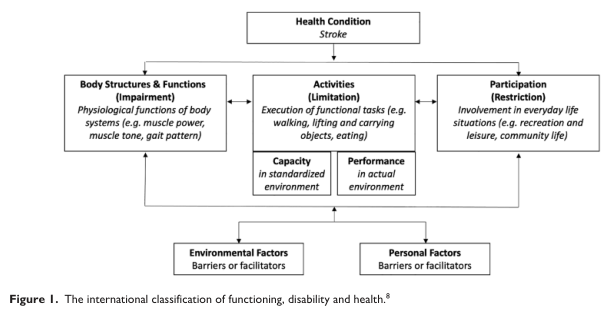
Summary : This figure presents the International Classification of Functioning, Disability and Health (ICF) model, specifically applied to stroke, illustrating the interrelationships between health condition, body functions, activities, participation, and contextual factors.

flowchart:  

# Nodes :  
  • Health Condition (rectangle): "Stroke"  
  • Body Structures & Functions (Impairment) (rectangle): "Physiological functions of body systems (e.g. muscle power, muscle tone, gait pattern)"  
  • Activities (Limitation) (rectangle): "Execution of functional tasks (e.g. walking, lifting and carrying objects, eating)"  
      – Capacity (sub-rectangle): "in standardized environment"  
      – Performance (sub-rectangle): "in actual environment"  
  • Participation (Restriction) (rectangle): "Involvement in everyday life situations (e.g. recreation and leisure, community life)"  
  • Environmental Factors (rectangle): "Barriers or facilitators"  
  • Personal Factors (rectangle): "Barriers or facilitators"  

# Connectors :  
  • Arrow from Health Condition to Body Structures & Functions, Activities, and Participation.  
  • Bidirectional arrows between Body Structures & Functions and Activities.  
  • Bidirectional arrows between Activities and Participation.  
  • Arrows from Environmental Factors and Personal Factors to Body Structures & Functions, Activities, and Participation.  

# Layout :  
  • Central top node (Health Condition) branches to three horizontally aligned nodes (Body Structures & Functions, Activities, Participation).  
  • Activities node is subdivided into Capacity and Performance.  
  • Environmental and Personal Factors are aligned below, with arrows pointing upward to the three main domains.  

# Analysis :  
  • The diagram visually organizes the ICF framework, emphasizing that stroke (as a health condition) impacts body functions, activities, and participation, all of which are influenced by environmental and personal factors.  
  • The bidirectional arrows highlight the dynamic and reciprocal relationships among impairments, activity limitations, and participation restrictions.  
  • The model underscores the importance of context (environmental and personal factors) in shaping outcomes for individuals with stroke.
Summary : This figure presents the International Classification of Functioning, Disability and Health (ICF) model, specifically applied to stroke, illustrating the interrelationships between health condition, body functions, activities, participation, and contextual factors. flowchart: # Nodes : • Health Condition (rectangle): "Stroke" • Body Structures & Functions (Impairment) (rectangle): "Physiological functions of body systems (e.g. muscle power, muscle tone, gait pattern)" • Activities (Limitation) (rectangle): "Execution of functional tasks (e.g. walking, lifting and carrying objects, eating)" – Capacity (sub-rectangle): "in standardized environment" – Performance (sub-rectangle): "in actual environment" • Participation (Restriction) (rectangle): "Involvement in everyday life situations (e.g. recreation and leisure, community life)" • Environmental Factors (rectangle): "Barriers or facilitators" • Personal Factors (rectangle): "Barriers or facilitators" # Connectors : • Arrow from Health Condition to Body Structures & Functions, Activities, and Participation. • Bidirectional arrows between Body Structures & Functions and Activities. • Bidirectional arrows between Activities and Participation. • Arrows from Environmental Factors and Personal Factors to Body Structures & Functions, Activities, and Participation. # Layout : • Central top node (Health Condition) branches to three horizontally aligned nodes (Body Structures & Functions, Activities, Participation). • Activities node is subdivided into Capacity and Performance. • Environmental and Personal Factors are aligned below, with arrows pointing upward to the three main domains. # Analysis : • The diagram visually organizes the ICF framework, emphasizing that stroke (as a health condition) impacts body functions, activities, and participation, all of which are influenced by environmental and personal factors. • The bidirectional arrows highlight the dynamic and reciprocal relationships among impairments, activity limitations, and participation restrictions. • The model underscores the importance of context (environmental and personal factors) in shaping outcomes for individuals with stroke.

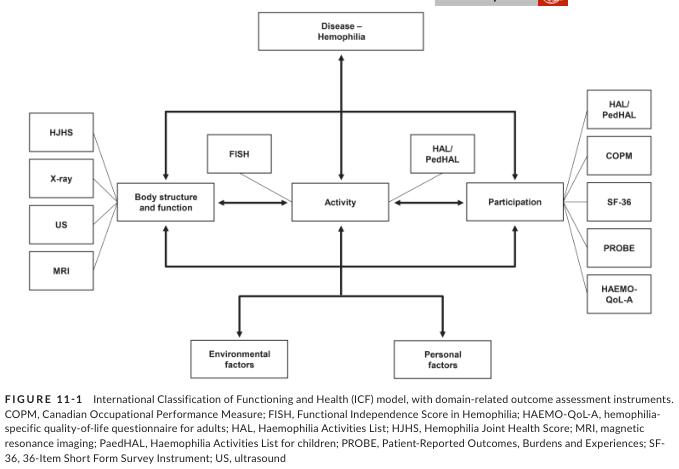
Summary : This flowchart illustrates the International Classification of Functioning and Health (ICF) model as applied to hemophilia, showing the relationships between disease, body structure and function, activity, participation, and influencing factors, along with associated outcome assessment instruments.

flowchart:
# Nodes :
  • Disease – Hemophilia (rectangle)
  • Body structure and function (rectangle)
  • Activity (rectangle)
  • Participation (rectangle)
  • Environmental factors (rectangle)
  • Personal factors (rectangle)
  • HJHS (rectangle, linked to Body structure and function)
  • X-ray (rectangle, linked to Body structure and function)
  • US (rectangle, linked to Body structure and function)
  • MRI (rectangle, linked to Body structure and function)
  • FISH (rectangle, linked to Activity)
  • HAL/PedHAL (rectangle, linked to both Activity and Participation)
  • HAL/PedHAL (rectangle, linked to Participation)
  • COPM (rectangle, linked to Participation)
  • SF-36 (rectangle, linked to Participation)
  • PROBE (rectangle, linked to Participation)
  • HAEMO-QoL-A (rectangle, linked to Participation)

# Connectors :
  • Disease – Hemophilia → Body structure and function
  • Disease – Hemophilia → Activity
  • Disease – Hemophilia → Participation
  • Body structure and function ↔ Activity (bidirectional arrow)
  • Activity ↔ Participation (bidirectional arrow)
  • Body structure and function → Environmental factors
  • Body structure and function → Personal factors
  • HJHS, X-ray, US, MRI → Body structure and function
  • FISH → Activity
  • HAL/PedHAL → Activity and Participation
  • HAL/PedHAL, COPM, SF-36, PROBE, HAEMO-QoL-A → Participation

# Layout :
  • Central vertical flow from Disease – Hemophilia down to Body structure and function, Activity, and Participation.
  • Body structure and function, Activity, and Participation are horizontally aligned and interconnected.
  • Environmental factors and Personal factors branch downward from Body structure and function.
  • Assessment instruments are shown as side branches to their respective domains.

# Analysis :
  • The flowchart demonstrates a multidimensional approach to assessing hemophilia, integrating clinical, functional, and patient-reported outcomes.
  • Disease impacts body structure/function, activity, and participation, with feedback loops between these domains.
  • Multiple assessment tools are mapped to specific domains, highlighting the comprehensive evaluation strategy.
  • Environmental and personal factors are considered as influences on body structure and function.

Summary : This flowchart illustrates the International Classification of Functioning and Health (ICF) model as applied to hemophilia, showing the relationships between disease, body structure and function, activity, participation, and influencing factors, along with associated outcome assessment instruments. flowchart: # Nodes : • Disease – Hemophilia (rectangle) • Body structure and function (rectangle) • Activity (rectangle) • Participation (rectangle) • Environmental factors (rectangle) • Personal factors (rectangle) • HJHS (rectangle, linked to Body structure and function) • X-ray (rectangle, linked to Body structure and function) • US (rectangle, linked to Body structure and function) • MRI (rectangle, linked to Body structure and function) • FISH (rectangle, linked to Activity) • HAL/PedHAL (rectangle, linked to both Activity and Participation) • HAL/PedHAL (rectangle, linked to Participation) • COPM (rectangle, linked to Participation) • SF-36 (rectangle, linked to Participation) • PROBE (rectangle, linked to Participation) • HAEMO-QoL-A (rectangle, linked to Participation) # Connectors : • Disease – Hemophilia → Body structure and function • Disease – Hemophilia → Activity • Disease – Hemophilia → Participation • Body structure and function ↔ Activity (bidirectional arrow) • Activity ↔ Participation (bidirectional arrow) • Body structure and function → Environmental factors • Body structure and function → Personal factors • HJHS, X-ray, US, MRI → Body structure and function • FISH → Activity • HAL/PedHAL → Activity and Participation • HAL/PedHAL, COPM, SF-36, PROBE, HAEMO-QoL-A → Participation # Layout : • Central vertical flow from Disease – Hemophilia down to Body structure and function, Activity, and Participation. • Body structure and function, Activity, and Participation are horizontally aligned and interconnected. • Environmental factors and Personal factors branch downward from Body structure and function. • Assessment instruments are shown as side branches to their respective domains. # Analysis : • The flowchart demonstrates a multidimensional approach to assessing hemophilia, integrating clinical, functional, and patient-reported outcomes. • Disease impacts body structure/function, activity, and participation, with feedback loops between these domains. • Multiple assessment tools are mapped to specific domains, highlighting the comprehensive evaluation strategy. • Environmental and personal factors are considered as influences on body structure and function.
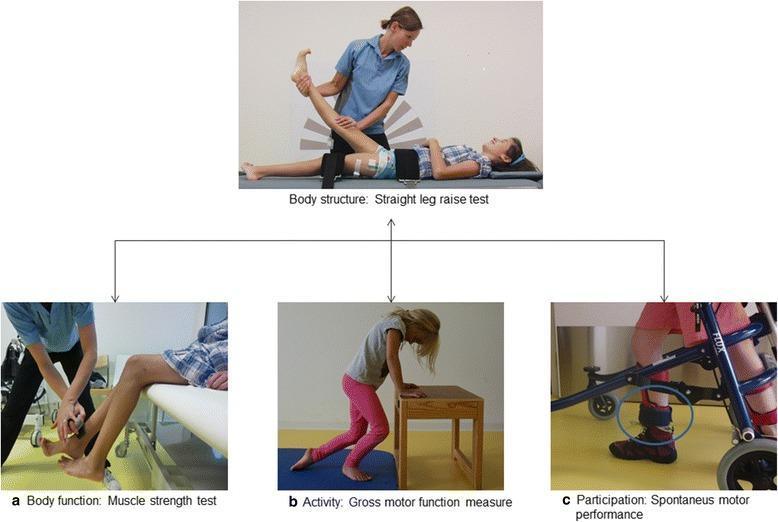
A composite medical illustration and clinical photograph series demonstrating pediatric physical therapy assessments framed within the International Classification of Functioning, Disability and Health (ICF) domains. 

Top panel: A clinical photograph shows the 'Body Structure' level via a Straight Leg Raise (SLR) test. A child lies supine with a stabilization strap across the pelvis while a therapist elevates one leg to assess hamstring flexibility or neural tension. 

Bottom panel (Left - 'a'): 'Body Function' measurement using a hand-held dynamometer (microFET2) to evaluate knee extensor strength. The child is seated on a bench with legs dangling while a clinician applies resistance at the ankle.

Bottom panel (Middle - 'b'): 'Activity' domain illustrated by a child performing a component of the Gross Motor Function Measure-66 (GMFM-66), involving transitional movements using a small bench for support.

Bottom panel (Right - 'c'): 'Participation' level showing spontaneous motor performance. A child uses a gait trainer (walker) with a 3D accelerometer (Actiwatch) attached to the right ankle to track daily activity levels. 

This image illustrates the comprehensive evaluation of motor disability in pediatric populations, likely related to cerebral palsy.

A composite medical illustration and clinical photograph series demonstrating pediatric physical therapy assessments framed within the International Classification of Functioning, Disability and Health (ICF) domains. Top panel: A clinical photograph shows the 'Body Structure' level via a Straight Leg Raise (SLR) test. A child lies supine with a stabilization strap across the pelvis while a therapist elevates one leg to assess hamstring flexibility or neural tension. Bottom panel (Left - 'a'): 'Body Function' measurement using a hand-held dynamometer (microFET2) to evaluate knee extensor strength. The child is seated on a bench with legs dangling while a clinician applies resistance at the ankle. Bottom panel (Middle - 'b'): 'Activity' domain illustrated by a child performing a component of the Gross Motor Function Measure-66 (GMFM-66), involving transitional movements using a small bench for support. Bottom panel (Right - 'c'): 'Participation' level showing spontaneous motor performance. A child uses a gait trainer (walker) with a 3D accelerometer (Actiwatch) attached to the right ankle to track daily activity levels. This image illustrates the comprehensive evaluation of motor disability in pediatric populations, likely related to cerebral palsy.

Here is a thorough overview of the ICF model:

The ICF Model - International Classification of Functioning, Disability and Health

What Is It?

The ICF is a framework developed and published by the World Health Organization (WHO) in 2001. Its full name is the International Classification of Functioning, Disability and Health. It provides a universal, standardized language and conceptual basis for defining, measuring, and classifying human health and disability.
The key philosophical shift the ICF introduced is moving away from a purely biomedical model (which only asks "what disease does this person have?") toward a biopsychosocial model (which asks "how does this person function in their life, and what factors enable or restrict that?").
The WHO's official ICF page describes it as the standard framework for measuring health and disability at both individual and population levels.

The Two-Part Structure of ICF

Part 1: Functioning and Disability

1. Body Functions and Structures
  • Body Functions: physiological functions of body systems (e.g., muscle power, cognition, vision, cardiac function)
  • Body Structures: anatomical parts of the body (e.g., joints, limbs, organs)
  • Problems here are called Impairments
2. Activities and Participation
  • Activities: execution of tasks or actions by an individual (e.g., walking, eating, reading)
  • Participation: involvement in life situations (e.g., working, going to school, social interaction)
  • Problems here are called Activity Limitations and Participation Restrictions
  • Each domain can be assessed in two ways:
    • Capacity - what the person can do in a standardized/controlled environment
    • Performance - what the person actually does in their real-world environment

Part 2: Contextual Factors

3. Environmental Factors
  • External factors that can act as barriers or facilitators
  • Examples: physical accessibility, social attitudes, legislation, assistive technology, support from family
4. Personal Factors
  • Internal factors such as age, gender, coping style, education, lifestyle, social background
  • These are not yet classified by ICF codes but are recognized as important

The ICF Model Diagram (applied to Stroke)

ICF model applied to Stroke - showing Health Condition, Body Structures & Functions, Activities, Participation, Environmental and Personal Factors
The arrows in the model are bidirectional - meaning all components influence one another. A person's level of participation can influence their body function (e.g., staying active preserves muscle strength), and environmental barriers can restrict participation even if body function is intact.

Core Concepts

ConceptMeaning
FunctioningUmbrella term for body functions, activities, and participation (positive aspects)
DisabilityUmbrella term for impairments, activity limitations, and participation restrictions (negative aspects)
Health ConditionThe underlying disease, disorder, or injury (e.g., stroke, diabetes, depression)
Contextual FactorsEnvironmental + personal factors that shape the experience of disability
A key insight: two people with the same diagnosis can have completely different ICF profiles. A person with a spinal cord injury may have full participation in society thanks to a supportive environment and assistive technology, while another with the same impairment in a different context may be severely restricted.

How Is the ICF Used?

1. Clinical Assessment and Goal Setting

Clinicians use ICF to move beyond diagnosis and understand the full impact of a condition on a patient's life. It helps set patient-centered rehabilitation goals that go beyond just restoring body functions - targeting meaningful activities and participation in daily life.

2. Standardized Documentation and Coding

The ICF provides alphanumeric codes for each component. Clinicians can document functional status consistently across facilities, countries, and disciplines. It is used alongside ICD-11 (which codes diseases/causes of death) and ICHI (International Classification of Health Interventions).

3. ICF Core Sets

Because the full ICF has over 1,400 categories, researchers and clinicians have developed ICF Core Sets - shortened, condition-specific lists of ICF categories most relevant to specific health conditions (e.g., stroke, low back pain, diabetes, breast cancer, COPD). These are the most practical tool for clinical use.

4. Outcome Measurement and Research

ICF provides a conceptual framework for choosing outcome measures in clinical trials and research. It helps researchers categorize what any given assessment tool is actually measuring (body function? activity? participation?).

5. Policy and Legislation

Governments use ICF to design disability legislation, social security systems, and workplace accommodation policies. It helps define who qualifies as disabled for legal/benefits purposes in a more nuanced, functioning-based way.

Where Is the ICF Used?

The CDC's ICF overview notes it is used across a wide range of sectors:
SectorExample Application
RehabilitationPhysical therapy, occupational therapy, speech-language pathology (e.g., ASHA uses ICF as its practice framework)
EducationSpecial education planning, assessing children with developmental disabilities
Mental HealthDocumenting functional impact of psychiatric disorders
NeurologyStroke, traumatic brain injury, multiple sclerosis, cerebral palsy
MusculoskeletalLow back pain, arthritis, orthopedic surgery outcomes
Primary CareChronic disease management (diabetes, COPD, heart failure)
Social PolicyDisability benefits, employment support, housing accessibility
InsuranceDetermining work capacity and disability claims
Public HealthPopulation-level surveys on disability prevalence
Digital HealthIntegration into electronic health records (EHRs)
According to a 20-year review published in PMC, the ICF has been most widely applied in:
  • Clinical practice (especially rehabilitation)
  • Policy development
  • Education
  • International research grants (EU projects like COURAGE in EUROPE, PARADISE, MARATONE)

ICF vs. the Old Medical Model

Old Medical/Biomedical ModelICF Biopsychosocial Model
FocusDisease and impairmentFunctioning and context
Disability defined asA property of the personOutcome of person-environment interaction
GoalCure or fix the impairmentEnable participation and quality of life
LanguagePatient "suffers from" or "is afflicted by"Person "has a health condition that affects functioning"

ICF in Pediatrics

The ICF has a child-specific adaptation called ICF-CY (Children and Youth version), used in pediatric physical therapy, early intervention, and school-based services. It accounts for the developmental nature of childhood and includes domains specific to learning, play, and family interaction.

Summary

The ICF is the global standard for thinking about, measuring, and communicating about disability and functioning. It reframes disability not as a personal tragedy or a fixed medical label, but as the result of an interaction between a person's health condition and their environment. This makes it a powerful tool across clinical care, research, education, law, and public health - anywhere that understanding how people live with health conditions matters more than just knowing what diagnosis they carry.

t`ell me about it's aim how` is it applied a`nd it's main component

Your credits are exhausted. You can purchase a top-up or subscribe to a plan to continue using Orris. If you're already subscribed, your daily credits will reset tomorrow.
This is a shared conversation. Sign in to Orris to start your own chat.