
Cephalohematoma
Reading File
A cephalohematoma is a subperiosteal hemorrhage in newborns, typically caused by birth trauma. Blood collects between the periosteum and the skull bone, is limited by suture lines, and usually resolves spontaneously over weeks to months.
Searching sources...
Finding Sources
Searching PubMed
cephalohematoma newborn birth trauma
Finding Sources
Reading File
Reading File
Reading File
Loading Image
Finding Sources
Here is a thorough overview of cephalohematoma based on authoritative textbook sources.
Cephalohematoma
Definition and Anatomy
A cephalohematoma is a subperiosteal collection of blood in the newborn, occurring between the periosteum and the outer surface of the skull bone. It is caused by rupture of the diploic and/or emissary veins, typically as a result of birth trauma.
Because the periosteum adheres tightly to the various suture lines, the hemorrhage is strictly confined and does not cross suture lines - this is the defining anatomical feature that distinguishes it from other birth-related scalp injuries.
- Rosen's Emergency Medicine, p. 3138
- Fitzpatrick's Dermatology, Vol. 1
Anatomical Diagram
The diagram below shows where cephalohematoma sits relative to other birth-related scalp injuries:
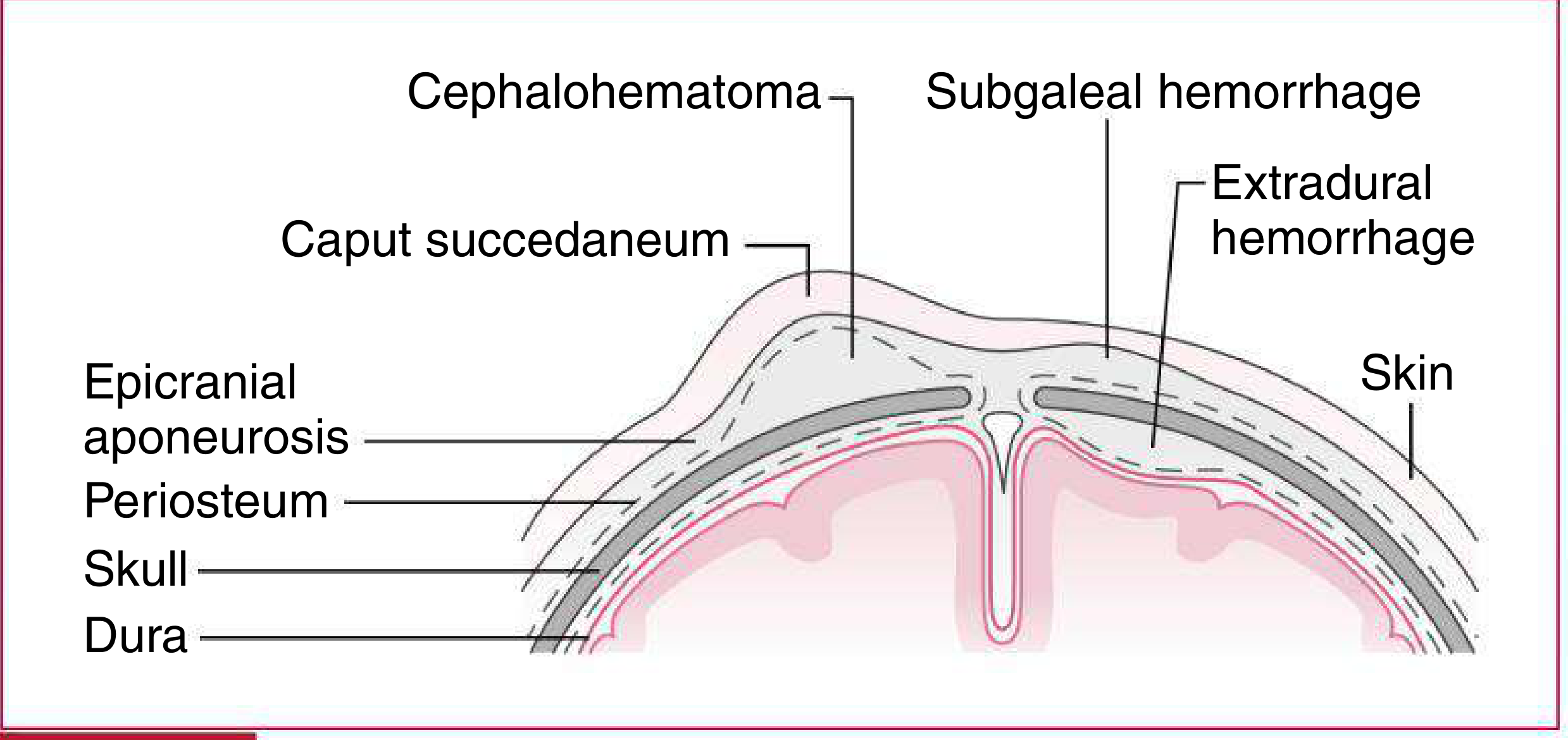
Harriet Lane Handbook, 23rd ed. - Types of extradural fluid collections in newborn infants
Comparison: Birth-Related Extradural Fluid Collections
The table below (from Harriet Lane Handbook) contrasts the three main entities:
| Feature | Caput Succedaneum | Cephalohematoma | Subgaleal Hemorrhage |
|---|---|---|---|
| Location | At point of contact; can extend across sutures | Usually over parietal bones; does not cross sutures | Beneath epicranial aponeurosis; may extend to orbits or nape of neck |
| Findings | Vaguely demarcated; pitting edema, shifts with gravity | Distinct margins; initially firm, more fluctuant after 48 hr | Firm to fluctuant, ill-defined borders; may have crepitus or fluid waves |
| Timing | Maximal at birth; resolves in 48-72 hr | Increases after birth for 12-24 hr; resolution over weeks | Progressive after birth; resolution over weeks |
| Severity | Minimal | Rarely severe | May be severe, especially with associated coagulopathy |
Harriet Lane Handbook, 23rd ed., Table 18.3
Etiology and Risk Factors
- Birth trauma - the most common cause
- Vacuum extraction - particularly associated with cephalohematoma formation
- Forceps delivery - a less common but recognized association
Clinical Features
- Appears as a firm, well-delimited swelling, usually over one parietal bone (unilateral)
- Does not cross suture lines (key distinguishing feature)
- Increases in size over the first 12-24 hours after birth as blood continues to accumulate, then gradually resolves
- Becomes more fluctuant after 48 hours
- Usually unilateral, though bilateral cases occur
Complications
- Neonatal jaundice (hyperbilirubinemia) - as the hematoma resorbs, breakdown of red blood cells releases bilirubin, which can contribute to or worsen neonatal jaundice
- Calcification - the hematoma may calcify rather than fully resorb, leaving a hard bony prominence; this usually remodels over months to years
- Underlying skull fracture - a linear skull fracture may be present beneath the hematoma; clinically significant in a minority of cases
- Infection/abscess - rare but recognized complication; aspiration should be avoided due to infection risk
Management
- Conservative (watchful waiting) is the standard approach for uncomplicated cases
- The lesion resolves spontaneously over several weeks to a few months
- Do not aspirate - aspiration risks introducing infection with no clinical benefit in most cases
- Monitor for jaundice and treat hyperbilirubinemia if significant (phototherapy as needed)
- If an underlying skull fracture is suspected clinically, imaging (skull X-ray or CT) may be warranted
- Reassure parents that calcification, if it occurs, typically remodels with skull growth
Key Differentiating Points (Quick Reference)
| Feature | Cephalohematoma | Caput Succedaneum |
|---|---|---|
| Layer | Subperiosteal | Subcutaneous |
| Suture lines | Does NOT cross | Crosses freely |
| Onset | Appears hours after birth | Present at birth |
| Consistency | Firm, then fluctuant | Soft, pitting edema |
| Resolution | Weeks | 48-72 hours |
Sources:
- Fitzpatrick's Dermatology, Vol. 1 - "Caput Succedaneum and Cephalohematoma"
- Harriet Lane Handbook, 23rd ed. - Table 18.3, Figure 18.3
- Rosen's Emergency Medicine - "Scalp Injuries," p. 3138
This is a shared conversation. Sign in to Orris to start your own chat.