
Structures present in angle of eye
Reading File
Finding Sources
Finding Sources
Finding Sources
Finding Sources
Finding Sources
Finding Sources
Finding Sources
Finding Sources
Reading File
Searching Images
medial canthus angle of eye anatomy structures
Loading Image
Searching the Web
structures present in medial canthus angle of eye anatomy caruncle plica semilunaris
The textbook diagram from Morgan and Mikhail's Clinical Anesthesiology clearly labels the five key structures at the medial canthus (angle of eye). Combined with standard anatomical knowledge and the textbook content, here is a comprehensive answer.
Structures Present in the Angle (Canthus) of the Eye
The eye has two angles (canthi): the medial canthus (inner angle) and the lateral canthus (outer angle). The medial canthus is far more anatomically rich.
Medial Canthus (Angulus Oculi Medialis)
The diagram below from Morgan & Mikhail's Clinical Anesthesiology shows the key numbered structures:
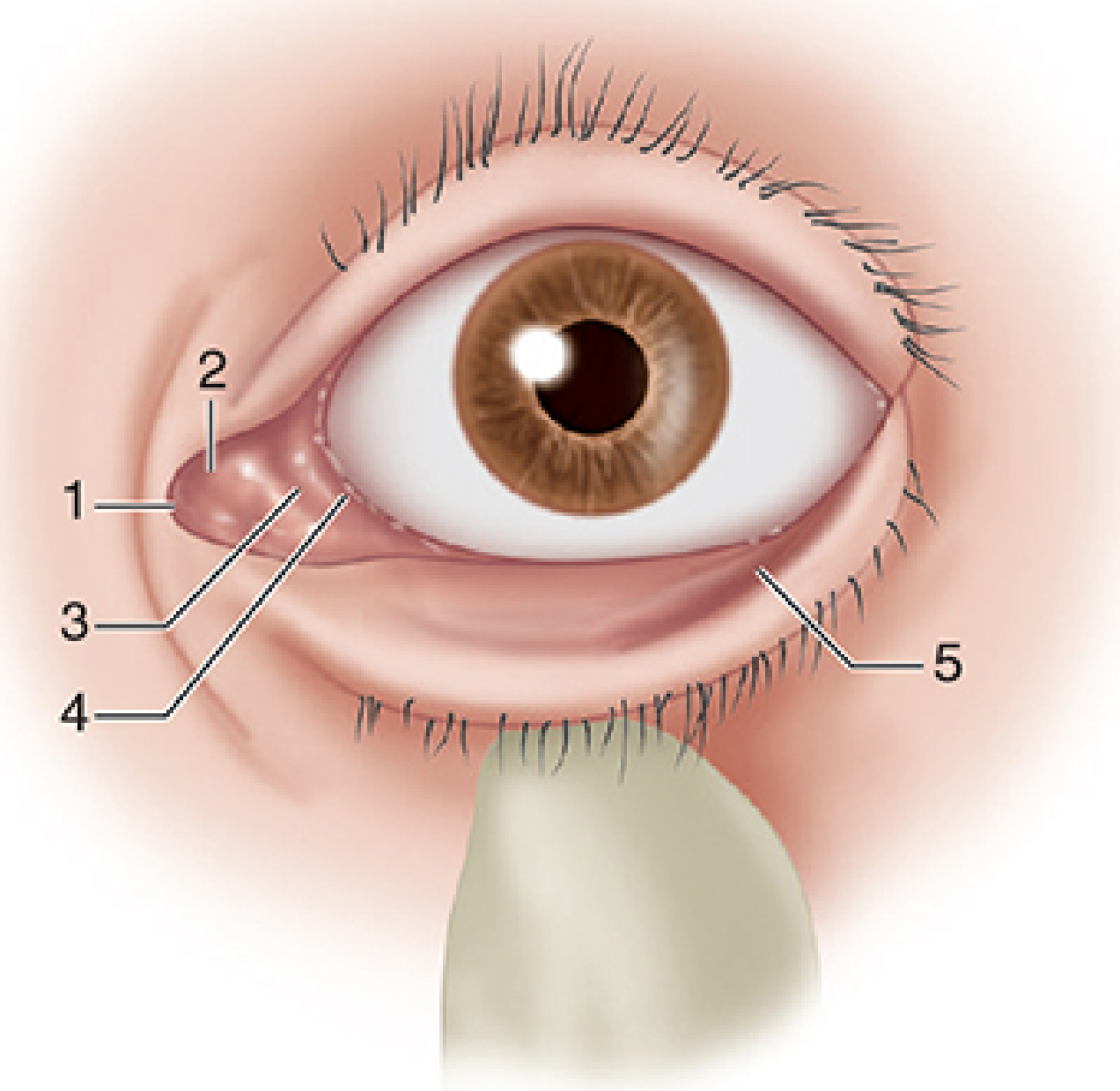
Numbered: (1) medial canthus region, (2) lacrimal caruncle, (3) plica semilunaris (semilunaris fold of conjunctiva), (4) lower lacrimal punctum, (5) lateral canthus
1. Lacrimal Caruncle (Caruncula Lacrimalis)
- A small, pinkish-red, fleshy mound of modified skin situated at the medial angle in the lacus lacrimalis (lacrimal lake).
- Contains sebaceous glands, sweat glands, and fine hairs.
- Represents a vestige of the nictitating membrane.
- Supplied by the infratroclear branch of the nasociliary nerve (CN V₁).
2. Plica Semilunaris (Plica Semilunaris Conjunctivae)
- A crescent-shaped fold of conjunctiva lateral to the caruncle.
- Homologue of the nictitating membrane (third eyelid) in lower vertebrates.
- Contains smooth muscle (Horner's muscle fibres may be associated with it).
- Helps maintain the conjunctival sac and tear flow toward the lacrimal lake.
3. Lacrimal Lake (Lacus Lacrimalis)
- A small triangular space at the medial canthus where tears collect before draining.
- Bounded by the caruncle medially and the plica semilunaris laterally.
4. Lacrimal Puncta (Superior & Inferior)
- Two tiny openings (puncta lacrimalia) on the lacrimal papillae, one on each lid margin, near the medial canthus (~6 mm from the angle).
- Entry point for tears into the lacrimal drainage system (canaliculi → lacrimal sac → nasolacrimal duct).
5. Lacrimal Papillae
- Small elevations on the lid margins at the medial end that bear the lacrimal puncta.
- The lid margin turns slightly inward here so the punctum dips into the lacrimal lake.
6. Medial Palpebral Ligament (Medial Canthal Tendon)
- A strong fibrous band connecting both upper and lower tarsal plates to the frontal process of the maxilla (anterior lacrimal crest) and the lacrimal bone (posterior lacrimal crest).
- Forms the anterior and posterior limbs that straddle the lacrimal sac.
7. Lacrimal Canaliculi (Superior & Inferior)
- Begin at the puncta and run first vertically (~2 mm) then horizontally (~8 mm) medially to drain into the lacrimal sac.
- The infratroclear nerve supplies sensation in this region.
8. Lacrimal Sac (deep to medial canthal tendon)
- Sits in the lacrimal fossa between the anterior and posterior limbs of the medial canthal tendon.
- Continues downward as the nasolacrimal duct.
Lateral Canthus (Angulus Oculi Lateralis)
Comparatively simpler; contains:
| Structure | Detail |
|---|---|
| Lateral palpebral commissure | Where upper and lower lids join at a sharp angle (~60°) |
| Lateral palpebral ligament (lateral canthal tendon) | Attaches tarsus to orbital (Whitnall's) tubercle on the zygomatic bone, ~4 mm behind orbital rim |
| Lateral raphe | Interlacing fibres of orbicularis oculi at the outer angle |
| Lacrimal gland (palpebral lobe) | The palpebral lobe of the lacrimal gland is visible through the conjunctiva just above the lateral canthus |
Summary Table
| Structure | Canthus | Key Feature |
|---|---|---|
| Lacrimal caruncle | Medial | Modified skin with glands; vestige of nictitating membrane |
| Plica semilunaris | Medial | Conjunctival fold; nictitating membrane homologue |
| Lacrimal lake | Medial | Tear collection space |
| Lacrimal puncta (×2) | Medial | Tear drainage entry points |
| Lacrimal canaliculi (×2) | Medial | Drainage channels to lacrimal sac |
| Lacrimal sac | Medial (deep) | Reservoir before nasolacrimal duct |
| Medial canthal tendon | Medial | Anchors tarsal plates to bone; straddles lacrimal sac |
| Lateral canthal tendon | Lateral | Anchors to Whitnall's tubercle |
| Lateral raphe | Lateral | Orbicularis oculi interlacing |
Clinical pearls:
- The infratroclear nerve (from nasociliary, CN V₁) supplies the caruncle, lacrimal sac, and skin of the medial canthus — relevant for nerve blocks.
- Tumours most commonly affect the lower lid, then the medial canthus, upper lid, and lateral canthus (Kanski's Clinical Ophthalmology).
- Lacerations within 6–8 mm of the medial canthus risk lacrimal canalicular damage and require ophthalmology referral (Tintinalli's Emergency Medicine).
— Morgan & Mikhail's Clinical Anesthesiology, 7e; Kanski's Clinical Ophthalmology; Localization in Clinical Neurology, 8e
Structures present in angle of eye Searched 5 sources ! Something went wrong. Please try again or reach out to us for help. We encountered an error while processing your request. Please try again or reach out to us for help. 🔗 Contact Support ✉️ hi@orris.care Ask Orris
Reading File
Finding Sources
Finding Sources
Reading File
Finding Sources
Reading File
Finding Sources
Reading File
Loading Image
Loading Image
Loading Image
Here is a comprehensive answer on the structures present at the angle (canthus) of the eye, supported by textbook diagrams.
Structures Present in the Angle of the Eye
The eye has two angles: the medial canthus (inner/nasal angle) and the lateral canthus (outer/temporal angle). The medial canthus is anatomically richer.
Medial Canthus (Angulus Oculi Medialis)
The diagram below from Morgan & Mikhail's Clinical Anesthesiology, 7e labels the key surface structures:
(1) Medial canthus region, (2) Lacrimal caruncle, (3) Plica semilunaris / semilunaris fold of conjunctiva, (4) Inferior lacrimal punctum, (5) Lateral canthus region
Surface / Visible Structures
| Structure | Description |
|---|---|
| Lacrimal caruncle | Small pinkish-red fleshy mound in the lacus lacrimalis (lacrimal lake). Modified skin containing sebaceous glands, sweat glands, and fine hairs. Vestige of the nictitating membrane. Supplied by the infratroclear nerve (CN V₁) |
| Plica semilunaris | Crescent-shaped fold of bulbar conjunctiva lateral to the caruncle. Homologue of the nictitating membrane (third eyelid). Contains smooth muscle fibres |
| Lacrimal lake (Lacus lacrimalis) | Triangular space between the caruncle and globe where tears pool before draining |
| Lacrimal papillae | Small elevations on the lid margins at the medial end, each bearing a punctum |
| Superior & inferior lacrimal puncta | Two tiny openings ~6 mm from the medial angle on each lid margin; entry point for tear drainage |
Deep Structures
| Structure | Description |
|---|---|
| Medial palpebral ligament (medial canthal tendon) | Strong fibrous band attaching both tarsal plates to the anterior lacrimal crest (maxilla). Has anterior and posterior limbs that straddle the lacrimal sac |
| Superior & inferior lacrimal canaliculi | Begin at each punctum → run vertically ~2 mm → then horizontally ~8 mm → drain into the lacrimal sac |
| Lacrimal sac | Sits in the lacrimal fossa, between the anterior and posterior limbs of the medial canthal tendon; continues as the nasolacrimal duct |
| Lacrimal part of orbicularis oculi | Deep fibres passing from medial border to the posterior lacrimal crest; may aid tear drainage by compressing the lacrimal sac |
Lateral Canthus (Angulus Oculi Lateralis)
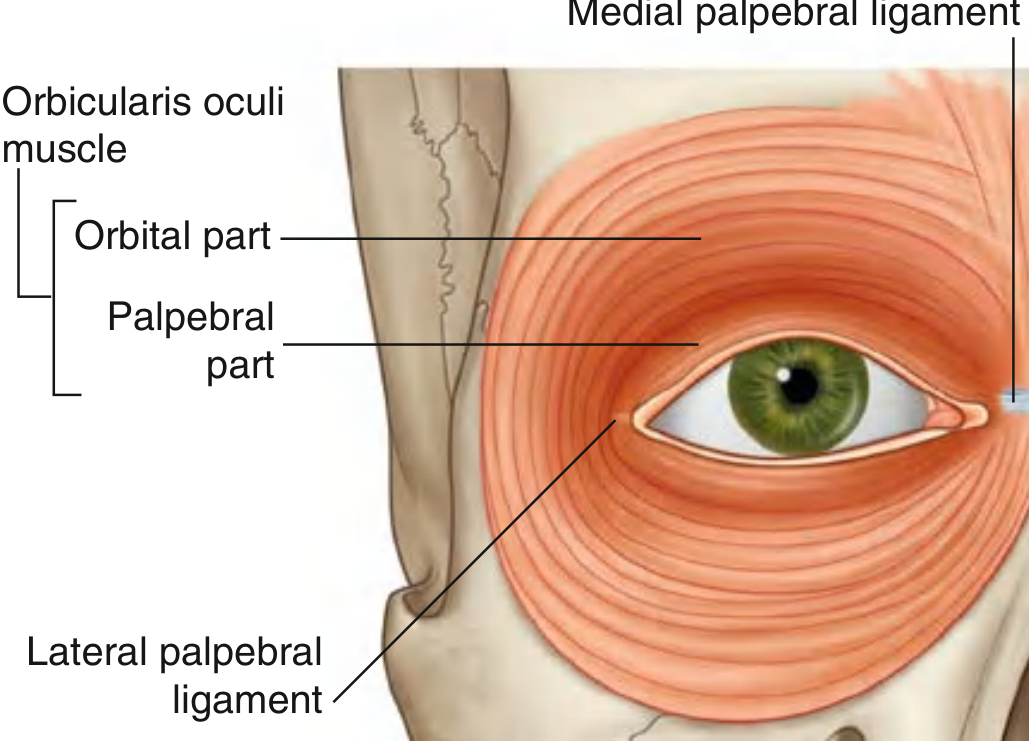
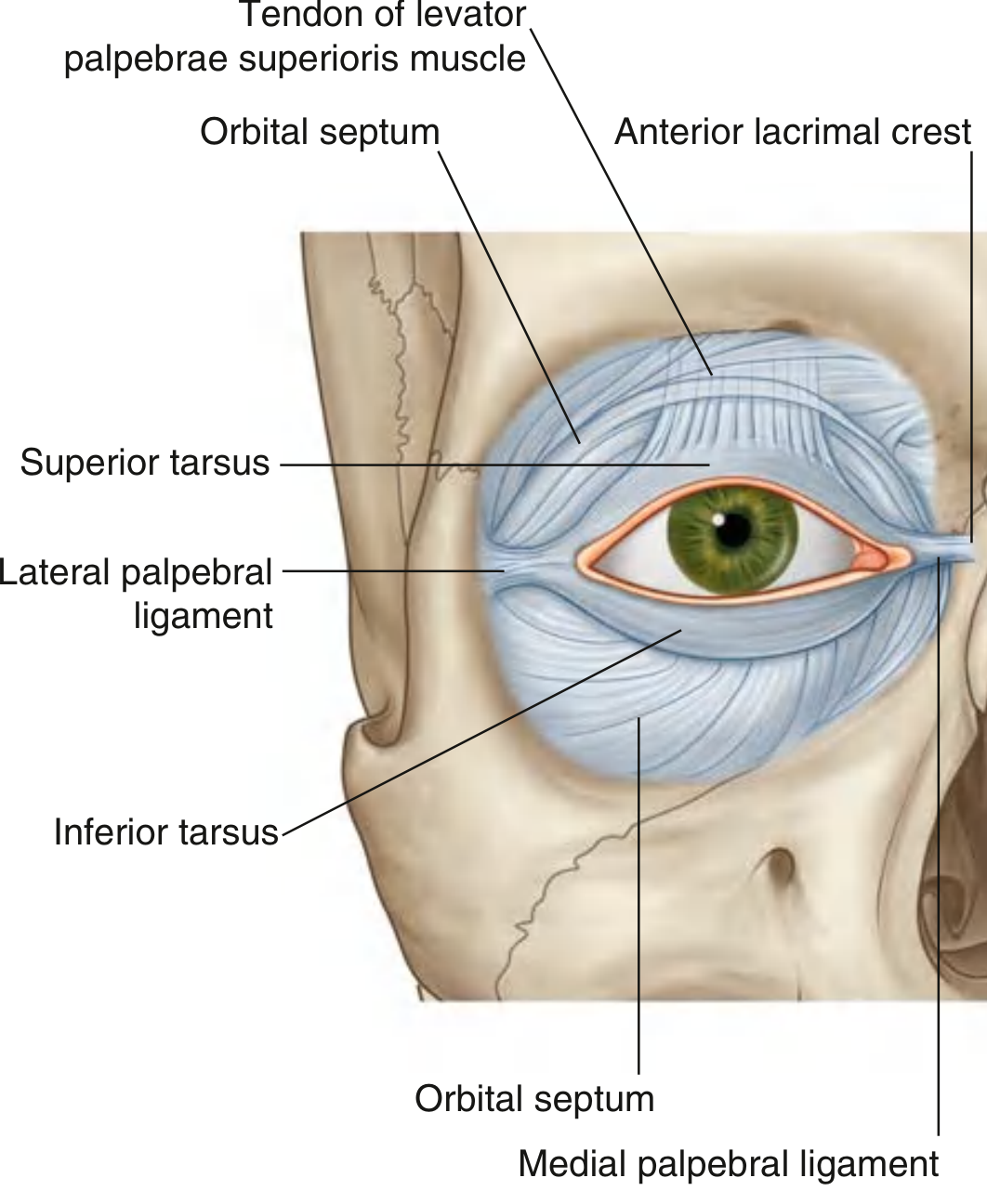
| Structure | Description |
|---|---|
| Lateral palpebral commissure | Where upper and lower lids meet at an acute angle (~60°), positioned 2 mm higher than the rounded medial canthal angle |
| Lateral palpebral ligament (lateral canthal tendon) | Attaches tarsal plates to Whitnall's tubercle on the zygomatic bone (~4 mm behind the orbital rim) |
| Lateral raphe | Interlacing fibres of orbicularis oculi at the outer angle |
| Palpebral lobe of lacrimal gland | Visible through the superolateral conjunctiva just above and behind the lateral canthus |
Summary
| Structure | Canthus | Key Note |
|---|---|---|
| Lacrimal caruncle | Medial | Skin vestige; infratroclear nerve supply |
| Plica semilunaris | Medial | Nictitating membrane homologue |
| Lacrimal lake | Medial | Tear collection space |
| Lacrimal puncta (×2) | Medial | Tear drainage entry points |
| Lacrimal canaliculi (×2) | Medial | Lead to lacrimal sac |
| Lacrimal sac | Medial (deep) | Between anterior & posterior limbs of canthal tendon |
| Medial canthal tendon | Medial | Anterior + posterior limbs straddle the lacrimal sac |
| Lacrimal part of orbicularis | Medial (deep) | Attaches to posterior lacrimal crest; aids tear drainage |
| Lateral canthal tendon | Lateral | Attaches to Whitnall's tubercle |
| Lateral raphe | Lateral | Orbicularis interlacing fibres |
| Palpebral lobe of lacrimal gland | Lateral | Visible superolaterally |
Clinical points:
- The infratroclear nerve (from nasociliary, CN V₁) supplies the caruncle, lacrimal sac, and medial canthal skin — relevant for regional blocks (Localization in Clinical Neurology, 8e)
- Eyelid lacerations within 6–8 mm of the medial canthus risk lacrimal canalicular damage and require ophthalmology referral
- A swelling above the medial canthal tendon suggests lacrimal sac tumour; below it suggests dacryocystitis (Wills Eye Manual)
- The lateral canthal tendon is cut in lateral canthotomy to decompress orbital compartment syndrome
Sources: Gray's Anatomy for Students; Morgan & Mikhail's Clinical Anesthesiology, 7e; Cummings Otolaryngology; Wills Eye Manual; Localization in Clinical Neurology, 8e
This is a shared conversation. Sign in to Orris to start your own chat.