I now have a clear view of both charts. Let me provide a comprehensive explanation.
Trivandrum Developmental Screening Chart (TDSC) - Complete Guide
What is the TDSC?
The Trivandrum Developmental Screening Chart (TDSC) is a simple, validated developmental screening tool developed in India (Trivandrum, Kerala) specifically for use in low-resource and community settings. It was developed by Nair et al. and is based on the Bayley Scales of Infant Development, adapted for the Indian population.
- It screens children from 0 to 6 years of age
- It uses 51 developmental milestones arranged in 2 charts:
- Chart 1: 0-3 years (items 1-51 roughly)
- Chart 2: 3-6 years
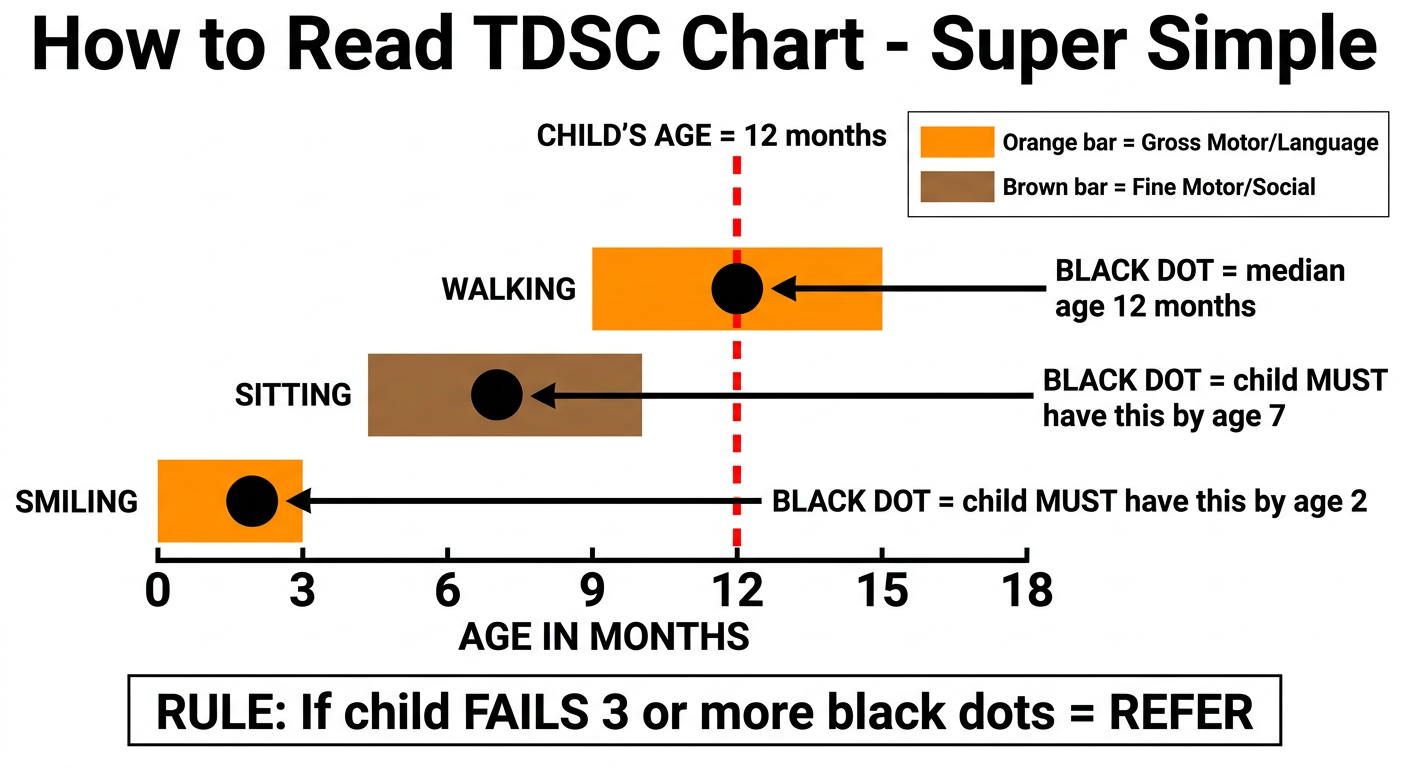
- Each milestone is shown as a horizontal bar spanning the age range during which that milestone is normally acquired
- The x-axis = Age in months
- Each bar has a black dot/mark indicating the median age at which the milestone is achieved
How to Read the Chart
Color Coding
- Orange/Light bars = Gross motor or language milestones
- Dark red/Brown bars = Fine motor or personal-social milestones
- The bars span from the earliest age to the latest age at which a milestone should normally appear
The Black Dot
- The black dot on each bar = the 50th percentile (median) age for that milestone
- If a child has NOT achieved a milestone and the black dot for that milestone is already past the child's current age, the child is delayed for that item
How Screening Works (The Vertical Line Method)
- Draw a vertical line at the child's current age (in months) on the x-axis
- All milestones whose black dot falls to the LEFT of the vertical line should already be achieved
- If the child fails 3 or more milestones whose median age is past the child's current age, the child is considered developmentally delayed - refer for full assessment
- If the child fails even 1 milestone, it warrants close follow-up
TDSC 0-3 Years: Key Milestones (Bottom to Top = Youngest to Oldest)
The milestones in Chart 1 (0-3 years) include the following domains - Gross Motor (GM), Fine Motor (FM), Language (L), Personal-Social (PS):
Gross Motor Milestones
| Milestone | Approx. Age |
|---|
| Lifts head (prone) | 1-2 months |
| Holds head steady | 3-4 months |
| Rolls over | 4-5 months |
| Sits with support | 4-6 months |
| Sits without support | 6-8 months |
| Stands with support | 7-9 months |
| Pulls to stand | 9-11 months |
| Walks with support | 10-12 months |
| Walks independently | 12-15 months |
| Runs | 15-18 months |
| Climbs stairs (with help) | 18-24 months |
| Jumps | 24-30 months |
Fine Motor Milestones
| Milestone | Approx. Age |
|---|
| Follows light (horizontally) | 1-2 months |
| Hands open most of the time | 2-3 months |
| Reaches for objects | 4-5 months |
| Transfers objects hand to hand | 5-7 months |
| Pincer grasp | 9-11 months |
| Scribbles | 12-15 months |
| Builds tower of 2 cubes | 14-16 months |
| Builds tower of 6+ cubes | 20-24 months |
| Copies a circle | 30-36 months |
Language Milestones
| Milestone | Approx. Age |
|---|
| Alerts to sound | 0-1 month |
| Social smile | 1.5-2.5 months |
| Vocalizes (cooing) | 2-3 months |
| Laughs aloud | 3-4 months |
| Turns to voice | 5-7 months |
| Says "mama/dada" (non-specific) | 8-10 months |
| First meaningful word | 10-14 months |
| 2-3 words with meaning | 12-18 months |
| 2-word phrases | 18-24 months |
| 3-word sentences | 24-30 months |
| Speaks in sentences | 30-36 months |
Personal-Social Milestones
| Milestone | Approx. Age |
|---|
| Regards face | 0-1 month |
| Recognizes mother | 2-3 months |
| Responds to name | 6-8 months |
| Waves bye-bye | 9-12 months |
| Feeds self with spoon | 15-18 months |
| Removes garments | 18-24 months |
| Dresses/undresses partly | 24-36 months |
TDSC 3-6 Years: Key Milestones
Gross Motor
| Milestone | Approx. Age |
|---|
| Rides tricycle | 36-42 months |
| Hops on one foot | 42-48 months |
| Skips | 48-60 months |
| Walks heel-to-toe | 48-54 months |
Fine Motor / Cognitive
| Milestone | Approx. Age |
|---|
| Copies a cross (+) | 36-42 months |
| Draws a person (2-4 parts) | 42-48 months |
| Copies a square | 48-54 months |
| Copies a triangle | 54-60 months |
| △ △ O (shape test) | ~36 months |
| Names colors | 36-42 months |
| Counts 10 objects | 48-60 months |
| Knows name of coins | 54-60 months |
| Writes name | 60-72 months |
Language
| Milestone | Approx. Age |
|---|
| Tells first and last name | 36-42 months |
| Names colors | 36-42 months |
| Follows 3-step commands | 36-42 months |
| Defines words by use | 48-54 months |
| Tells story | 54-60 months |
| Names opposite analogies | 60-72 months |
| Reads a sentence | 60-72 months |
Personal-Social
| Milestone | Approx. Age |
|---|
| Plays cooperatively | 42-48 months |
| Dresses without supervision | 48-60 months |
| Names friends | 48-54 months |
| Goes to school | 54-72 months |
TDSC Scoring
- Draw vertical line at child's current age in months
- Count milestones whose median (black dot) is to the left of that line
- Child must pass all those milestones
- Failure = unable to perform a milestone when median age has passed
- Developmental delay suspected: Failure of 3 or more items
- Refer for detailed evaluation (Gesell, Bayley, DASII)
Viva Questions on TDSC (With Detailed Answers)
Q1. What is the TDSC? Who developed it and where?
The Trivandrum Developmental Screening Chart was developed by Nair MK, George B, Philip E, Prasad N, Sunitha RM, and Bhaskaran D at the SAT Hospital, Government Medical College, Trivandrum (now Thiruvananthapuram), Kerala, India. It was published in 1991. It is based on the Bayley Scales of Infant Development and was validated for the Indian population.
Q2. What age range does TDSC cover? How many milestones?
- TDSC covers 0 to 6 years (0-72 months)
- It has 51 milestones divided across 2 charts:
- Chart 1: 0-3 years
- Chart 2: 3-6 years
Q3. What does each bar on the chart represent?
Each horizontal bar represents one developmental milestone. The left end of the bar = earliest age by which some children achieve the milestone. The right end = latest normal age. The black dot in the middle of the bar = the 50th percentile (median) age of acquisition.
Q4. How do you use the TDSC to screen a child?
- Note the child's exact age in months
- Draw a vertical line on the chart at that age
- Identify all milestones whose black dot lies to the LEFT of the line - these should already be achieved
- Test the child for those milestones
- If the child fails 3 or more milestones, developmental delay is suspected and referral is indicated
Q5. What is the significance of the black dot on the TDSC bar?
The black dot marks the median age (50th percentile) at which that milestone is normally achieved. If a child has NOT achieved the milestone by the age marked by the black dot, they are in the delayed half of the normal population. Failure at multiple such milestones warrants concern.
Q6. What are the domains of development assessed by TDSC?
The four domains are:
- Gross Motor - large muscle movements (rolling, sitting, walking, running)
- Fine Motor/Adaptive - hand-eye coordination, manipulation (grasping, building, drawing)
- Language - receptive and expressive communication
- Personal-Social - self-care, social interaction, play
Q7. What is the difference between developmental screening and developmental assessment?
- Screening (e.g., TDSC, Denver II) = quick, simple, identifies children at risk - does NOT diagnose
- Assessment (e.g., Bayley Scales, Gesell, DASII) = detailed, comprehensive evaluation done by trained professionals - provides diagnosis and developmental age
Q8. What are other developmental screening tools used in India/globally?
| Tool | Age Range | Details |
|---|
| TDSC | 0-6 years | India, simple, community-based |
| Denver Developmental Screening Test (DDST / Denver II) | 0-6 years | USA, 125 items, 4 domains |
| Development Assessment Scale for Indian Infants (DASII) | 0-30 months | Indian normative data |
| Gesell Developmental Schedule | 0-5 years | Detailed, older standard |
| Ages & Stages Questionnaire (ASQ) | 0-5 years | Parent-completed |
| Modified Checklist for Autism (M-CHAT) | 16-30 months | Autism screening |
Q9. What is DASII? How does it differ from TDSC?
DASII (Development Assessment Scale for Indian Infants) was developed by Phatak based on Bayley Scales but with Indian normative data. It is more detailed and gives a Mental Development Index (MDI) and Psychomotor Development Index (PDI). TDSC is simpler, quicker, and more suitable for use in primary care or community settings by trained workers. DASII is used for formal assessment.
Q10. What are the key gross motor milestones and their ages? (Very common viva topic)
| Milestone | Age |
|---|
| Head control (prone) | 1-2 months |
| Head control (sitting) | 4 months |
| Rolls over | 5 months |
| Sits without support | 6-7 months |
| Stands with support | 9 months |
| Walks independently | 12-15 months |
| Runs | 15-18 months |
| Climbs stairs (both feet each step) | 18-24 months |
| Rides tricycle | 3 years |
| Hops on one foot | 4 years |
| Skips | 5 years |
Q11. What are the key language milestones?
| Milestone | Age |
|---|
| Social smile | 6 weeks (1.5 months) |
| Cooing | 2-3 months |
| Monosyllables (ba, da, ma) | 6 months |
| "Mama/dada" non-specific | 9 months |
| "Mama/dada" specific + 1 other word | 12 months |
| 2-word combinations | 18 months |
| 3-word sentences | 24 months |
| Full sentences, asks questions | 3 years |
| Tells a story | 4-5 years |
Red flags:
- No babble by 12 months
- No single words by 16 months
- No 2-word phrases by 24 months
- Any loss of previously acquired language at any age
Q12. What are the red flags for developmental delay in a child under 1 year?
- 3 months: Not smiling, not fixing and following
- 4 months: Persistent head lag
- 6 months: Not reaching for objects, no vocalizing
- 9 months: Not sitting unsupported
- 12 months: Not standing, not saying any words
- At any age: Loss of previously acquired milestones (regression - most alarming sign)
Q13. What is "developmental regression" and why is it important?
Regression = loss of previously acquired milestones. This is an absolute red flag and is NEVER normal. It suggests:
- Neurodegenerative disease (e.g., metachromatic leukodystrophy, Rett syndrome)
- Metabolic disorders (e.g., neuronal ceroid lipofuscinosis)
- Psychosocial causes (e.g., after trauma, new sibling) - but these cause temporary regression in higher-order skills only
Q14. What causes global developmental delay (GDD)?
Prenatal causes:
- Chromosomal disorders (Down syndrome, trisomy 18)
- Congenital infections (TORCH)
- Intrauterine growth restriction
- Teratogens (alcohol - FASD)
Perinatal causes:
- Birth asphyxia / hypoxic-ischemic encephalopathy (HIE)
- Hyperbilirubinemia / kernicterus
- Prematurity
Postnatal causes:
- CNS infections (meningitis, encephalitis)
- Hypothyroidism (if untreated)
- Severe malnutrition
- Lead toxicity
- Deprivation/neglect
Q15. What is the advantage of TDSC over Denver II in India?
- TDSC was normed on Indian children, making it more culturally valid
- It is simpler and uses fewer items (51 vs 125 in Denver II)
- It is cheaper and can be used by trained community health workers (ASHA, ANM)
- The bar chart format is easier to use visually at the bedside
- Denver II was normed on American children and may not reflect the developmental timeline of Indian children accurately
Q16. What do the different colored bars in TDSC signify?
In the TDSC:
- Orange/Light colored bars typically represent language and gross motor milestones
- Dark red/Brown bars represent fine motor and personal-social milestones
This color differentiation helps quickly identify which domain a milestone belongs to and allows rapid visual assessment of any particular domain's progress.
Q17. By what age should a child walk independently? What if they don't?
Normal walking independently = 12-15 months (median ~12.5 months). Walking up to 18 months is considered within normal limits.
If a child is NOT walking by 18 months, evaluation is needed. Causes include:
- Cerebral palsy (most common cause of delayed walking)
- Neuromuscular disorders (Duchenne muscular dystrophy, spinal muscular atrophy)
- Intellectual disability
- Normal variant ("bottom shufflers" may walk later)
Q18. What is Denver II? How is it different from the original DDST?
The DDST (Denver Developmental Screening Test) was revised in 1990 to create Denver II. Changes include:
- Increased items from 105 to 125
- Added a language section (expressive and receptive)
- New normative data
- Replaced "abnormal/normal" with "normal/suspect/untestable"
- Uses same 4 domains: GM, FM-Adaptive, Language, Personal-Social
Q19. Name some milestones that are specifically tested in the 3-6 year TDSC chart.
From Chart 2:
- Rides tricycle (~36 months)
- Names colors (~36 months)
- Draws a person (~42-48 months)
- Hops on one foot (~42 months)
- Copies a square (~48 months)
- Skips (~48-54 months)
- Counts 10 objects (~48-60 months)
- Names opposite analogies (~60 months)
- Writes own name (~60-72 months)
- Reads a sentence (~66-72 months)
- △ △ O shape test - copy shapes (triangle, circle) tested around 36-48 months
Q20. What is the "Shape Copy Test" seen in TDSC Chart 2?
The chart shows "△ △ O Draw/Copy Test" - this refers to a child's ability to copy geometric shapes:
- Circle - achieved around 3 years
- Cross (+) - achieved around 3.5-4 years
- Square - achieved around 4-4.5 years
- Triangle - achieved around 5 years
The classic sequence to remember: Circle → Cross → Square → Triangle (age 3 → 3.5 → 4 → 5)
Quick Memory Aid for Viva
| Age | Key Milestone to Remember |
|---|
| 6 weeks | Social smile |
| 3 months | Head control in prone |
| 6 months | Sits with support, reaches objects |
| 9 months | Pincer grasp, stands with support |
| 12 months | Walks, 1 word |
| 18 months | Walks well, 6+ words, tower of 3-4 |
| 2 years | Runs, 2-word phrases, tower of 6 |
| 3 years | Rides tricycle, 3-word sentences, copies circle |
| 4 years | Hops, copies cross, counts 4 objects |
| 5 years | Skips, copies square, 10 words vocabulary |
| 6 years | Copies triangle, reads, writes name |
This is the complete guide to the TDSC chart. The most commonly asked viva questions center on: how to USE the chart (the black dot and vertical line method), the key milestones at specific ages, red flags for delay, and how TDSC compares to Denver II and DASII. The fact that TDSC is India-specific and community-validated is a high-yield differentiator examiners love to ask about.