
Explain innate and acquired immunity
Reading File
Finding Sources
Finding Sources
Reading File
Reading File
Reading File
Reading File
Reading File
Finding Sources
Loading Image
Reading File
Reading File
I now have comprehensive material from multiple authoritative textbooks. Here is a thorough explanation:
Innate and Acquired (Adaptive) Immunity
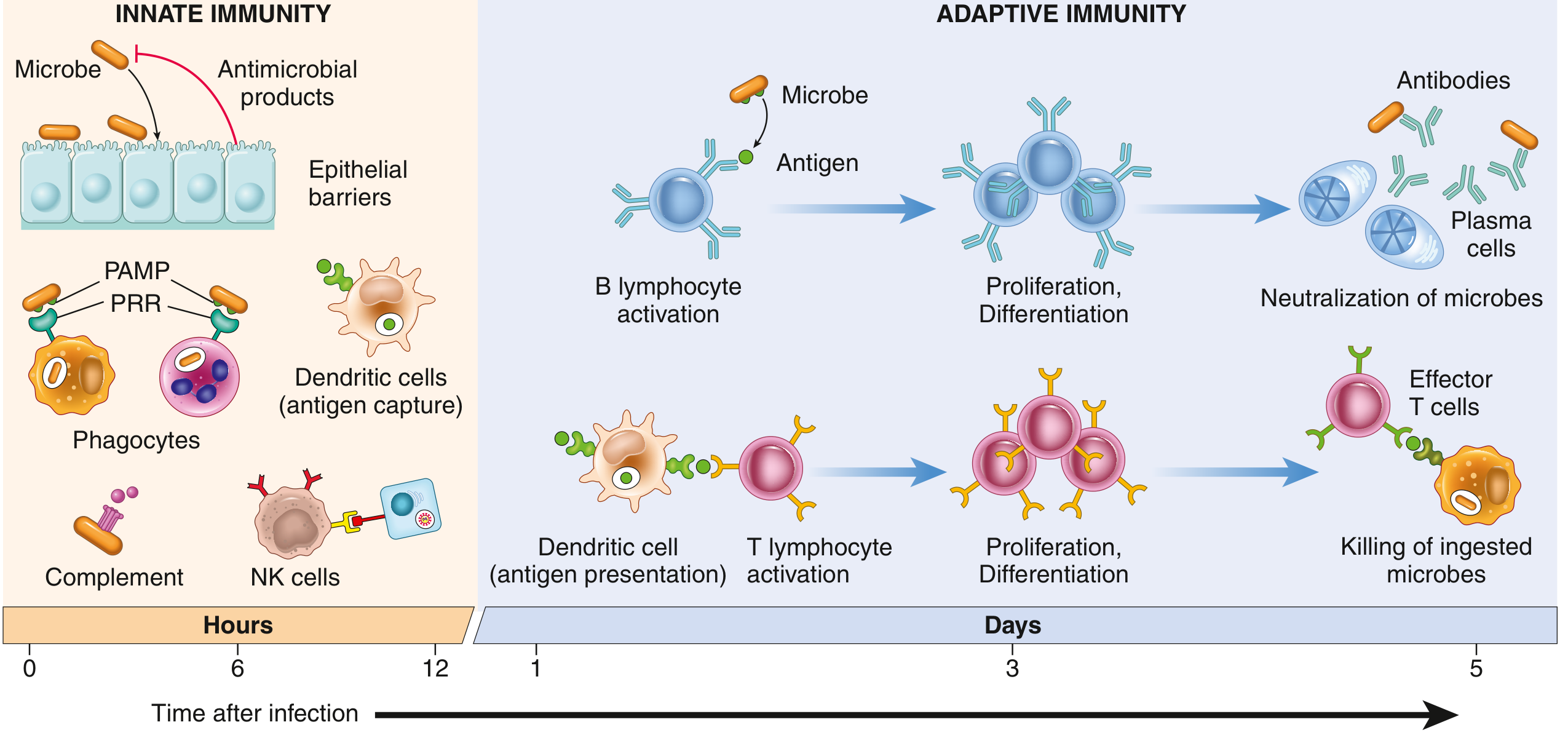
Overview
The immune system operates through two overlapping but distinct arms. Innate immunity is the immediate, non-specific first line of defense, present from birth and essentially unchanged by repeated exposures. Acquired (adaptive) immunity is a slower, highly specific response that improves with each encounter with a pathogen — the basis of immunological memory and vaccination.
I. Innate Immunity
Key Features
- Responds within minutes to hours
- Uses a limited repertoire of pattern recognition receptors (PRRs) — approximately 100 types recognizing a few thousand conserved molecular patterns
- Does not improve with repeat exposure — each encounter produces a virtually identical response
- Acts both independently and as a launcher for adaptive immunity
Components
| Component | Role |
|---|---|
| Epithelial barriers | Physical blockade; produce antimicrobial peptides (e.g., defensins) |
| Phagocytes (neutrophils, macrophages) | Engulf and destroy microbes |
| Dendritic cells (DCs) | Capture antigens; bridge innate and adaptive immunity |
| Natural killer (NK) cells | Kill virus-infected cells and tumor cells without prior sensitization |
| Complement system | Opsonizes microbes; triggers inflammation; lyses pathogens |
| Mast cells & innate lymphoid cells (ILCs) | Release inflammatory mediators |
Pattern Recognition: PAMPs and DAMPs
The innate system distinguishes self from non-self by recognizing:
- PAMPs (Pathogen-Associated Molecular Patterns): conserved microbial structures (e.g., LPS, viral RNA, bacterial peptidoglycans). These are essential for microbial survival, so pathogens cannot easily mutate away from them.
- DAMPs (Damage-Associated Molecular Patterns): signals released by necrotic or injured host cells (e.g., uric acid, released ATP).
PRR Classes
- Toll-Like Receptors (TLRs) — the best-characterized. Plasma-membrane TLRs detect extracellular bacterial products (e.g., LPS). Endosomal TLRs detect phagocytosed viral/bacterial nucleic acids. Activation triggers cytokine production, interferons (IFNs), and costimulators for lymphocyte activation.
- NOD-Like Receptors (NLRs) — cytosolic sensors; detect cell damage products (uric acid, K⁺ efflux) and microbial products. Form the inflammasome, which activates caspase-1 to produce IL-1β.
- RIG-like receptors — cytosolic RNA sensors; induce type I IFNs during viral replication.
- C-type lectin receptors — on macrophages/DCs; detect fungal and bacterial polysaccharides; promote phagocytosis.
Effector Reactions
- Inflammation — cytokines, complement activation, and other mediators recruit leukocytes that phagocytose and destroy pathogens, and clear damaged cells.
- Antiviral defense — Type I interferons (IFN-α, IFN-β) inhibit viral replication in infected and neighboring uninfected cells.
II. Acquired (Adaptive) Immunity
Key Features
- Slower onset — days to weeks for the primary response
- Highly specific — can distinguish minute structural differences between antigens (epitopes)
- Improves with exposure — secondary responses are faster, stronger, and qualitatively different (immunological memory)
- Clonally distributed — each lymphocyte clone bears a unique receptor for one antigen
Types
| Type | Mediator | Target |
|---|---|---|
| Humoral immunity | B lymphocytes → plasma cells → antibodies | Extracellular pathogens, toxins |
| Cell-mediated immunity | T lymphocytes (effector T cells) | Intracellular pathogens, virus-infected cells, tumor cells |
Lymphocyte Development
Both T and B cells arise from hematopoietic stem cells in the bone marrow, but diverge during preprocessing:
- T lymphocytes migrate to and mature in the thymus. There they acquire antigen-specific T-cell receptors (TCRs) and undergo thymic selection — up to 90% of developing T cells are destroyed because they either fail to recognize self-MHC or react against self-antigens (preventing autoimmunity).
- B lymphocytes are preprocessed in the fetal liver (mid-fetal life) and bone marrow (late fetal life and after birth). In birds, this occurs in the bursa of Fabricius — hence "B" cells.
Clonal Selection
Millions of pre-formed lymphocyte clones exist before any antigen exposure. When a pathogen enters, its antigens select and activate only the complementary clone (Burnet's clonal selection theory, 1957). That clone then proliferates, massively expanding antigen-specific cells.
T Lymphocytes
- CD4⁺ Helper T cells (~60–70% of circulating T cells): secrete cytokines (e.g., IFN-γ, IL-4) that stimulate B cells to produce antibodies and activate macrophages to kill phagocytosed microbes. HIV destroys these cells, causing the profound immune failure of AIDS.
- CD8⁺ Cytotoxic T lymphocytes (CTLs) (~30–40%): directly kill virus-infected cells and tumor cells.
- Regulatory T cells (Tregs): suppress immune responses; maintain self-tolerance.
T cells recognize antigens only as peptide fragments presented by MHC molecules on antigen-presenting cells (APCs). CD4⁺ cells see peptides on MHC class II; CD8⁺ cells see peptides on MHC class I.
B Lymphocytes and Antibodies
B cells bear ~100,000 membrane immunoglobulin molecules as antigen receptors. Upon antigen binding (with T-cell help for protein antigens), B cells proliferate and differentiate into plasma cells that secrete antibodies. Antibodies:
- Neutralize pathogens and toxins
- Opsonize microbes for phagocytosis
- Activate complement
- Provide protection against doses of toxin up to 100,000 times the lethal dose in unimmunized individuals (Guyton & Hall)
Immunological Memory
Each exposure generates long-lived memory cells. Secondary responses are:
- More rapid (memory cells are more abundant and have lower activation thresholds)
- Greater in magnitude
- Often qualitatively different (e.g., antibody class switching from IgM to IgG)
This is the biological basis of vaccination.
Comparing the Two Systems
| Feature | Innate Immunity | Acquired (Adaptive) Immunity |
|---|---|---|
| Speed | Minutes–hours | Days–weeks |
| Specificity | Broad (PAMPs, DAMPs) | Extremely specific (individual epitopes) |
| Memory | None | Yes — improves with each exposure |
| Receptors | Germline-encoded PRRs (~100 types) | Somatically rearranged (10⁷–10⁹ specificities) |
| Key cells | Neutrophils, macrophages, DCs, NK cells | T lymphocytes, B lymphocytes |
| Soluble mediators | Cytokines, complement, interferons | Antibodies, cytokines |
| Diversity | Limited | Vast (gene segment recombination) |
How They Work Together
The innate system does not operate in isolation. Dendritic cells activated by PAMPs upregulate costimulatory molecules (CD80/86) and migrate to lymph nodes, where they present peptide-MHC complexes to naive T cells — linking innate recognition to adaptive activation. Without these innate-derived signals, T cells encountering antigen enter a state of anergy rather than activation. Conversely, T-cell cytokines (particularly IFN-γ) dramatically enhance the killing capacity of innate macrophages.
Sources: Robbins & Kumar Basic Pathology; Cellular and Molecular Immunology (Abbas); Guyton and Hall Textbook of Medical Physiology
Difference between virus and bacteria with general virus properties
Finding Sources
Finding Sources
Reading File
Finding Sources
Finding Sources
Reading File
Finding Sources
Reading File
Finding Sources
Reading File
Loading Image
Finding Sources
Finding Sources
Reading File
Finding Sources
Reading File
Loading Image
I now have comprehensive textbook material. Here is the full answer:
Viruses vs. Bacteria — and General Properties of Viruses
Part I: Viruses vs. Bacteria — Key Differences
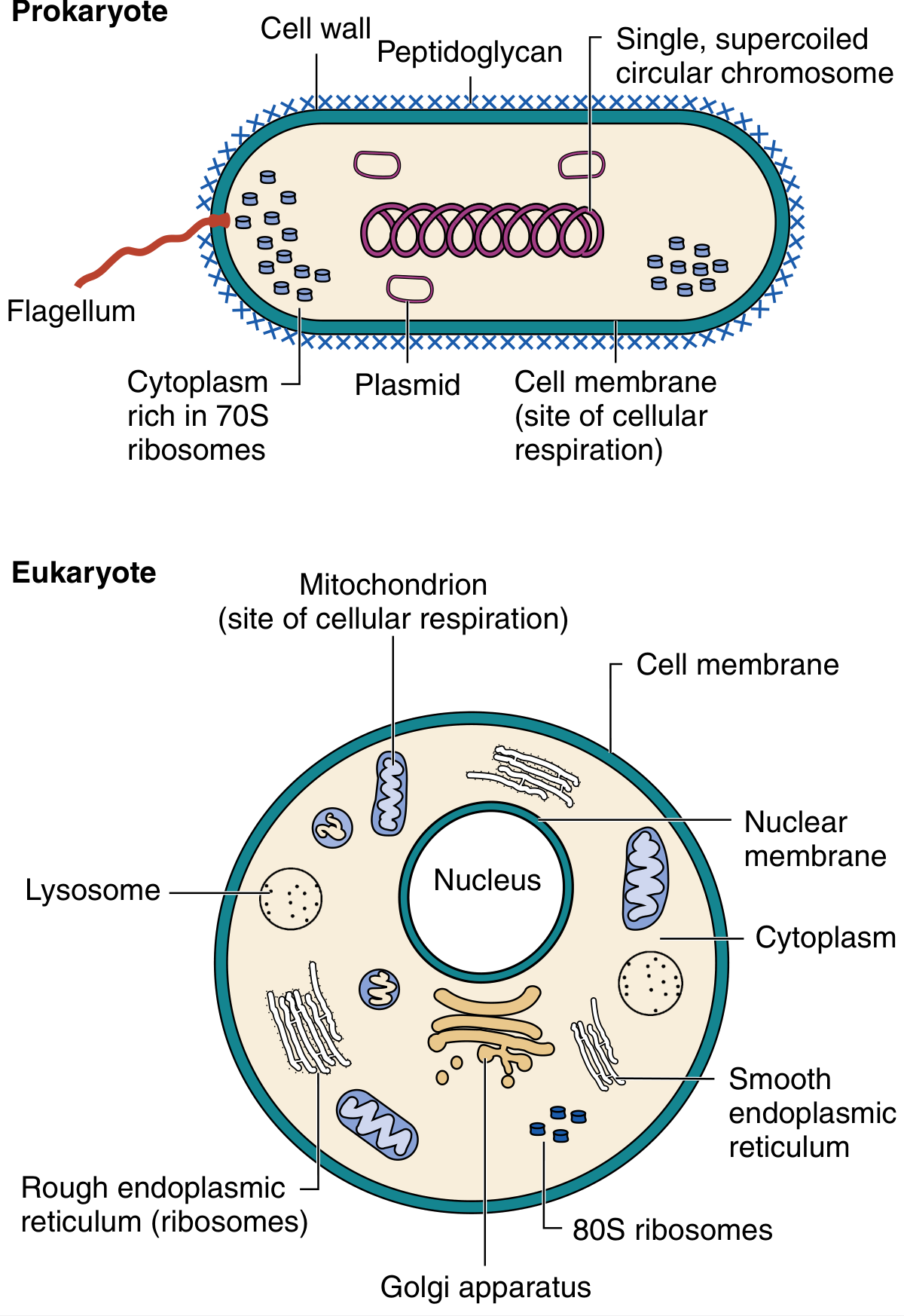
Bacteria are living, single-celled prokaryotes that carry out their own metabolism. Viruses are obligate intracellular genetic parasites that are not cells at all — they are inert outside a host and have no metabolic machinery of their own.
Structural Comparison
| Feature | Bacteria | Viruses |
|---|---|---|
| Cell structure | Prokaryotic cell (no nuclear membrane) | Not a cell — virion only |
| Size | 0.5–3.0 µm | 20–300 nm (10–100× smaller) |
| Nucleic acid | Both DNA and RNA simultaneously | Only one type (either DNA or RNA, never both) |
| Genome | Single circular dsDNA chromosome (+ plasmids) | DNA or RNA; ss or ds; linear or circular; may be segmented |
| Cell wall | Present — contains peptidoglycan (target of β-lactams) | Absent |
| Ribosomes | 70S ribosomes (target of aminoglycosides, macrolides, etc.) | None |
| Metabolism | Self-sufficient — own enzymes for energy, biosynthesis | None — completely dependent on host cell machinery |
| Reproduction | Binary fission (asexual) | Replication within a host cell; does not divide |
| Motility | Some have simple flagella | None |
| Cytoplasm/organelles | Has cytoplasm; lacks mitochondria, ER, Golgi | None |
| Can grow on artificial media | Yes (most) | No — require living cells |
| Susceptibility to antibiotics | Yes (target cell wall, ribosomes, membranes, etc.) | No — antibiotics are ineffective |
| Susceptibility to antivirals | No | Yes (target virus-specific enzymes) |
| Interferon sensitivity | No | Yes — interferons inhibit viral replication |
| Filtration | Retained by Seitz/Berkefeld filters | Pass through bacteria-retaining filters (historically key distinction) |
Part II: General Properties of Viruses
1. Size and Basic Nature
Viruses range from ~20 to 300 nm in diameter — making them the smallest known infectious agents. They contain only one kind of nucleic acid (either RNA or DNA, never both) as their genome. The entire infectious particle is called a virion.
"Viruses are parasites at the genetic level, replicating only in living cells and are inert in the extracellular environment." — Jawetz, Melnick & Adelberg's Medical Microbiology
2. Structural Components
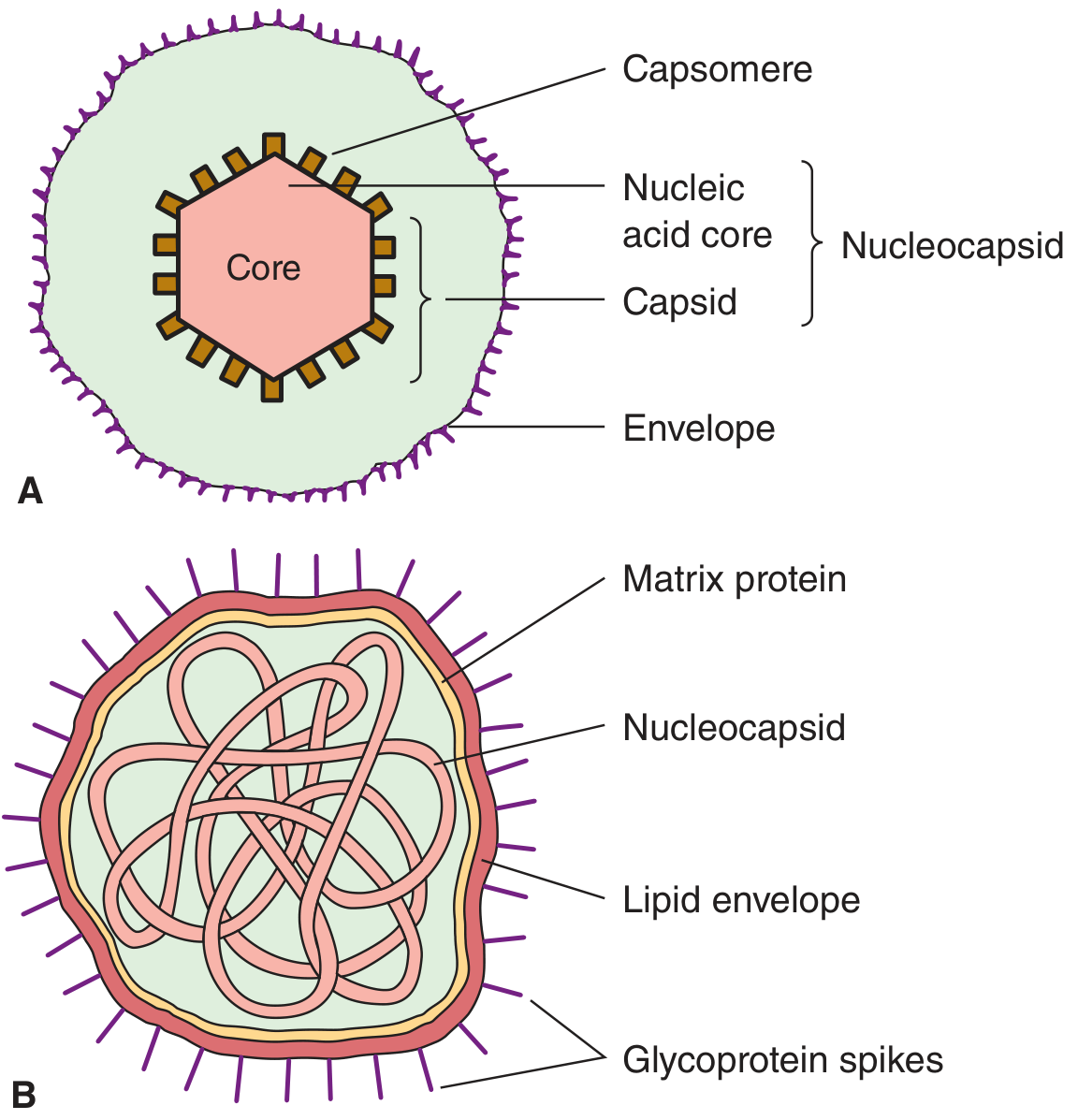
| Component | Description |
|---|---|
| Nucleic acid core | The viral genome — may be DNA or RNA, ss or ds, linear or circular, segmented or non-segmented |
| Capsid | Protein shell encasing the nucleic acid; made of repeating protein subunits called capsomeres |
| Nucleocapsid | Capsid + nucleic acid together |
| Envelope | Lipid bilayer membrane acquired by budding through a host cell membrane; present in some viruses only |
| Peplomers (spikes) | Virus-encoded glycoproteins projecting from the envelope surface; used for host cell attachment |
| Matrix protein | Links envelope to nucleocapsid in enveloped viruses |
3. Capsid Symmetry
Viruses are classified by the geometric arrangement of their capsomeres:
- Icosahedral symmetry — 20 triangular faces; roughly spherical appearance (e.g., poliovirus, adenovirus, herpesvirus)
- Helical symmetry — rod-shaped or filamentous; capsomeres arranged in a helix around the nucleic acid (e.g., influenza, rabies)
- Complex symmetry — neither icosahedral nor helical (e.g., poxviruses, bacteriophages)
4. Enveloped vs. Non-enveloped (Naked)
| Property | Enveloped | Naked (Non-enveloped) |
|---|---|---|
| Lipid envelope | Present | Absent |
| Ether/detergent sensitivity | Sensitive (lipid disrupted) | Resistant |
| Stability in environment | Fragile — inactivated by drying, acid, detergents | More stable |
| Transmission | Usually require close contact/moist surfaces | Can survive on surfaces, fecal-oral routes |
| Examples | HIV, influenza, herpes, hepatitis B | Poliovirus, adenovirus, rotavirus, HAV |
5. Classification Criteria
Viruses are classified by the following properties (ICTV taxonomy — families end in -viridae):
- Type of nucleic acid — DNA or RNA
- Strandedness — single-stranded (ss) or double-stranded (ds)
- Polarity — positive-sense (+), negative-sense (−), or ambisense
- Segmentation — number and size of genome segments
- Capsid symmetry — icosahedral, helical, complex
- Envelope — present or absent
- Size of virion — 20–300 nm
- Physicochemical properties — thermal/pH stability, buoyant density
- Antigenic properties — reactions to antisera
- Biologic properties — host range, tissue tropism, mode of transmission, pathogenicity
6. Replication Strategy
Because viruses have no ribosomes or metabolic enzymes, they must hijack the host cell entirely:
General steps of viral replication:
- Attachment (Adsorption) — viral surface proteins bind specific host cell receptors
- Penetration/Entry — fusion with membrane or receptor-mediated endocytosis
- Uncoating — nucleic acid is released from capsid within the cell
- Early gene expression — virus encodes enzymes needed for genome replication (DNA-binding proteins, polymerases)
- Genome replication — viral nucleic acid is copied many times
- Late gene expression — structural proteins (capsid proteins, glycoproteins) are synthesized
- Assembly — new nucleocapsids are assembled
- Release — naked viruses lyse the cell; enveloped viruses bud through the host membrane, acquiring their envelope
DNA viruses replicate predominantly in the nucleus (exception: poxviruses replicate in the cytoplasm). Many establish persistent/latent infections (e.g., herpesviruses).
RNA viruses replicate in the cytoplasm using RNA-dependent RNA polymerases. Retroviruses (e.g., HIV) use reverse transcriptase to make DNA from RNA, which integrates into the host genome.
7. Host Range and Tropism
A given virus may infect a broad or extremely narrow range of hosts. Tissue tropism is determined by the distribution of specific host cell receptors that match viral surface proteins. Viruses infect organisms from bacteria (bacteriophages) and algae to all higher plants and animals.
8. Effects on the Host Cell
Viral infection may result in:
- No apparent effect — subclinical infection
- Cytopathic effect (CPE) — cell swelling, rounding, fusion, inclusion bodies, death
- Cell transformation — oncogenic viruses integrate into the host genome, driving uncontrolled cell proliferation (e.g., HPV, EBV)
- Latency — viral genome persists silently in the host, reactivating later (e.g., HSV, VZV)
Quick-Reference Summary
| Bacteria | Virus | |
|---|---|---|
| Living? | Yes | No (inert outside host) |
| Size | 0.5–3 µm | 20–300 nm |
| Nucleic acid | DNA + RNA | DNA or RNA only |
| Cell wall | Peptidoglycan | None |
| Ribosomes | 70S | None |
| Reproduce | Binary fission | Replicate using host machinery |
| Treatable with antibiotics | Yes | No |
| Treatable with antivirals | No | Yes |
Sources: Jawetz, Melnick & Adelberg's Medical Microbiology 28e; Medical Microbiology 9e (Murray)
Humoral immunity
Finding Sources
Finding Sources
Reading File
Reading File
Reading File
Finding Sources
Finding Sources
Finding Sources
Your credits are exhausted. Your daily credits reset tomorrow, or you can purchase a top-up for more.
This is a shared conversation. Sign in to Orris to start your own chat.