This is exactly the diagram needed. Now I have all the information to write a comprehensive answer. Let me compose it.
Basal-Bolus and Premixed Insulin Regimens
Physiological Basis: What Are We Trying to Mimic?
The normal pancreas secretes insulin in two patterns:
- Basal secretion - a low, continuous background release (~50% of total daily insulin) that suppresses hepatic glucose output in the fasting state.
- Prandial (bolus) secretion - sharp, meal-stimulated peaks that handle carbohydrate influx after each meal.
The goal of any intensive insulin regimen is to reproduce this physiological profile as closely as possible.
Insulin Preparations: Pharmacokinetics Reference
Before discussing regimens, here is the key pharmacokinetic data from Goldman-Cecil Medicine (Table 210-4):
| Type | Agent(s) | Onset | Peak | Duration |
|---|
| Rapid-acting analogue | Lispro, Aspart, Glulisine | 15-30 min | 30-90 min | 3-4 h |
| Short-acting (Regular) | Human Regular | ~30 min | 2-4 h | 5-8 h |
| Intermediate (NPH) | Human NPH | 2-4 h | 6-10 h | 16-20 h |
| Long-acting analogue | Glargine U100 | 1.5-2 h | Peakless | 16-20 h |
| Long-acting analogue | Detemir | 1.5-2 h | Relatively flat | 12-24 h |
| Ultra long-acting | Degludec | ~1 h | Peakless | >42 h |
Structural Modifications of Insulin Analogues
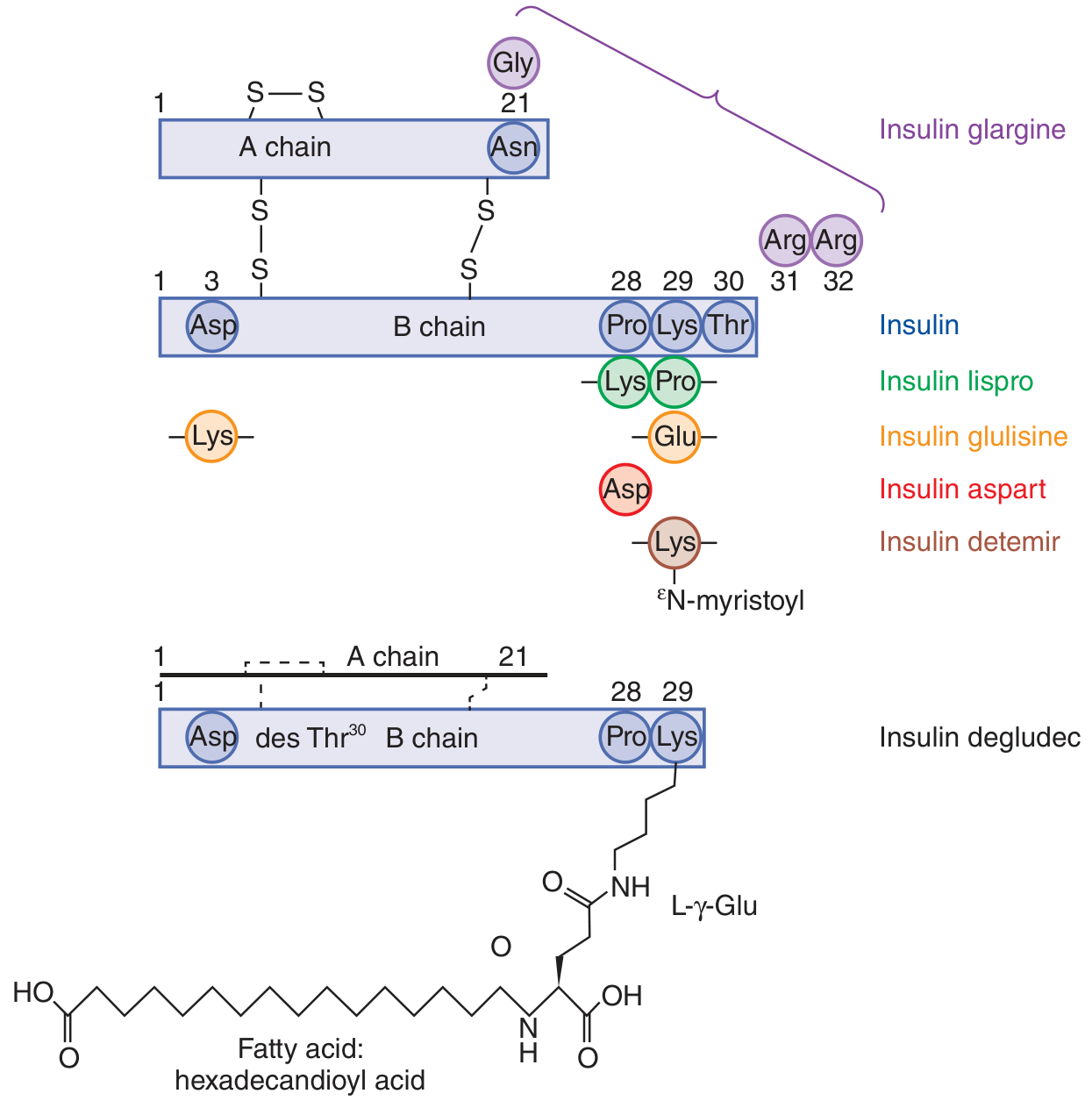
The molecular basis for these different profiles is shown below (Figure 51-7, Goodman & Gilman):
- Lispro: B28 Pro↔B29 Lys swap - rapidly dissociates into monomers
- Aspart: B28 Pro→Asp - reduced self-association
- Glulisine: B3 Asn→Lys, B29 Lys→Glu
- Glargine: Two Arg added to B-chain C-terminus + A21 Asn→Gly; precipitates at subcutaneous pH → peakless slow release
- Detemir: Fatty acid (myristoyl) attached at B29 Lys - binds albumin, slowing release
- Degludec: B30 Thr deleted + hexadecandioyl acid at B29 Lys; forms multi-hexamers subcutaneously → ultra-long action
1. BASAL-BOLUS (Multiple Daily Injection) Regimen
Concept
Also called the multiple daily injection (MDI) regimen or physiological insulin replacement. It is considered the gold standard for Type 1 DM and advanced Type 2 DM.
"The ultimate goal of insulin replacement therapy is to mimic the normal insulin response to hyperglycemia in both the fasting and postprandial states. Physiological insulin replacement regimens include the use of basal-bolus insulin preparations administered in a multiple daily injection (MDI) regimen."
- Textbook of Family Medicine, 9e
Components
| Component | Role | Agent Used |
|---|
| Basal insulin | Suppresses fasting hepatic glucose production; ~40-50% of TDD | Glargine, Detemir, or Degludec (once or twice daily) |
| Prandial (bolus) insulin | Covers carbohydrate load at each meal; remaining 50-60% of TDD divided into 3 doses | Rapid-acting analogue: Lispro, Aspart, or Glulisine (15 min before each meal) |
| Correction factor | Added to prandial dose if pre-meal glucose is elevated | 1 unit per 10-15 g carbohydrate + correction |
Dosing
- Total daily dose (TDD): 0.4-0.7 units/kg/day in type 1 DM; up to 1-2 units/kg/day in insulin-resistant type 2 DM
- Basal: ~40-50% of TDD given as a single injection of glargine or degludec
- Bolus: ~50-60% of TDD divided equally before each of 3 meals (i.e., ~10-20% of TDD per meal)
- Correction factor example (Goldman-Cecil): 1 unit to lower plasma glucose by 20-50 mg/dL
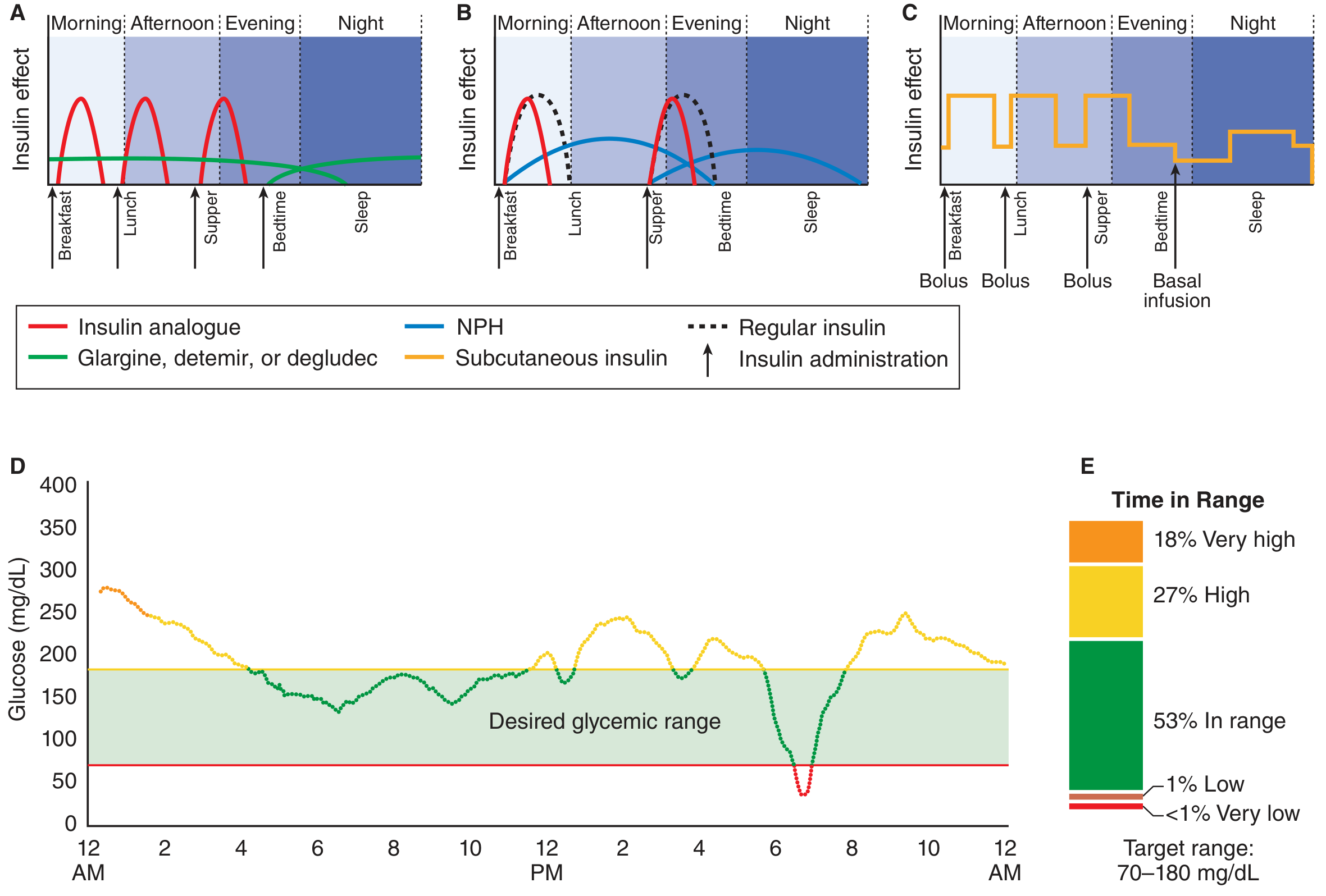
Key Diagram: Commonly Used Insulin Regimens
The figure below (Figure 51-8, Goodman & Gilman) illustrates three regimen types. Panel A is the classic basal-bolus MDI; Panel B is NPH-based twice-daily (less physiological); Panel C is continuous subcutaneous insulin infusion (CSII/pump):
Panel A - Basal-Bolus (MDI):
- Green flat line = glargine/detemir/degludec (peakless basal)
- Red peaked curves = rapid-acting analogue before breakfast, lunch, and supper
- Result: closely mimics normal physiology
Panel B - NPH + Regular (less physiological):
- Blue curves = NPH given twice daily (breakfast + dinner)
- Dotted black = Regular insulin at breakfast and dinner
- Problem: NPH has a peak (risk of between-meal hypoglycemia), and regular insulin has a delayed onset (must inject 30-45 min before eating)
Panel C - Insulin Pump (CSII):
- Programmed basal rate (orange steps), with meal boluses
Advantages of Basal-Bolus
- Most closely mimics physiological insulin secretion
- Allows flexible mealtimes and carbohydrate counting
- Better HbA1c reduction vs. conventional regimens
- Independently adjustable basal and bolus components
Disadvantages
- Requires 4+ injections per day
- Demands patient education and motivation
- Higher risk of hypoglycemia if dosing is incorrect
- More expensive (analogue insulins)
2. PREMIXED INSULIN Regimens
Concept
Premixed preparations combine a rapid/short-acting prandial insulin with an intermediate-acting insulin in a fixed ratio in a single vial or pen. They provide both basal and bolus coverage in one injection, typically given twice daily before breakfast and before dinner.
"Premixed preparations combine rapid-acting (prandial) and long-duration (basal) insulins in a single vial or pen injector. Using these fixed-dose insulins can reduce dosing errors...premixed insulin preparations is simple, user friendly, and more physiological than NPH-plus-regular-insulin injections."
- Textbook of Family Medicine, 9e
Available Formulations
Human premixed insulins (older):
| Product | Composition | Timing |
|---|
| Humulin 70/30 / Novolin 70/30 | 70% NPH + 30% Regular | Inject 30 min before meal |
| Humulin 50/50 | 50% NPH + 50% Regular | Inject 30 min before meal |
Analogue premixed insulins (preferred):
| Product | Composition | Mechanism | Timing |
|---|
| Lispro 75/25 (Humalog Mix) | 75% lispro protamine + 25% lispro | Protamine delays 75% of lispro | 15 min before meal |
| Lispro 50/50 (Humalog Mix 50) | 50% lispro protamine + 50% lispro | Equal basal/prandial ratio | 15 min before meal |
| Biaspart 70/30 (NovoMix 30) | 70% aspart protamine + 30% aspart | Protamine delays 70% of aspart | 15 min before meal |
The protamine-delayed fraction acts as the "basal" component by slowing absorption of that portion of the rapid-acting analogue. For example, a 20-unit dose of Lispro 75/25 = 5 units of free lispro (bolus) + 15 units of lispro-protamine (basal).
Typical Regimen: Twice Daily
Before Breakfast:   2/3 of total daily premixed dose
Before Dinner:      1/3 of total daily premixed dose
"A premixed insulin can be given twice daily before breakfast and dinner. In general, the secretagogues are discontinued when premeal insulin is added, but sensitizing and other agents are continued based on individual patient needs."
- Washington Manual of Medical Therapeutics
When to Use
- Patients with HbA1c between 8.5% and 10% (Family Medicine, 9e)
- Those who eat three regular meals daily on a fixed schedule
- Patients who prefer fewer injections (2 vs. 4+ with MDI)
- Patients with visual impairment or limited dexterity who cannot mix insulin
- Patients unable or unwilling to self-adjust individual insulin components
Limitations
- Fixed ratio - cannot independently adjust basal and bolus components
- Requires regular meal timing - flexible eating is not compatible
- Less physiological than MDI - cannot fully customize to meal-by-meal variation
- Higher rate of hypoglycemia vs. basal insulin alone
- Human premixed: severe hypoglycemia in 2-14% vs. analogue premixed: 2-8%
- Analogue premixed preferred over human premixed for lower postprandial excursions
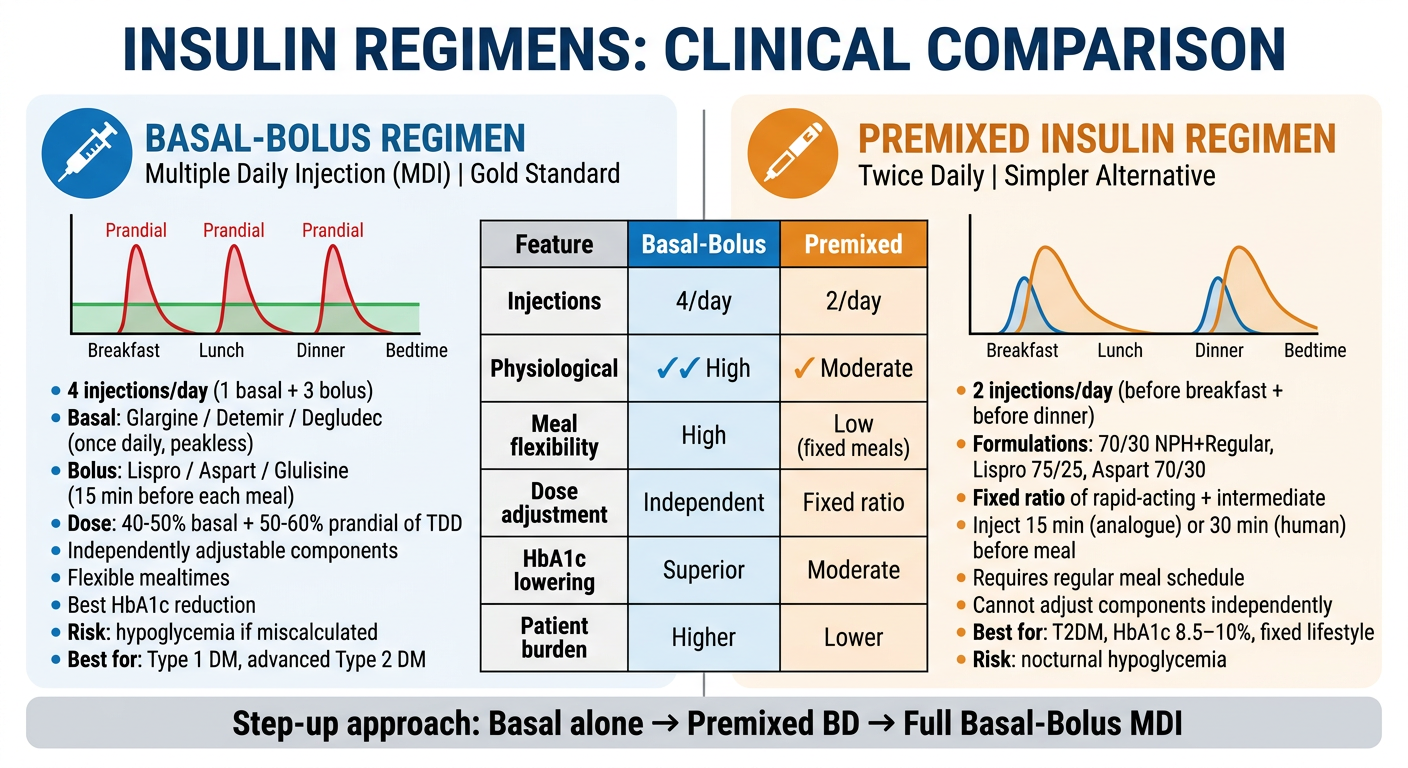
Comparison: Basal-Bolus vs. Premixed
| Feature | Basal-Bolus (MDI) | Premixed (Twice Daily) |
|---|
| Physiological | Yes (closely mimics pancreas) | Partially |
| Injections/day | 4 (3 bolus + 1 basal) | 2 |
| Meal flexibility | High | Low (fixed meals required) |
| Dose adjustability | Independent adjustment possible | Fixed ratio - no independent adjustment |
| Best HbA1c lowering | Superior | Moderate |
| Hypoglycemia risk | Moderate | Moderate-high (especially nocturnal) |
| Patient burden | Higher (education, monitoring) | Lower |
| Use in T1DM | First choice | Not recommended |
| Use in T2DM | When MDI needed or HbA1c >10% | HbA1c 8.5-10%, fixed lifestyle |
| Cost | Higher | Moderate |
Step-up Approach in Type 2 DM (Katzung)
"Simply adding nighttime intermediate- or long-acting insulin may lead to improved fasting glucose levels. If daytime glucose levels are problematic, premixed insulins before breakfast and dinner may help. If such a regimen does not achieve adequate control, a more intensive basal-bolus insulin regimen combined with rapid-acting analogue before meals can be instituted."
- Katzung's Basic and Clinical Pharmacology, 16e
This outlines the clinical escalation:
- Basal insulin alone (once daily, add to oral agents)
- Premixed twice daily (if basal alone insufficient)
- Full basal-bolus MDI (if premixed fails or HbA1c remains high)
Initiating and Intensifying Basal-Bolus in Practice
From the Textbook of Family Medicine, 9e:
- Start prandial insulin at the meal with the greatest postprandial glucose rise (identified by structured SMBG - measuring before and 2 hours after each meal)
- Initial dose of prandial insulin: 0.1 unit/kg per meal
- If 2-hour postprandial glucose is consistently >50 mg/dL above target, increase the mealtime dose by 1 unit/day
- A delta value (pre-meal minus 2-hour postprandial glucose) helps predict hypoglycemia risk - a large negative delta warns of impending hypoglycemia
- Repeat HbA1c to assess response; intensify as needed
Summary
The basal-bolus regimen is the gold standard physiological approach using a separate peakless long-acting insulin (glargine/detemir/degludec) plus rapid-acting analogues before each meal. It requires higher patient engagement but achieves the best glycemic control.
Premixed insulins offer a simpler twice-daily alternative combining both functions in one injection at a fixed ratio, suitable for type 2 DM patients with regular lifestyles and moderate HbA1c elevation, but they sacrifice flexibility and independent dose adjustment.
Sources:
- Goldman-Cecil Medicine International Edition, Table 210-4 and p. 2474
- Goodman & Gilman's Pharmacological Basis of Therapeutics, Figures 51-7 and 51-8, p. 1052-1053
- Textbook of Family Medicine, 9e, pp. 983-984
- Katzung's Basic and Clinical Pharmacology, 16e, p. 1197
- Washington Manual of Medical Therapeutics, p. 902