
NM junction
Reading File
Finding Sources
Finding Sources
Good sources found. Let me pull from the core physiology and pharmacology texts simultaneously.
Reading File
Reading File
Reading File
Reading File
Reading File
Loading Image
I now have comprehensive content. Let me also fetch the nicotinic receptor diagram and the steps diagram for a complete answer.
Loading Image
Loading Image
Excellent — I have all the material needed for a comprehensive answer. Here is a full account of the neuromuscular junction.
Neuromuscular Junction (NMJ)
The neuromuscular junction (NMJ), also called the motor end plate, is the specialized chemical synapse between the terminal of a somatic motor neuron and a skeletal muscle fiber. It is the most intensely studied synapse in the nervous system, and its principles apply broadly to central synaptic transmission.
1. Anatomy
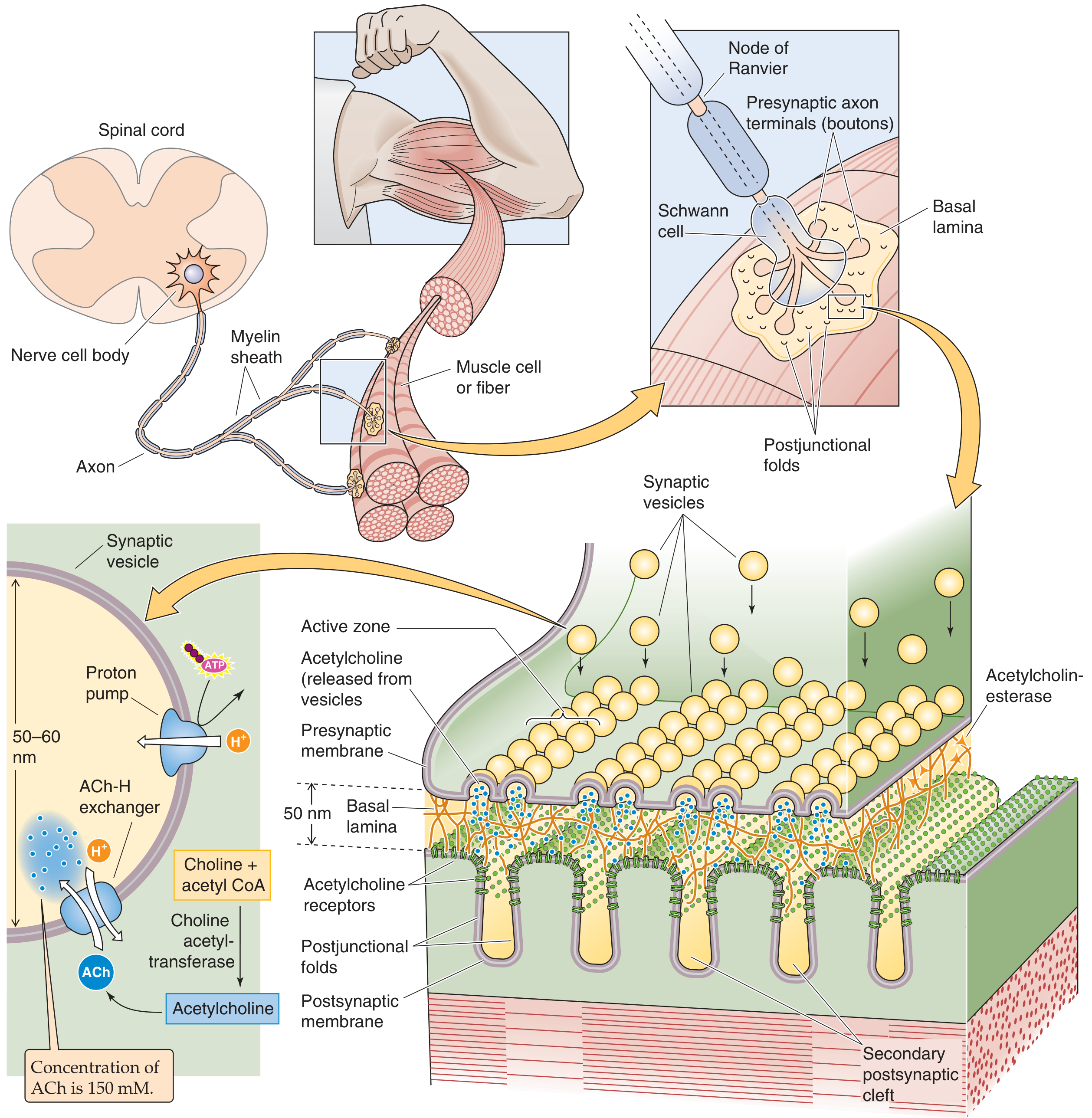
Motor neuron:
- Cell body in the ventral horn of the spinal cord
- Large myelinated axon (Aα) that branches near the muscle
- Each branch innervates a single muscle fiber (one NMJ per fiber, at its midpoint)
- The set of all fibers innervated by one motor neuron = motor unit
Presynaptic terminal (bouton):
- Loses its myelin sheath at the NMJ
- Contains abundant mitochondria (for ATP/ACh synthesis) and ~300,000 ACh-containing synaptic vesicles
- Active zones on the presynaptic membrane face the postjunctional folds
- Flanked by voltage-gated Ca²⁺ channels on either side of dense bars
- Capped by Schwann cells on its outer face
Synaptic cleft:
- 20–30 nm wide (synaptic gutter/trough)
- Filled with basal lamina containing acetylcholinesterase (AChE)
Postsynaptic membrane (motor end plate):
- Muscle membrane forms deep junctional folds → greatly increases surface area
- Crests of folds are densely packed with nicotinic ACh receptors (nAChR)
- Voltage-gated Na⁺ channels at the depths of the folds amplify the end plate potential (EPP)
2. ACh Synthesis & Storage
Acetylcholine is synthesized in the nerve terminal cytoplasm:
Choline + Acetyl-CoA → ACh (catalyzed by choline acetyltransferase)
ACh is packaged into vesicles via a vesicular ACh transporter (VAChT) driven by a proton gradient (ACh–H⁺ exchanger). Each vesicle contains ~10,000 molecules of ACh. The intravesicular concentration of ACh is ~150 mM.
3. Steps of Synaptic Transmission
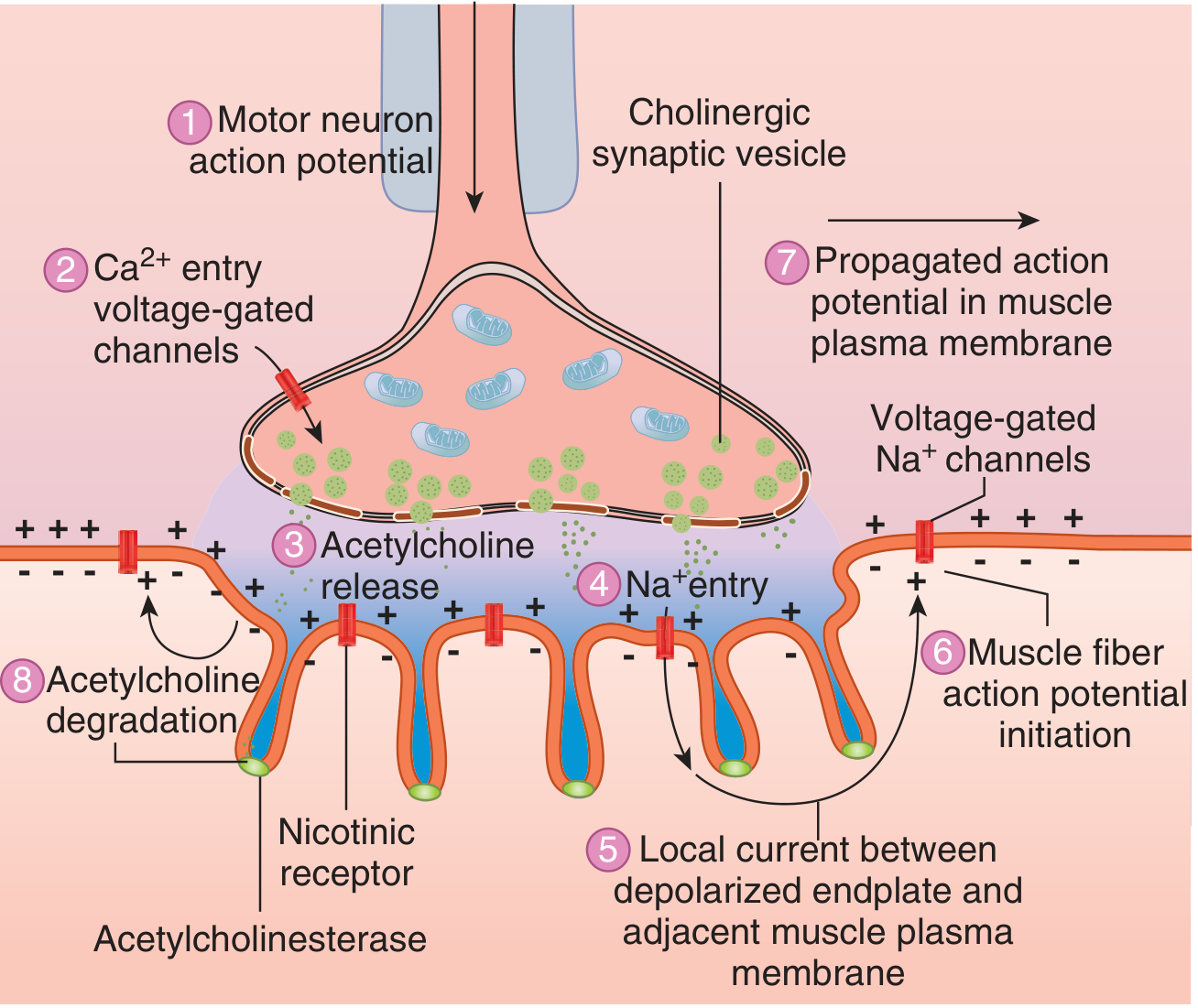
| Step | Event |
|---|---|
| ① Action potential arrives | Motor neuron AP propagates to bouton |
| ② Ca²⁺ influx | Depolarization opens voltage-gated Ca²⁺ channels; Ca²⁺ enters terminal |
| ③ ACh exocytosis | Ca²⁺ activates Ca²⁺/calmodulin kinase → phosphorylates synapsin → ~125 vesicles fuse with active zone, releasing ACh into cleft |
| ④ ACh binds nAChR | ACh diffuses ≥50 nm and binds to postsynaptic N_M receptors at junctional fold crests |
| ⑤ Na⁺ entry / EPP | Receptor-channel opens → Na⁺ influx (dominant) and K⁺ efflux → end plate potential (EPP) of +50–75 mV locally |
| ⑥ AP initiation | EPP depolarizes adjacent muscle membrane beyond threshold → voltage-gated Na⁺ channels open → muscle fiber AP |
| ⑦ AP propagation | AP spreads bidirectionally along sarcolemma → excitation-contraction coupling |
| ⑧ ACh termination | AChE (in basal lamina) hydrolyzes ACh → choline + acetate in milliseconds; choline is recycled into terminal |
4. The Nicotinic ACh Receptor (nAChR)
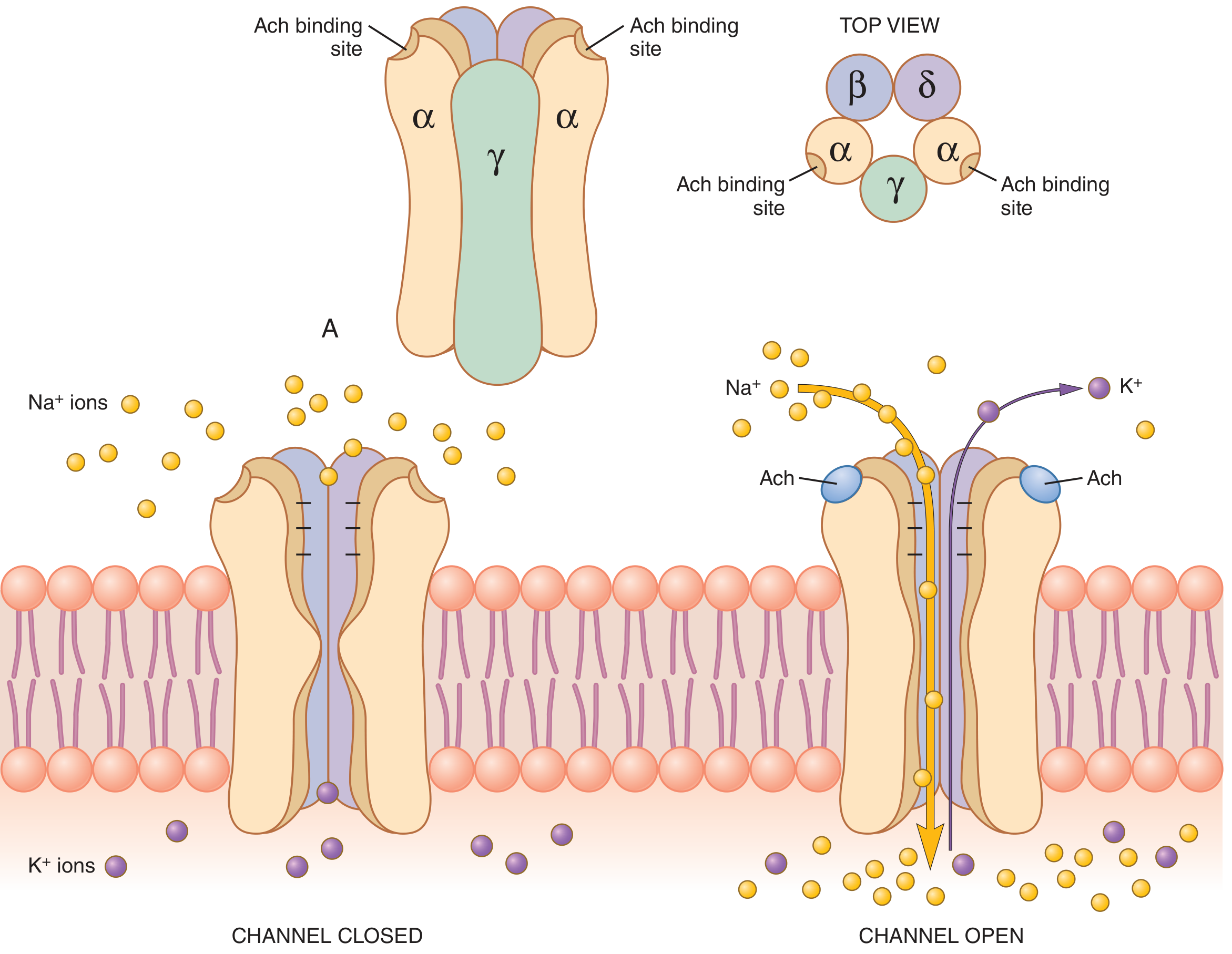
- Pentameric ligand-gated ion channel: subunit composition α₂βγδ (fetal/denervated) or α₂βεδ (adult junctional)
- Two ACh binding sites at α/γ and α/δ interfaces — both must be occupied to open the channel
- The M2 transmembrane helix of each subunit lines the cation-selective pore
- Negative charges at the channel mouth exclude anions (Cl⁻)
- On opening: large Na⁺ influx (driving force ~160 mV inward) and smaller K⁺ efflux → net depolarization
- Adult (ε) receptors: conductance 59 pS, mean open time 1.6 ms
- Fetal/denervated (γ) receptors: conductance 40 pS, mean open time 4.4 ms — also spread over extrasynaptic membrane
5. End Plate Potential (EPP)
- Normal EPP rises to +50–75 mV above resting potential at the end plate
- This is ~3× the threshold needed to fire a muscle AP (safety factor = ~3)
- Subthreshold EPPs (miniature end plate potentials, MEPPs) occur spontaneously from random single-vesicle release; quantum of ~10,000 ACh molecules
- The large safety factor ensures reliable 1:1 nerve-to-muscle transmission under normal conditions
6. Termination of Signal
- Acetylcholinesterase (anchored in basal lamina): cleaves ACh within a few milliseconds
- Choline is recovered by a high-affinity transporter in the presynaptic terminal and re-acetylated
- A small fraction of ACh diffuses out of the cleft and is lost
7. Clinical Relevance — Drugs & Diseases
| Category | Mechanism | Examples |
|---|---|---|
| Depolarizing NMB | Persistent agonist at nAChR → sustained depolarization → flaccid paralysis | Succinylcholine |
| Non-depolarizing NMB | Competitive antagonist at nAChR | Rocuronium, vecuronium, cisatracurium |
| Anticholinesterases | Inhibit AChE → ↑ ACh at junction | Neostigmine, pyridostigmine (reversal of NMB; treat myasthenia gravis) |
| Myasthenia gravis (MG) | Autoantibodies against nAChR (or MuSK) → ↓ functional receptors → fatigable weakness | AChR-Ab in ~85% |
| Lambert-Eaton syndrome | Autoantibodies against presynaptic voltage-gated Ca²⁺ channels → ↓ ACh release | Associated with SCLC |
| Botulinum toxin | Cleaves SNARE proteins (SNAP-25, synaptobrevin) → blocks ACh vesicle fusion → flaccid paralysis | Clostridium botulinum |
| Organophosphates | Irreversible AChE inhibition → ACh accumulates → initial fasciculations then paralysis | Nerve agents, pesticides |
Summary
The NMJ converts a neural electrical signal into a muscle mechanical event through a precise sequence: AP → Ca²⁺ entry → ACh exocytosis → nAChR activation → EPP → muscle AP → contraction. The large safety factor (3×), rapid AChE termination, and dense postsynaptic receptor clustering make it fast, reliable, and tightly regulated.
Sources: Guyton & Hall Textbook of Medical Physiology; Medical Physiology (Boron & Boulpaep); Ganong's Review of Medical Physiology, 26e
Epidermis layer
Your credits are exhausted. Your daily credits reset tomorrow, or you can purchase a top-up for more.
Epidermis layer
Your credits are exhausted. Your daily credits reset tomorrow, or you can purchase a top-up for more.
This is a shared conversation. Sign in to Orris to start your own chat.