
Types of breath sound
Reading File
Now let me search the medical library for breath sounds content in parallel.
Finding Sources
Searching Images
types of breath sounds auscultation lung
Finding Sources
Good, I have the key file paths. Let me read the detailed content from Murray & Nadel's and Fishman's.
Reading File
Reading File
Let me read the next section on adventitious sounds in detail.
Reading File
I now have comprehensive content. Let me compile the full answer.
Types of Breath Sounds
Breath sounds are classified into normal (physiologic) and adventitious (abnormal) sounds. The classification below follows standardized American Thoracic Society (ATS) nomenclature. - Murray & Nadel's Textbook of Respiratory Medicine, p. 398
I. Normal Breath Sounds
1. Normal Breath Sounds (formerly "Vesicular")
- Frequency: 200-600 Hz, decreasing power with increasing Hz
- Character: Soft, nonmusical, heard mainly on inspiration; expiratory phase is softer or even inaudible
- Where heard: Over most of the lung periphery
- Origin: Turbulent airflow within lobar and segmental bronchi (NOT air entering alveoli - that is a silent diffusion process)
- Expiratory sounds are softer because they originate in larger, more central airways where the large air volume of the lungs dampens them
Note: The old term "vesicular" is discouraged because it incorrectly implied the sounds came from air entering the alveolar vesicles.
2. Tracheal Breath Sounds
- Frequency: 75-1600 Hz; flat until a sharp decrease at ~900 Hz
- Character: Hollow, tubular, nonmusical; heard in both inspiration AND expiration equally
- Where heard: Just below the suprasternal notch / over the trachea
- Clinical value: Audible tracheal sounds confirm open central and upper airways
II. Adventitious (Abnormal) Breath Sounds
A. Bronchial Breath Sounds
- Character: Loud, medium-pitched, tubular; as loud or louder on expiration than on inspiration (equal I:E ratio)
- Same acoustic quality as tracheal sounds but heard in the lung periphery
- Clinical significance: Classic sign of lung consolidation (pneumonia, pulmonary edema, hemorrhage) - consolidated lung amplifies and transmits centrally generated sounds to the periphery. Also confirms the airway to that region is patent.
B. Diminished / Absent Breath Sounds
- Occur when a sound barrier interposes between central airways and the chest wall
- Causes: Pleural effusion, pneumothorax, peripheral bulla, obstructing mass, COPD (hyperinflation), obesity, thick chest wall
III. Adventitious Sounds - Two Main Categories
Adventitious sounds are divided into discontinuous (crackles) and continuous (wheezes, rhonchi, stridor).
Discontinuous Sounds
1. Fine Crackles (Fine Rales / Crepitations)
| Feature | Detail |
|---|---|
| Sound | Softer, shorter, higher-pitched pops |
| Timing | Mid-to-late inspiration |
| Mechanism | Explosive opening of small airways that had collapsed due to surface tension forces |
| Clinical | Atelectasis, pulmonary fibrosis (ILD), early pulmonary edema, CHF |
| Behavior | May disappear after several deep breaths or coughing (if small airways stay open) |
| Late inspiratory crackles | More typical of restrictive disease (fibrosis) - greater tension needed to pop open stiff airways |
2. Coarse Crackles (Coarse Rales)
| Feature | Detail |
|---|---|
| Sound | Louder, lower-pitched, longer explosive sounds |
| Timing | Early inspiration or expiration |
| Mechanism | Intermittent airway opening; rupture of fluid films; secretions in distal airways |
| Clinical | Bronchiectasis, secretions, resolving pneumonia |
| Behavior | May change with cough but rarely disappear entirely |
Continuous Sounds (duration > 250 msec)
3. Wheezes
| Feature | Detail |
|---|---|
| Frequency | High-pitched; dominant frequency ≥ 400 Hz |
| Character | Hissing, musical quality |
| Timing | Predominantly expiratory (but can be biphasic) |
| Mechanism | Fluttering of airway walls at or above critical flow velocity |
| Clinical | Airway narrowing - diffuse = asthma/COPD; focal = intraluminal lesion or extrinsic compression |
| Note | Pitch and intensity do NOT correlate with degree of obstruction; duration in the respiratory cycle does |
4. Rhonchi
| Feature | Detail |
|---|---|
| Frequency | Low-pitched; dominant frequency < 200 Hz (snoring quality) |
| Character | Continuous, gurgling/snoring sound |
| Mechanism | Rupture of fluid films + airway wall vibrations in large airways |
| Clinical | Secretions in large airways (bronchitis, post-aspiration) |
| Behavior | Clears with coughing or suctioning - distinguishes from wheeze |
5. Stridor
| Feature | Detail |
|---|---|
| Character | Continuous, high-pitched, mainly inspiratory sound |
| Where heard | Best heard over the neck |
| Mechanism | Extrathoracic variable or fixed upper airway obstruction |
| Clinical | Urgent! - anaphylaxis, epiglottitis, croup, foreign body, laryngeal edema |
IV. Extrapulmonary Sound
Pleural Friction Rub
- Character: Creaking or leather-rubbing sound, heard in both inspiration and expiration
- Mechanism: Inflamed pleural surfaces rubbing against each other
- Clinical: Pleuritis (pleurisy), pulmonary infarction, pleural mesothelioma
- Distinguishing feature: Does NOT change with coughing; disappears if effusion develops (separates the surfaces)
Quick Summary Table
| Sound | Type | Pitch | Phase | Key Condition |
|---|---|---|---|---|
| Normal breath sounds | Normal | Low | Inspiratory dominant | Normal lung |
| Tracheal sounds | Normal | High | Both phases | Normal trachea |
| Bronchial sounds (peripheral) | Abnormal | Medium-high | Equal I+E | Consolidation |
| Fine crackles | Adventitious - discontinuous | High | Late inspiration | Fibrosis, pulmonary edema |
| Coarse crackles | Adventitious - discontinuous | Low | Early inspiration/exp | Secretions, bronchiectasis |
| Wheeze | Adventitious - continuous | High (>400 Hz) | Expiratory | Asthma, COPD, airway narrowing |
| Rhonchi | Adventitious - continuous | Low (<200 Hz) | Both (clears with cough) | Large airway secretions |
| Stridor | Adventitious - continuous | High | Inspiratory (neck) | Upper airway obstruction |
| Pleural friction rub | Extrapulmonary | Variable | Both phases | Pleuritis |
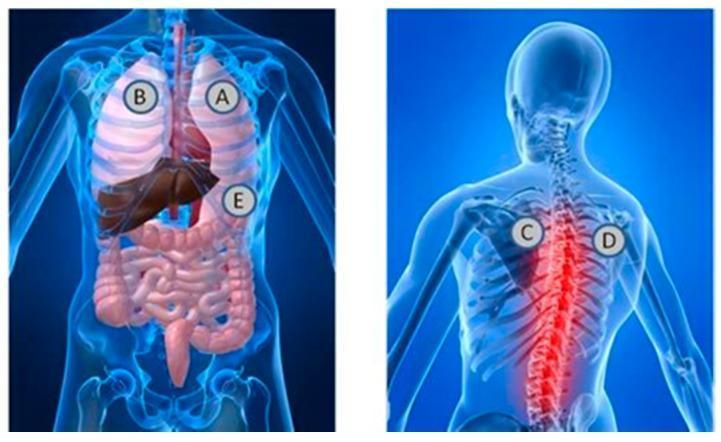
Here is a stethoscope placement reference for auscultation:
Sources: Murray & Nadel's Textbook of Respiratory Medicine, pp. 398-399; Fishman's Pulmonary Diseases and Disorders; Textbook of Family Medicine, 9e
This is a shared conversation. Sign in to Orris to start your own chat.