
Function of basal ganglion
Reading File
The basal ganglia are subcortical nuclei that primarily regulate voluntary movement, motor learning, and motor control. They act as a feedback loop between the cortex and thalamus - receiving input from the cortex, processing it, and projecting back via the thalamus to regulate movement initiation and suppression. Key functions include voluntary motor control, procedural learning, habit formation, and reward-based behavior.
Searching sources...
Finding Sources
Finding Sources
Excellent - found dedicated sections in Guyton, Kandel's Principles of Neural Science, and Neuroscience: Exploring the Brain. Let me read the key sections in parallel.
Reading File
Reading File
Reading File
Now let me read the Guyton section on the caudate circuit and cognitive functions, and the direct/indirect pathway details from Neuroscience: Exploring the Brain.
Reading File
Reading File
I now have rich content from multiple authoritative textbooks. Let me also fetch the key circuit diagrams to include in the answer.
Loading Image
Loading Image
I now have comprehensive information from multiple authoritative textbooks and the key circuit diagrams. Here is a thorough answer:
Functions of the Basal Ganglia
Anatomy - Components
The basal ganglia are a group of subcortical nuclei consisting of:
- Caudate nucleus + Putamen = Striatum (main input station)
- Globus pallidus (internal segment, GPi - main output; external segment, GPe)
- Substantia nigra (pars compacta - dopaminergic; pars reticulata)
- Subthalamic nucleus (STN) - closely associated
(Neuroscience: Exploring the Brain, 5th Ed.)
1. Execution of Complex Motor Patterns - The Putamen Circuit
One of the principal roles of the basal ganglia is to function in association with the corticospinal system to control complex learned patterns of motor activity. When the basal ganglia sustain serious damage, a person's writing becomes crude, as if learning for the first time.
Other motor patterns dependent on basal ganglia include:
- Cutting paper with scissors
- Hammering nails, shooting a basketball
- Vocalization, controlled eye movements
- Virtually all skilled movements, most performed subconsciously
Pathway (Putamen Circuit):
Premotor/supplementary cortex + somatosensory cortex → Putamen → Globus pallidus (internal) → Ventroanterior/Ventrolateral thalamus → Primary motor cortex and supplementary areas
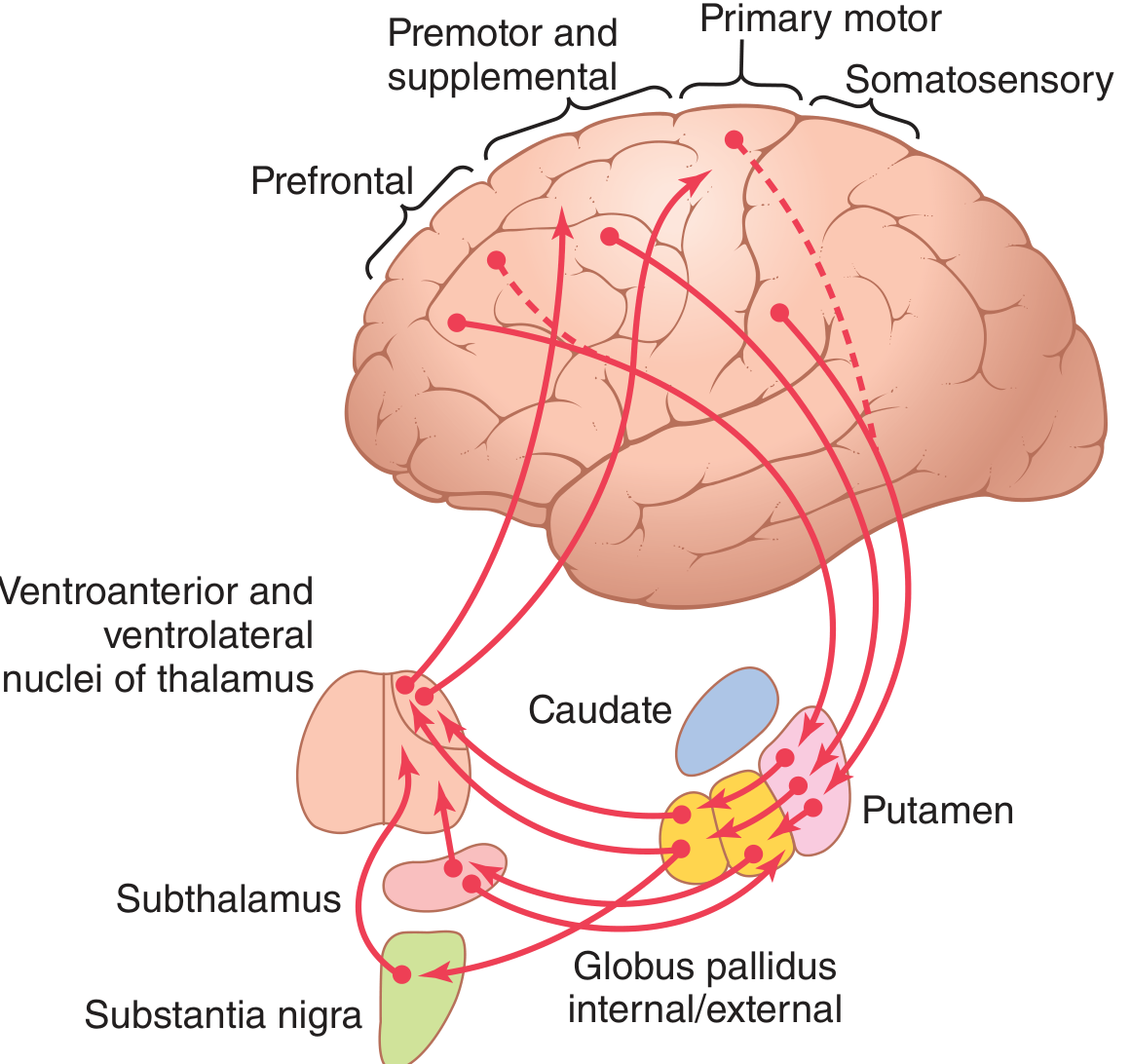
(Guyton and Hall Textbook of Medical Physiology)
2. Timing and Scaling of Movements
Two important basal ganglia capabilities:
- Determine how rapidly a movement is performed
- Control how large (amplitude) the movement will be
Example: writing the letter "A" slowly or rapidly, small on paper or large on a chalkboard - the proportional characteristics remain the same. In patients with severe basal ganglia lesions, these timing and scaling functions are poor or nonexistent. The caudate cognitive motor control circuit (working with the posterior parietal cortex) is thought to be the substrate for this function.
(Guyton and Hall)
3. Cognitive Motor Control - The Caudate Circuit
The caudate circuit functions mainly with association areas of the cerebral cortex to provide cognitive control of motor activity - determining subconsciously, within seconds, which patterns of movement will be used to achieve a complex goal. Example: seeing a lion and automatically deciding to turn, run, and climb a tree - without "thinking too long."
(Guyton and Hall)
4. Direct and Indirect Pathways - The Motor Selection Mechanism
The basal ganglia operate through two parallel pathways, both regulating the motor thalamus (VL nucleus):
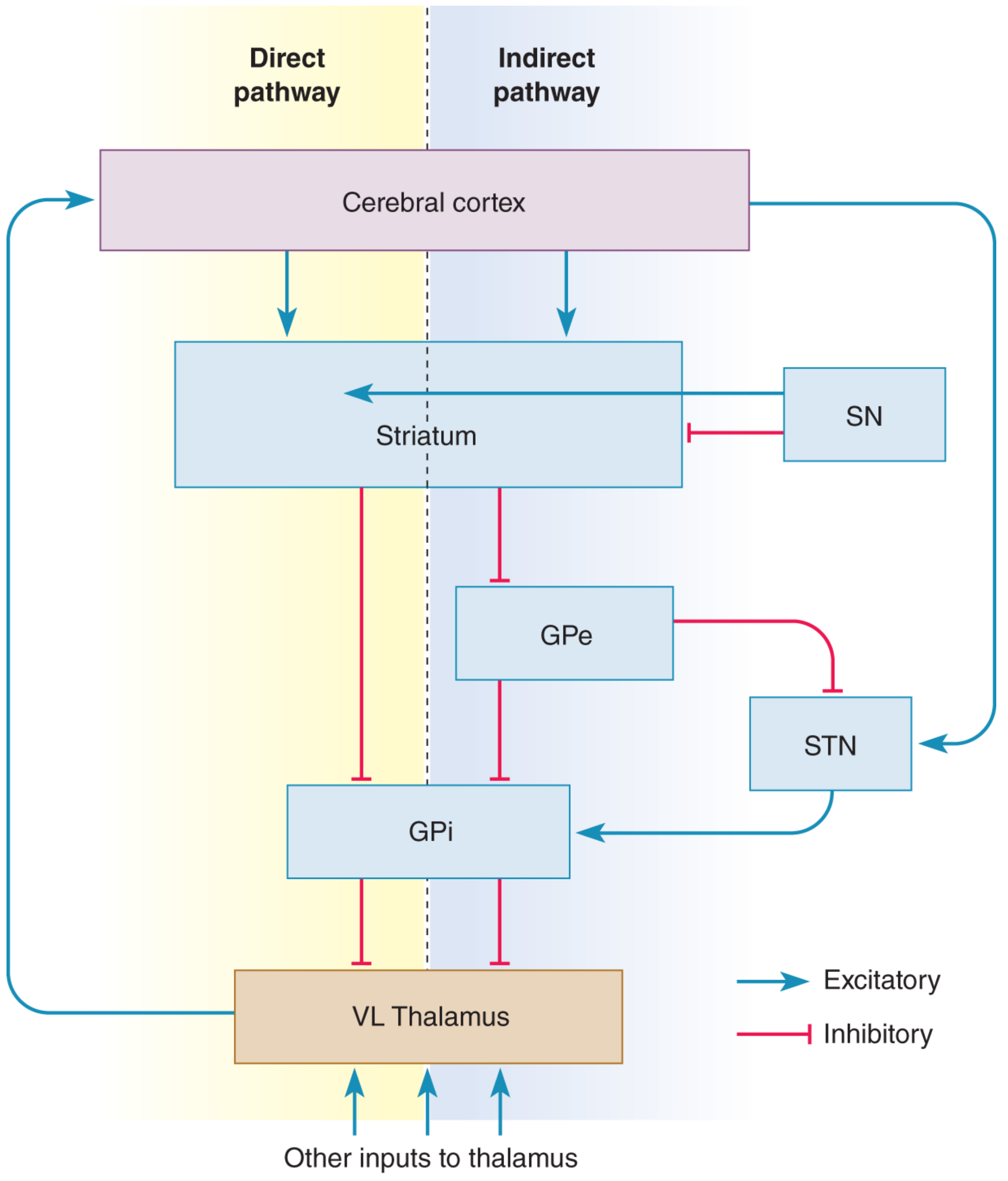
Direct Pathway (facilitates movement = "GO")
Cortex → Striatum (excite) → GPi (inhibit) → VL Thalamus (disinhibited = active) → Cortex/SMA (excited)
- GPi neurons are tonically active at rest, inhibiting the thalamus
- Cortical activation suppresses GPi, releasing the thalamus from inhibition
- Result: facilitation of desired movement
Indirect Pathway (suppresses movement = "STOP")
Cortex → Striatum (excite) → GPe (inhibit) → STN (disinhibited) → GPi (excited) → VL Thalamus (inhibited) → Cortex/SMA (suppressed)
- Tends to antagonize the direct pathway
- Suppresses competing, inappropriate motor programs
Net result: The direct pathway selects the desired motor action; the indirect pathway simultaneously suppresses competing motor programs.
(Neuroscience: Exploring the Brain, 5th Ed.)
5. Dopaminergic Modulation - Substantia Nigra
The substantia nigra pars compacta provides dopaminergic input to the striatum:
- Facilitates the direct pathway (excitatory via D1 receptors)
- Inhibits the indirect pathway (inhibitory via D2 receptors)
Loss of dopaminergic neurons → loss of this modulation → net increase in GPi inhibitory output → reduced thalamic activation → hypokinesia (as in Parkinson's disease)
6. Action Selection (Broad Function)
According to Kandel's Principles of Neural Science (6th Ed.), the most modern view of basal ganglia function is as a selection mechanism - not just for motor actions, but for:
| Domain | What is selected |
|---|---|
| Sensorimotor | Which movement to execute |
| Cognitive | Which thought/plan to act on |
| Motivational/Affective | Which goal-directed behavior to pursue |
| Habitual | Reinforcement learning, habit formation |
The basal ganglia help answer the fundamental challenge all vertebrates face: choosing one behavior from several competing options.
7. Summary Table of Functions
| Function | Circuit/Nucleus |
|---|---|
| Execution of learned motor patterns | Putamen circuit |
| Timing and scaling of movements | Caudate circuit + posterior parietal cortex |
| Cognitive-motor integration | Caudate circuit |
| Movement initiation ("GO") | Direct pathway |
| Suppression of unwanted movements | Indirect pathway |
| Dopaminergic modulation of all above | Substantia nigra |
| Procedural learning and habit formation | Striatum |
| Reward-based/reinforcement learning | Ventral striatum (nucleus accumbens) |
8. Clinical Correlates of Basal Ganglia Dysfunction
| Lesion Site | Clinical Manifestation |
|---|---|
| Globus pallidus | Athetosis (writhing movements) |
| Subthalamic nucleus | Hemiballismus (flailing limb movements) |
| Putamen (multiple small lesions) | Chorea (flicking movements) |
| Substantia nigra | Parkinson's disease (rigidity, akinesia, resting tremor) |
| Striatal imbalance (indirect > direct) | Huntington's disease (excess movement, dementia) |
(Guyton and Hall; Neuroscience: Exploring the Brain, 5th Ed.; Kandel's Principles of Neural Science, 6th Ed.)
Key Take-away: The basal ganglia are not simply a motor structure - they serve as a broad-purpose selection system, operating in motor, cognitive, motivational, and affective domains. Their core mechanism is disinhibition: tonic inhibitory output from GPi is selectively reduced to allow desired actions, while the indirect pathway suppresses competing ones.
This is a shared conversation. Sign in to Orris to start your own chat.