
Eye ka refractive power matlab kya physics se kya relation
Aankhon ka refractive power physics ke lens formula se directly related hai. Seedha jawab pehle:
- Aankhon mein mainly cornea (~43D) aur crystalline lens (~15-20D) refractive power provide karte hain
- Total eye power ~60 Diopters hoti hai
- Diopter (D) = 1/focal length (meters) - yahi physics ka connection hai
- Jab light ek medium se doosre mein jaati hai (air → cornea → aqueous humor → lens), refraction hoti hai
Searching sources...
Reading File
Finding Sources
Finding Sources
Finding Sources
Reading File
Reading File
Loading Image
Finding Sources
Bahut achha content mila hai. Ab ek comprehensive answer taiyaar karta hoon.
Aankhon ka Refractive Power - Physics se Connection
Physics ka Core Concept: Refraction
Jab light ek medium se doosre medium mein jaati hai to uski speed change hoti hai, aur agar surface curved ho to light bend (refract) hoti hai. Aankhon mein yahi principle kaam karta hai.
Refractive Index (n) ek measure hai ki us substance mein light kitni tez chalti hai:
- Air ka refractive index = 1.0003
- Cornea ka refractive index = 1.376
- Aqueous humor = ~1.336
- Lens = ~1.386
Focal Power ka Formula (Physics se seedha aaya hua)
Ek spherical lens surface ki focal power:
Focal Power (D) = (n₂ - n₁) / r
Jahan:
- n₁ = pehle medium ka refractive index
- n₂ = doosre medium ka refractive index
- r = lens surface ki curvature radius (meters mein)
- D = Diopter (unit of power) = 1 / focal length (meters)
Yani 1 Diopter wala lens light ko 1 meter pe focus karta hai, aur 2 Diopter wala 0.5 meter pe.
(Medical Physiology, p. 538)
Aankhon mein Light ka Safar
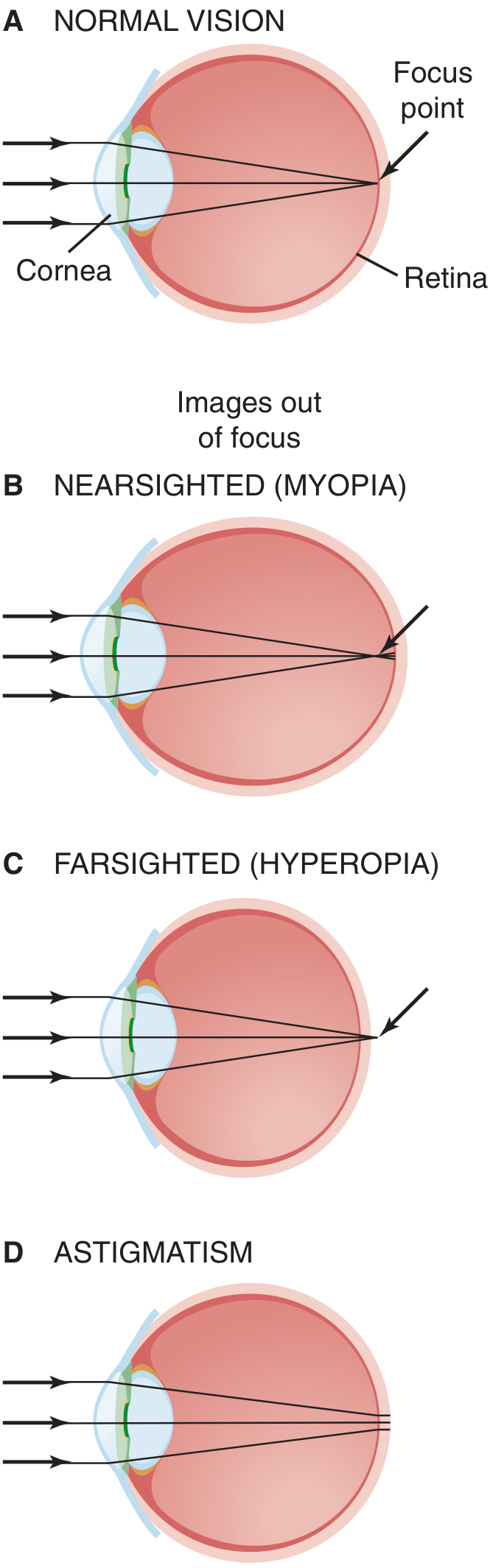
Light aankhon mein in layers se guzarti hai - har transition pe refraction hoti hai:
| Structure | Kya karta hai |
|---|---|
| Tear film | Pehli transparent surface |
| Cornea | Sabse zyada refraction (+48.2 D) |
| Cornea-aqueous interface | Thoda power wapas leta hai (-5.9 D) |
| Crystalline Lens | Variable focusing power (~15-20 D) |
| Vitreous humor | Light retina tak pahunchati hai |
Cornea: Main Refractive Surface
- Cornea aankhon ki ~70-75% refractive power provide karta hai
- Iska outer surface (air → cornea) bade refractive index difference ki wajah se +48.2 D power deta hai
- Andar ki surface (cornea → aqueous humor) se thoda sa power (-5.9 D) kho jaata hai kyunki wahan index difference bahut kam hai
Crystalline Lens: Variable Power (Accommodation)
Lens ki khaasiyat yeh hai ki yeh apni shape change kar sakta hai - isse accommodation kehte hain:
- Jab ciliary muscles contract karti hain → zonular fibers dheelay ho jaate hain → lens gol (rounder) ho jaata hai → curvature (r) kam ho jaata hai → formula ke hisaab se power badhti hai (D = n₂-n₁/r mein r chota = D bada)
- Jab ciliary muscles relax karti hain → lens 납작 (flat) ho jaata hai → power kam hoti hai → door ki cheezein focus hoti hain
Yeh ek real-time physics adjustment hai jo aankh har second karta rehta hai!
Total Eye Power
| Component | Power |
|---|---|
| Cornea (outer surface) | +48.2 D |
| Cornea (inner surface) | -5.9 D |
| Crystalline Lens (relaxed) | ~+15 D |
| Total (relaxed eye) | ~60 Diopters |
Yeh ~60 D power light ko retina pe focus karti hai jo cornea se ~24 mm peeche hoti hai.
Refractive Errors - Physics kahan galat ho jaata hai?
| Error | Physics | Correction |
|---|---|---|
| Myopia (Nearsightedness) | Eyeball zyada lamba, light retina se PEHLE focus hoti hai | Concave lens (negative power) |
| Hyperopia (Farsightedness) | Eyeball chota, light retina ke PEECHE focus hoti | Convex lens (positive power) |
| Astigmatism | Cornea ki curvature uneven, ek point focus nahi banta | Cylindrical lens |
| Presbyopia | Lens stiff ho jaata hai (aging), accommodation fail | Reading glasses |
Summary
Physics ka jo Snell's Law (refraction ka mool niyam) hai, wahi aankhon mein apply hota hai. Diopter ek derived unit hai jो seedha focal length ki reciprocal hai (1/f). Cornea sabse zyada power deta hai (~42-48 D), aur lens accommodation ke zariye near/far focusing adjust karta hai. Puri aankh ek biological optical system hai jahan physics ke principles exactly follow hote hain.
- Medical Physiology (Boron & Boulpaep), p. 538-539
- Guyton and Hall Textbook of Medical Physiology
Eye ka refractive power conea ka alga jaise
Aap pooch rahe hain har individual component (cornea, lens, aqueous, etc.) ka alag-alag refractive power. Seedha answer pehle:
- Cornea ~43-48 D, Lens ~15-20 D (variable), Total ~60 D
- Har surface alag contribute karti hai
Searching sources...
Finding Sources
Finding Sources
Reading File
Finding Sources
Finding Sources
Reading File
Finding Sources
Finding Sources
Reading File
Loading Image
Ab sab kuch clear hai. Yeh raha poora breakdown:
Aankhon ke Har Component ka Alag Refractive Power
Pehle - Refractive Index samjho (diagram dekho)
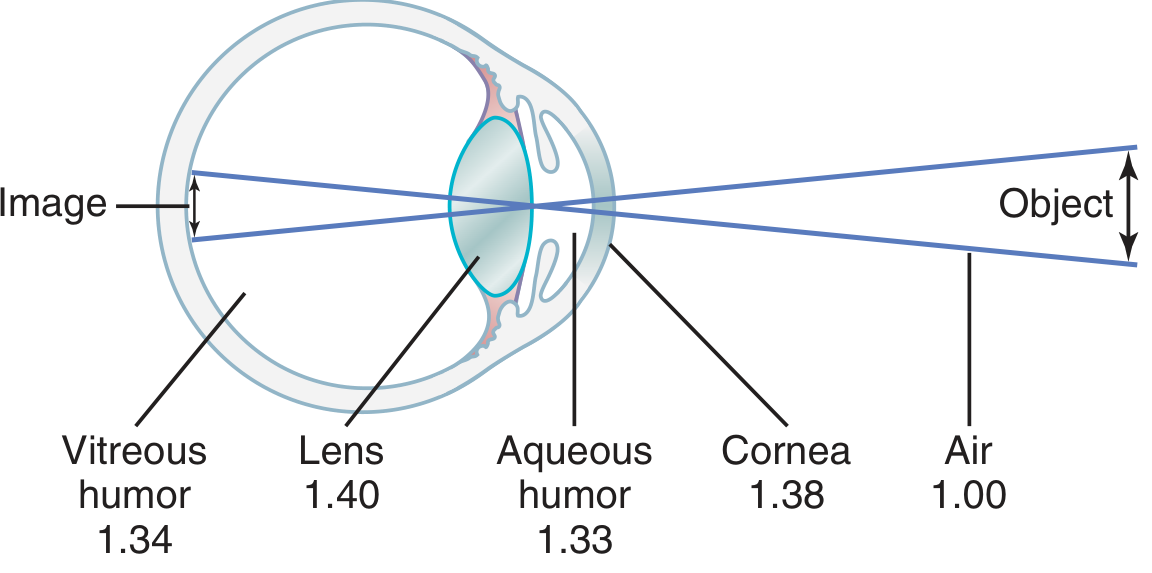
Light jab ek medium se doosre mein jaati hai, tab jo index difference hota hai, wahi refraction/power decide karta hai:
| Medium | Refractive Index (n) |
|---|---|
| Air | 1.00 |
| Cornea | 1.38 |
| Aqueous humor | 1.33 |
| Crystalline Lens | 1.40 (average) |
| Vitreous humor | 1.34 |
4 Refractive Interfaces - Alag Alag Power
Aankhon mein 4 surfaces par refraction hoti hai:
1. Air → Cornea (Anterior surface)
- Index change: 1.00 → 1.38 = difference of 0.38 (SABSE BADA!)
- Yahi sabse zyada power deta hai
- Power: ~+48.2 D
- Isi liye cornea aankhon ki ~2/3 power provide karta hai
2. Cornea → Aqueous humor (Posterior surface)
- Index change: 1.38 → 1.33 = difference of only 0.04 (bahut chota)
- Reversed curvature hoti hai is surface par, to power negative
- Power: -5.9 D (thoda power wapas cheen leta hai)
- Net Cornea Power = 48.2 - 5.9 = ~42.3 D
3. Aqueous humor → Lens (Anterior surface of lens)
- Index change: 1.33 → 1.40 = difference of 0.07
4. Lens → Vitreous humor (Posterior surface of lens)
- Index change: 1.40 → 1.34 = difference of 0.06
- Lens dono sides se contribute karta hai
- Total Lens Power = ~20 D (relaxed state mein)
Summary Table - Kya kitna contribute karta hai
| Component | Power | % of Total |
|---|---|---|
| Cornea (net) | ~42 D | ~2/3 (67%) |
| Crystalline Lens | ~20 D (relaxed) | ~1/3 (33%) |
| Aqueous humor | negligible | - |
| Vitreous humor | negligible | - |
| TOTAL (relaxed eye) | ~59-60 D | 100% |
Cornea itna powerful kyun hai?
Air aur Cornea ke beech index difference = 0.38
Aqueous aur Lens ke beech index difference = sirf 0.07
Isliye cornea zyada power deta hai - index difference bada hoga, utni zyada refraction hogi. Formula yaad karo:
D = (n₂ - n₁) / r
Lens mein n difference chota hai (aaspaas sab ~1.33-1.40 hain), to uski power kam aati hai despite badi curved surface hone ke baad bhi.
Lens ki Khaasiyat - Accommodation
Lens ki power fixed nahi hai - yeh change kar sakta hai:
| Condition | Ciliary Muscle | Lens Shape | Power |
|---|---|---|---|
| Door dekhna (far) | Relaxed | 납작 (flat) | ~20 D |
| Paas dekhna (near) | Contract | Gol (round) | ~34 D |
| Accommodation range (children) | - | - | +14 D extra |
Jaise-jaise umar badhti hai, lens stiff ho jaata hai aur yeh accommodation kam hoti jaati hai - isse Presbyopia kehte hain (40+ ki umar mein reading glasses ki zaroorat).
"Reduced Eye" - Simplified Model
Clinically sab surfaces ko milaakar ek single lens maan lete hain - ise "Reduced Eye" kehte hain:
- Single refractive point retina se 17 mm aage
- Total power = 59 D (distant vision)
(Guyton & Hall Textbook of Medical Physiology, p. 623)
(Medical Physiology - Boron & Boulpaep, p. 538-539)

178310666492120347162745329543.jpg
Yaha eye kya hai jab conea lens alag se diapter dia hai toh
Conea ka Refractive Power lens से ज्यादा है तो फिर reflective index cornea का lens से कम कैसे?
Bahut achha sawal! Yeh ek classic confusion hai. Seedha jawab:
Refractive power sirf refractive index pe depend nahi karta - DIFFERENCE pe depend karta hai.
Confusion Clear Karo - Ek Example se
Socho ek swimming pool mein pani hai. Agar tum pani ke andar se dekho, to cheezein uthni bent nahi dikhti jitni bahar se dikhti hain. Kyunki jo medium surrounding mein hai, woh matter karta hai.
Formula yaad karo
D = (n₂ - n₁) / r
Power decide hota hai n₂ - n₁ se, matlab do mediums ke beech ka FARK.
Cornea ka case
AIR (n = 1.00) →→→ CORNEA (n = 1.37-1.38)
Index difference = 1.38 - 1.00 = 0.38 ← BAHUT BADA FARK
Isliye cornea ki power = 43-45 D (high!)
Lens ka case
AQUEOUS HUMOR (n = 1.33) →→→ LENS (n = 1.40) →→→ VITREOUS (n = 1.34)
Index difference = 1.40 - 1.33 = 0.07 ← BAHUT CHOTA FARK
Isliye lens ki power = 16-17 D (low!)
Aapke image ka "Eye - 58-60 D" kya hai?
Aapne bilkul sahi pooch - Eye = 58-60 D alag kyun diya hai jab Cornea + Lens = 43 + 17 = ~60 D hi hota hai?
Jawab yeh hai:
Image mein jo breakdown hai:
- Cornea = 43-45 D → Yeh net cornea power hai (anterior surface ka +48 D MINUS posterior surface ka -5 D = ~43 D)
- Lens = 16-17 D → Lens ki net power surrounded by aqueous/vitreous
- Eye = 58-60 D → Inhi dono ka TOTAL (43 + 17 = 60 D)
To "Eye" wala figure alag number nahi hai - yeh Cornea + Lens ka sum hi hai!
Key Insight - Table mein dekho
| Surface | Left medium (n) | Right medium (n) | DIFFERENCE | Power |
|---|---|---|---|---|
| Cornea anterior | Air (1.00) | Cornea (1.38) | 0.38 | High (+48 D) |
| Cornea posterior | Cornea (1.38) | Aqueous (1.33) | -0.05 | Small (-5 D) |
| Lens anterior | Aqueous (1.33) | Lens (1.40) | 0.07 | Moderate |
| Lens posterior | Lens (1.40) | Vitreous (1.34) | -0.06 | Moderate |
Conclusion: Lens ka apna refractive index (1.40) cornea se zyada hone ke bawajood uski power kam hai, kyunki uske aaspaas ka medium (aqueous/vitreous ~1.33-1.34) bhi similar index ka hai - difference chota hai isliye power kam hai.
Cornea powerful hai kyunki AIR ke baad seedha aata hai - air ka index 1.00 aur cornea ka 1.38 - yeh bada jump power deta hai.
This is a shared conversation. Sign in to Orris to start your own chat.