

IMG-20260602-WA0005.jpg
A 26 yr old female has white spots with gradual onset behind her neck since one month no associated itching or irritation give the condition and management
Reading File
The image shows multiple small, hypopigmented (lighter than surrounding skin) macules on the posterior neck and upper back - no scaling, no erythema. Combined with the gradual onset, young female, no itching, the most likely diagnosis is Pityriasis Versicolor (Tinea Versicolor) or Idiopathic Guttate Hypomelanosis, though the distribution also raises Vitiligo as a differential.
Searching sources...
Finding Sources
Finding Sources
Searching PubMed
pityriasis versicolor treatment management
Reading File
Reading File
Reading File
Now let me get the treatment section for Tinea Versicolor and look at Fitzpatrick's for management:
Reading File
Reading File
I now have sufficient information for a complete answer. Let me also fetch the clinical image from the textbook for context.
Loading Image
Here is the full clinical assessment and management plan:
Diagnosis: Pityriasis (Tinea) Versicolor
The image shows multiple well-defined, round-to-oval hypopigmented macules on the posterior neck and upper back, consistent with Pityriasis Versicolor (also called Tinea Versicolor).
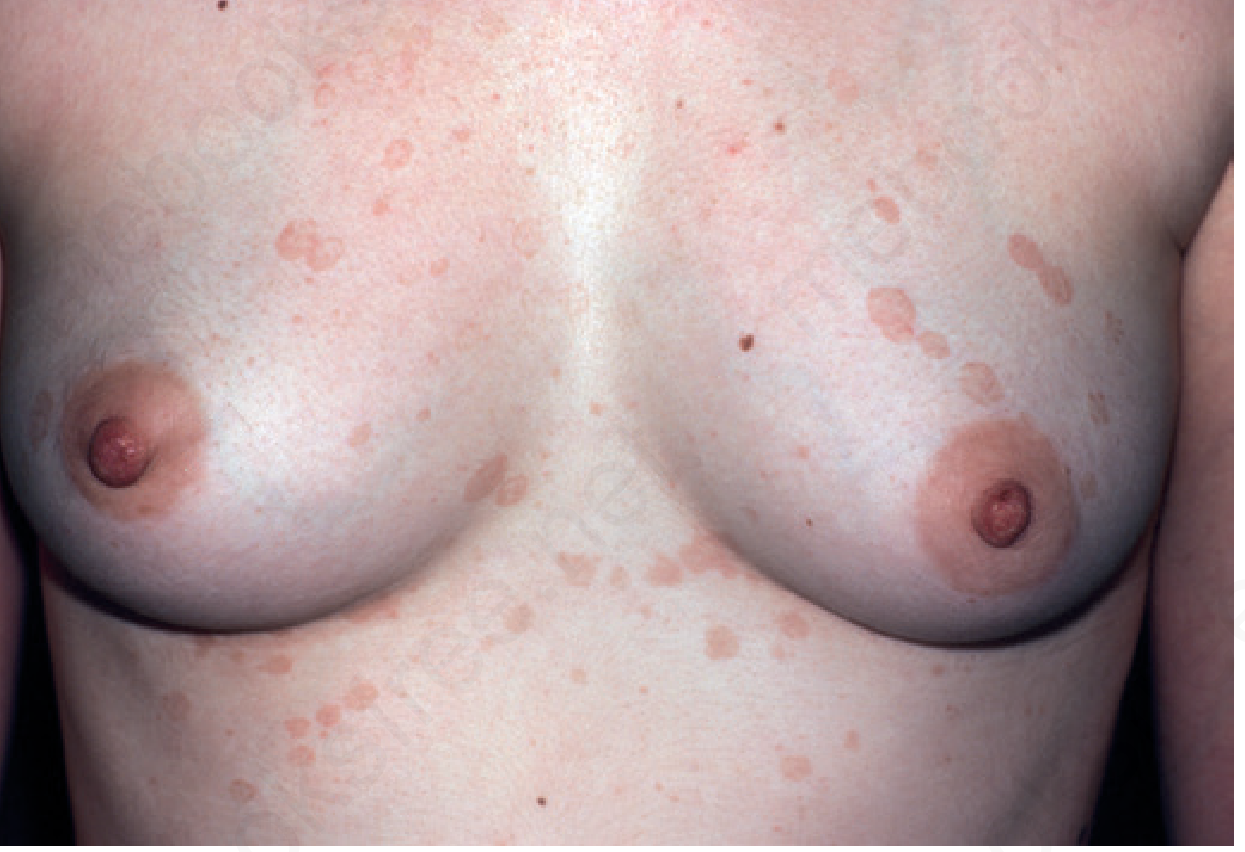
Textbook image of Tinea Versicolor (Andrews' Diseases of the Skin, p. 358)
Why This Diagnosis Fits
| Feature | This Patient | Pityriasis Versicolor |
|---|---|---|
| Age | 26 yr female | Young adults, common in women |
| Location | Posterior neck, upper back | Sternal, back, neck, shoulders - classic sites |
| Morphology | White/hypopigmented macules | Hypopigmented or hyperpigmented coalescing macules |
| Onset | Gradual, 1 month | Gradual |
| Itching | None | Generally asymptomatic - major concern is appearance |
| Season | - | More common in summer/warm climates |
The condition is caused by Malassezia species (mainly M. globosa). In hypopigmented tinea versicolor, the yeast produces dicarboxylic acids that inhibit melanin synthesis, resulting in poorly melanized melanosomes that are not transferred to keratinocytes. This is especially conspicuous in dark-skinned individuals.
Confirm the Diagnosis
- KOH mount of skin scrapings: shows "spaghetti and meatballs" pattern - short, thick hyphae + clusters of spores
- Wood's lamp: may show yellow-green fluorescence
- No culture needed in routine cases
Differential Diagnosis to Keep in Mind
- Vitiligo - completely depigmented (chalk-white), no scale, sharp margins, often perioral/periorbital; not hypopigmented
- Pityriasis alba - poorly marginated, associated with atopy
- Seborrheic dermatitis - erythematous yellowish scale, greasy
- Leprosy (indeterminate/tuberculoid) - hypoesthetic patch; check sensation
- Pityriasis rosea - collarette scale, herald patch, usually itchy
Management
Topical Treatment (first-line)
| Agent | Regimen |
|---|---|
| Selenium sulfide 2.5% lotion | Apply daily for 7 days, leave 10 min then wash off; or single overnight application monthly as prophylaxis |
| Ketoconazole 2% shampoo/cream | Apply to affected area, leave 5-10 min, wash off; daily for 2-3 weeks |
| Zinc pyrithione soap | Cost-effective, well tolerated; daily wash for treatment and prophylaxis |
| Clotrimazole / miconazole cream | Apply twice daily for 2-4 weeks |
| Ciclopirox olamine cream | Twice daily for 2 weeks |
Systemic Treatment (for extensive/recurrent disease)
- Itraconazole 200 mg once daily for 7 days, OR 400 mg as a single dose
- Fluconazole 400 mg single dose (can repeat monthly for prophylaxis)
- Note: Oral terbinafine is not effective for tinea versicolor (poor secretion in sweat)
Prophylaxis (important - high relapse rate)
- Monthly overnight application of selenium sulfide or ketoconazole shampoo
- Weekly washing with zinc pyrithione bar
- Monthly oral fluconazole 400 mg if recurrent
Counseling Points (Patient Education)
- Hypopigmentation will persist for weeks to months after successful treatment - this is NOT treatment failure; it takes time for melanocytes to recover.
- Sun exposure (UV) may speed up repigmentation.
- Recurrence is common - prophylactic treatment is important.
- The condition is not contagious in the conventional sense.
Sources: Andrews' Diseases of the Skin, p. 357-358; Dermatology 2-Volume Set 5e (Bolognon et al.), p. 1896-1911; Andrews' Diseases of the Skin, p. 1001 (vitiligo differential)
This is a shared conversation. Sign in to Orris to start your own chat.