
treatment for curpal tunnel syndrome
"carpal tunnel syndrome"[MeSH Terms] AND treatment
carpal tunnel syndrome anatomy treatment

<table><thead><tr><th>Authors</th><th>Year</th><th>Article Title</th><th>Periodical</th><th>Reason for Exclusion</th></tr></thead><tbody><tr><td></td><td></td><td>system and full motion forearm supports</td><td></td><td></td></tr><tr><td>Heidarian,A.; Abbasi,H.; Hasanzadeh,Hoseinabadi M.; Hajialibeyg,A.; Kalantar Motamedi,S.M.; Seifirad,S.</td><td>2013</td><td>Comparison of Knifelight Surgery versus Conventional Open Surgery in the Treatment of Carpal Tunnel Syndrome</td><td>Iran Red Crescent Med J</td><td>Does not meet inclusion criteria (invasive follow-up<3 month)</td></tr><tr><td>Helm,R.H.; Vaziri,S.</td><td>2003</td><td>Evaluation of carpal tunnel release using the Knifelight instrument</td><td>J Hand Surg Br</td><td>Does not meet inclusion criteria (invasive follow-up<3 month)</td></tr><tr><td>Helm,R.H.; Vaziri,S.</td><td>2003</td><td>Evaluation of carpal tunnel release using the Knifelight(registered trademark) instrument</td><td>Journal of Hand Surgery</td><td>duplicate of PM:12809659</td></tr><tr><td>Helwig,A.L.</td><td>2000</td><td>Treating carpal tunnel syndrome</td><td>J Fam Pract.</td><td>Insufficient data</td></tr><tr><td>Hennessey,W.J.; Kuhlman,K.A.</td><td>1997</td><td>The anatomy, symptoms, and signs of carpal tunnel syndrome</td><td>Phys.Med.Rehabil.Clin.N.Am.</td><td>background</td></tr><tr><td>Henry,S.L.; Hubbard,B.A.; Concannon,M.J.</td><td>2008</td><td>Splinting after carpal tunnel release: current practice, scientific evidence, and trends</td><td>Plast.Reconstr.Surg</td><td>survey</td></tr><tr><td>Hentz,V.R.</td><td>1977</td><td>Common hand problems</td><td>Surg Clin North Am</td><td>background</td></tr><tr><td>Herbison,G.J.; Teng,C.; Martin,J.H.; Ditunno,J.F.,Jr.</td><td>1973</td><td>Carpal tunnel syndrome in rheumatoid arthritis</td><td>Am J Phys Med</td><td>insufficient data; very low study design</td></tr><tr><td>Herman,G.E.; Schork,M.A.; Shy,Y.; Elfont,E.A.; Arbit,S.</td><td>1995</td><td>Histologists, microtomy, chronic repetitive trauma, and techniques to avoid injury: I. A statistical evaluation of the job functions performed by histologists</td><td>Journal of Histotechnology</td><td>not exclusive to CTS; very low study design</td></tr><tr><td>Herrick,R.T.; Herrick,S.K.</td><td>1987</td><td>Thermography in the detection of carpal tunnel syndrome and other compressive neuropathies</td><td>J Hand Surg Am</td><td>not exclusive to CTS; confounded design</td></tr><tr><td>Herrmann,D.N.; Logigian,E.L.</td><td>2002</td><td>Electrodiagnostic approach to the patient with suspected mononeuropathy of the upper extremity</td><td>Neurol.Clin.</td><td>background information; commentary</td></tr></tbody></table>
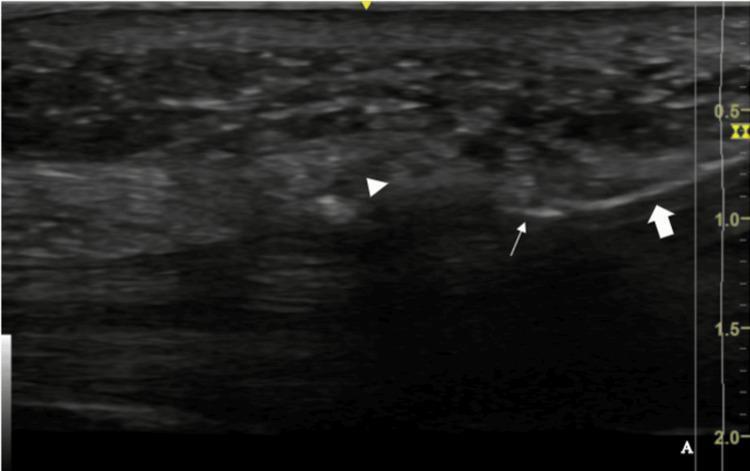
This diagnostic image is a sonographic long-axis view of the wrist, demonstrating a Sono-Instrument during a carpal tunnel release procedure. The cutting instrument (indicated by a thick white solid arrow) is positioned in the sagittal plane, making contact with the proximal portion of the transverse carpal ligament (TCL), which appears as a structure with intermediate echogenicity (marked by a white arrowhead). A distinctive hyperechoic line (noted by a thin white arrow) is visible at the distal tip of the instrument. This highly reflective linear feature corresponds to ultrasound wave reflection over a specialized flange on the blade, serving as a critical visual marker to identify the exact cutting edge of the instrument in real-time. The image illustrates the ultrasound-guided surgical technique for safely releasing the TCL while maintaining precise spatial awareness of the surgical tool relative to the wrist anatomy. This clinical visualization is essential for orthopedic surgeons and radiologists focusing on minimally invasive treatment of carpal tunnel syndrome.
Treatment of Carpal Tunnel Syndrome (CTS)
1. Conservative (Non-operative) Treatment
- The first-line treatment for mild-to-moderate CTS. The wrist is held in a neutral position (not more than 10 degrees of extension).
- Splints are best prescribed for nighttime use to prevent provocative wrist positioning during sleep. Daytime use should be limited to avoid secondary muscle weakness and fatigue.
- "Off the shelf" splints often need adjustment to neutral before use.
- Effective for symptom relief, but long-term effectiveness is limited for moderate-to-severe cases. (Firestein & Kelley's Textbook of Rheumatology)
- Oral NSAIDs (e.g., ibuprofen) are used for pain control as an adjunct to splinting.
- They do not alter the underlying nerve compression but help manage symptoms.
- Avoiding repetitive forceful finger/wrist flexion-extension, vibrating tools, and sustained wrist flexion positions.
- 100-200 mg/day has been reported helpful in some cases, but efficacy has not been confirmed in randomized controlled trials. (Firestein & Kelley's Rheumatology)
2. Corticosteroid Injection
- Methylprednisolone (or other corticosteroids) injected locally into the carpal tunnel can provide effective short-term relief.
- Long-term efficacy is mixed; symptoms frequently recur.
- Risk of permanent median nerve injury if performed incorrectly - hence this requires proper technique.
- Best indicated when:
- The condition is thought to be temporary (e.g., pregnancy-related CTS)
- Surgery must be deferred due to medical conditions
- Bridging therapy while awaiting definitive treatment
- 5% dextrose injection is an emerging alternative supported by recent evidence (Goldman-Cecil Medicine).
3. Physical Therapy and Other Conservative Modalities
- Nerve and tendon gliding exercises
- Carpal bone mobilization
- Ultrasound therapy and low-level laser therapy (LLLT)
- Extracorporeal shockwave therapy (ESWT) - gaining evidence support
- Platelet-rich plasma (PRP) injections - newer approach showing promise in studies
4. Surgical Treatment - Carpal Tunnel Release (CTR)
- Failure to respond to a full course of conservative treatment
- Late findings of objective sensory loss, thenar atrophy, or weakness - early surgery should be recommended in these patients rather than prolonged conservative management
- Persistent or recurrent symptoms after corticosteroid injections
| Approach | Description |
|---|---|
| Open CTR | Incision ≤3 cm long, parallel to palm skin creases; transverse carpal ligament (TCL) divided under direct vision |
| Endoscopic CTR | Single-portal (Agee) or dual-portal (Chow) technique; TCL cut endoscopically |
- The endoscopic approach is generally preferred (Goldman-Cecil Medicine) due to faster return to activities and less scar tenderness, though outcomes at 6-12 months are equivalent to open release.
- Wide-awake local anesthesia no tourniquet (WALANT) surgery is an increasingly used technique, reducing costs and risks compared to sedation.
- Ultrasound-guided percutaneous CTR is a newer minimally invasive technique still under evaluation.
- Division of the transverse carpal ligament (TCL) decompresses the median nerve.
- The incision parallels the thenar crease to avoid the palmar cutaneous branch of the median nerve and reduce scar sensitivity.
- Synovectomy of the flexor tendons may be performed if hypertrophic synovitis is present.
- Most patients get excellent relief of pain and paresthesias.
- Thenar atrophy and objective weakness may improve but recovery is slower and depends on duration of compression before surgery.
- Early surgery is recommended when severe neurological signs are present - do not wait in these cases.
5. Treatment of Underlying Conditions
- Hypothyroidism - thyroid replacement therapy
- Diabetes mellitus - glycemic optimization
- Pregnancy-related CTS - usually resolves after delivery; splinting and injections bridge treatment
- Rheumatoid arthritis - treatment of synovitis reduces tunnel pressure
- Obesity - weight management
Summary Algorithm
Mild-Moderate CTS
    ↓
Wrist splinting (neutral, mainly nocturnal) + NSAIDs
    ↓ (if insufficient after 4-6 weeks)
Corticosteroid injection ± physical therapy
    ↓ (if failed conservative treatment OR severe/progressive)
Surgical carpal tunnel release (endoscopic preferred)
Note: In patients with objective sensory loss or thenar atrophy at presentation, skip prolonged conservative management and proceed to early surgery to prevent permanent nerve damage.