
Vasudevan as source of biochemistry and dr jambulkar Tell gout Lesh nychan Oritic acidiura for 5 marks
I'll read the medical library skill first, then search for all three topics in parallel.
Reading File
Now let me search all three topics in parallel from the biochemistry textbooks.
Finding Sources
Finding Sources
Finding Sources
Harper's Biochemistry has all three topics. Let me read them all in parallel now.
Finding Sources
Reading File
Reading File
Now let me get the Gout section from Harper's and the full Lesch-Nyhan + Orotic aciduria content, plus fetch the relevant diagram.
Finding Sources
Reading File
Loading Image
Now let me get the Gout section content and the orotic aciduria pathway image.
Reading File
Loading Image
I have enough content now. Let me also fetch the orotic aciduria pathway figure referenced in the text (Figure 33-9).
Finding Sources
I have all the information needed. Let me now compile the full 5-mark answers.
Biochemistry Notes - Purine & Pyrimidine Metabolism
Source: Harper's Illustrated Biochemistry, 32nd Ed. (Chapters 32-33)
1. GOUT (5 Marks)
Definition
Gout is a clinical condition arising from hyperuricemia - elevated serum uric acid - leading to deposition of monosodium urate crystals in joints and soft tissues, causing an acute inflammatory arthritis called gouty arthritis.
Biochemical Background: Uric Acid Formation
Humans convert adenosine and guanosine to uric acid (the end product of purine catabolism):
Adenosine → (adenosine deaminase) → Inosine → (purine nucleoside phosphorylase) → Hypoxanthine → (xanthine oxidase) → Xanthine → (xanthine oxidase) → Uric acid
Guanosine → Guanine → (xanthine oxidase) → Xanthine → Uric acid
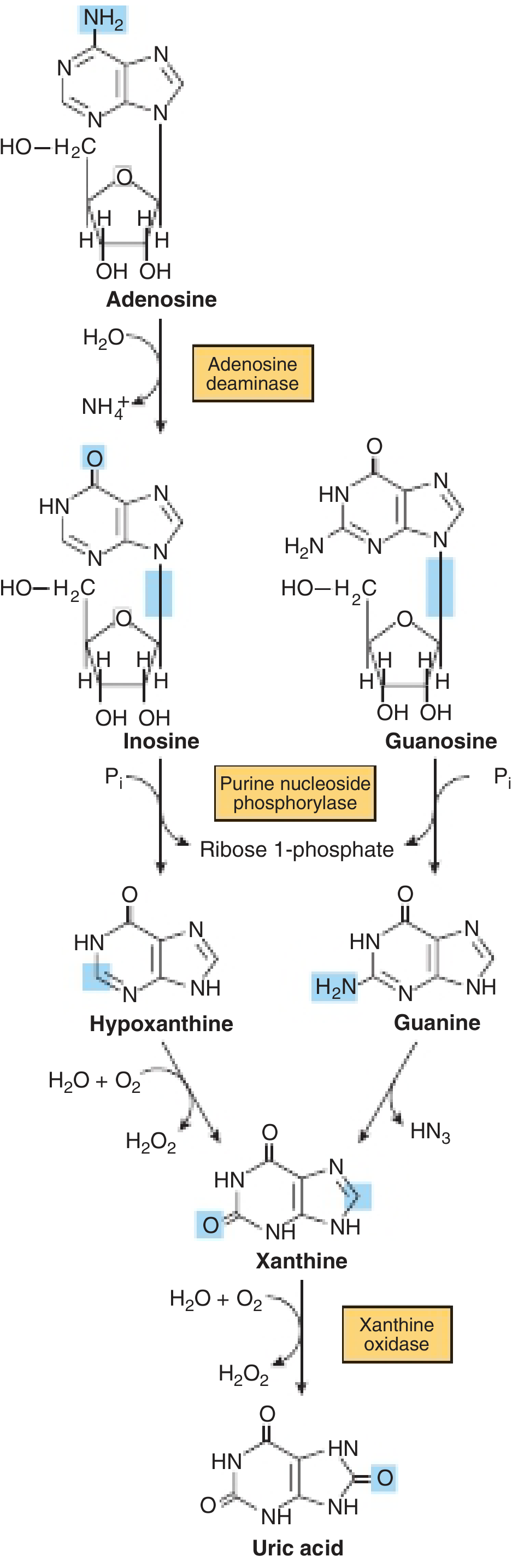
Humans lack uricase, so unlike other mammals, we cannot convert uric acid to the soluble product allantoin. Uric acid is thus poorly soluble and precipitates.
Pathogenesis
When serum urate levels exceed the solubility limit, sodium urate crystallizes in soft tissues and joints, triggering an inflammatory reaction (gouty arthritis).
Causes of hyperuricemia:
| Mechanism | Example |
|---|---|
| Overproduction of purines | Defects in PRPP synthetase (elevated Vmax, increased affinity for ribose-5-phosphate, or resistance to feedback inhibition) |
| Reduced renal excretion | Most common - abnormalities in renal handling of uric acid |
| Increased tissue turnover | Cancer, psoriasis, chemotherapy |
Genetic Defects Causing Gout
Various genetic defects in PRPP synthetase (reaction 1 of purine synthesis) present clinically as gout:
- Elevated Vmax of enzyme
- Increased affinity for ribose-5-phosphate
- Resistance to feedback inhibition
- All result in overproduction and overexcretion of purine catabolites
Classification
- Primary gout - unknown enzyme defects; may have normal or increased uric acid synthesis with decreased/normal excretion
- Secondary gout - due to known diseases (cancer, psoriasis, Lesch-Nyhan syndrome, von Gierke disease) that enhance tissue turnover or purine production
Treatment Basis (Biochemistry)
- Allopurinol - inhibits xanthine oxidase, reducing uric acid formation (xanthine and hypoxanthine accumulate instead, which are more soluble)
2. LESCH-NYHAN SYNDROME (5 Marks)
Definition
Lesch-Nyhan syndrome is an X-linked recessive disorder of purine metabolism characterized by overproduction hyperuricemia, neurological abnormalities, and self-mutilation.
Enzyme Defect
Deficiency of HPRT (Hypoxanthine-Guanine PhosphoRibosylTransferase)
- Gene: HPRT1 (X-linked)
- HPRT is a purine salvage enzyme that normally recycles hypoxanthine and guanine back to IMP and GMP respectively
Biochemical Mechanism
HPRT normally catalyzes:
Hypoxanthine + PRPP → IMP + PPi Guanine + PRPP → GMP + PPi
When HPRT is absent/deficient:
- Hypoxanthine and guanine cannot be salvaged → they are degraded to uric acid via xanthine oxidase
- PRPP accumulates (since it is not consumed in salvage) → this excess PRPP drives the de novo purine synthesis pathway → further overproduction of purines → further hyperuricemia
Clinical Features (5 Marks - include these)
| Feature | Description |
|---|---|
| Hyperuricemia | Overproduction type |
| Uric acid lithiasis | Kidney stones from uric acid |
| Gout | Recurrent gouty arthritis |
| Intellectual disability | Neurological |
| Choreoathetosis | Movement disorder |
| Spasticity | Neurological |
| Self-mutilation | Pathognomonic - biting fingers, lips, tongue |
| Onset | Neonatal - orange crystalline deposits in diapers (uric acid) |
Mutations in HPRT1 include:
- Deletions
- Frameshift mutations
- Base substitutions
- Aberrant mRNA splicing
Treatment
- Allopurinol controls hyperuricemia and gout but does not correct the neurological deficits
- No definitive cure
3. OROTIC ACIDURIA (5 Marks)
Definition
Orotic aciduria is a rare autosomal recessive disorder of pyrimidine biosynthesis characterized by excessive excretion of orotic acid in urine, megaloblastic anemia, and growth retardation.
Normal Pyrimidine Biosynthesis (Key Steps)
The de novo pyrimidine pathway:
- Carbamoyl phosphate synthetase II (cytosolic)
- Aspartate transcarbamoylase
- Dihydroorotase → dihydroorotate
- Dihydroorotate dehydrogenase → orotate
- Orotate phosphoribosyltransferase (OPRT) → orotidylate (OMP) [Reaction 5]
- Orotidylate decarboxylase (ODCase) → UMP [Reaction 6]
Types of Orotic Aciduria
| Type | Enzyme Deficient | Reactions Affected |
|---|---|---|
| Type I (classic) | Both OPRT and ODCase | Reactions 5 & 6 |
| Type II (rarer) | ODCase only | Reaction 6 only |
In both types, orotic acid accumulates and is excreted in urine.
Clinical Features
- Megaloblastic anemia (not responsive to B12 or folate)
- Growth retardation / failure to thrive
- Orotic acid crystals in urine
- Intellectual disability (if untreated)
Biochemical Basis of Anemia
- Defective pyrimidine synthesis → insufficient UMP → insufficient thymidylate for DNA synthesis → impaired cell division → megaloblastic anemia
Secondary Causes of Orotic Aciduria
1. Reye Syndrome:
- Severely damaged mitochondria cannot utilize carbamoyl phosphate
- Carbamoyl phosphate leaks to cytosol → cytosolic overproduction of orotic acid
2. Ornithine Transcarbamoylase (OTC) Deficiency (Urea Cycle defect):
- Deficiency of liver mitochondrial OTC → excess carbamoyl phosphate exits to cytosol → stimulates pyrimidine biosynthesis → orotic acid, uracil, and uridine excreted
- Mild orotic aciduria, increased by high-nitrogen diet
3. Drug-Induced Orotic Aciduria:
| Drug | Mechanism |
|---|---|
| Allopurinol | Acts as alternate substrate for OPRT (reaction 5); resulting nucleotide inhibits ODCase (reaction 6) → orotic aciduria + orotidinuria |
| 6-Azauridine | Converted to 6-azauridylate → competitively inhibits ODCase (reaction 6) → orotic acid and orotidine excreted |
Treatment
- Uridine administration (bypasses the block) - corrects anemia and growth
- Uridine is phosphorylated to UMP directly, bypassing the defective enzymes
Quick Comparison Table (Exam Ready)
| Feature | Gout | Lesch-Nyhan | Orotic Aciduria |
|---|---|---|---|
| Type | Purine catabolism | Purine salvage defect | Pyrimidine synthesis defect |
| Enzyme defect | PRPP synthetase (or renal) | HPRT (HPRT1 gene) | OPRT and/or ODCase |
| Key metabolite ↑ | Uric acid | Uric acid (+ PRPP) | Orotic acid |
| Inheritance | Multifactorial / X-linked | X-linked recessive | Autosomal recessive |
| Key clinical sign | Gouty arthritis, tophi | Self-mutilation | Megaloblastic anemia |
| Treatment | Allopurinol | Allopurinol (partial) | Uridine |
Source: Harper's Illustrated Biochemistry, 32nd Ed., Chapter 33 (Nucleotide Metabolism), pp. 354-358
Secondary gout
Secondary gout develops as a consequence of another disease or condition that increases uric acid production or decreases its excretion—as opposed to primary gout from genetic enzyme defects. Let me search the medical library for comprehensive coverage.
Finding Sources
Finding Sources
Good sources found. Let me read the detailed content on secondary causes.
Reading File
Reading File
Reading File
Let me get more specific details on the secondary causes - especially Box 193.2 mentioned earlier.
Reading File
Let me search for Box 193.2 more directly.
Finding Sources
I have enough detailed information. Let me compile the comprehensive answer on secondary gout.
SECONDARY GOUT
Definition
Secondary gout is hyperuricemia and gout that develops as a consequence of an identifiable underlying clinical disorder, medication, or toxic state—in contrast to primary (idiopathic) gout where no specific cause is evident.
Key distinction:
- Primary gout: Polygenic basis, uncertain etiology (essential hyperuricemia)
- Secondary gout: Specific identifiable process causing hyperuricemia
Classification of Secondary Causes
Secondary hyperuricemia (leading to gout) can be divided into two major categories:
1. CAUSES OF URATE OVERPRODUCTION
Increased synthesis and catabolism of purines
A. Hematologic Malignancies & Tumor Lysis
- Acute leukemias - rapid proliferation of blast cells
- Lymphomas - massive nucleic acid turnover
- Tumor lysis syndrome - acute massive destruction of tumor cells releasing intracellular purines and nucleic acids → rapid purine catabolism to uric acid
- Hemolytic anemias - accelerated destruction of RBCs → increased nucleic acid catabolism
B. Solid Tumors & High Cell Turnover
- Psoriasis - massive skin cell proliferation and turnover
- Aggressive neoplasms - rapid cell division
- Post-chemotherapy - colchicine, corticosteroids, and chemotherapeutic agents cause massive tumor cell destruction
C. Metabolic Diseases
- Von Gierke disease (glucose-6-phosphatase deficiency) - overproduction of PRPP → enhanced purine synthesis
- Lesch-Nyhan syndrome (HPRT deficiency) - failure of purine salvage → increased PRPP → purine overproduction
D. High Dietary Purine Intake
- Red meat, liver, kidneys, sardines, anchovies
- High-protein diet
- Alcohol (especially beer)
2. CAUSES OF URATE UNDEREXCRETION
Decreased renal excretion of uric acid (80% of hyperuricemia cases)
A. Renal Insufficiency / Chronic Kidney Disease (CKD)
- Any stage of CKD leads to reduced glomerular filtration and tubular secretion of urate
- Most common secondary cause of hyperuricemia
- Progressive decline in GFR reduces clearance of uric acid
B. Medications (Drug-Induced)
-
Diuretics - thiazide diuretics and loop diuretics (classic cause)
- Mechanism: Compete for tubular secretion; reduce urine pH → decreased urate excretion
- High-dose aspirin (salicylates) - inhibit uric acid secretion at low doses; promote excretion at high doses
-
Other drugs:
- Cyclosporine
- Tacrolimus
- Antiretrovirals (e.g., ritonavir)
- Pyrazinamide
- Ethambutol
- Theophylline
C. Organic Acidemias (Interfere with Tubular Secretion)
- Lactic acidosis - elevated lactate competes with urate for tubular secretion
- Diabetic ketoacidosis - elevated acetoacetic acid interferes with renal tubular secretion of urate
- Starvation ketosis
- Alcoholic ketoacidosis
D. Dehydration / Volume Depletion
- Reduced glomerular filtration rate
- Enhanced renal tubular reabsorption of urate
E. Genetic Renal Transporter Defects (can present secondarily in context of other disease)
- ABCG2 mutations (loss-of-function) - defective uric acid export
- URAT1 mutations or overactivity - excessive uric acid reabsorption
- GLUT9 dysfunction
- Familial Juvenile Hyperuricemic Nephropathy (FJHN) / Medullary Cystic Kidney Disease (MCKD) - progressive renal disease with early hyperuricemia
Combined Underexcretion + Overproduction
Important: Many patients with secondary gout have BOTH mechanisms:
- Underexcretion is the predominant feature in ~80% of hyperuricemia
- Overproduction occurs in ~25% of cases
- Combined defects increase risk substantially
Example: Patient with CKD on diuretics + chemotherapy = dual mechanism underexcretion + overproduction
Clinical Features Distinguishing Secondary vs. Primary Gout
| Feature | Primary Gout | Secondary Gout |
|---|---|---|
| Age of onset | Usually >40 years; gradual | May occur at any age; often acute |
| Identifiable cause | None evident | Clear underlying disease/drug/toxin |
| Uric acid level | Often moderately elevated | Often very high (>8-10 mg/dL) |
| Acute presentation | Classic podagra (big toe) | May be polyarticular; can occur anywhere |
| Course | Intermittent attacks | Dependent on underlying disease course |
| Labs | Hyperuricemia + normal renal function | Hyperuricemia ± abnormal renal function |
| Responsiveness to Rx | Good response to urate-lowering therapy | May require treatment of underlying condition |
Management of Secondary Gout
1. Treat the Underlying Condition
- Control malignancy (chemotherapy, radiation)
- Manage CKD (ACE-I, ARB, control BP/glucose)
- Correct metabolic acidosis
- Rehydrate if dehydrated
2. Modify Medications
- Discontinue offending drugs if possible:
- Replace thiazide diuretics with ACE-I or ARB
- Avoid high-dose aspirin
- Use alternative antiretrovirals if available
- Switch to uricosuric alternatives if needed
3. Lifestyle Modifications
- Avoid purine-rich foods: liver, kidneys, red meat, sardines, anchovies
- Limit alcohol: especially beer (high purine content)
- Maintain hydration: 2-3 L daily to promote urate excretion
- Weight management: obesity reduces renal urate excretion
4. Acute Attack Management
- NSAIDs (indomethacin, naproxen) - first-line anti-inflammatory
- Colchicine - early in attack (reduces inflammation; less effective if delayed)
- Corticosteroids - if NSAIDs/colchicine contraindicated
5. Urate-Lowering Therapy
Only after acute attack resolves; target serum urate <0.36 mmol/L (<6 mg/dL)
-
Xanthine oxidase inhibitors:
- Allopurinol - reduces uric acid production
- Febuxostat - selective xanthine oxidase inhibitor
-
Uricosuric agents (enhance renal excretion):
- Probenecid - inhibits tubular reabsorption of urate
- Benzbromarone
- Lesinurad
-
Uricase:
- Pegloticase - converts uric acid to allantoin (for refractory cases)
Key Points for Exam
- Secondary gout has an identifiable cause (disease, drug, or toxin)
- 80% of hyperuricemia is due to underexcretion; 25% due to overproduction
- Most common secondary cause: CKD + diuretics
- Most acute secondary cause: Tumor lysis syndrome (massive uric acid spike)
- Management requires treating the underlying condition + urate-lowering therapy
- Prophylactic allopurinol is started AFTER acute attack resolves, during flare treatment
Sources:
- Rheumatology, 2-Volume Set (Elsevier 2022), Chapter 193 - Gout
- Tietz Textbook of Laboratory Medicine, 7th Edition
- Firestein & Kelley's Textbook of Rheumatology, Chapter 96
This is a shared conversation. Sign in to Orris to start your own chat.