
Corticosteroid notes for pharmacology proper
Reading File
Now let me search the library for corticosteroid content across multiple angles simultaneously.
Finding Sources
Finding Sources
Finding Sources
Now let me search the pharmacology textbooks specifically for corticosteroid content:
Finding Sources
Finding Sources
Let me search the pharmacology books directly by their ISBN:
Finding Sources
Finding Sources
The Goodman & Gilman block14 and Katzung block8 have the main content. Let me read both simultaneously:
Reading File
Reading File
Excellent content. Let me continue reading both books for more details on specific drugs, adverse effects, and clinical uses:
Reading File
Reading File
Now let me read the adverse effects and specific drug tables from Goodman & Gilman, plus get the Katzung table on drug comparisons:
Reading File
Searching Images
corticosteroid glucocorticoid receptor mechanism of action diagram
I have comprehensive material. Let me now fetch the diagram from Goodman & Gilman that shows the GR mechanism:
Loading Image
Reading File
According to KDT
KDT = KD Tripathi's Essentials of Medical Pharmacology. Let me find it in the library.
Searching sources...
Finding Sources
Finding Sources
KD Tripathi's textbook is not in the library. The available pharmacology textbooks are Goodman & Gilman, Katzung, and Lippincott. Let me check if Lippincott has good corticosteroid coverage (it's also a very popular exam-oriented pharmacology text, similar in spirit to KDT), and pull all three for the most complete notes.
Finding Sources
Finding Sources
Finding Sources
Finding Sources
Finding Sources
Finding Sources
Lippincott block3 has the corticosteroid chapter. Let me read it in full alongside the Katzung adrenal chapter:
Reading File
Reading File
I have Lippincott's corticosteroid chapter clearly. Let me read more of it - the glucocorticoids section with clinical uses and drug comparisons:
Reading File
Now let me fetch the key Lippincott diagrams:
Loading Image
Loading Image
I now have comprehensive material from Lippincott (which follows a very similar framework to KDT) plus Goodman & Gilman. Let me compile the complete notes.
Note: KD Tripathi's Essentials of Medical Pharmacology is not available in the library. The notes below are compiled from Lippincott Illustrated Reviews: Pharmacology and Goodman & Gilman's, which cover corticosteroids in the same structured, exam-oriented format as KDT. The content is equivalent for pharmacology exam preparation.
Corticosteroids - Pharmacology Notes
(Lippincott Illustrated Reviews: Pharmacology + Goodman & Gilman's)
1. Adrenal Cortex - Zones and Products
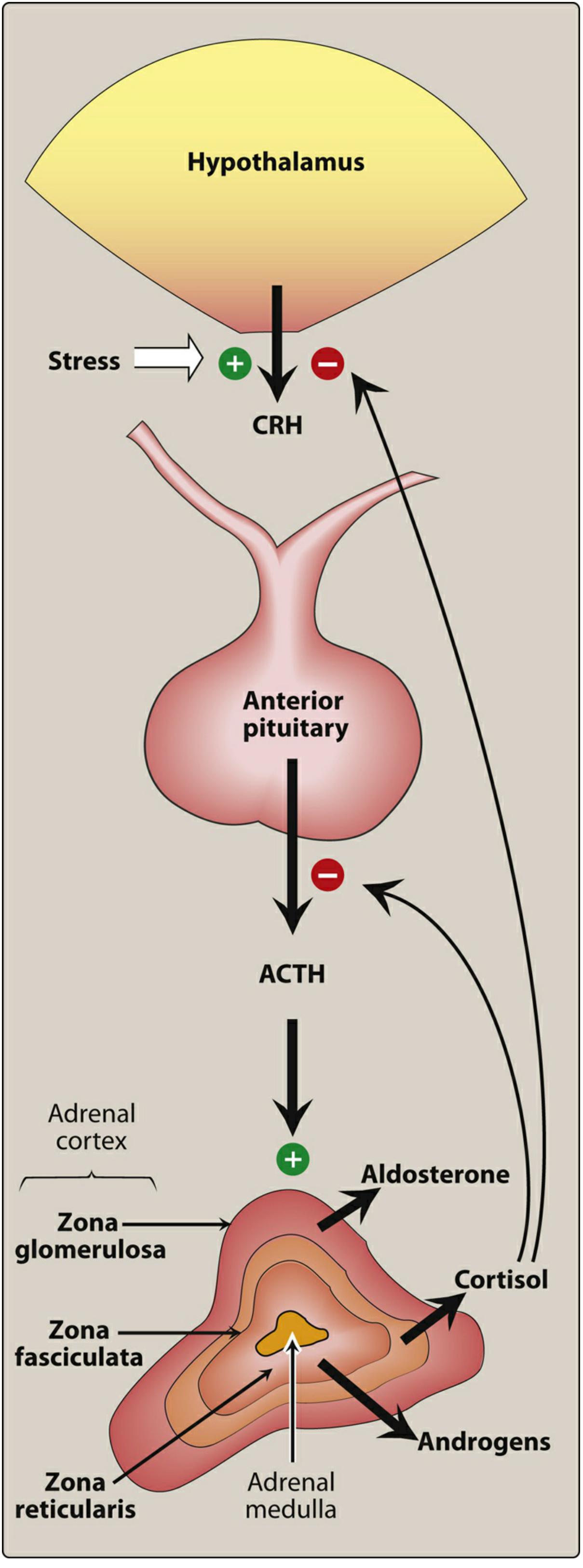
Figure: HPA axis and adrenal cortex zones (Lippincott, Fig. 26.2)
| Zone | Product | Function |
|---|---|---|
| Zona glomerulosa (outer) | Mineralocorticoids (aldosterone) | Salt and water metabolism |
| Zona fasciculata (middle) | Glucocorticoids (cortisol) | Metabolism, stress response |
| Zona reticularis (inner) | Adrenal androgens | Sex hormone precursors |
- Zones fasciculata and reticularis (and to a lesser extent glomerulosa) are controlled by ACTH from the anterior pituitary
- ACTH is itself released in response to hypothalamic CRH
- Glucocorticoids provide negative feedback on both ACTH (pituitary) and CRH (hypothalamus)
- Cortisol secretion is diurnal - peak in early morning, smaller secondary peak in late afternoon
2. Mechanism of Action
Corticosteroids bind to specific intracellular cytoplasmic receptors:
- Glucocorticoid Receptors (GR / NR3C1) - widely distributed throughout the body
- Mineralocorticoid Receptors (MR / NR3C2) - mainly excretory organs: kidney, colon, salivary glands, sweat glands. Both types also found in brain.
Steps:
- Steroid crosses cell membrane (lipid soluble)
- Binds cytoplasmic receptor (receptor resides in cytoplasm complexed with chaperone proteins - heat shock proteins)
- Receptor-hormone complex dimerizes
- Recruits coactivator or corepressor proteins
- Translocates into nucleus
- Attaches to glucocorticoid response elements (GREs) on gene promoters
- Acts as transcription factor - turns genes ON (with coactivators) or OFF (with corepressors)
Because this mechanism involves gene transcription and protein synthesis, many effects take hours to days to manifest.
Cortisol vs. Aldosterone - Receptor Specificity:
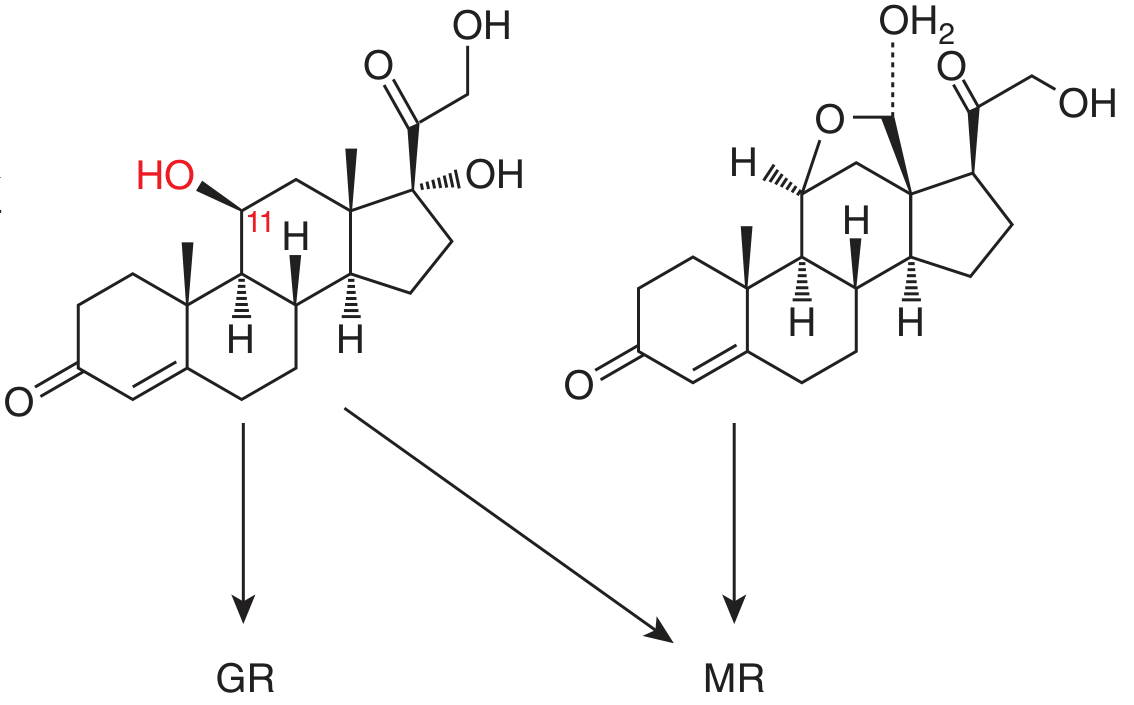
- Cortisol and aldosterone bind MR with equally high affinity; cortisol has more modest GR affinity
- In mineralocorticoid target tissues, cortisol is converted to inactive cortisone by 11β-HSD2, preventing inappropriate MR activation
- In other tissues, cortisone is converted back to active cortisol by 11β-HSD1
3. Physiologic and Pharmacologic Effects of Glucocorticoids
A. Metabolism
| System | Effect |
|---|---|
| Carbohydrate | ↑ Hepatic gluconeogenesis (↑ PEPCK, glucose-6-phosphatase, glycogen synthase) → ↑ blood glucose; ↓ peripheral glucose utilization |
| Protein | ↑ Catabolism in muscle → release of amino acids for gluconeogenesis; ↑ glutamine synthesis |
| Fat | Lipolysis ↑ (permissive for GH and catecholamines); redistribution → central obesity, moon facies, buffalo hump, supraclavicular fat |
| Overall | "Diabetogenic" - can precipitate or worsen diabetes mellitus |
B. Fluid and Electrolytes
- Glucocorticoids have mild mineralocorticoid-like effects (Na+ retention, K+ loss, hypertension) at high doses
- Decrease Ca²⁺ absorption from gut, increase Ca²⁺ mobilization from bone, increase renal Ca²⁺ excretion → ↓ total body calcium
- Permissive role in free water excretion via the kidney (GC-deficient patients cannot excrete free water normally → hyponatremia)
C. Blood Cell Effects
| Cell Type | Effect |
|---|---|
| Neutrophils (PMNs), erythrocytes, platelets, Hb | ↑ Increased |
| Eosinophils, basophils, monocytes, lymphocytes | ↓ Decreased (redistributed to lymphoid tissue) |
Mnemonic: "BELM↓, NEPR↑" - Basophils, Eosinophils, Lymphocytes, Monocytes decrease; Neutrophils, Erythrocytes, Platelets, (RBC) Rise
D. Anti-inflammatory and Immunosuppressive Actions (Most Important Therapeutic Property)
- ↑ Lipocortin (annexin A1) - inhibits phospholipase A2 → blocks arachidonic acid release → ↓ prostaglandins and leukotrienes
- ↓ Cytokine production - IL-1, IL-2, IL-6, TNF-α, IFN-γ
- Inhibit NF-κB - key transcription factor for inflammatory genes
- Stabilize mast cell and basophil membranes → ↓ histamine release
- Inhibit leukocyte and macrophage responses to mitogens and antigens
- ↓ Capillary permeability (decrease tissue edema)
- Inhibit fibroblast proliferation → impaired wound healing
E. Cardiovascular System
- Mineralocorticoid effects (mainly aldosterone): Na⁺ retention → hypertension, cardiac fibrosis
- Glucocorticoids: permissive for catecholamine-mediated vascular tone; maintain normal cardiac output
F. CNS / Behavioral Effects
- Euphoria, anxiety, insomnia at high doses
- Overt psychosis with long-term use
- Affect mood and cognitive function
G. HPA Axis Suppression
- Exogenous glucocorticoids suppress ACTH and CRH via negative feedback
- Prolonged use leads to adrenal cortical atrophy
- Abrupt withdrawal risks adrenal insufficiency (Addisonian crisis)
4. Specific Corticosteroid Drugs - Comparison Table
(Equivalent anti-inflammatory dose to cortisol/hydrocortisone 20 mg)
| Drug | Anti-inflammatory Potency (relative) | Mineralocorticoid Potency | Duration of Action | Equivalent Dose |
|---|---|---|---|---|
| Hydrocortisone (cortisol) | 1 | 1 | Short (8-12 h) | 20 mg |
| Cortisone | 0.8 | 0.8 | Short (8-12 h) | 25 mg |
| Prednisone | 4 | 0.8 | Intermediate (12-36 h) | 5 mg |
| Prednisolone | 4 | 0.8 | Intermediate (12-36 h) | 5 mg |
| Methylprednisolone | 5 | 0.5 | Intermediate (12-36 h) | 4 mg |
| Triamcinolone | 5 | 0 | Intermediate (12-36 h) | 4 mg |
| Dexamethasone | 25-30 | 0 | Long (36-72 h) | 0.75 mg |
| Betamethasone | 25-30 | 0 | Long (36-72 h) | 0.6 mg |
| Fludrocortisone | 10 | 125 (highest MC) | Intermediate | - |
| Aldosterone | 0.3 | 500 | - | - |
Key exam points:
- Dexamethasone and betamethasone - no mineralocorticoid activity; longest acting; used for fetal lung maturation (antenatal) and cerebral edema
- Fludrocortisone - highest mineralocorticoid activity; used in Addison's disease and orthostatic hypotension
- Triamcinolone - no mineralocorticoid activity; used in intra-articular injections and topical preparations
- Prednisone is a prodrug, converted to active prednisolone in the liver
5. Pharmacokinetics
- Absorption: Well absorbed orally; topical, inhaled, intra-articular, and IV routes available
- Binding: >90% bound to plasma proteins - mainly corticosteroid-binding globulin (CBG/transcortin) and albumin
- Metabolism: Liver microsomal oxidizing enzymes (CYP3A4); inactive conjugates excreted in urine
- Prodrugs: Cortisone → cortisol (active); Prednisone → prednisolone (active)
- Half-life vs biological duration: plasma t½ is short for most, but biological (tissue) duration is much longer
6. Therapeutic Uses
Replacement Therapy (Physiologic)
- Addison's disease (primary adrenal insufficiency): hydrocortisone + fludrocortisone
- Congenital adrenal hyperplasia (CAH): hydrocortisone to suppress androgen overproduction
- Hypopituitarism/secondary adrenal insufficiency: hydrocortisone
Inflammatory and Autoimmune Diseases
- Rheumatoid arthritis, SLE, vasculitis - prednisone 1 mg/kg/day initially
- Inflammatory bowel disease (Crohn's, UC)
- Dermatomyositis, polymyositis, polymyalgia rheumatica
- Minimal change nephrotic syndrome (prednisone 1-2 mg/kg for 6 weeks - >95% remission in 3 months)
Allergic Diseases
- Anaphylaxis (adjunct - primary is epinephrine)
- Allergic rhinitis (intranasal steroids)
- Contact dermatitis, urticaria, drug reactions, angioedema
- Severe asthma - IV methylprednisolone
Respiratory
- Asthma - inhaled corticosteroids (ICS) are mainstay of preventive therapy
- COPD exacerbations
- Antenatal lung maturation (fetal surfactant induction): betamethasone 12 mg IM q24h × 2 doses, OR dexamethasone 6 mg IM q12h × 4 doses (at 26-34 weeks gestation)
Neurological
- Cerebral edema (tumors, abscesses): dexamethasone (no sodium retention)
- Bacterial meningitis (Haemophilus influenzae type b in children) - reduces neurological sequelae
- Spinal cord injury (controversial)
Oncology/Hematology
- Leukemias, lymphomas (cytotoxic immunosuppression)
- Multiple myeloma
- Thrombocytopenia, hemolytic anemia
Infectious Diseases (selected)
- COVID-19 requiring mechanical ventilation: dexamethasone (significant survival benefit - RECOVERY trial)
- HIV + Pneumocystis jirovecii pneumonia (PCP): adjunct steroids reduce respiratory failure and mortality
- Bacterial meningitis in children: dexamethasone reduces sensorineural hearing loss
Organ Transplantation
- Immunosuppression to prevent rejection (usually combined with tacrolimus/cyclosporine + azathioprine)
Ophthalmic
- Uveitis, iritis, keratitis, post-surgical inflammation
- NOT in herpes simplex keratitis (can worsen by suppressing immune response and promoting viral replication)
Dermatology
- Topical: eczema, psoriasis, contact dermatitis
- Intralesional: keloids, lichen planus
7. Adverse Effects (Long-term / Supraphysiologic Use)
Mnemonic: "STOP Making Bony Cuts For Good"
Skin - Thrombosis - Osteoporosis - Peptic ulcer - Metabolic - Behavior - Ocular - Cataracts - Fat redistribution - Growth suppression
| System | Adverse Effect |
|---|---|
| Metabolic | Hyperglycemia → steroid-induced diabetes; dyslipidemia |
| Fluid/Electrolyte | Na⁺ retention, edema, hypokalemic alkalosis, hypertension |
| Musculoskeletal | Osteoporosis (30-50% of chronic users fracture; mainly trabecular bone, vertebral bodies and ribs); proximal muscle myopathy |
| Skin | Thin skin, striae, easy bruising (ecchymoses), impaired wound healing, acne |
| Fat redistribution | Moon facies, buffalo hump, central obesity, supraclavicular fat - "Cushing's habitus" |
| GI | ↑ Risk gastritis, peptic ulcer (synergistic with NSAIDs), GI bleeding; can mask peritonitis |
| CNS/Behavioral | Euphoria, insomnia, depression, anxiety, psychosis |
| Ophthalmic | Posterior subcapsular cataracts (dose and duration related), glaucoma |
| Immunosuppression | Increased susceptibility to infections; reactivation of latent TB (screen before starting) |
| HPA suppression | Adrenal atrophy → adrenal insufficiency on abrupt withdrawal |
| Growth | Growth retardation in children |
| Cardiovascular | Hypertension, cardiac hypertrophy, atherosclerosis (MR-mediated) |
Cataracts: Posterior subcapsular type; dose and duration related; children especially at risk. May progress even after dose reduction. Patients on ≥10-15 mg/day prednisone long-term → periodic slit-lamp exams.
Osteoporosis: Preferentially affects trabecular bone; vertebrae and ribs most common fracture sites. Glucocorticoids decrease bone formation (↓ osteoblast activity) and increase bone resorption. Managed with calcium, vitamin D, and bisphosphonates for prevention.
8. Contraindications and Precautions
Absolute caution in:
- Peptic ulcer disease (especially with NSAIDs)
- Active systemic infections (TB, fungal, herpes)
- Psychosis
- Uncontrolled diabetes mellitus
- Severe osteoporosis
- Uncontrolled hypertension
- Heart failure
Pre-treatment screening:
- Screen for latent TB (Mantoux/IGRA) before prolonged therapy
- Vaccinate (pneumococcal, influenza, varicella) before starting if possible - efficacy of some vaccines is reduced once on steroids
9. Dosing Principles
| Principle | Detail |
|---|---|
| Lowest effective dose | Always titrate to minimum needed dose |
| Alternate-day therapy | Allows HPA recovery between doses; large doses (e.g., 100 mg prednisone) every other day can reduce side effects; preferred for long-term maintenance |
| Divided doses | Used when continuous suppression needed (e.g., CAH) |
| Stress dosing | Patients on chronic steroids need supplemental doses during surgery, trauma, illness (sick-day rules: double dose) |
| Tapering | Never stop abruptly after >2-3 weeks use; taper gradually to allow HPA axis recovery |
| Circadian timing | Giving dose in morning (8 AM) mimics cortisol peak and causes less HPA suppression |
| Evening sensitivity | Target tissues are more sensitive to evening GC administration (CLOCK/BMAL-1 mechanism) |
Steroid withdrawal syndrome: Even without frank adrenal insufficiency, rapid tapering can cause: fatigue, malaise, arthralgias, myalgias, fever, depression - possibly due to relative cortisol deficiency at tissue level.
10. Inhibitors of Corticosteroid Synthesis
| Drug | Mechanism | Use |
|---|---|---|
| Metyrapone | Blocks 11β-hydroxylase (↓ cortisol synthesis) | Cushing's syndrome diagnosis (metyrapone test); treatment |
| Ketoconazole | Blocks multiple CYP enzymes in steroid synthesis | Cushing's syndrome |
| Aminoglutethimide | Blocks cholesterol → pregnenolone (side-chain cleavage) | Cushing's, breast cancer |
| Mitotane | Adrenolytic (destroys zona fasciculata and reticularis) | Adrenocortical carcinoma |
| Etomidate | Inhibits 11β-hydroxylase | Rapid control of Cushing's (IV) |
Glucocorticoid Receptor Antagonist
- Mifepristone (RU-486) - competitive GR and progesterone receptor antagonist; used in Cushing's syndrome with hyperglycemia; also used for pregnancy termination
11. Special Scenarios
Topical Steroids (Potency Classes)
- Class 1 (superpotent): Clobetasol propionate
- Class 2-3 (potent): Betamethasone dipropionate, fluocinonide
- Class 4-5 (mid-potency): Triamcinolone acetonide, fluocinolone acetonide
- Class 6-7 (low potency): Hydrocortisone, desonide
- Avoid prolonged use on face, flexures, in infants - systemic absorption risk
Inhaled Corticosteroids (ICS)
- Beclomethasone, budesonide, fluticasone, mometasone, ciclesonide
- Minimize systemic adverse effects by local action
- Main local side effects: oral candidiasis (thrush), dysphonia - prevented by rinsing mouth after use
Antenatal Steroids
- Betamethasone or dexamethasone (both cross placenta; lack 11β-HSD2 inactivation)
- Used at 26-34 weeks gestation for fetal lung maturation
- Reduce: respiratory distress syndrome, intraventricular hemorrhage, neonatal mortality
Sources: Lippincott Illustrated Reviews: Pharmacology, p. 866-875 | Goodman & Gilman's Pharmacological Basis of Therapeutics, Ch. 50, p. 1028-1040
This is a shared conversation. Sign in to Orris to start your own chat.