
Residual chlorine
residual chlorine water treatment public health standards
Residual Chlorine
Definition
Chlorine demand = Amount of chlorine added - Amount of residual chlorine remaining at the end of a specific contact period (usually 60 minutes) at a given temperature and pH.
- Park's Textbook of Preventive & Social Medicine, p. 815
Types of Residual Chlorine
| Type | Description |
|---|---|
| Free residual chlorine | HOCl (hypochlorous acid) and OCl⁻ (hypochlorite ion) - the most active germicidal form. Appears only after the "breakpoint" is crossed. |
| Combined residual chlorine | Chloramines (loose compounds of chlorine + ammonia) - less efficient than free chlorine but more persistent. |
Minimum Recommended Level
- WHO guidelines: free residual chlorine ≥ 0.5 mg/L after at least 30 min contact time at pH < 8.0
- At point of delivery: 0.2 - 0.5 mg/L is generally sufficient under normal conditions
- EPA Maximum Residual Disinfectant Level (MRDL): 4.0 mg/L (upper safety limit)
Breakpoint Chlorination
- All ammonia in water has been converted to chloramines (combined chlorine)
- Continued chlorine addition then destroys the chloramines
- Residual chlorine first falls, then when all combined chlorine is destroyed, free residual chlorine begins to rise proportionally with the dose added
- Park's, p. 815
Tests for Residual Chlorine
1. Orthotolidine (OT) Test
- Developed in 1918
- Reagent: Orthotolidine dissolved in 10% hydrochloric acid
- When added to chlorinated water, it turns yellow; intensity varies with concentration
- OT reacts with free chlorine instantaneously (read within 10 seconds)
- Reacts with combined chlorine more slowly (15-20 minutes)
- Cannot distinguish free vs. combined chlorine alone; also gives false positives with nitrites, iron, manganese
2. Orthotolidine-Arsenite (OTA) Test
- Modification of OT test
- Determines free and combined chlorine separately
- Overcomes errors from interfering substances (nitrites, iron, manganese)
- More accurate than plain OT test
Significance
- Disinfection efficacy: A free residual of ≥ 0.5 mg/L for ≥ 1 hour kills bacteria and viruses. Chlorine has no effect on spores, protozoal cysts, and helminthic ova except at higher doses.
- Continuous protection: Unlike boiling (which offers no residual protection), free residual chlorine continues protecting water during storage and distribution.
- Surveillance indicator: Regular measurement of chlorine residuals can partly replace bacteriological surveillance in distribution systems.
- Breakpoint check: If free residual is < 0.5 mg/L after one hour, the chlorination procedure must be repeated.
Correct Chlorine Dose Formula
Chlorination Agents (sources of residual chlorine)
| Agent | Available Chlorine | Notes |
|---|---|---|
| Bleaching powder (CaOCl₂) | ~33% when fresh | Unstable; loses potency on exposure to light, air, moisture |
| High Test Hypochlorite (HTH/Perchloron) | 60-70% | More stable than bleaching powder |
| Chlorine gas | Near 100% | Cheapest; requires special equipment (e.g., Paterson's chloronome) |
| Chloramine | Variable | Less efficient; more persistent residual; less taste/odor issues |
| Chlorine tablets (halazone) | Standardized | Useful for small volumes; relatively costly |
Why Residual Chlorine Matters in the Distribution System
- Park's Textbook of Preventive & Social Medicine, pp. 815-819
Explain chlorination process in a simple way
Chlorination - Simply Explained
What is it?
Think of it like this 🧼
Step-by-Step Process
Step 1 - Water must be clear first
Step 2 - Chlorine demand is met
- Killing bacteria
- Oxidizing organic matter
- Reacting with ammonia (forming chloramines)
Step 3 - The Breakpoint
Add chlorine → Chloramines form (combined chlorine rises)
Add more    → Chloramines get destroyed (residual FALLS)
Add even more → FREE chlorine starts appearing (the "breakpoint")
Step 4 - Free Residual Chlorine appears
Step 5 - Contact Time
Note: Chlorine does NOT kill spores, cysts, or worm eggs - even at standard doses.
Step 6 - Test the water
Simple Formula to Remember
Correct Chlorine Dose = Chlorine Demand + 0.5 mg/L (residual)
Visual Summary
Dirty water
    ↓
Add chlorine
    ↓
Chlorine "fights" dirt & germs  ← Chlorine demand
    ↓
Breakpoint reached
    ↓
Free residual chlorine remains (≥ 0.5 mg/L)
    ↓
Wait 1 hour (contact time)
    ↓
Test with OTA test
    ↓
Safe drinking water ✓
Why is the Residual Important?
Common Chlorinating Agents (Simple Version)
| Agent | Think of it as... |
|---|---|
| Bleaching powder | The cheap household option - works but degrades fast |
| HTH (Perchloron) | More concentrated, more stable version |
| Chlorine gas | Industrial-grade, most efficient, needs special equipment |
| Chloramine | Slower but gives longer-lasting residual, less smell |
| Chlorine tablets | Portable version for small quantities of water |
Create a visual infographic explaining chlorination steps
A clean, professional medical/public health infographic titled "The Chlorination Process" explaining water purification steps. Vertical flowchart style with 6 numbered steps, each with a simple icon and short description: Step 1 - "Clear the Water" - icon of muddy water being filtered, text: "Remove turbidity first. Cloudy water blocks chlorine from working." Step 2 - "Add Chlorine" - icon of chlorine being added to water tank, text: "Chlorine fights bacteria, oxidizes organic matter, reacts with ammonia." Step 3 - "Chlorine Demand Met" - icon of germ being destroyed, text: "Chlorine gets 'used up' destroying impurities. This is the Chlorine Demand." Step 4 - "Breakpoint Reached" - icon of a graph showing the breakpoint curve (residual rises after the dip), text: "All ammonia destroyed. Free chlorine now starts to accumulate." Step 5 - "Contact Time: 1 Hour" - icon of a clock/timer, text: "Free residual chlorine ≥ 0.5 mg/L must stay in water for at least 60 minutes." Step 6 - "Test & Confirm" - icon of a test tube turning yellow, text: "OTA test confirms ≥ 0.5 mg/L free residual. If less, repeat chlorination." At the bottom: a green banner "Safe Drinking Water" with a checkmark. Formula box: "Correct Dose = Chlorine Demand + 0.5 mg/L residual". Color scheme: blue and teal for water, yellow for warnings, green for safety. Clean sans-serif font. White background.
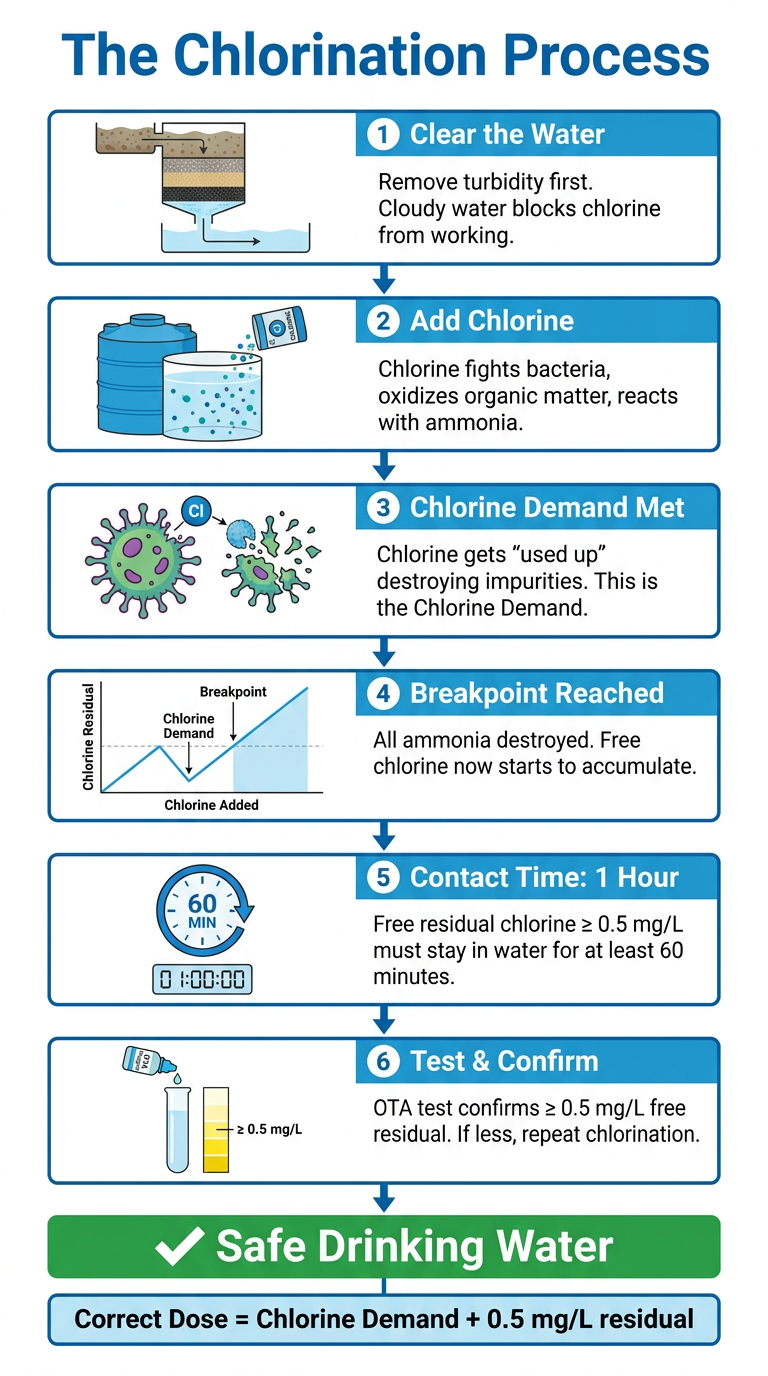
- Clear the Water - Remove turbidity before chlorination
- Add Chlorine - Chlorine targets bacteria, organics, and ammonia
- Chlorine Demand Met - Chlorine gets consumed fighting impurities
- Breakpoint Reached - Free chlorine begins to accumulate after all ammonia is destroyed
- Contact Time: 1 Hour - Free residual must be ≥ 0.5 mg/L for at least 60 minutes
- Test & Confirm - OTA test verifies the residual; repeat if it falls below 0.5 mg/L
In what form chlorine is added
Forms in Which Chlorine is Added to Water
1. Chlorine Gas (Cl₂)
- First choice for large water treatment plants
- Advantages: Cheap, quick in action, efficient, easy to apply
- Disadvantage: Irritant to eyes and poisonous - requires special equipment
- Equipment used: Paterson's Chloronome - a device that measures, regulates, and administers gaseous chlorine to water supplies
2. Bleaching Powder (CaOCl₂ - Chlorinated Lime)
- White amorphous powder with a pungent chlorine smell
- Contains about 33% available chlorine when freshly made
- Unstable - loses chlorine on exposure to air, light, and moisture
- Stabilized bleach = bleaching powder mixed with excess lime (retains strength longer)
- Storage: dark, cool, dry place in a closed corrosion-resistant container
- Roughly 2.5 g disinfects 1,000 litres of water
- Most commonly used for well disinfection in rural/epidemic settings
3. Chlorine Solution
- Prepared from bleaching powder
- 4 kg of bleaching powder (25% available chlorine) + 20 litres of water = 5% chlorine solution
- Ready-made solutions in different strengths are available commercially
- Also degrades on exposure to light or prolonged storage
4. High Test Hypochlorite / HTH / Perchloron
- A calcium compound containing 60-70% available chlorine
- More stable than bleaching powder - deteriorates much less on storage
- Solutions prepared from HTH are used for water disinfection
5. Chloramine
- A loose compound of chlorine + ammonia
- Used in some large water treatment plants instead of chlorine gas
- Less tendency to produce chlorinous tastes and odors
- Gives a more persistent type of residual chlorine (stays longer in distribution system)
- Less efficient germicidally than free chlorine
6. Chlorine Tablets (e.g., Halazone Tablets)
- Available under various trade names
- Good for disinfecting small quantities of water
- Costly compared to other methods
- NEERI (National Environmental Engineering Research Institute, Nagpur) developed a new type - 15 times better than ordinary halogen tablets
- A single 0.5 g tablet disinfects 20 litres of water
7. Iodine (Emergency use)
- Not a chlorine form, but used as an emergency substitute
- 2 drops of 2% ethanol solution of iodine per 1 litre of clear water
- Contact time: 20-30 minutes
- Does not react with ammonia or organics - stays in active molecular form
- Limitation: not suitable for routine large-scale use
Quick Comparison Table
| Form | Available Chlorine | Best For | Stability |
|---|---|---|---|
| Chlorine gas | ~100% | Large treatment plants | Requires equipment |
| Bleaching powder | ~33% | Wells, rural, epidemics | Unstable |
| HTH/Perchloron | 60-70% | General disinfection | More stable |
| Chloramine | Variable | Large plants | Persistent residual |
| Chlorine tablets | Standardized | Small volumes, field use | Convenient |
| Chlorine solution | Depends on preparation | Flexible use | Degrades with light/storage |
- Park's Textbook of Preventive & Social Medicine, pp. 815-818
Explain chloramine as a chlorinating agent and its process in breakpoint chlorination
Chloramine as a Chlorinating Agent & Breakpoint Chlorination
Part 1 - What is Chloramine?
Chlorine (Cl₂) + Ammonia (NH₃) → Chloramine (NH₂Cl / NHCl₂ / NCl₃)
Part 2 - Chloramine as a Deliberate Chlorinating Agent
Advantages:
- Less chlorinous taste and odor - does not produce the strong chlorine smell
- More persistent residual - stays active longer in the distribution system (pipes, storage tanks)
- Useful for long distribution networks where maintaining residual is important
Disadvantages:
- Slower germicidal action than free chlorine
- Less efficient at killing pathogens
- Because of slower action, it is not widely used in water treatment
"The greatest drawback of chloramines is that they have a slower action than chlorine and therefore they are not being used to any great extent in water treatment."
- Park's Textbook, p. 815
Part 3 - The Role of Chloramine in Breakpoint Chlorination
Phase-by-Phase Breakdown
Phase 1 - Chloramine Formation (Combined Chlorine Rises)
- Chlorine added → reacts with ammonia → chloramines form
- Residual chlorine measured = combined chlorine (chloramines)
- As more chlorine is added, more chloramines form
- Residual rises initially
Cl₂ + NH₃ → NH₂Cl (monochloramine) + HCl
           → NHCl₂ (dichloramine)
           → NCl₃  (trichloramine / nitrogen trichloride)
Phase 2 - Chloramine Destruction (Residual FALLS - the "hump and dip")
- If chlorine dose is increased further, the additional chlorine starts destroying the chloramines themselves
- The chloramines break down into nitrogen gas (N₂) and other end products that carry no residual chlorine
- This causes the total residual chlorine to fall even though you're adding more chlorine
- This is the confusing but critical part - more chlorine = less residual (temporarily)
Chloramine + More Cl₂ → N₂ + HCl + H₂O (no residual)
Phase 3 - The Breakpoint (Free Chlorine Appears)
- All the ammonia has now been destroyed completely
- All combined chlorines (chloramines) have been eliminated
- The next drop of chlorine added has nothing left to react with
- It now appears directly as free residual chlorine (HOCl / OCl⁻)
- From this point, residual rises proportionally with every additional dose
The Breakpoint Chlorination Curve
Residual
Chlorine
(mg/L)
  |          ___
  |         /   \         <-- Combined chlorine (chloramines) peak
  |        /     \
  |       /       \___    <-- Residual FALLS (chloramines being destroyed)
  |      /            \
  |_____/              \__________/  <-- BREAKPOINT here, then free Cl rises
  |
  |-------------------------------------------------> Chlorine Dose Added
| Zone | What's Happening | Residual Type |
|---|---|---|
| Before breakpoint (rising) | Chloramines forming | Combined chlorine |
| Before breakpoint (falling) | Chloramines being destroyed | Combined chlorine (falling) |
| At breakpoint | All chloramines destroyed | Zero |
| After breakpoint | Free chlorine accumulates | Free chlorine |
What is the Breakpoint Dose?
- Satisfy the chlorine demand of the water
- Completely destroy all chloramines
- Allow free chlorine to just begin appearing
Breakpoint Chlorination vs. Superchlorination
| Feature | Breakpoint Chlorination | Superchlorination |
|---|---|---|
| Method | Chlorine dose taken precisely to the breakpoint | Very large dose of chlorine added |
| Control | Rational, controlled | Less precise |
| Dechlorination needed? | Usually not | Yes - excess chlorine must be removed after |
| Suitable for | Normal water treatment | Heavily polluted, fluctuating-quality water |
| Relationship | Breakpoint chlorination = controlled superchlorination | - |
"Breakpoint chlorination achieves the same results as superchlorination in a rational manner and can therefore be construed as controlled superchlorination."
- Park's Textbook, p. 815
Key Takeaway in One Line
When chlorine meets ammonia in water, it forms chloramines (combined chlorine). Adding more chlorine destroys these chloramines. The point where they are all destroyed and free chlorine begins to appear is the breakpoint - and dosing to reach this point is called breakpoint chlorination.
- Park's Textbook of Preventive & Social Medicine, pp. 815-816