
Markings on a Bone
Reading File
Bones have a rich set of surface markings - projections, depressions, and openings - that serve as attachment points for muscles/ligaments, passageways for nerves/vessels, and articular surfaces. Let me pull the full anatomy coverage from the textbooks.
Searching sources...
Finding Sources
Finding Sources
Finding Sources
Finding Sources
Finding Sources
Finding Sources
Finding Sources
Finding Sources
Reading File
Finding Sources
Finding Sources
Finding Sources
Finding Sources
Finding Sources
Finding Sources
Finding Sources
I found the "Bony Skeleton and Structure of Tubular Bones" section. Let me read it, along with adjacent sections on bone structure.
Reading File
Reading File
Let me look at the section specifically covering the tubular bone structure and any sections covering surface markings (projections, depressions, foramina).
Reading File
Finding Sources
Finding Sources
The library has bone anatomy books but not a dedicated "bone markings" glossary section. I have enough foundational content plus comprehensive knowledge to deliver a thorough, well-organized answer. Let me now fetch the bone structure diagram image and compile the full response.
Loading Image
Here is a thorough overview of bone markings - the named features found on the surface of bones.
Markings on a Bone
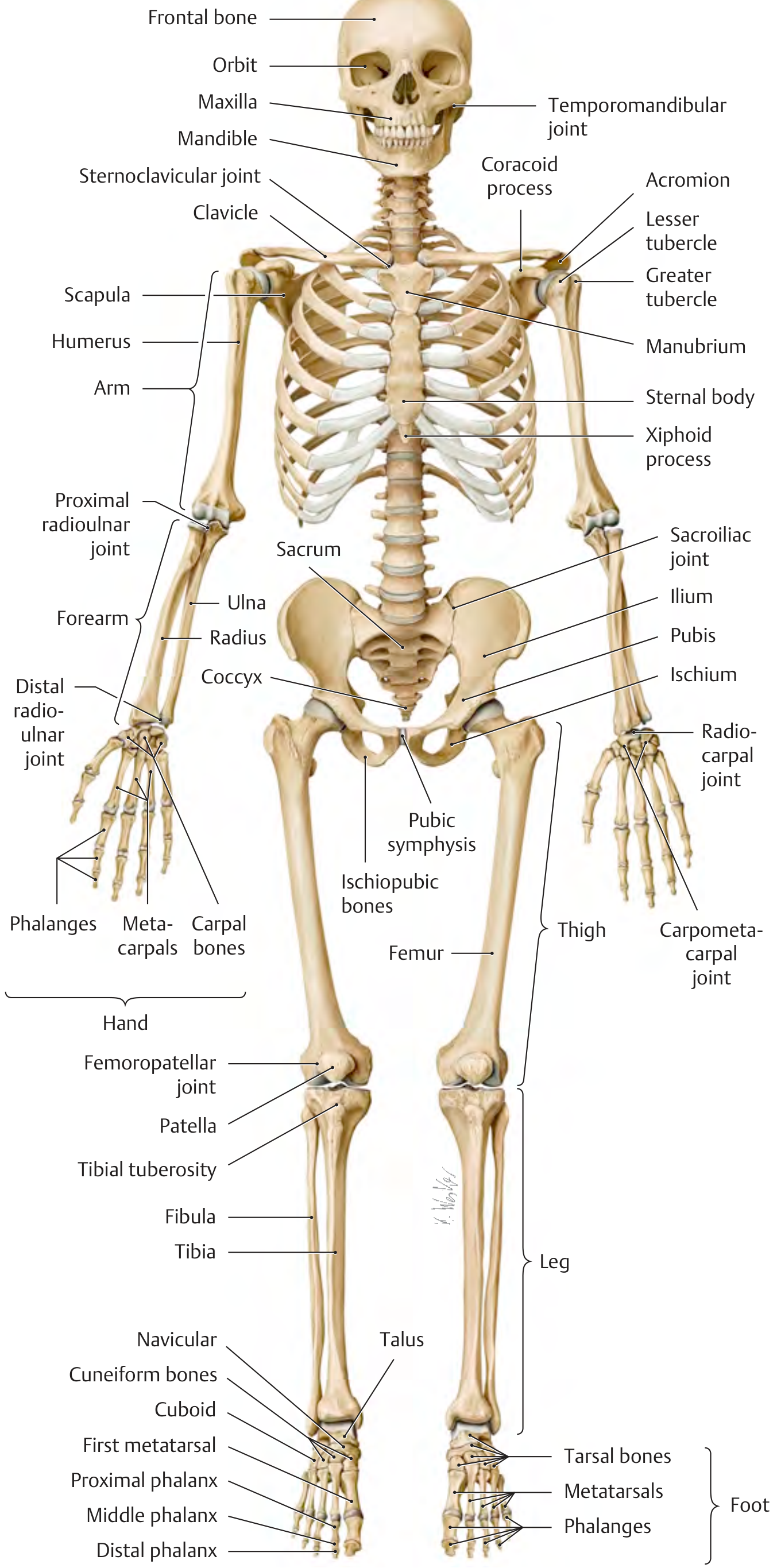
Bone markings fall into three broad functional categories: projections (elevated areas), depressions (sunken areas), and openings (passages for nerves and vessels). Each has a specific anatomical name depending on its shape, size, and function.
1. Projections (Prominences)
These are raised areas that project above the surface. They serve as attachment sites for muscles, tendons, and ligaments, or as articular surfaces.
Processes (Large Named Projections)
| Term | Description | Example |
|---|---|---|
| Process | Any bony prominence or projection | Coracoid process of scapula, transverse process of vertebra |
| Spine (Spinous process) | Sharp, slender projection | Spine of scapula, spinous process of vertebrae |
| Ramus | Arm-like extension that forms an angle with the main body of bone | Ramus of mandible, inferior ramus of pubis |
Knob-like and Rounded Projections
| Term | Description | Example |
|---|---|---|
| Condyle | Large, rounded articular knuckle at the end of a bone | Medial/lateral condyle of femur, occipital condyles |
| Epicondyle | Projection above (epi-) a condyle; non-articular; for tendon/ligament attachment | Medial/lateral epicondyle of humerus |
| Head | Rounded, ball-like articular end, often connected to the shaft by a neck | Head of femur, head of humerus, head of radius |
| Neck | Constricted region connecting head to shaft | Anatomical neck of humerus, neck of femur |
Bumps and Ridges for Muscle/Tendon Attachment
| Term | Description | Example |
|---|---|---|
| Tubercle | Small, rounded projection | Greater and lesser tubercle of humerus, adductor tubercle of femur |
| Tuberosity | Large, rough, rounded projection | Tibial tuberosity (attachment of patellar tendon), ischial tuberosity, deltoid tuberosity of humerus |
| Trochanter | Very large, blunt, irregular projection (unique to femur) | Greater trochanter, lesser trochanter |
| Malleolus | Rounded, hammer-shaped projection | Medial malleolus (tibia), lateral malleolus (fibula) |
| Crest | Prominent ridge or border of bone | Iliac crest, sacral crest, intertrochanteric crest |
| Line (Linea) | Low, narrow ridge - less prominent than a crest | Linea aspera of femur, soleal line of tibia |
| Ridge | Narrow elevated border | Interosseous ridge of radius/ulna |
| Trochanterion / Trochlea | Pulley-shaped articular surface | Trochlea of humerus (for articulation with ulna), trochlea of talus |
| Facet | Small, flat articular surface | Costal facets on vertebrae, facets of carpals |
Blade-like and Pointed Structures
| Term | Description | Example |
|---|---|---|
| Acromion | Flat, lateral extension | Acromion of scapula |
| Styloid process | Long, pointed, spike-like projection | Styloid process of radius, ulna, temporal bone |
| Mastoid process | Large, rounded, nipple-like process | Mastoid process of temporal bone |
| Olecranon | Large, blunt proximal projection of ulna | Tip of elbow |
2. Depressions (Concavities)
These are hollowed or sunken areas, often receiving the projections of adjacent bones or housing tendons and nerves.
| Term | Description | Example |
|---|---|---|
| Fossa | Shallow, bowl-shaped depression or pit | Infraspinous fossa of scapula, olecranon fossa and coronoid fossa of humerus, iliac fossa |
| Sulcus (Groove) | Furrow or channel on the bone surface | Bicipital groove (intertubercular sulcus) of humerus, sulcus for radial nerve |
| Notch (Incisure) | A deep indentation or cleft at the edge of a bone | Greater/lesser sciatic notch, trochlear notch of ulna, jugular notch |
| Facet | Small, flat, shallow articular depression | Articular facets of vertebrae |
| Pit (Fovea) | Small, pit-like depression | Fovea capitis of the femoral head (attachment of ligament of head) |
| Sinus | Air-filled cavity within a bone, lined by mucosa | Frontal sinus, maxillary sinus, ethmoid sinus |
| Meatus | Canal or tunnel running through a bone | External acoustic meatus, internal acoustic meatus |
| Fissure | Narrow, slit-like opening | Superior orbital fissure, inferior orbital fissure |
3. Openings (Foramina and Passageways)
These allow nerves, blood vessels, and other structures to pass through or into bones.
| Term | Description | Example |
|---|---|---|
| Foramen (pl. foramina) | Rounded hole or aperture through a bone | Foramen magnum, obturator foramen, mental foramen, nutrient foramen |
| Canal | Tunnel running the length of bone (or through it) | Haversian canal (within osteons), condylar canal, carotid canal |
| Fissure | Narrow, elongated cleft or slit | Superior/inferior orbital fissure |
| Meatus | Tube-like passage | External acoustic meatus |
Quick Reference Summary Table
| Category | Terms |
|---|---|
| Large projections | Process, spine, ramus, trochanter, malleolus |
| Articular projections | Head, condyle, epicondyle, facet, trochlea |
| Rough attachment sites | Tuberosity, tubercle, crest, line, ridge |
| Depressions | Fossa, sulcus/groove, notch, fovea, pit |
| Air spaces | Sinus, cell |
| Openings/passageways | Foramen, meatus, canal, fissure |
Why Bone Markings Matter
- Muscle/tendon attachment: Tuberosities, tubercles, crests, and lines are roughened to increase the surface area gripping tendons and ligaments (e.g., the tibial tuberosity anchors the patellar tendon - attachment of the quadriceps femoris).
- Articulation: Condyles, heads, facets, and trochleae form the smooth surfaces of joints, covered by hyaline cartilage in life.
- Neurovascular passageways: Foramina and canals guide nerves and blood vessels to their targets without injury from movement (e.g., the nutrient foramen admits the nutrient artery that supplies compact bone).
- Palpable landmarks: Many markings (iliac crest, medial epicondyle, mastoid process, tibial tuberosity, acromion) are used clinically to locate underlying structures, plan injections, and assess injuries.
- Forensic/anthropological identification: Patterns of markings reflect musculature, activity level, sex, and age in skeletal remains.
Sources: General Anatomy and Musculoskeletal System, THIEME Atlas of Anatomy; Gray's Anatomy for Students
Bones and cartilages: Skeleton, Bones, function of bones, bone tissue and it's types, classification of bones, markings on a bone, gross anatomy of an adult typical long bone, ossification, diaphysis and epiphysis, Bone growth and Remodeling, blood supply of long bones, Bone Injury and repair
Reading File
This is a broad, multi-topic anatomy query. Let me run parallel searches across all the major subtopics at once.
Finding Sources
Finding Sources
Finding Sources
Finding Sources
Finding Sources
Excellent - Junqueira's Histology has a full bone chapter. Let me now read all the key sections in parallel.
Reading File
Reading File
Reading File
Reading File
Reading File
Reading File
Reading File
Reading File
Finding Sources
Reading File
Reading File
Reading File
Reading File
Reading File
Finding Sources
Reading File
Reading File
Now let me fetch the key images and read bone cells / bone matrix sections in parallel.
Reading File
Loading Image
Loading Image
Excellent - I have two outstanding diagrams. Let me now fetch the endochondral ossification diagram and blood supply diagram, plus read more bone cell content.
Loading Image
Loading Image
Loading Image
I now have all the key content and images. Let me read the bone matrix and osteoclast sections, plus the epiphyseal plate zones.
Reading File
Reading File
Here is the complete, textbook-grounded guide to bones and cartilages covering every topic you listed.
Bones and Cartilages: A Complete Overview
1. The Skeleton
The human skeleton is the internal framework of the body, comprising 206 bones in the adult, along with cartilages, joints, and ligaments. It is divided into two functional divisions:
| Division | Components |
|---|---|
| Axial skeleton | Skull, vertebral column, ribs, sternum (80 bones) |
| Appendicular skeleton | Limb bones, pectoral girdle, pelvic girdle (126 bones) |
2. Functions of Bones
Bone tissue serves both mechanical and metabolic functions (Junqueira's Basic Histology, 17e, p. 351):
- Support - provides a rigid framework for the body; supports soft tissues
- Protection - shields vital organs (brain in cranium, heart/lungs in thorax, spinal cord in vertebral column)
- Movement - bones act as levers, multiplying forces generated by skeletal muscle contractions and converting them into bodily movement
- Hematopoiesis - bone marrow (in medullary cavities and cancellous bone) is the site of blood cell production
- Mineral reservoir - stores 99% of the body's calcium and large amounts of phosphate in hydroxyapatite crystals; releases or absorbs these ions to maintain homeostasis
- Energy storage - yellow marrow (fat) in the medullary cavity stores lipid energy reserves
3. Bone Tissue and Its Types
Bone as a Connective Tissue
Bone is a specialized connective tissue composed of:
- Calcified extracellular matrix (organic + inorganic)
- Three major cell types: osteoblasts, osteocytes, osteoclasts
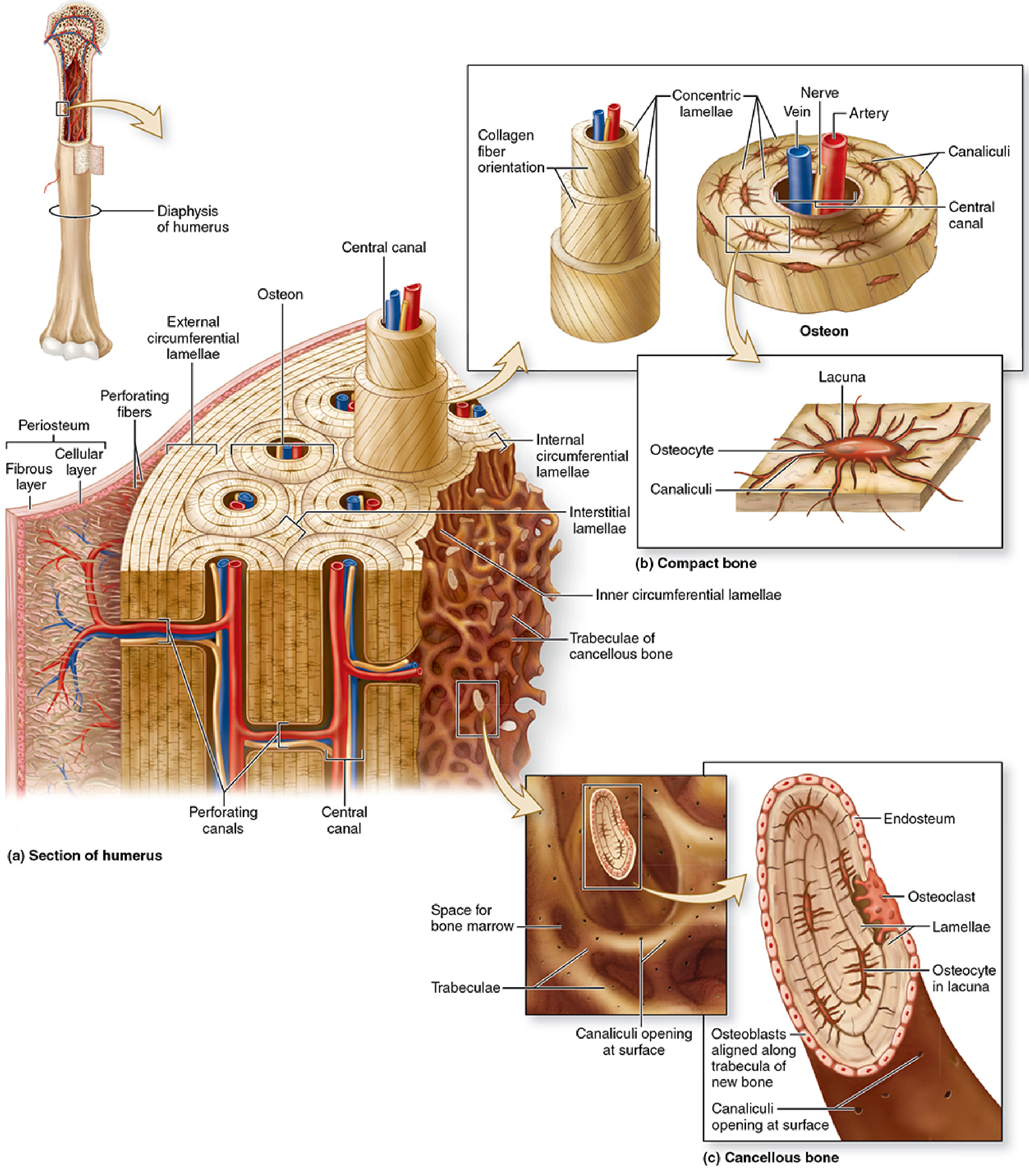
The Three Bone Cell Types
1. Osteoblasts
- Originate from mesenchymal stem cells
- Active cuboidal cells arranged in a single layer on bone surfaces
- Synthesize and secrete osteoid: the organic matrix (type I collagen, proteoglycans, osteonectin, osteocalcin)
- Direct mineralization of osteoid by hydroxyapatite [Ca₁₀(PO₄)₆(OH)₂]
- After completing secretion, become osteocytes, bone lining cells, or undergo apoptosis
2. Osteocytes
- Most abundant bone cell
- Former osteoblasts trapped in calcified matrix inside lacunae
- Extend long cytoplasmic processes through narrow canaliculi connecting lacunae to each other and to blood vessels
- Form a "lacunar-canalicular network" - the bone's mechanostat
- Maintain calcified matrix; their death triggers matrix resorption
- Act as mechanosensors: detect mechanical load and signal osteoblasts/osteoclasts accordingly
3. Osteoclasts
- Large, multinucleated (up to 50 nuclei), motile cells
- Derived from fusion of bone marrow monocytes
- Form a ruffled border on bone surface, creating a sealed resorption lacuna (Howship's lacuna)
- Secrete H⁺ ions (carbonic anhydrase II) and lysosomal enzymes (cathepsin K, collagenase) to dissolve bone matrix
- Development requires M-CSF and RANKL from osteoblasts
Bone Matrix
| Component | Details |
|---|---|
| Organic (35%) | Mainly type I collagen fibers; also proteoglycans, osteocalcin, osteopontin, bone sialoprotein |
| Inorganic (65%) | Hydroxyapatite crystals [Ca₁₀(PO₄)₆(OH)₂]; also Ca²⁺, Mg²⁺, F⁻, Na⁺ |
The combination of flexible collagen + rigid hydroxyapatite gives bone both strength and resilience.
Periosteum and Endosteum
- Periosteum: two-layered connective tissue sheath covering all bone surfaces except articular cartilage
- Outer (fibrous) layer: dense collagen, fibroblasts; Sharpey's fibers anchor it to bone
- Inner (cellular/osteogenic) layer: osteoprogenitor cells, osteoblasts, blood vessels
- Endosteum: thin connective tissue layer lining medullary cavity and trabecular surfaces; contains osteoprogenitor cells and osteoblasts
Types of Bone Tissue (Junqueira's, p. 364-365)
By Histological Organization
| Type | Features | Location |
|---|---|---|
| Woven (immature) bone | Random, non-lamellar collagen arrangement; higher cell density; lower mineral content; forms fast but weak | Fetal bone; fracture callus; tendon insertions |
| Lamellar (mature) bone | Ordered, concentric collagen lamellae; lower cell density; higher mineral; strong | All adult bone |
By Gross Appearance
Compact (cortical) bone (80% of total bone mass):
- Dense outer shell of bones
- Structural unit = osteon (Haversian system): cylindrical unit ~1 cm long, 250-350 μm diameter
- Each osteon = 5-20 concentric lamellae around a central Haversian canal (contains blood vessels, nerves)
- Volkmann's canals: transverse/oblique channels connecting Haversian canals to each other and to periosteal vessels
- Outer and inner surfaces have circumferential lamellae; spaces between osteons filled by interstitial lamellae
Cancellous (trabecular/spongy) bone (20% of total bone mass):
- Lattice of thin, interconnecting bony struts called trabeculae
- Spaces between trabeculae contain bone marrow
- No osteons; trabeculae nourished by diffusion from adjacent marrow
- Located in epiphyses of long bones, short/flat/irregular bones
4. Classification of Bones
Bones are classified by shape (THIEME Atlas, p. 58):
| Type | Description | Examples |
|---|---|---|
| Long bones | Length > width; tubular shaft with expanded ends | Humerus, femur, tibia, radius, phalanges |
| Short bones | Roughly cuboidal; equal dimensions | Carpal and tarsal bones |
| Flat bones | Thin, plate-like; two layers of compact with cancellous (diploë) between | Scapula, ilium, parietal bone, sternum |
| Irregular bones | Complex shape fitting none of above | Vertebrae, ethmoid, sphenoid |
| Pneumatic bones | Contain air-filled sinuses | Frontal, maxilla, ethmoid, sphenoid |
| Sesamoid bones | Embedded within tendons; protect from friction | Patella (largest), sesamoids at thumb base |
| Accessory (supernumerary) bones | Anomalous extra bones from unfused ossification centers | Wormian bones of calvaria, accessory tarsal bones |
5. Markings on a Bone
Bone surface markings fall into three categories:
Projections
| Term | Description | Example |
|---|---|---|
| Head | Rounded articular end | Head of femur, head of humerus |
| Condyle | Large rounded articular knuckle | Medial/lateral femoral condyles |
| Epicondyle | Projection above a condyle (non-articular) | Medial epicondyle of humerus |
| Trochlea | Pulley-shaped articular surface | Trochlea of humerus |
| Process | Any bony prominence | Coracoid, mastoid, styloid, spinous |
| Spine | Sharp, slender projection | Spine of scapula, vertebral spinous process |
| Trochanter | Very large, blunt irregular projection | Greater/lesser trochanter of femur |
| Tuberosity | Large rough rounded projection | Tibial tuberosity, ischial tuberosity |
| Tubercle | Small rounded projection | Greater/lesser tubercle of humerus |
| Crest | Prominent ridge | Iliac crest, sacral crest |
| Line | Low, narrow ridge | Linea aspera of femur |
Depressions
| Term | Description | Example |
|---|---|---|
| Fossa | Shallow bowl-shaped depression | Infraspinous fossa, olecranon fossa |
| Sulcus/Groove | Channel or furrow | Bicipital groove, radial groove |
| Notch | Deep indentation at bone edge | Greater/lesser sciatic notch |
| Fovea/Pit | Small pit | Fovea capitis of femoral head |
| Sinus | Air-filled cavity in bone | Frontal, maxillary, sphenoid sinus |
| Meatus | Tubular canal | External/internal acoustic meatus |
Openings
| Term | Description | Example |
|---|---|---|
| Foramen | Rounded hole | Foramen magnum, nutrient foramen, mental foramen |
| Canal | Tunnel running through bone | Haversian canal, carotid canal |
| Fissure | Narrow slit | Superior orbital fissure |
6. Gross Anatomy of an Adult Typical Long Bone
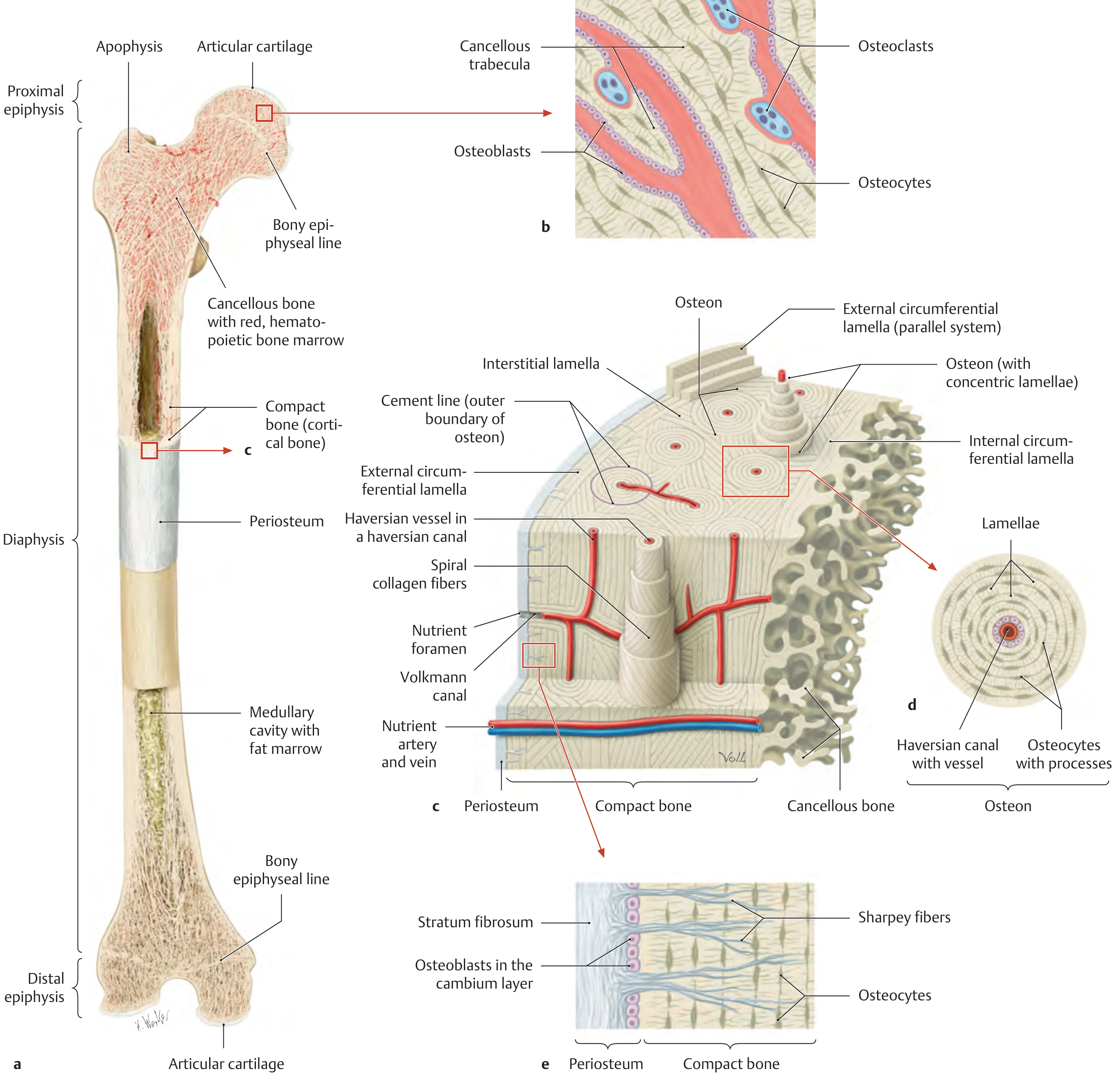
A typical long bone (e.g., femur, humerus) has the following regions:
Proximal epiphysis
|
Articular cartilage (hyaline)
Epiphyseal line (fusion scar)
|
Metaphysis (flared region)
|
┌────────────────────────────────┐
│ DIAPHYSIS │
│ ┌──────────────────────────┐ │
│ │ Periosteum (outer) │ │
│ │ Compact bone (cortex) │ │
│ │ Medullary cavity │ │
│ │ (yellow marrow) │ │
│ │ Endosteum (inner) │ │
│ └──────────────────────────┘ │
└────────────────────────────────┘
|
Metaphysis
Epiphyseal line
|
Distal epiphysis
Articular cartilage
| Component | Description |
|---|---|
| Articular cartilage | Hyaline cartilage covering joint surfaces; no perichondrium; persists throughout adult life |
| Epiphysis | Expanded ends of long bone; cancellous bone with red marrow inside; covered by articular cartilage |
| Epiphyseal line | Remnant of the epiphyseal plate after growth is complete; visible as dense line on X-ray |
| Metaphysis | Flared transition zone between diaphysis and epiphysis; highly vascular; cancellous bone |
| Diaphysis | Tubular shaft; outer cylinder of compact bone enclosing medullary cavity |
| Medullary cavity | Central space filled with yellow (fatty) marrow in adults; red marrow in children |
| Periosteum | Dense fibrous covering with inner osteogenic layer |
| Endosteum | Thin layer lining medullary cavity and trabecular surfaces |
| Nutrient foramen | Opening in compact bone shaft for entry of nutrient artery |
7. Ossification (Osteogenesis)
Bone forms by one of two processes (Junqueira's, p. 375):
A. Intramembranous Ossification
- Bone forms directly from condensed mesenchyme (no cartilage template)
- Forms: most skull and jaw bones, clavicle, scapula
- Sequence:
- Osteoprogenitor cells in condensed mesenchyme proliferate around capillaries
- Differentiate into osteoblasts → secrete osteoid → calcifies as woven bone with osteocytes in lacunae
- Adjacent ossification centers fuse
- Woven bone remodels to compact bone; central region remains cancellous with marrow
B. Endochondral Ossification
- Bone replaces a preformed hyaline cartilage model of the bone
- Forms: most bones of the body (all long bones, short bones, base of skull)
- Sequence (Junqueira's, p. 377):
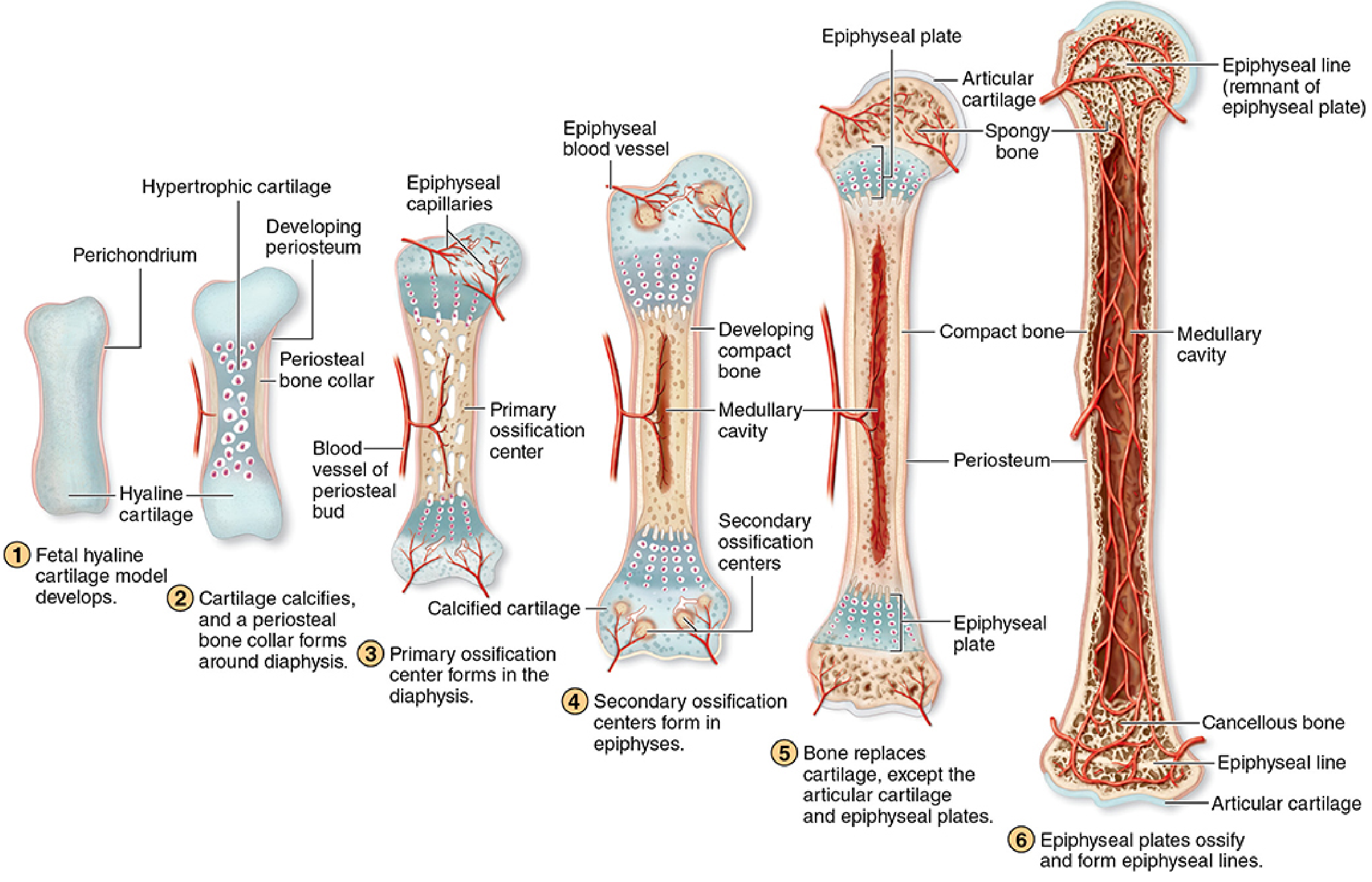
| Stage | Event |
|---|---|
| 1 | Embryonic hyaline cartilage model forms |
| 2 | Chondrocytes at center hypertrophy; matrix calcifies; cells die |
| 3 | Periosteal bone collar forms around diaphysis; perichondrium → periosteum |
| 4 | Periosteal bud (blood vessel + osteoprogenitors) invades → primary ossification center in diaphysis |
| 5 | Osteoblasts deposit woven bone on cartilage spicules; marrow cavity forms |
| 6 | Near birth: secondary ossification centers form in epiphyses |
| 7 | Epiphyseal plate (growth plate) persists between primary and secondary centers |
| 8 | Epiphyseal closure at ~age 20; bone length no longer increases |
Epiphyseal (Growth) Plate Zones (Proximal → Distal)
| Zone | Activity |
|---|---|
| 1. Reserve (resting) cartilage | Typical hyaline cartilage; stores cells for future proliferation |
| 2. Proliferative zone | Chondrocytes divide rapidly; form columns parallel to long axis |
| 3. Hypertrophic zone | Cells enlarge; secrete type X collagen; compress matrix into spicules |
| 4. Calcified cartilage zone | Chondrocytes release matrix vesicles + osteocalcin; hydroxyapatite crystals form |
| 5. Ossification zone | Capillaries and osteoblasts invade; osteoid deposited on cartilage spicules → woven then lamellar bone |
8. Diaphysis and Epiphysis
Diaphysis
- The cylindrical shaft of a long bone
- Wall = thick compact bone (cortex)
- Central medullary cavity with yellow (adipose) marrow in adults
- Contains the nutrient foramen for the nutrient artery
- Primary ossification center forms here first (in utero)
- Functions: mechanical strength (resists bending/torsion), lever arm for muscles
Epiphysis
- The expanded ends of a long bone
- Shell of compact bone enclosing a cancellous network
- In adults: filled with red bone marrow (hematopoietic)
- Covered by articular cartilage at joint surfaces
- Contains secondary ossification centers (form around birth)
- Apophysis: a secondary ossification center that is not articular (e.g., greater trochanter); serves as tendon/ligament attachment
9. Bone Growth and Remodeling
Bone Growth
Longitudinal growth (increase in length):
- Occurs exclusively at the epiphyseal plate (growth plate)
- Chondrocytes proliferate on the epiphyseal side; ossification occurs on the diaphyseal side
- The plate is maintained as long as new cartilage is added at the same rate it is replaced by bone
- Stops when the plate is completely replaced by bone = epiphyseal closure (~18-20 years)
Appositional (radial) growth (increase in width/diameter):
- New bone deposited beneath periosteum (periosteal osteoblasts)
- Simultaneous resorption on endosteal surface enlarges medullary cavity
- Net effect: bone widens without greatly increasing weight
Bone Remodeling (Junqueira's, p. 387)
Adult bone undergoes continuous remodeling - the coordinated activity of osteoblasts and osteoclasts:
- Rate in children can be 200× faster than adults
- Osteoclasts create cutting cones, tunneling through old bone
- Osteoblasts follow and fill the tunnel with new osteons
- Purpose:
- Adapts bone to changing mechanical stresses
- Repairs microdamage
- Maintains calcium homeostasis
- Replaces old, fatigued bone with new
Hormonal regulation of bone:
| Hormone | Source | Effect on Bone |
|---|---|---|
| Parathyroid hormone (PTH) | Parathyroids | ↑ osteoclast activity → bone resorption → ↑ Ca²⁺ |
| Calcitonin | Thyroid | ↓ osteoclast activity → bone deposition → ↓ Ca²⁺ |
| Growth hormone / IGF-1 | Pituitary / Liver | ↑ epiphyseal cartilage growth → longitudinal growth |
| Estrogen/Testosterone | Gonads | ↑ bone formation and density; deficiency → osteoporosis |
| Vitamin D | Skin/Diet | ↑ Ca²⁺ absorption; deficiency → rickets (children), osteomalacia (adults) |
10. Blood Supply of Long Bones
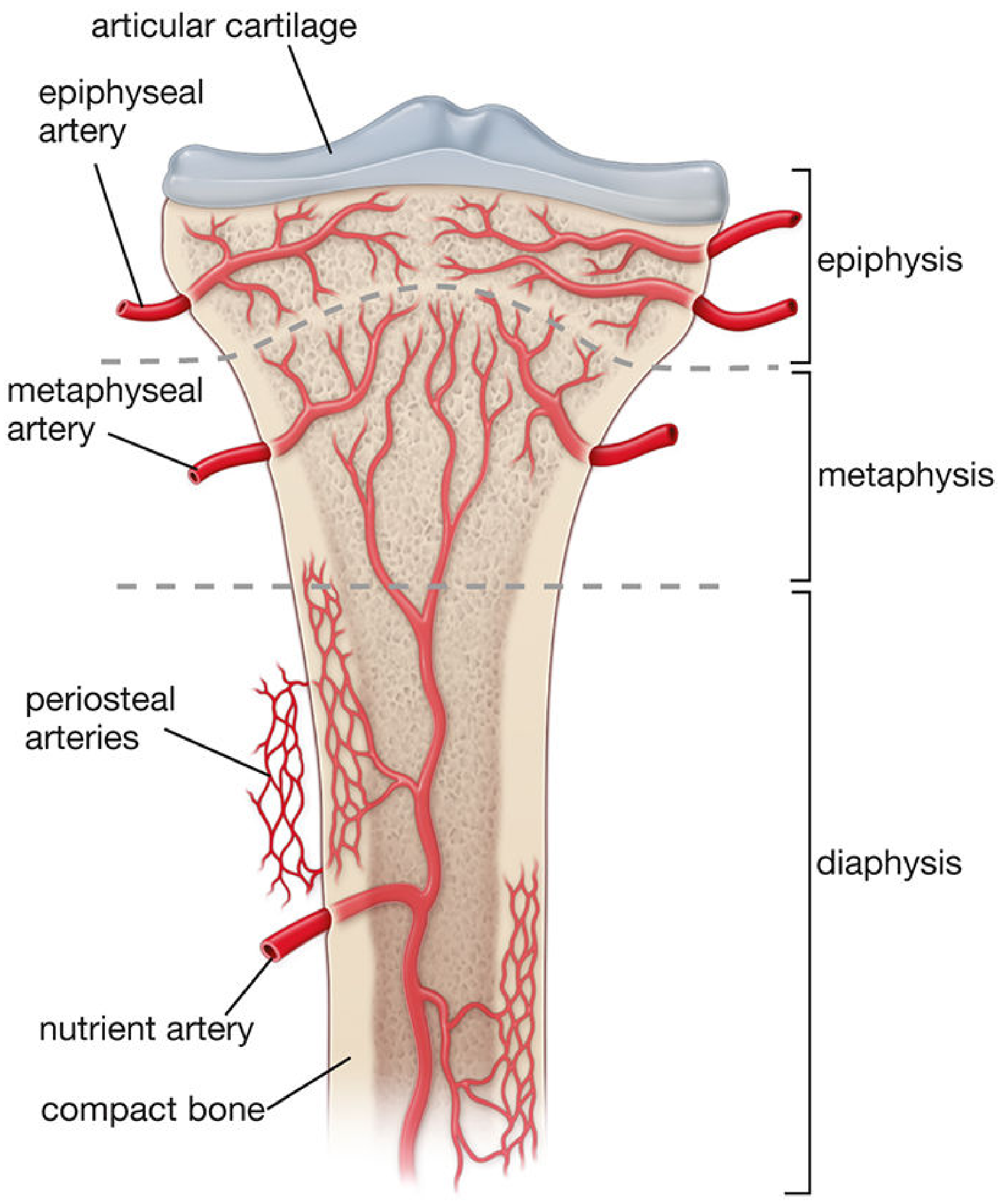
Long bones receive blood from three systems (Miller's Orthopaedics; Histology: Text and Atlas, p. 589):
| System | Vessels | Region Supplied |
|---|---|---|
| Nutrient artery system | 1-2 nutrient arteries enter diaphysis through nutrient foramen → ascend/descend in medullary canal → branch into endosteal cortical arterioles | Inner 2/3 of cortical bone (high pressure, 60% of cortex) |
| Metaphyseal-epiphyseal system | Multiple small arteries from periarticular vascular plexus (e.g., geniculate arteries) enter at metaphysis and epiphysis | Cancellous bone of metaphysis and epiphysis |
| Periosteal system | Periosteal capillaries penetrate via Volkmann's canals | Outer 1/3 of cortical bone (low pressure) |
Direction of blood flow:
- Arterial flow in mature bone = centrifugal (inside → outside): high-pressure nutrient system dominates
- Venous flow = centripetal (outside → inside)
- When nutrient artery is disrupted (fracture), periosteal system dominates → flow becomes centripetal
- Bone receives 5-10% of cardiac output
Bones at risk for avascular necrosis due to tenuous blood supply:
- Scaphoid (wrist), talus, femoral head, odontoid process
11. Bone Injury and Repair
Types of Fractures (Pye's Surgical Handicraft)
| Type | Mechanism | Features |
|---|---|---|
| Transverse | Direct blow (3-point force) | Perpendicular to long axis; more soft tissue damage |
| Spiral | Rotational stress | Diagonal line; less soft tissue damage |
| Crush/Compression | Axial compression of cancellous bone | Vertebral bodies, calcaneus |
| Burst | Explosive compression | Vertebrae; fragments driven outward |
| Avulsion | Traction by tendon/ligament | Fragment torn off bone; analogous to ligament rupture |
| Greenstick | Bending force in children | Incomplete fracture; cortex intact on concave side |
| Comminuted | High-energy trauma | Multiple fragments |
| Pathological | Abnormal bone (tumor, osteoporosis) | Minimal force |
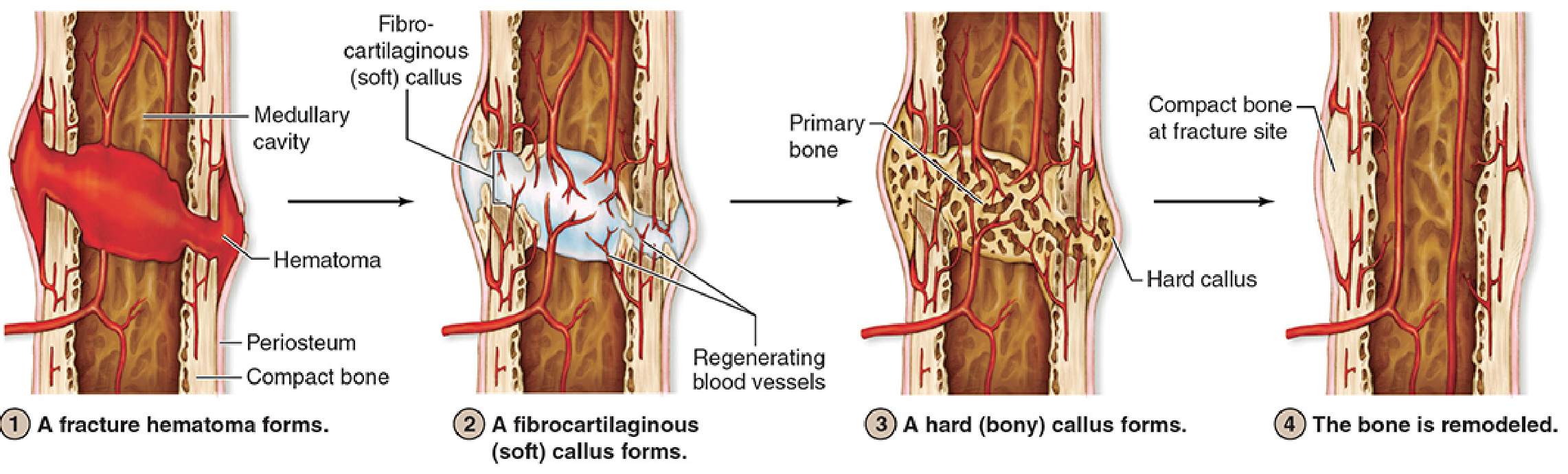
Bone Fracture Healing (Junqueira's, p. 387-389)
| Stage | Timing | Events |
|---|---|---|
| 1. Hematoma formation | Hours | Torn vessels bleed; fracture hematoma forms; bone cells near break die; macrophages and osteoclasts begin debridement |
| 2. Soft (procallus) formation | Days-2 weeks | Macrophages remove clot; periosteum and endosteum proliferate; fibrocartilaginous soft callus (procallus) forms around fracture; regenerating blood vessels invade |
| 3. Hard callus formation | Weeks | Fibrocartilage undergoes ossification (endochondral + intramembranous); woven bone hard callus forms; fracture ends stabilize |
| 4. Remodeling | Months-years | Osteoclasts resorb callus and woven bone; osteoblasts deposit lamellar bone; medullary cavity restored; original structure regained |
Factors promoting fracture healing:
- Good blood supply at fracture site
- Periosteum intact
- Adequate mechanical stability (not overly rigid; some micromotion stimulates callus)
- Young age; cancellous > cortical bone heals faster
- Adequate nutrition (Ca²⁺, vitamin C for collagen, vitamin D)
Factors impairing healing:
- Infection, poor vascularity, excessive mobility, large bone gaps, systemic disease (osteoporosis, diabetes)
- Intramedullary reaming devascularizes inner 50-80% of cortex
Non-union vs. malunion:
- Non-union: fracture fails to heal (fibrous tissue bridge persists = pseudarthrosis)
- Malunion: fracture heals in incorrect position
Summary Table: Key Concepts
| Topic | Key Point |
|---|---|
| Skeleton | 206 bones; axial (80) + appendicular (126) |
| Bone functions | Support, protection, movement, hematopoiesis, mineral homeostasis |
| Bone cells | Osteoblasts (form), osteocytes (maintain), osteoclasts (resorb) |
| Bone matrix | 35% organic (type I collagen) + 65% inorganic (hydroxyapatite) |
| Bone types | Compact (80%) + cancellous (20%); woven vs. lamellar |
| Ossification | Intramembranous (flat bones) or endochondral (most bones) |
| Growth plate zones | Reserve → Proliferative → Hypertrophic → Calcified → Ossification |
| Bone blood supply | Nutrient artery + metaphyseal-epiphyseal + periosteal systems |
| Fracture repair | Hematoma → soft callus → hard callus → remodeling |
Sources: Junqueira's Basic Histology 17e; General Anatomy and Musculoskeletal System, THIEME Atlas; Histology: A Text and Atlas with Correlated Cell and Molecular Biology; Miller's Review of Orthopaedics 9e; Pye's Surgical Handicraft 22eYour credits are exhausted. Your daily credits reset tomorrow, or you can purchase a top-up for more.
This is a shared conversation. Sign in to Orris to start your own chat.