
Spinal segments involved in renal colic pain are: a) T7–T11 b) T9–T11 c) T11–L2 d) L1–L3 explain it
The correct answer is c) T11–L2.
Renal colic pain is referred through the sympathetic afferents that travel with the renal and ureteric plexuses. The kidney and ureter receive their sympathetic supply from the lower thoracic and upper lumbar segments (T11, T12, L1, L2), which is why renal colic produces flank pain that radiates to the groin and inner thigh - the same dermatomal distribution.
Searching sources...
Reading File
Finding Sources
Finding Sources
Finding Sources
Finding Sources
Reading File
Reading File
Finding Sources
Finding Sources
Loading Image
Reading File
Reading File
Now I have comprehensive textbook data. Here is the full explanation:
Answer: (c) T11–L2
The spinal segments involved in renal colic (more accurately called ureteric colic) pain are T11 to L2.
Why T11–L2? The Anatomy of Referred Pain
Renal/ureteric colic pain is visceral referred pain. The kidney and ureter are supplied by sympathetic afferent nerve fibers. These fibers travel back through the renal and ureteric plexuses, enter the sympathetic chain, and synapse in the dorsal horn of the spinal cord at segments T11, T12, L1, and L2.
Because these visceral afferents converge with somatic afferents from the same spinal levels (a phenomenon called convergence-projection), the brain misinterprets the pain as coming from the somatic (skin/muscle) territories of those same dermatomes - explaining the classical radiation pattern.
The Dermatomes T11–L2 and Why They Matter
| Spinal Level | Somatic territory innervated | How it explains colic pain |
|---|---|---|
| T11 | Flank, loin region | Loin/flank pain at the start of colic |
| T12 | Lower flank, upper iliac fossa | Lower flank/abdominal pain |
| L1 | Groin, inguinal region, upper inner thigh | Radiation to groin |
| L2 | Upper inner thigh, scrotum/labium | Radiation to testis/labium majus |
This is why renal colic classically radiates from the loin to the groin, and can cause hypersensitivity or aching in the testis/scrotum (or labium majus in females) - the kidney and testis/ovary share the same nerve supply (both T10–L1).
As stated in Smith and Tanagho's General Urology: "Pain experienced during the preruptive phase of herpes zoster involving any of the segments between T11 and L2 may simulate pain of renal origin" - confirming that renal pain maps exactly to these dermatomes.
Why the Other Options Are Wrong
| Option | Segments | Why incorrect |
|---|---|---|
| (a) T7–T11 | Mid-thoracic | These are for gastric, hepatic, splenic, and pancreatic pain - too high for the kidney |
| (b) T9–T11 | Lower thoracic | Covers small intestine (T9–T11) pain, not the full kidney/ureter territory |
| (d) L1–L3 | Upper lumbar | Too low - L3 is not part of renal innervation; also overlaps with hip/thigh somatic territory |
For reference, Morgan & Mikhail's Clinical Anesthesiology lists the referred pain segments from viscera as:
- Kidney, ovaries, testes: T10–L1
- Ureters: T10–T12
- Uterus: T11–L2
The uterus shares very similar innervation to the ureter, which is why dysmenorrhoea and ureteric colic can feel so alike.
Classical Pain Radiation Pattern
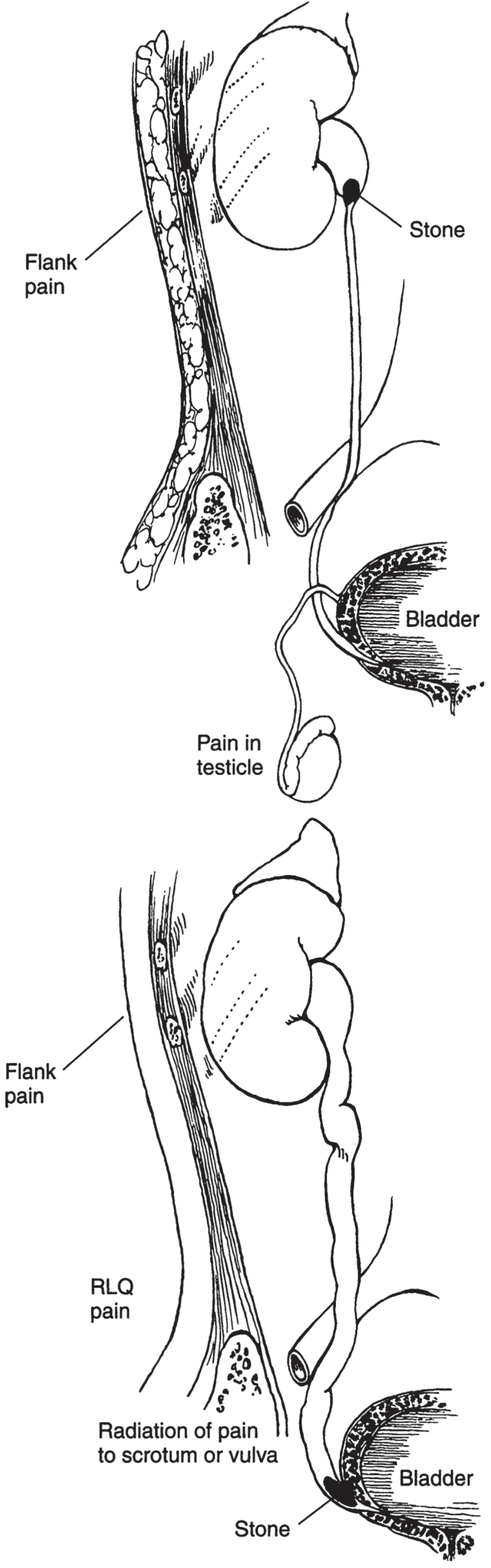
Figure from Smith & Tanagho's General Urology - showing how a stone at the ureteropelvic junction causes flank pain radiating to the testis (shared T11–L2 innervation), while a low ureteral stone causes pain radiating to the scrotum/vulva.
Quick Memory Aid
"T11 to L2 = Loin to Groin" The four levels (T11, T12, L1, L2) correspond exactly to the four zones of pain radiation: flank → lower abdomen → groin → testis/labium.
Sources: Smith and Tanagho's General Urology, 19th ed.; Morgan & Mikhail's Clinical Anesthesiology, 7th ed.; Bailey and Love's Short Practice of Surgery, 28th ed.
This is a shared conversation. Sign in to Orris to start your own chat.