
Winging of scapula
Reading File
Winging of the scapula occurs when the medial border of the scapula protrudes posteriorly from the back. It is most commonly caused by paralysis of the serratus anterior muscle (long thoracic nerve injury), but can also occur from trapezius weakness (spinal accessory nerve).
Searching sources...
Finding Sources
Finding Sources
Reading File
Reading File
Reading File
Reading File
Loading Image
Loading Image
Reading File
Here is a complete breakdown of Winging of the Scapula from authoritative sources:
Winging of the Scapula
Definition: Protrusion of the medial border and/or inferior angle of the scapula away from the thoracic wall, occurring when muscles that normally stabilize the scapula against the chest wall are weakened or paralysed.
Anatomy & Mechanism
The serratus anterior muscle (innervated by the long thoracic nerve, C5-C6-C7) runs along the lateral thoracic wall on the external surface of the muscle, just deep to skin and subcutaneous fascia. Its normal function is to protract the scapula and keep the medial border and inferior angle applied to the thoracic wall.
When serratus anterior is paralysed, the medial border and inferior angle elevate away from the chest wall - this is "winging." Normal arm elevation is also lost because scapular rotation is impaired.
- Gray's Anatomy for Students
Types of Winging
The direction of winging is named by where the inferior angle moves:
| Type | Inferior Angle Moves | Nerve Injured | Muscle Paralysed |
|---|---|---|---|
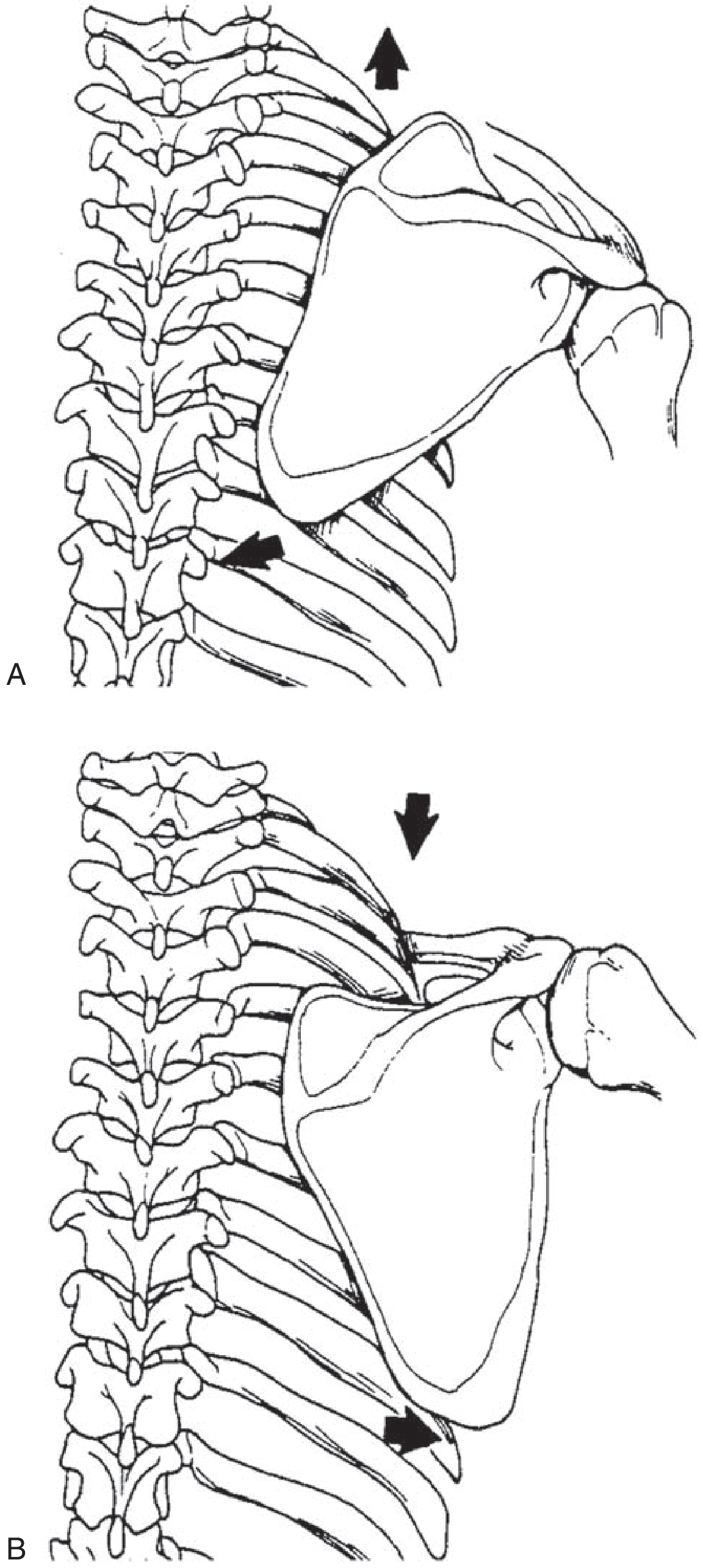
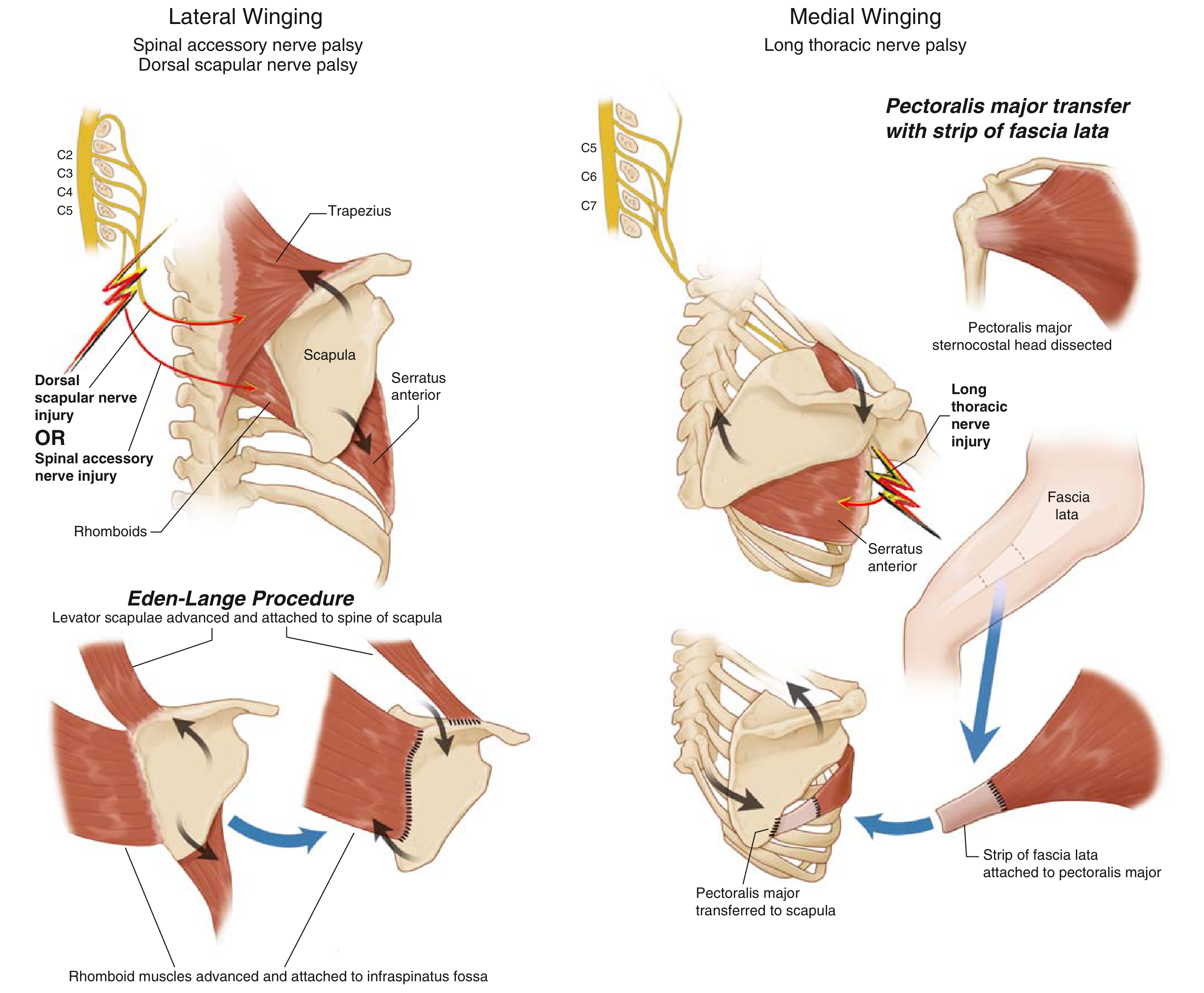
| Medial Winging | Medially + superiorly | Long thoracic nerve (C5-C7) | Serratus anterior |
| Lateral Winging | Laterally | Spinal accessory nerve (CN XI) | Trapezius |
| Lateral Winging (also) | Laterally | Dorsal scapular nerve | Rhomboids |
Mnemonic (from Miller's Review of Orthopaedics):
-
SWIM = Serratus Winging Inferior Medial
-
TRAWL = Trapezius and Rhomboids Are Winged Laterally
-
Miller's Review of Orthopaedics, 9th Ed.
Diagrams
(A) Medial winging - serratus anterior palsy (long thoracic nerve). (B) Lateral winging - trapezius palsy (spinal accessory nerve):
Causes
-
Neurological (most common):
- Long thoracic nerve injury -> serratus anterior palsy -> medial winging
- Spinal accessory nerve (CN XI) injury -> trapezius palsy -> lateral winging (+ shoulder drop, inability to shrug, difficulty abducting arm above 90°)
- Dorsal scapular nerve injury -> rhomboid palsy -> lateral winging
-
Osseous: Osteochondromas, fracture malunions, clavicle malunion/shortening (causes scapular rotation and translation anteriorly)
-
Muscular: Facioscapulohumeral muscular dystrophy (winging due to trapezius dysfunction)
-
Voluntary: Can be performed voluntarily in some individuals
-
Intraarticular disease
Clinical Testing
Test for serratus anterior (long thoracic nerve): Ask the patient to push against a wall with an outstretched hand. If the muscle is paralysed, the vertebral border and inferior angle of the scapula will stand out from the chest wall - "winging of the scapula."
- S. Das Manual on Clinical Surgery, 13th Ed.
Treatment
Conservative:
- Selective muscle strengthening may reduce winging
- Observation for nerve recovery (especially after traumatic long thoracic nerve injury - up to 12 months)
Surgical (when >12 months of conservative care has failed):
| Type | Procedure |
|---|---|
| Medial winging (serratus palsy) | Pectoralis major transfer to the scapula + strip of fascia lata |
| Lateral winging (trapezius/rhomboid palsy) | Eden-Lange procedure: levator scapulae advanced to spine of scapula + rhomboids advanced to infraspinatus fossa (transferred laterally) |
- Miller's Review of Orthopaedics, 9th Ed.; Campbell's Operative Orthopaedics, 15th Ed. 2026
Key Summary Points
- Most common cause: Long thoracic nerve injury -> serratus anterior palsy -> medial winging
- Long thoracic nerve (C5-C7) runs superficially on the lateral chest wall - vulnerable to direct trauma, backpack pressure, radical mastectomy, first rib resection
- Spinal accessory nerve injury (e.g., posterior triangle neck surgery) causes lateral winging + shoulder drop
- The direction is defined by the position of the inferior angle of the scapula
- Rhomboid palsy (dorsal scapular nerve) also causes lateral winging but is less common
This is a shared conversation. Sign in to Orris to start your own chat.