
Give me pain management pathway and flowchart associated with that and images from the Harrison book, 22nd edition.
Reading File
Finding Sources
Finding Sources
Finding Sources
Searching Images
pain pathways nociceptive neuropathic pain management analgesic ladder diagram
Searching PubMed
"Pain Management"[MeSH Terms] AND "Systematic Review"[Publication Type]
Searching the Web
CDC 2022 Clinical Practice Guideline Prescribing Opioids for Pain updated 2024 page
Finding Sources
Finding Sources
Finding Sources
query_images_db
Reading File
Reading File
query_images_db
Reading File
Reading File
Loading Image
Loading Image
Reading File
Reading File
Reading Web Page
https://www.cdc.gov/mmwr/volumes/71/rr/rr7103a1.htm
Adult pain-management pathway
This is a general clinical framework based on Harrison's Principles of Internal Medicine, 22nd ed., Chapter 14. It must be adapted for the pain cause, age, organ function, pregnancy status, comorbidities, and local protocols.
1. First assess and treat emergencies
Immediate urgent evaluation if pain is accompanied by:
- Hemodynamic instability, altered mental status, respiratory distress
- Acute chest, abdominal, or severe headache symptoms suggesting a time-sensitive disorder
- New focal neurologic deficit, spinal cord compression features, cauda equina symptoms
- Sepsis, acute limb ischemia, compartment syndrome, major trauma
- Rapidly escalating pain out of proportion to findings
Principle: establish and treat the underlying cause while starting analgesia. Harrison's describes this as the ideal treatment for acute pain. (Harrison's Principles of Internal Medicine, 22nd ed., p. 140)
Flowchart
PATIENT WITH PAIN
        │
        ▼
1. Rapid assessment
   • Pain score and functional impact
   • Site, onset, duration, character, radiation
   • Triggers/relievers, prior therapies, medication history
   • Examine for red flags / emergency cause
        │
        ├── Red flags or unstable patient
        │       ▼
        │   Resuscitate + urgent diagnosis-specific treatment
        │   Give appropriate titrated analgesia concurrently
        │
        └── Stable patient
                │
                ▼
2. Identify mechanism and time course
   ├─ Acute pain: <1 month
   ├─ Subacute pain: 1-3 months
   └─ Chronic pain: ≥3 months
                │
                ▼
3. Phenotype the pain
   ├─ Nociceptive
   │    • Somatic: localized, aching, throbbing
   │    • Visceral: deep, colicky, poorly localized
   ├─ Neuropathic
   │    • Burning, electric/shooting, tingling
   │    • Allodynia, sensory loss, hyperalgesia
   ├─ Nociplastic
   │    • Altered pain processing, often diffuse pain
   └─ Mixed pain
                │
                ▼
4. Start multimodal treatment
   • Education, reassurance, activity restoration, sleep support
   • Treat underlying pathology
   • Non-drug measures: heat/ice when appropriate, exercise/physiotherapy,
     psychological strategies, rehabilitation
   • Mechanism-directed nonopioid medication where appropriate
                │
                ▼
5. Reassess pain AND function
   ├─ Adequate relief / improving function
   │      → Continue briefly as needed, de-escalate when possible
   │
   └─ Inadequate relief
          │
          ├─ Recheck diagnosis, mechanism, adherence, adverse effects
          ├─ Add or change a mechanism-specific therapy
          ├─ Consider short opioid trial only when expected benefit outweighs risk
          └─ Refer for pain, palliative-care, neurology, or procedural input
             when pain is refractory, complex, or functionally disabling
Mechanism-directed treatment map
| Pain pattern | Typical clues | Usual treatment direction |
|---|---|---|
| Inflammatory or somatic nociceptive pain | Localized aching or throbbing, tissue injury/inflammation | Treat cause; acetaminophen or an NSAID if appropriate; local measures, rehabilitation |
| Visceral nociceptive pain | Deep, cramping/colicky, poorly localized | Diagnose and correct visceral cause; use condition-specific treatment plus analgesia |
| Neuropathic pain | Burning, electric-shock quality, tingling, numbness, allodynia | Consider topical lidocaine for focal allodynia; gabapentin/pregabalin or selected antidepressants such as duloxetine, venlafaxine, nortriptyline, or desipramine, individualized to patient factors |
| Nociplastic or chronic widespread pain | Diffuse tenderness, altered processing, sleep/mood symptoms may coexist | Exercise and rehabilitation, sleep and psychological interventions, selected centrally acting drugs when indicated; avoid escalating analgesics without functional benefit |
| Cancer or end-of-life pain | Often mixed nociceptive and neuropathic mechanisms | Multimodal analgesia, opioids when indicated, adjuvants, radiotherapy or nerve/neuraxial procedures when appropriate, specialist palliative-care involvement |
Harrison's notes that neuropathic pain following peripheral or central nervous-system injury can be severe and often responds poorly to standard analgesics. It describes anticonvulsants such as gabapentin/pregabalin and certain antidepressants as first-line medication options, selected individually. (Harrison's Principles of Internal Medicine, 22nd ed., pp. 139-144)
Opioid decision branch
Is an opioid necessary after diagnosis, non-drug care,
and suitable nonopioid treatment have been considered?
        │
        ├─ No
        │   → Continue multimodal, mechanism-targeted plan.
        │
        └─ Yes, benefit for pain AND function is expected to exceed risk
                │
                ▼
      • Define functional goal and exit/taper plan
      • Screen for overdose, sedative co-use, substance-use and mental-health risk
      • Prefer immediate-release formulation for new acute use
      • Use the lowest effective dose for the shortest necessary duration
      • Avoid automatic continuation
      • Reassess benefit, function, sedation, constipation, misuse and overdose risk
                │
                ├─ Meaningful benefit outweighs harm → continue with periodic review
                └─ No meaningful benefit or harms predominate → taper/stop safely,
                   optimize nonopioid treatment, consider specialist support
For subacute and chronic noncancer pain, the current CDC opioid guideline prefers nonopioid therapies and recommends considering opioids only when anticipated benefits for pain and function outweigh risks. Harrison's also emphasizes assessment of function, adverse effects, adherence, and ongoing benefit-harm review during chronic opioid therapy. (Harrison's Principles of Internal Medicine, 22nd ed., pp. 143-144)
Harrison's 22nd edition image: pain transmission and descending modulation
This is Figure 14-4 from the Harrison's 22E content: peripheral nociceptor activation, spinal transmission through the spinothalamic tract, thalamic relay, cortical processing, and descending modulation from cortex/hypothalamus through midbrain and medulla.
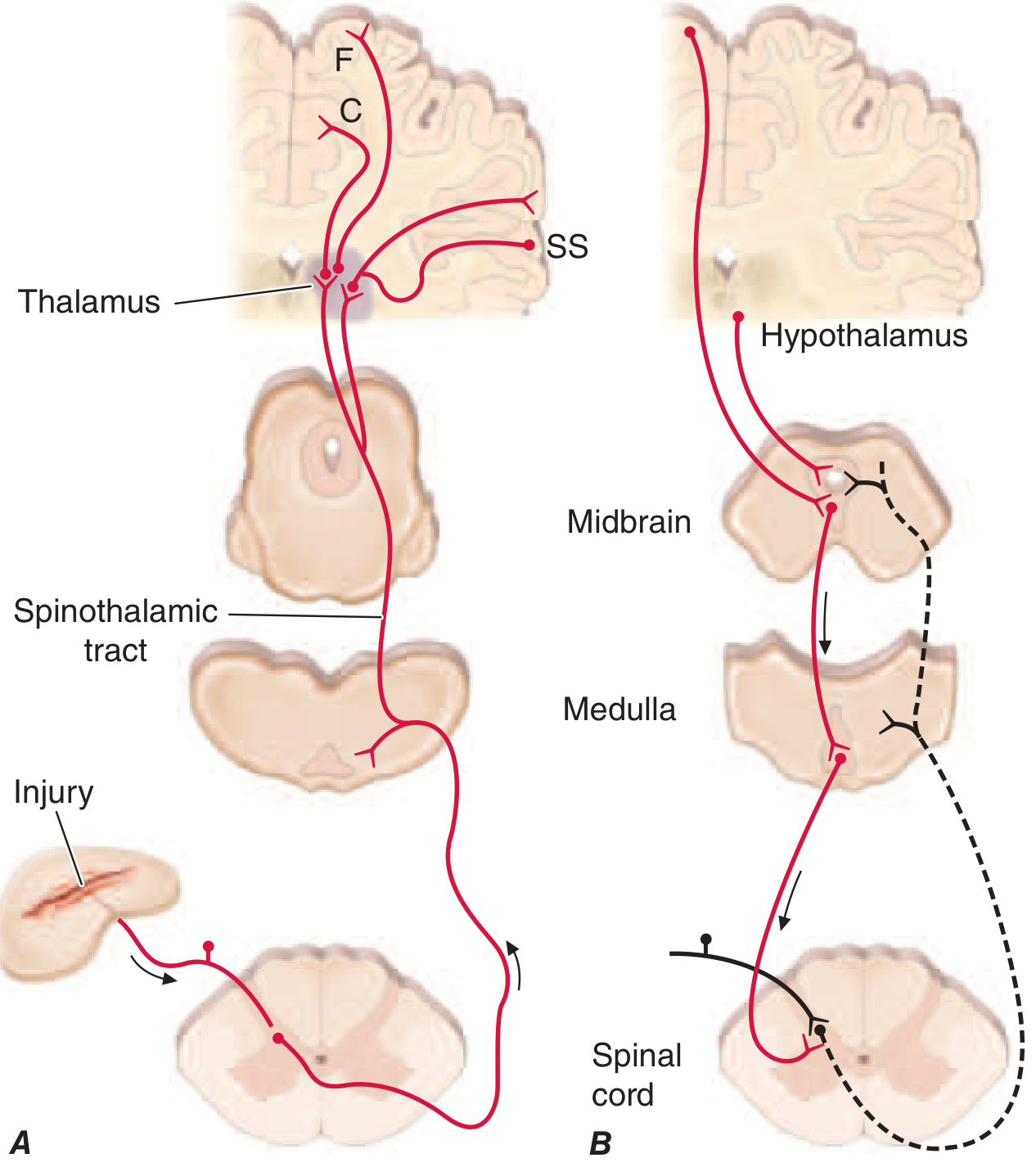
Harrison's Principles of Internal Medicine, 22nd ed., p. 138, Figure 14-4.
Harrison's associated terminal pain-management flowchart
This figure presents a stepwise mild-to-severe analgesic approach and distinguishes nociceptive from neuropathic pain. Use it in the palliative or terminal-care context for which it was presented, rather than as a universal dosing protocol.
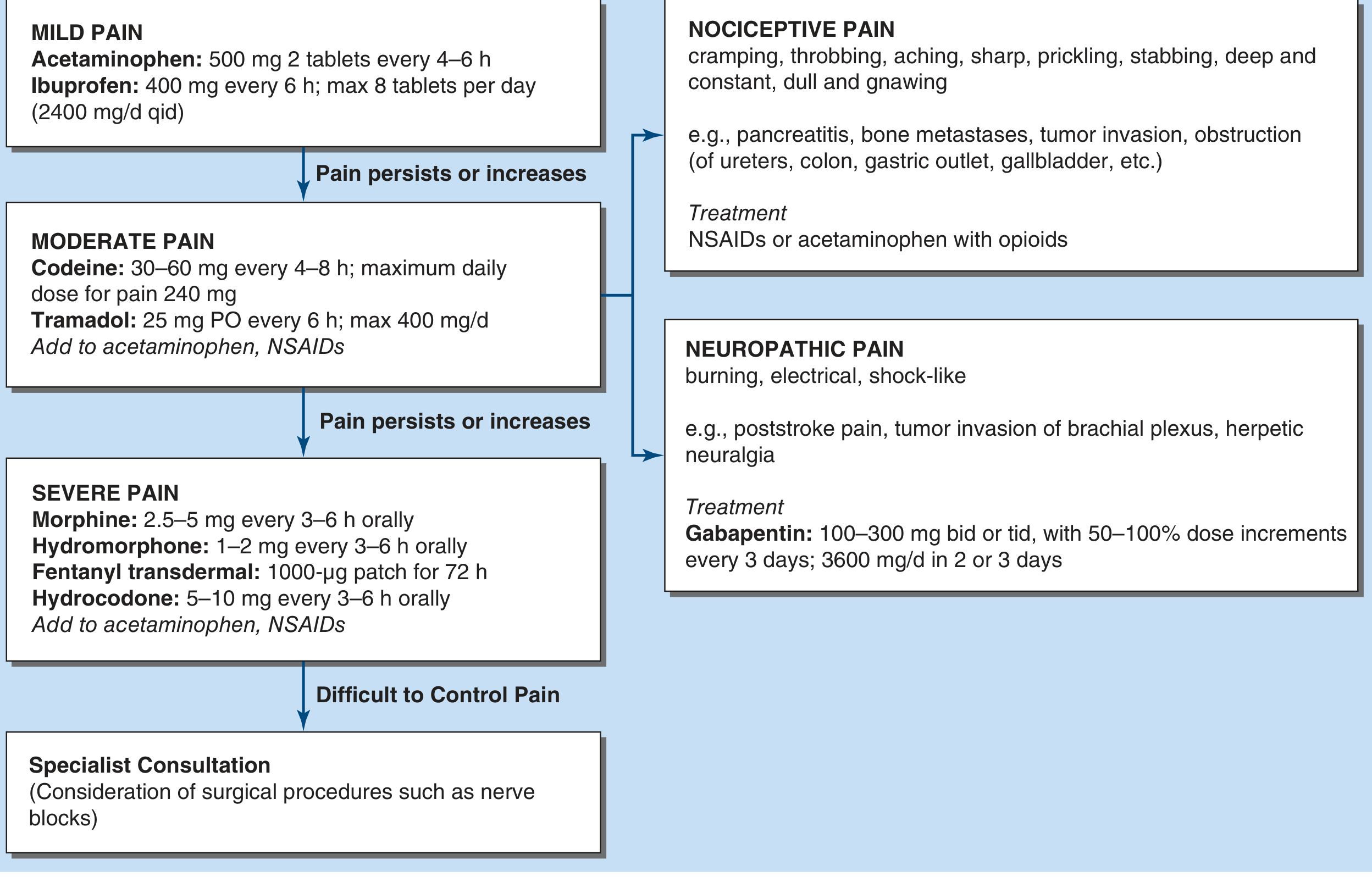
Key practical point: pain intensity alone should not determine treatment. Reassess the diagnosis, pain mechanism, functional effect, response to prior treatment, and medication risks at every escalation step.
This is a shared conversation. Sign in to Orris to start your own chat.