
Nervis system
The nervous system is one of the body's main control systems. Here's a quick overview:
Structure: It's divided into the Central Nervous System (CNS - brain and spinal cord) and the Peripheral Nervous System (PNS - all nerves outside the CNS).
Function: It receives sensory input, processes information, and sends motor output to muscles and glands.
Cell types: Neurons (signal-conducting cells) and glial cells (support cells like astrocytes, oligodendrocytes, Schwann cells).
PNS divisions: Somatic (voluntary) and Autonomic (involuntary - sympathetic "fight or flight" and parasympathetic "rest and digest").
Searching sources...
Reading File
Finding Sources
Searching the Web
nervous system overview anatomy physiology
Finding Sources
Finding Sources
Reading File
Finding Sources
Reading File
Reading File
Loading Image
Reading File
Here is a thorough overview of the Nervous System, drawn from authoritative medical textbooks (Gray's Anatomy for Students, Medical Physiology, Guyton & Hall):
The Nervous System
Overview
The nervous system is the body's major controlling, regulatory, and communicating system. Together with the endocrine system, it maintains homeostasis. It receives sensory input, integrates information, and produces motor output to muscles and glands.
1. Major Divisions
The nervous system is traditionally divided into three overlapping parts (from Medical Physiology):
| Subdivision | Components | Key Feature |
|---|---|---|
| Central (CNS) | Brain + spinal cord (including CN II and retina) | Oligodendrocytes provide myelin; axons cannot regenerate |
| Peripheral (PNS) | Peripheral ganglia, sensory receptors, spinal/cranial nerves | Schwann cells provide myelin; axons can regenerate |
| Autonomic (ANS) | Selected portions of both CNS and PNS | Functionally distinct visceral control system |
2. Functional Organization
Functionally (Gray's Anatomy for Students):
- Somatic nervous system - carries conscious sensation from the periphery to the CNS and controls voluntary (skeletal) muscles
- Visceral (autonomic) nervous system - regulates homeostatic functions (heart rate, blood pressure, digestion, temperature, reproduction)
Afferent vs. Efferent:
- Afferent nerves - carry signals toward the CNS (sensory)
- Efferent nerves - carry signals away from the CNS (motor)
3. The Brain
The cerebrum is the largest, most developed area and is the center of highest functions. The cerebral hemispheres are divided into four major lobes:
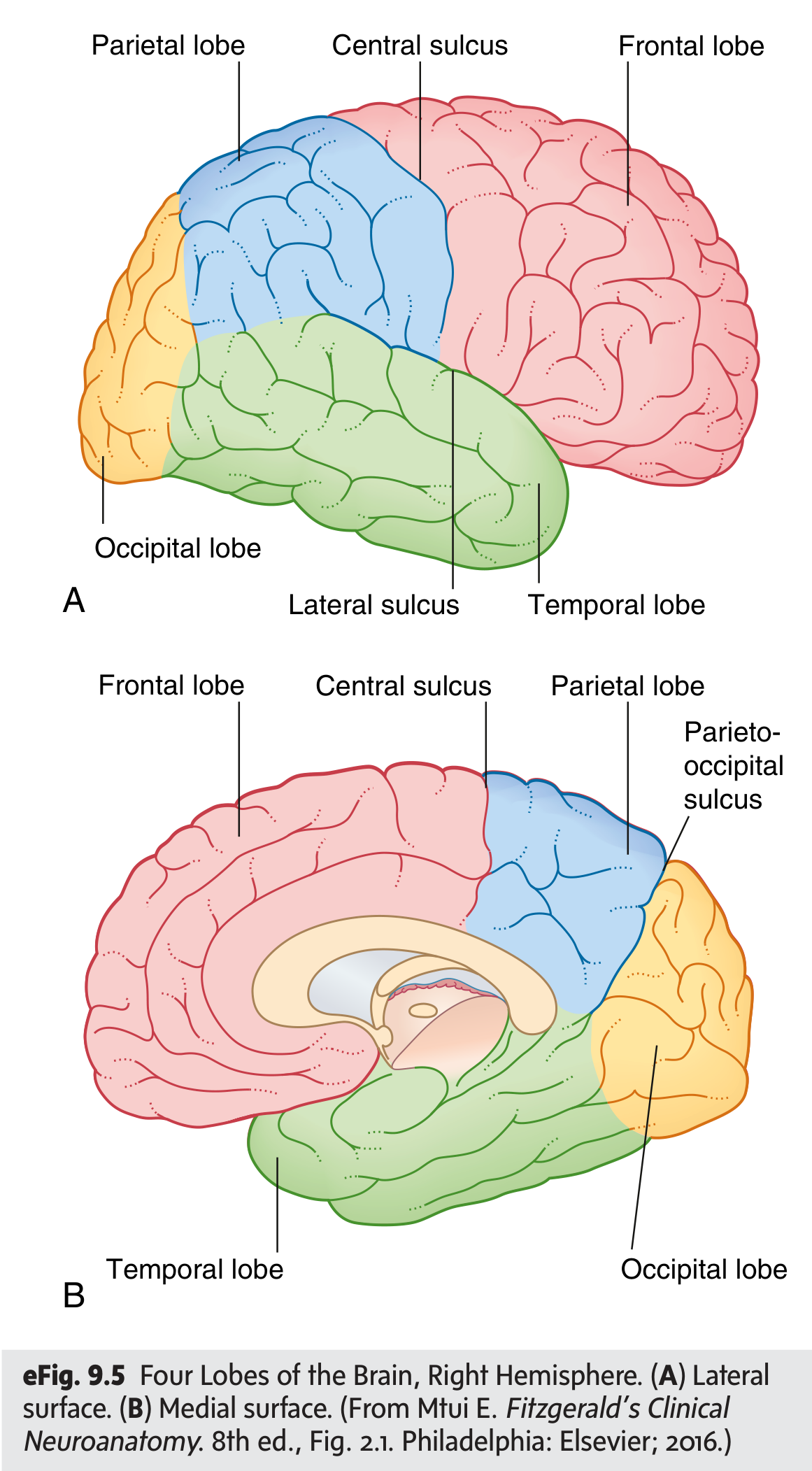
- Frontal lobe - voluntary movement, executive function, speech (Broca's area)
- Parietal lobe - somatosensory processing, spatial awareness
- Temporal lobe - auditory processing, memory, language comprehension
- Occipital lobe - visual processing
Gray matter vs. White matter:
- Gray matter = neuron cell bodies (cortical surface in brain; deep/central in spinal cord)
- White matter = myelinated axons (deep in brain; superficial in spinal cord - opposite arrangement)
The brain also includes the brainstem (midbrain, pons, medulla oblongata) and cerebellum.
4. Cells of the Nervous System
The human brain contains approximately 100 billion (10¹¹) neurons and a slightly greater number of glial cells. (Medical Physiology)
Neurons
- The fundamental signaling units
- Feature dendrites (receptive end) and an axon (conducts signals away from cell body)
- First clearly described by Santiago Ramón y Cajal using Camillo Golgi's silver-staining method (1885)
Glial (Neuroglial) Cells - support and maintenance
| Cell Type | Location | Function |
|---|---|---|
| Astrocytes | CNS | Structural support, blood-brain barrier, ion homeostasis |
| Oligodendrocytes | CNS | Myelinate CNS axons (each myelinates many axons) |
| Schwann cells | PNS | Myelinate PNS axons (one per axon segment) |
| Microglia | CNS | Immune surveillance, phagocytosis |
5. The Autonomic Nervous System (ANS)
The ANS controls involuntary visceral functions. It is further divided into:
Sympathetic ("Fight or Flight")
- Originates from spinal cord segments T1 to L2 (thoracolumbar outflow)
- Uses two-neuron chains: preganglionic neuron (in intermediolateral horn of spinal cord) → postganglionic neuron (in paravertebral or prevertebral ganglia)
- Preganglionic fibers exit via white rami; postganglionic fibers re-enter spinal nerves via gray rami
- About 8% of fibers in a typical skeletal nerve are sympathetic (controlling blood vessels, sweat glands, piloerector muscles)
- Neurotransmitter: norepinephrine (postganglionic); acetylcholine (preganglionic)
Parasympathetic ("Rest and Digest")
- Originates from brainstem (CN III, VII, IX, X) and sacral spinal cord S2-S4 (craniosacral outflow)
- Ganglia are located close to or within the target organ
- Neurotransmitter: acetylcholine (both pre- and postganglionic)
6. The Spinal Cord
- Runs within the vertebral canal, protected by meninges (dura mater, arachnoid, pia mater)
- Contains 31 pairs of spinal nerves
- White matter is superficial (ascending/descending tracts); gray matter is deep (H-shaped, contains motor neurons)
- Gives rise to somatic and autonomic reflexes
7. Peripheral Nervous System (PNS)
- 12 pairs of cranial nerves (brain connections)
- 31 pairs of spinal nerves (spinal cord connections)
- Peripheral ganglia - clusters of neuron cell bodies outside the CNS
- A key difference from CNS: PNS axons can regenerate after injury (guided by Schwann cells)
Key Physiological Concepts
-
Regional specialization: damage to a specific brain area causes predictable, localizable symptoms - the basis of neurological diagnosis
-
Compensation after injury: achieved only by enhancement of existing circuits or recruitment of latent circuits - one brain area cannot functionally replace another
-
The brain is the most complex tissue in the body - its capacity for thought, memory, and consciousness is still not fully understood
-
Gray's Anatomy for Students, p. 1302
-
Medical Physiology (Boron & Boulpaep), p. 398
-
Guyton and Hall Textbook of Medical Physiology, p. 754
This is a shared conversation. Sign in to Orris to start your own chat.