
Osteoarthritis, proper physiotherapy management and related medicine
Reading File
Now I'll run parallel searches across the library and PubMed simultaneously.
Finding Sources
Finding Sources
Searching PubMed
"osteoarthritis"[MeSH Terms] AND "physical therapy"[MeSH Terms]
Reading File
Reading File
Finding Sources
Searching PubMed
"osteoarthritis"[MeSH Terms] AND "exercise therapy"[MeSH Terms]
Good data. Now let me read the Goldman-Cecil OA chapter (the main treatment section) and the Family Medicine chapter more deeply, plus search for pharmacology content.
Reading File
Reading File
Finding Sources
Reading File
Reading File
Reading File
Reading File
I now have rich content on OA management. Let me get the treatment section from Goldman-Cecil and fetch the OA pathology diagram.
Reading File
Loading Image
I now have comprehensive content. Let me also grab the drug treatment table and physiotherapy section from the Goldman-Cecil block.
Reading File
I now have all the content needed for a comprehensive answer. Let me compile the complete response.
Osteoarthritis: Pathophysiology, Physiotherapy Management & Pharmacology
Definition & Overview
Osteoarthritis (OA) is characterized by failed repair of synovial joint tissues after intra-articular stress. The resulting breakdown of cartilage and bone leads to pain, stiffness, and functional disability. It affects >500 million people worldwide and is the 15th highest cause of years lived with disability globally. Knee OA accounts for ~85% of the total OA burden; the lifetime risk is 40% in men and 47% in women.
— Goldman-Cecil Medicine, Ch. 241
Pathobiology
OA involves structural alterations in articular cartilage, subchondral bone, synovium, ligaments, capsule, and periarticular muscles — a dynamic interplay of mechanical, inflammatory, and metabolic pathways.
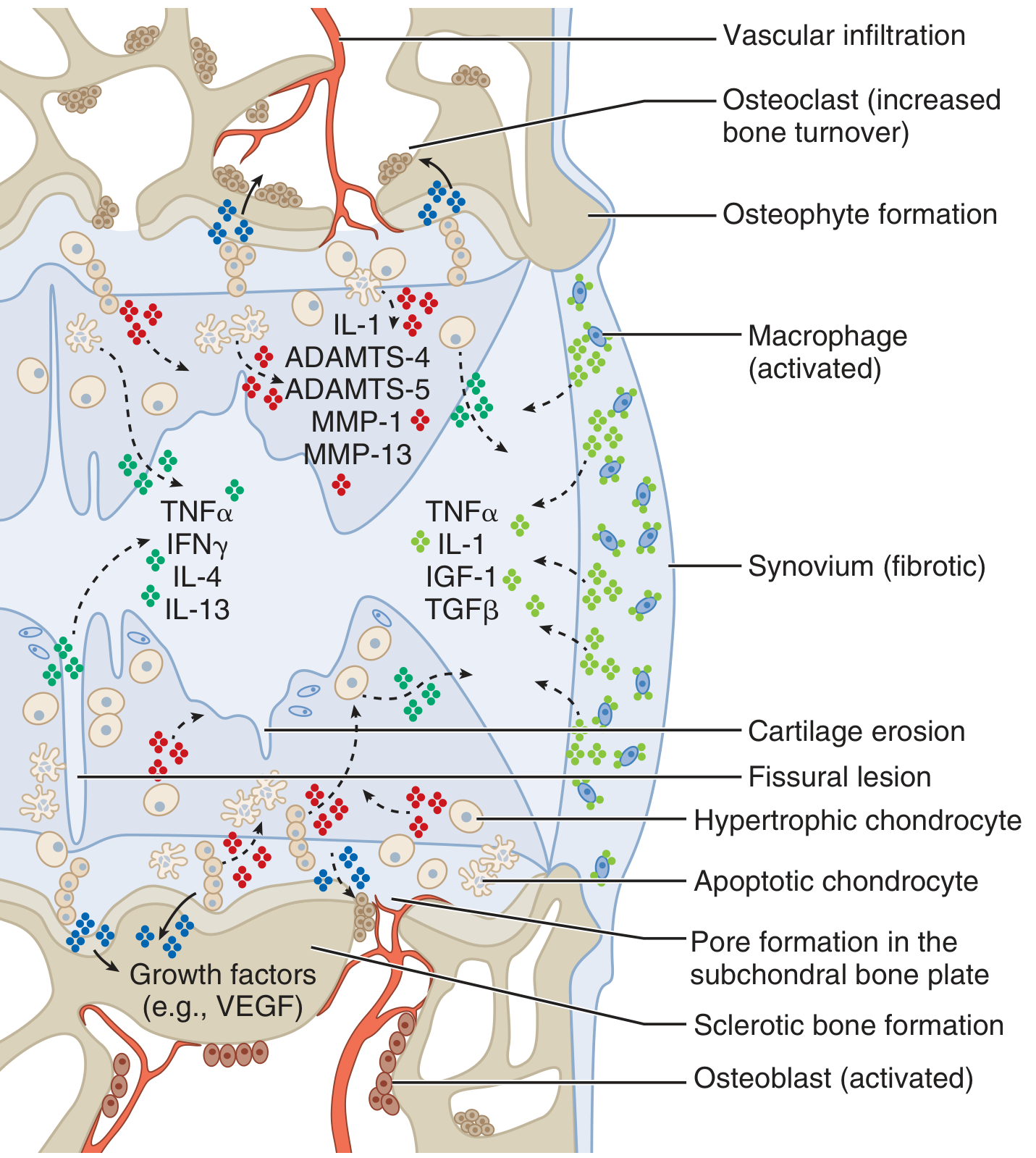
Key cellular events:
- Proteoglycan loss → cartilage swelling → disruption of type II collagen matrix
- Deep cartilage fissures + expansion of the calcified zone
- Hypertrophic chondrocytes release MMPs (MMP-1, MMP-13) and ADAMTS-4/5 (aggrecanases)
- Proinflammatory cytokines: IL-1, TNF-α, IL-4, IL-13, IFN-γ
- Subchondral: osteoclast activation → sclerotic bone, osteophyte formation, VEGF-driven vascular infiltration
- Synovium becomes fibrotic with macrophage and lymphocyte infiltration
Pain mechanisms follow a biopsychosocial model: peripheral nociception (loading of damaged joint) + central sensitization (neuropathic upregulation) — which is why standard analgesics sometimes fail and centrally-active agents may be needed.
Clinical Features
| Feature | Detail |
|---|---|
| Pain onset | Gradual; worse with use, relieved by rest |
| Stiffness | <30 min (morning or after inactivity — "gel phenomenon") |
| Signs | Crepitus, bony enlargement, Heberden nodes (DIP), Bouchard nodes (PIP), reduced ROM |
| Joints most affected | Knee, hip, hand (DIP/PIP/1st CMC), 1st MTP, spine |
| Distinguishing feature | NO systemic symptoms, no significant warmth/erythema |
Classification criteria for knee OA (ACR): knee pain + ≥3 of: age >50, stiffness <30 min, crepitus, bony tenderness, bony enlargement, no warmth → 95% sensitive, 69% specific.
Management Framework
Core principle: Active non-pharmacologic interventions are the mainstay; medications are adjuncts for persistent or severe symptoms. Management must be individually tailored.
I. Physiotherapy Management
A. Exercise Therapy (Core — Highest Evidence)
Exercise is the single most important, evidence-based intervention in OA. A 2024 Cochrane systematic review confirms exercise significantly reduces pain and improves function in knee OA. A 2025 BMJ network meta-analysis compared modalities and found combined aerobic + strengthening most effective.
| Exercise Type | Joints | Details |
|---|---|---|
| Aerobic exercise | Knee, Hip | Walking, cycling (stationary/outdoor), power walking, swimming — any activity raising heart rate |
| Strengthening | Hand, Knee, Hip | Quadriceps, hip abductors — via body weight, resistance bands, free weights, machines. Squats, seated knee extension |
| Neuromuscular / balance | Knee, Hip | Wobble boards, single-leg balancing, soft surface walking — improves proprioception & dynamic stability |
| Water-based (hydrotherapy) | Knee, Hip | Aqua aerobics, deep water running, hydrotherapy pool — low-impact, ideal for severe OA or obesity |
| Tai Chi / Yoga | Knee, Hip | Mind-body exercises with breathing coordination and mindfulness; evidence for pain and balance |
| Joint mobility & stability | Hand, Knee, Hip | Range-of-motion exercises, thumb base stability for hand OA |
| General physical activity | All | Walking, gardening, dancing, cycling to work |
Weak quadriceps may precede knee OA onset, underlining biomechanical importance of early strengthening. >44% of OA patients are currently inactive — activity promotion is essential.
B. Manual Therapy
Physiotherapists may apply joint mobilization and manipulation to improve ROM and reduce pain, used alongside exercise (not as a standalone).
C. TENS (Transcutaneous Electrical Nerve Stimulation)
Electrical stimulation has shown moderate improvement: ~25% improvement in knee OA, ~12% in cervical OA.
— Textbook of Family Medicine 9e
D. Thermal Modalities
- Heat: Superficial heat (hot packs, warm baths) for chronic stiffness
- Cold: Ice packs for acute flares and post-exercise swelling
E. Assistive Devices & Orthotics
- Walking aids (cane, walker) — reduce joint loading
- Bracing — indicated for varus/valgus malalignment (medial/lateral unloading brace for knee OA)
- Foot orthotics — lateral-wedge insoles for medial compartment knee OA; podiatry referral for abnormal foot posture
- Gait retraining — particularly if varus thrust is seen during gait
F. Patient Education & Self-Management
Patients should understand the disease process, set realistic goals, and participate in decision-making. Referral to self-management programs improves long-term adherence.
G. Weight Management
- BMI >25 or waist >80 cm (women) / >94 cm (men) → counsel for 5–10% weight reduction
- Diet + aerobic/strengthening exercise combination
- Refer to dietitian as needed
- Weight loss reduces mechanical joint load and systemic inflammatory adipokines
II. Pharmacologic Treatment
Step 1: Topical Agents (Preferred First-line Systemic Sparing)
| Drug | Notes |
|---|---|
| Topical NSAIDs (diclofenac gel/patch) | First preference over oral NSAIDs — equivalent efficacy for knee OA with minimal systemic absorption |
| Topical capsaicin | Depletes substance P; useful adjunct for hand/knee OA |
Step 2: Oral Analgesics
| Drug | Dose / Notes |
|---|---|
| Acetaminophen (paracetamol) | First-line oral analgesic; 500–1000 mg TID-QID; safer GI/CV profile than NSAIDs |
| Oral NSAIDs (ibuprofen, naproxen, diclofenac, celecoxib) | First-line for moderate–severe OA pain; use at lowest effective dose for shortest duration; COX-2 inhibitors (celecoxib) preferred in GI-risk patients |
| Duloxetine | SNRI; effective for central sensitization phenotype; also treats comorbid depression/anxiety |
| Tramadol | Weak opioid; consider when NSAIDs/acetaminophen fail; avoid long-term use |
Opioids have at most very modest benefit in OA and carry significant risks — reserve only for end-stage disease awaiting surgery.
Step 3: Intra-Articular Injections
| Injection | Evidence |
|---|---|
| Corticosteroids (triamcinolone, methylprednisolone) | Short-term (4–6 weeks) pain relief; Grade B evidence; repeat injections have diminishing returns and potential cartilage concerns |
| Hyaluronic acid (viscosupplementation) — Hyalgan, Synvisc | FDA approved for knee OA; onset takes weeks, lasts up to 6 months; meta-analyses show minimal benefit vs. placebo |
| Platelet-rich plasma (PRP) | Not of documented benefit; evidence insufficient |
Supplements (Adjuncts)
| Supplement | Notes |
|---|---|
| Glucosamine sulfate 1500 mg/day | Stimulates proteoglycan synthesis; sulfate form (not HCl) shows modest benefit in pain and radiographic joint space preservation |
| Chondroitin sulfate 1200 mg/day | Some evidence for hand OA; less consistent for knee |
| S-adenosylmethionine (SAMe) | As effective as NSAIDs in some meta-analyses; do not use at bedtime (stimulant effect) |
| Avocado-soybean unsaponifiables | Cochrane review: beneficial effects on function and NSAID intake |
Step 4: Surgical Referral
Refer to orthopedic surgery when all conservative options have failed:
- Pain disrupting sleep
- Severely reduced walking distance
- Markedly restricted ADLs
- Significantly reduced quality of life
Total joint replacement (TKR / THR) is the definitive option for end-stage OA.
III. Newer & Emerging Options
- Sprifermin (recombinant FGF-18 intra-articular injection): increases femorotibial cartilage thickness in trials; no symptomatic benefit yet confirmed
- Research into disease-modifying OA drugs (DMOADs) targeting IL-1, MMPs, and ADAMTS pathways is ongoing
Holistic Assessment Checklist (Practical Guide)
| Domain | Action |
|---|---|
| Joint symptoms | Differential diagnosis; consider imaging if atypical |
| Comorbidities | CVD/renal/hepatic disease influences NSAID selection |
| Psychological screen | Treat depression/anxiety (duloxetine serves double purpose) |
| Muscle strength | Prescribe strengthening; physio referral if weak quadriceps |
| BMI/obesity | Dietary + exercise intervention; dietitian referral |
| Falls risk | Gait aid, footwear advice, balance training |
| Foot posture | Orthotics/podiatry if abnormal |
| Patient expectations | Education, realistic goal-setting, self-management programs |
Recent Evidence Update
- Cochrane 2024 — Exercise for knee OA (PMID 39625083): Exercise significantly reduces pain and improves function; supports current guidelines
- BMJ 2025 — Network meta-analysis (PMID 41093618): Combined aerobic + resistance exercise is the most efficacious modality
- J Evid Based Med 2024 — Knee OA evaluation & management (PMID 38963824): Systematic review confirming multimodal approach superiority
Sources: Goldman-Cecil Medicine (26th ed.), Textbook of Family Medicine (9th ed.), Robbins & Kumar Basic Pathology
This is a shared conversation. Sign in to Orris to start your own chat.