
From standard books make a image of pancreas function test
Medical educational poster titled "PANCREATIC FUNCTION TESTS" from standard textbooks (Sleisenger & Fordtran, Bailey & Love, Schwartz's Surgery). Clean clinical table/diagram layout on white background. Top header: "PANCREATIC FUNCTION TESTS" in bold blue. Two main columns side by side: LEFT COLUMN - "DIRECT TESTS (Gold Standard)" in blue header: - Secretin Test: IV secretin → measure duodenal volume & HCO3- output. Most sensitive & specific. Requires duodenal intubation. - CCK Test: IV CCK → measure amylase, trypsin, chymotrypsin, lipase output in duodenum. - Secretin + CCK Combined: Measures both volume, HCO3- AND enzymes. Most complete assessment. - Endoscopic Pancreatic Function Test (ePFT): Endoscopic variant. Nearly as accurate as standard direct test. - Lundh Test Meal: Oral test meal (physiological) → measure duodenal trypsin. No IV hormone needed. RIGHT COLUMN - "INDIRECT TESTS (Tubeless)" in green header: - Fecal Elastase-1 (FE-1): Most widely used. Simple, specific. Low level = exocrine insufficiency. Not affected by enzyme therapy. - Fecal Fat (72-hr): Quantitative measurement of steatorrhea. Requires high-fat diet. Insensitive in mild disease. - Fecal Chymotrypsin: Simple stool test. Less specific than elastase. - NBT-PABA / Bentiromide Test: Oral substrate cleaved by chymotrypsin → PABA measured in urine. Non-specific. - Pancreolauryl Test: Similar principle to PABA test. Cheap. Rarely used now. - Serum Trypsinogen: Low levels suggest exocrine insufficiency. Bottom section: "KEY CLINICAL NOTES" box: • Exocrine insufficiency: maldigestion/steatorrhea only when function reduced to 5-10% of normal • Most sensitive tests: Direct hormonal (secretin/CCK) • Most practical/widely used: Fecal elastase-1 • Endocrine function: Blood glucose / HbA1c (type 3c diabetes) • Sources: Sleisenger & Fordtran GI, Schwartz Surgery 11e, Bailey & Love 28e
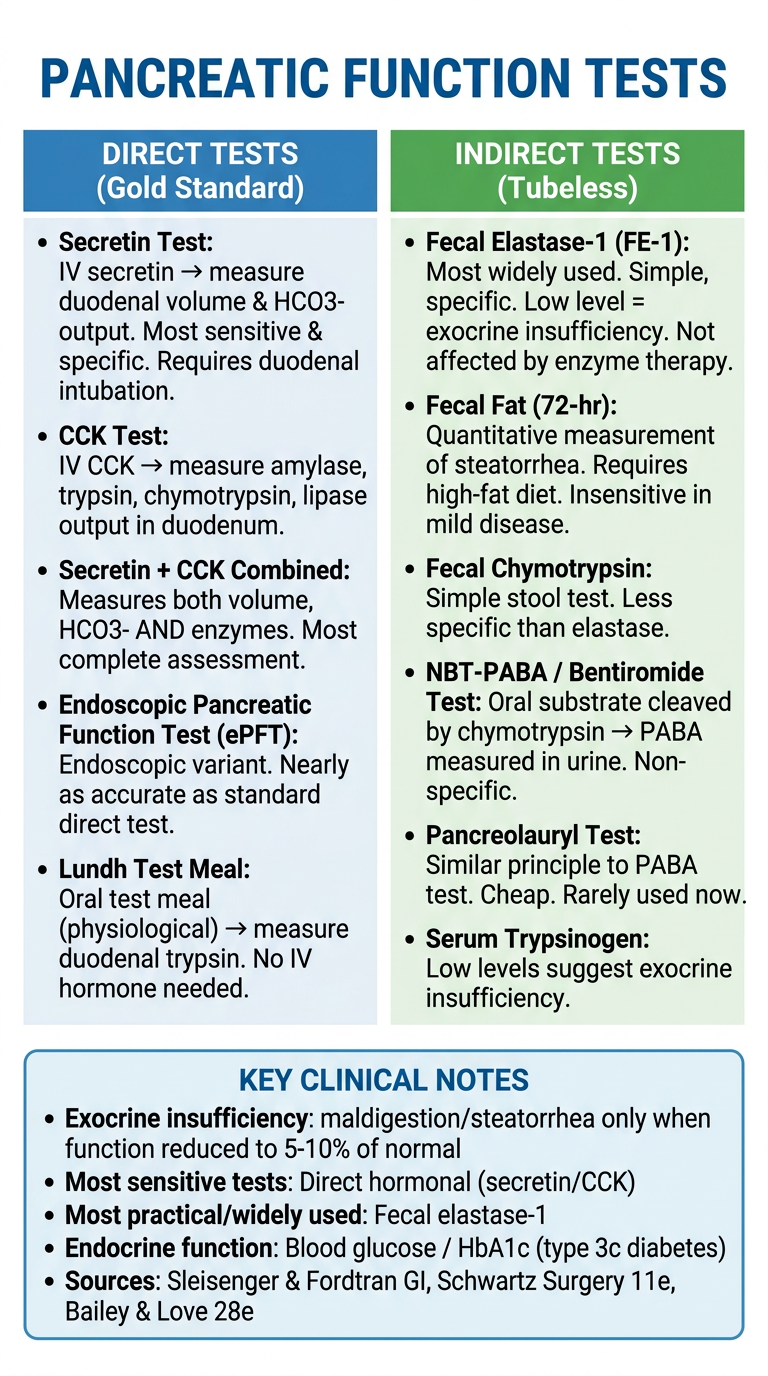
Pancreatic Function Tests - Summary from Standard Books
DIRECT TESTS (Gold Standard)
| Test | What is Measured | Key Feature |
|---|---|---|
| Secretin test | Duodenal volume + HCO3- output after IV secretin | Best for ductal (ductular cell) function |
| CCK test | Amylase, trypsin, chymotrypsin, lipase output after IV CCK | Best for acinar cell function |
| Secretin + CCK combined | Volume, HCO3-, and all enzymes | Most complete assessment |
| Endoscopic PFT (ePFT) | Same as above via endoscope instead of tube | Nearly as accurate; more tolerable |
| Lundh test meal | Duodenal trypsin after oral test meal | No IV hormone; physiological stimulus |
INDIRECT TESTS (Tubeless)
| Test | Principle | Notes |
|---|---|---|
| Fecal elastase-1 (FE-1) | Elastase level in stool | Most widely used; simple & specific |
| Fecal fat (72-hr) | Fat in stool on high-fat diet | Quantifies steatorrhea |
| Fecal chymotrypsin | Chymotrypsin in stool | Less specific than elastase |
| NBT-PABA / Bentiromide | Oral substrate cleaved by chymotrypsin → PABA in urine | Cheap; rarely used now |
| Pancreolauryl test | Similar to PABA test | Non-specific; obsolete |
| Serum trypsinogen | Low level = exocrine insufficiency | Useful marker |
Key Clinical Points
- Maldigestion/steatorrhea occurs only when exocrine function falls to 5-10% of normal
- Direct tests are the gold standard but require duodenal intubation and are not widely available
- Fecal elastase-1 is the most practical test in routine clinical use
- Endocrine function is assessed by blood glucose / HbA1c (type 3c diabetes mellitus)
Create ian image
What should the image be of?
Pf pancreas function test
Medical educational infographic titled "PANCREATIC FUNCTION TESTS (PFTs)" with a clean, professional clinical design on a white background with blue and green accents. SECTION 1 - Top center: Large bold title "PANCREATIC FUNCTION TESTS (PFTs)" with a small pancreas anatomical icon. SECTION 2 - Two large side-by-side boxes: LEFT BOX (Blue header): "DIRECT TESTS — Gold Standard" Subtitle: "Require duodenal intubation + IV secretagogue" Bullet points with icons: 🔵 Secretin Test → Measures duodenal HCO3⁻ and volume output. Best for ductal cell function. 🔵 CCK (Cholecystokinin) Test → Measures amylase, lipase, trypsin, chymotrypsin. Best for acinar cell function. 🔵 Secretin + CCK Combined → Most complete; measures both HCO3⁻ and all enzymes. 🔵 Endoscopic PFT (ePFT) → Endoscope replaces tube. Nearly as accurate. Better tolerated. 🔵 Lundh Test Meal → Oral test meal (physiological). Measures duodenal trypsin. No IV hormone needed. RIGHT BOX (Green header): "INDIRECT TESTS — Tubeless" Subtitle: "Detect moderate-to-severe insufficiency. Non-invasive." Bullet points: 🟢 Fecal Elastase-1 (FE-1) — MOST WIDELY USED. Simple stool test. Low level = exocrine insufficiency. 🟢 72-hr Fecal Fat — Quantifies steatorrhea on high-fat diet. Insensitive in mild disease. 🟢 Fecal Chymotrypsin — Stool test. Less specific than elastase. 🟢 NBT-PABA / Bentiromide Test — Oral substrate cleaved by chymotrypsin → PABA measured in urine. 🟢 Pancreolauryl Test — Similar to PABA test. Simple but non-specific. Rarely used now. 🟢 Serum Trypsinogen — Low serum level indicates exocrine insufficiency. SECTION 3 - Bottom yellow/amber highlight box: "KEY FACTS" • Steatorrhea only occurs when exocrine function drops to 5–10% of normal • Direct tests = most sensitive & specific (gold standard) • Fecal elastase-1 = most practical for routine clinical use • Endocrine function: assess with Blood Glucose / HbA1c (Type 3c Diabetes) • Sources: Sleisenger & Fordtran, Schwartz Surgery 11e, Bailey & Love 28e
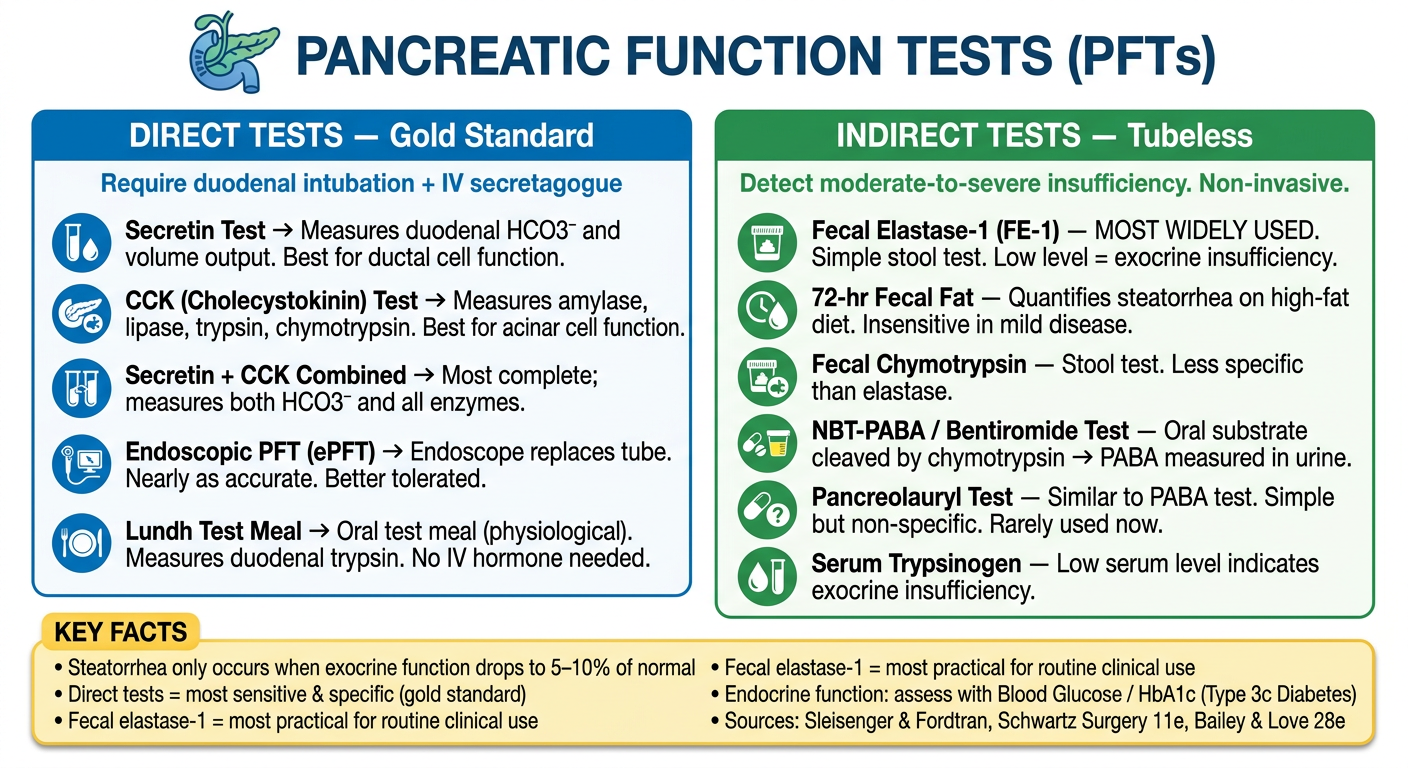
- Direct Tests (blue) - Secretin, CCK, Combined, Endoscopic PFT, Lundh Test Meal
- Indirect Tests (green) - Fecal Elastase-1, Fecal Fat, Chymotrypsin, NBT-PABA, Pancreolauryl, Serum Trypsinogen
- Key Facts at the bottom including the critical 5-10% threshold for steatorrhea