
Zinner syndrome
Reading File
Now let me search the medical library and PubMed in parallel for Zinner syndrome.
Finding Sources
Searching PubMed
Zinner syndrome seminal vesicle cyst renal agenesis
Searching the Web
Zinner syndrome clinical features diagnosis treatment
Good, now let me read the relevant textbook sections and get more detail from the library and web.
Reading File
Reading File
Finding Sources
Reading Web Page
https://www.frontiersin.org/journals/urology/articles/10.338…
Now let me read the full Zinner syndrome section from the Campbell-Walsh textbook and get the radiology textbook content.
Reading File
Reading File
I now have sufficient information to write a comprehensive answer. Let me compile it.
Zinner Syndrome
Definition: Zinner syndrome is a rare congenital triad resulting from a mesonephric (Wolffian) duct anomaly, comprising:
- Unilateral renal agenesis (URA)
- Ipsilateral seminal vesicle cyst
- Ejaculatory duct obstruction
It was first described by Albert Zinner in 1914 and represents the male counterpart to OHVIRA syndrome (Obstructed Hemi-Vagina and Ipsilateral Renal Anomaly) in females.
Embryology / Pathogenesis
The Wolffian (mesonephric) duct gives rise to the ureter, renal pelvis, collecting system, epididymis, vas deferens, seminal vesicle, and ejaculatory duct. A defect in the distal portion of the Wolffian duct during early embryogenesis (around weeks 4-7) leads to:
- Failure of the ureteric bud to contact the metanephric blastema → ipsilateral renal agenesis
- Atresia or agenesis of the ejaculatory duct → ejaculatory duct obstruction
- Accumulation of secretions in the seminal vesicle due to outflow obstruction → seminal vesicle cyst
This is why all three anomalies are ipsilateral. In Campbell-Walsh-Wein Urology, the syndrome is described as: "A seminal vesicle cyst caused by obstruction (atresia) of the ejaculatory duct may be seen in association with ipsilateral renal agenesis, and it has been referred to as Zinner syndrome." The same source notes that 6 cases (5%) were found among 119 boys with URA during ultrasound screening, indicating it is not uncommon among patients with URA. - Campbell-Walsh-Wein Urology
Additionally, in up to 70% of patients with renal agenesis, the absent ipsilateral epididymis, vas deferens, seminal vesicle, or seminal vesicle cyst may be observed. - Grainger & Allison's Diagnostic Radiology
Epidemiology
- Exclusively affects males (since it involves Wolffian duct derivatives)
- Rare condition - fewer than 200 well-documented cases in the literature
- Typically diagnosed in the 2nd to 4th decade of life, often after onset of sexual activity when secretions accumulate and cysts enlarge
- Left-sided dominance has been noted (left URA is more common, with a 3.5:1 left-to-right ratio)
Clinical Features
Most patients are asymptomatic until the 2nd-3rd decade. Symptoms, when present, include:
| Category | Symptoms |
|---|---|
| Lower urinary tract | Dysuria, urinary frequency, urgency, incomplete bladder emptying |
| Pain | Perineal pain, pelvic/scrotal pain (worse during defecation or ejaculation) |
| Ejaculatory | Hematospermia, painful ejaculation, decreased ejaculate volume |
| Infectious | Recurrent prostatitis, epididymitis, recurrent UTIs |
| Reproductive | Infertility (up to 45% of patients) |
Infertility arises because ejaculatory duct obstruction prevents sperm from reaching the ejaculate. Azoospermia or severe oligospermia may result.
Investigations
Imaging is the cornerstone of diagnosis:
- Ultrasound (transabdominal/transrectal): First-line screening tool. Can detect absent kidney, seminal vesicle cyst, and sometimes ejaculatory duct dilation. Transrectal US (TRUS) is particularly useful for evaluating the seminal vesicles.
- CT scan: Confirms renal agenesis and identifies cystic pelvic mass (seminal vesicle cyst).
- MRI pelvis (gold standard): Best modality - provides excellent soft tissue characterization of seminal vesicle cysts, ejaculatory duct obstruction, and confirms ipsilateral renal agenesis in one study. T2-weighted sequences show the cyst as high signal intensity.
- Cystoscopy: May reveal absent/ectopic ureteral orifice on the affected side; can occasionally identify cystic changes at the ureteral orifice or abnormal ejaculatory duct openings.
Semen analysis: May show azoospermia, low volume, acidic pH, absent fructose (indicating ejaculatory duct obstruction).
Differential Diagnosis
- Mullerian duct cyst (midline, not associated with renal agenesis)
- Prostatic utricle cyst (midline, small, opens into prostatic urethra)
- Vas deferens cyst
- Seminal vesicle abscess
- Wolffian duct cyst
- Pelvic/retroperitoneal neoplasm
The characteristic triad - absent kidney + ipsilateral cystic pelvic mass + ejaculatory duct obstruction - distinguishes Zinner syndrome from these entities.
Complications
- Infertility (~45%)
- Recurrent infections (cyst acts as reservoir)
- Ureteral ectopia - the ureter (if present as a stump) may insert ectopically into the seminal vesicle or prostatic urethra
- Malignant transformation: Rare - cases of adenocarcinoma, cystadenoma, and squamous cell carcinoma arising in seminal vesicle microcysts have been described
Management
Asymptomatic patients: Conservative management with regular follow-up (imaging surveillance for cyst enlargement or infection, and semen analysis for fertility assessment).
Symptomatic patients / cysts >5 cm:
| Approach | Details |
|---|---|
| Transurethral resection of ejaculatory duct (TURED) | Preferred minimally invasive option; relieves obstruction, may improve fertility |
| Transurethral unroofing/deroofing | For cysts with distal communication |
| Laparoscopic/robotic excision | For large or infected seminal vesicle cysts; good outcomes |
| Open surgical excision | Reserved for complex cases |
| TRUS-guided aspiration | Temporary relief; high recurrence rate |
For infertility, surgical correction of ejaculatory duct obstruction (TURED) may restore natural ejaculation of sperm. If unsuccessful, sperm retrieval (TESA/PESA) combined with IVF/ICSI is an option.
Genetic Considerations
Recent case reports with whole-exome sequencing have identified potential mutations in genes involved in Wolffian duct development, though no single causative gene has been firmly established. The condition is generally considered sporadic.
Summary
Zinner syndrome = Unilateral renal agenesis + Ipsilateral seminal vesicle cyst + Ejaculatory duct obstruction - all due to a single embryological defect in the distal Wolffian duct. It should be suspected in any male with unilateral renal agenesis and a cystic pelvic mass. MRI pelvis is the diagnostic gold standard. Treatment is conservative for asymptomatic patients; TURED or laparoscopic cyst excision for symptomatic cases. Infertility, affecting up to 45% of patients, requires dedicated evaluation and management.
Sources:
- Campbell-Walsh-Wein Urology (11th ed.)
- Grainger & Allison's Diagnostic Radiology
- Frontiers in Urology 2023 - Clinicopathological and genetic features of Zinner's syndrome
- Recent PubMed literature (2021-2026): 64 publications retrieved, predominantly case reports and reviews (PMIDs: 38900322, 36382324, 37069891)
Breast examination
Reading File
This is a broad clinical topic. Let me run parallel searches across the library and web.
Finding Sources
Finding Sources
Searching the Web
clinical breast examination technique inspection palpation lymph nodes findings
Good. Now let me read the detailed textbook sections on breast examination - particularly from Mulholland/Greenfield Surgery and Berek & Novak's Gynecology, plus Current Surgical Therapy.
Reading File
Reading File
Reading File
Let me read more of the Mulholland Surgery text (the palpation and findings section) and also get any images.
Reading File
Finding Sources
Let me fetch the key images and also read the nipple discharge section for completeness.
Loading Image
Loading Image
Reading File
I now have excellent content from multiple authoritative sources. Let me compile the comprehensive answer.
Clinical Breast Examination (CBE)
Overview
CBE is performed by a trained clinician and consists of three core components: inspection, palpation, and lymph node examination. It is done in both sitting/upright and supine positions. About 10-20% of breast cancers are not visible on screening mammography, and CBE by trained personnel increases cancer detection above mammography alone. - Current Surgical Therapy 14e
Before You Begin
- Ensure a chaperone is present when indicated (particularly for male examiners)
- Provide a front-opening gown; the patient is disrobed from the waist up
- Wash hands before and after
- Do not wear gloves if possible - they reduce tactile sensitivity for small lesions
- Take a relevant history first (see table below)
- If tenderness is present on one side, start on the non-tender side
Key history points:
| General | Specific to complaint |
|---|---|
| Age at menarche | Onset and duration of symptom |
| Pregnancy/lactation history | Relationship to menstrual cycle |
| Family history (breast/ovarian/other cancers) | Spontaneous vs. elicited discharge |
| Previous breast biopsies/surgery/radiation | Changes with position or activity |
| OCP / HRT use | |
| Last menstrual period |
Part 1: Inspection
Performed with the patient seated upright, facing the examiner. Inspect in the following positions:
- Arms relaxed at sides - baseline symmetry
- Arms raised above head - exposes the lower breast and inframammary fold
- Hands pressed on hips / pectoral contraction - accentuates skin tethering and dimpling
- Leaning forward - allows pendulous breasts to hang free, revealing asymmetry
What to assess:
| Feature | Normal | Concerning |
|---|---|---|
| Size & shape | Slight left-breast dominance is normal | Recent change in size or contour |
| Skin | Smooth, uniform | Dimpling, skin retraction, edema |
| Peau d'orange | Absent | Lymphatic obstruction (IBC vs. infection) |
| Erythema | Absent | Suggests IBC or mastitis |
| Nipple symmetry | Congenital inversion acceptable | New nipple inversion - high suspicion |
| Nipple-areola complex | Smooth | Eczematous changes / ulceration → Paget disease |
| Scars | Note previous surgical scars |
Tumors involving Cooper's ligaments can cause skin retraction best seen on pectoral contraction. Superficial tumors alter breast contour. - Mulholland & Greenfield's Surgery
Part 2: Lymph Node Examination (Sitting)
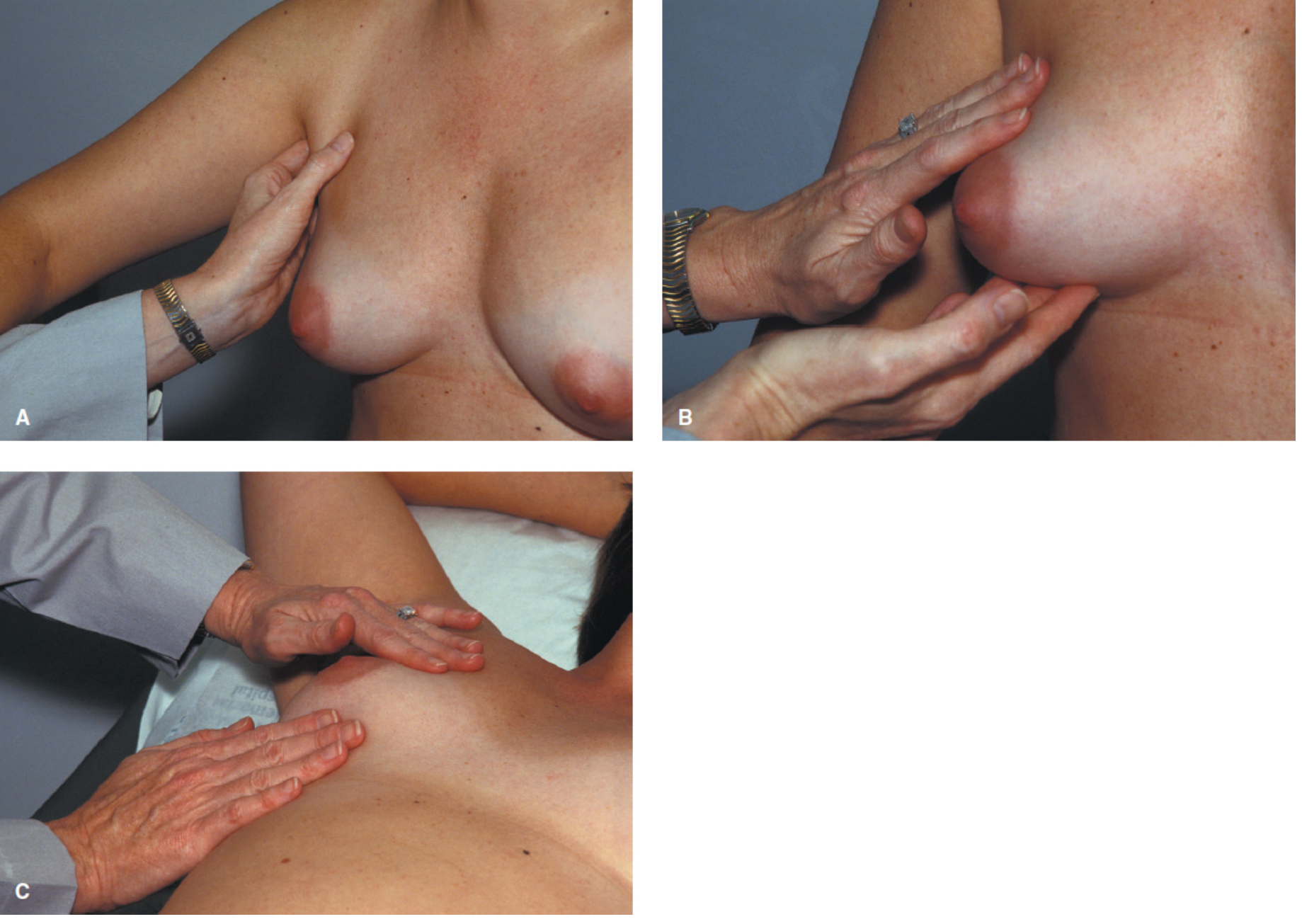
Performed before breast palpation while the patient remains sitting. Use the palmar pads of 2nd, 3rd, and 4th fingers.
Regions to examine:
-
Axillary nodes (most important for breast cancer staging):
- Support the patient's ipsilateral arm in slight abduction (~45°) to relax the pectoral muscles and axillary skin
- Place fingertips into the apex of the axilla and sweep down all four walls: anterior (pectoral), posterior (subscapular), medial (chest wall), and lateral (upper arm)
-
Supraclavicular nodes - palpate just above the clavicle medially
-
Infraclavicular nodes - below the medial clavicle
-
Cervical nodes - along the sternocleidomastoid
For each palpable node, document:
| Feature | Concerning findings |
|---|---|
| Size (cm) | >1 cm |
| Texture | Hard / firm (vs. soft, rubbery = reactive) |
| Mobility | Fixed/matted = malignant spread |
| Tenderness | Tender nodes more often reactive |
| Number | Multiple |
Part 3: Breast Palpation
Sitting Position
Bimanual palpation with the patient still seated - compare both breasts for asymmetry and masses.
Supine Position (primary palpation)
- Patient lies supine, ipsilateral arm raised above the head (flattens and spreads breast tissue over chest wall)
- Contralateral breast covered for privacy
- Use palmar pads of the middle three fingers (never fingertips)
- Apply three levels of pressure at each site:
- Light (superficial tissue)
- Medium (mid breast)
- Deep (posterior tissue against chest wall)
- Use gentle rotatory/circular motion at each point
Boundaries of examination:
- Superior: clavicle
- Inferior: lower rib cage / inframammary fold
- Medial: sternal border
- Lateral: midaxillary line
- Include the axillary tail of Spence (breast tissue extending into the axilla)
Search Patterns
| Pattern | Technique | Notes |
|---|---|---|
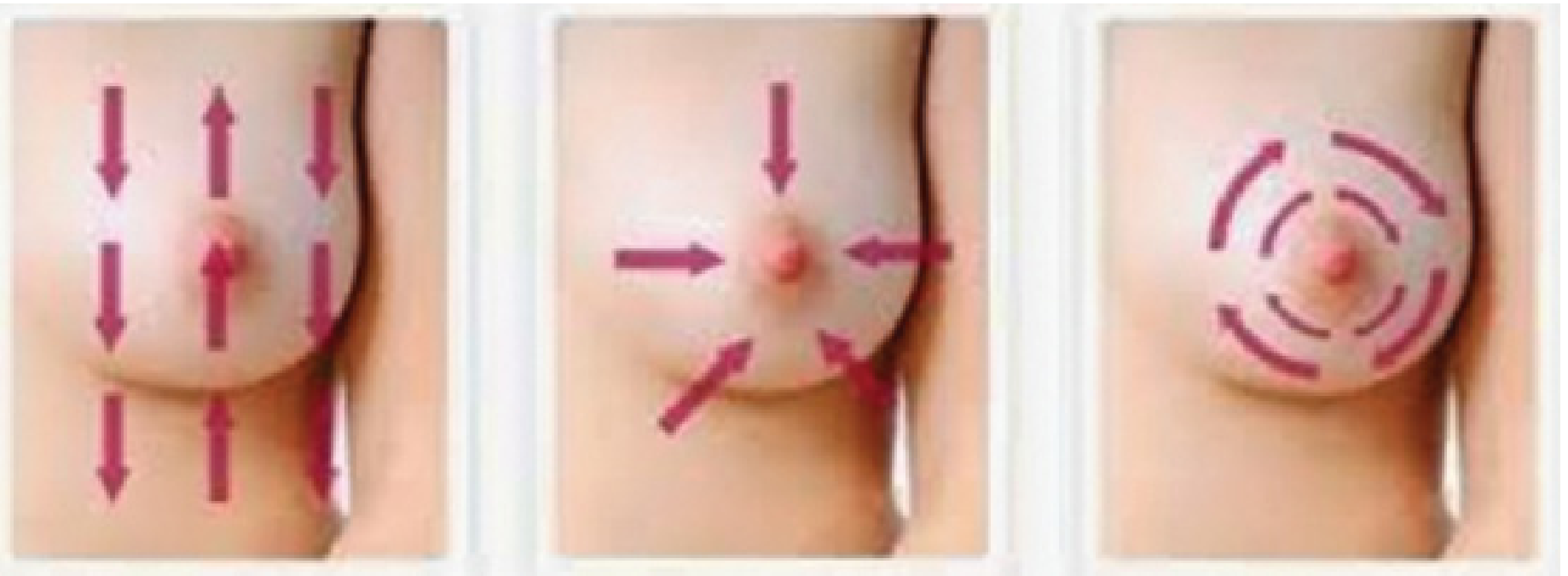
| Vertical strip (preferred) | Up-and-down parallel strips | Most thorough; includes nipple-areola complex; reduces risk of missing breast tissue |
| Radial spoke | Lines from periphery to nipple | May miss nipple-areola complex; requires separate nipple exam |
| Concentric circles | Outward expanding circles | May miss periphery and nipple; less recommended |
"The vertical strip pattern is preferred as it incorporates the nipple-areola complex. With the other two patterns, a separate examination of the nipple-areola complex must be performed." - Mulholland & Greenfield's Surgery
Characteristics of any Mass Found
Document the following:
| Feature | Benign (likely) | Malignant (suspicious) |
|---|---|---|
| Consistency | Soft, cystic, rubbery | Hard, stony |
| Shape | Round, oval, smooth margins | Irregular, spiculated |
| Mobility | Freely mobile | Fixed to skin or chest wall |
| Borders | Well-defined | Poorly defined |
| Tenderness | Tender (often fibrocystic) | Often non-tender |
| Skin changes | None | Dimpling, tethering, peau d'orange |
| Number | Often multiple (fibrocystic) | Usually single |
Note: Generalized lumpiness/nodularity is not pathologic - most normal breasts have more nodularity in the upper outer quadrant, at the inframammary ridge, and in the subareolar region. Comparing both sides for symmetry helps discriminate. - Mulholland & Greenfield's Surgery
Nipple Examination
- Inspect for retraction, eczema, ulceration (Paget disease), discharge
- Elicit discharge: massage each quadrant from periphery toward the nipple, then apply gentle pressure at the base of the nipple-areola complex
- Document discharge characteristics:
| Feature | Physiologic | Pathologic |
|---|---|---|
| Origin | Bilateral, multiple ducts | Unilateral, single duct orifice |
| Character | Milky, serous, multicolored | Clear, serous, or bloody |
| Onset | Elicited only | Spontaneous |
| Occult blood test | Negative | Positive |
Age predicts cancer risk in pathologic discharge: 3% malignancy in women <40, 10% in age 40-60, and 32% in those >60. - Mulholland & Greenfield's Surgery
Most common cause of pathologic discharge: Intraductal papilloma (benign). Other causes: DCIS (5-15%), ductal ectasia, malignancy.
The Seven "Ps" of Breast Examination
A useful mnemonic from Berek & Novak's Gynecology:
- Positions - sitting (arms at sides, raised, on hips) + supine
- Palpation - systematic, cover entire breast
- Pads of fingers - use finger pads, not tips
- Pressure - three levels (light, medium, deep)
- Perimeter - cover full anatomical extent (clavicle to inframammary fold, sternum to axillary line)
- Pattern of search - vertical strip preferred
- Patient education - instruct on BSE, what to report
Worrying ("Red Flag") Signs on Breast Examination
| Sign | Clinical significance |
|---|---|
| New nipple inversion | Malignancy until proven otherwise |
| Skin dimpling/retraction | Cooper's ligament involvement by tumor |
| Peau d'orange | Lymphatic obstruction (inflammatory breast cancer) |
| Erythema + induration | Inflammatory breast cancer vs. mastitis |
| Eczema/ulceration of nipple-areola | Paget disease of the breast |
| Hard, fixed, irregular mass | Strong suspicion for malignancy |
| Bloody nipple discharge | Papilloma, DCIS, or carcinoma |
| Hard fixed axillary nodes | Metastatic spread |
| Palpable mass mammographically occult | Still requires biopsy - up to 15% of cancers are mammography-occult |
After the Examination
- Any clinically suspicious mass requires tissue diagnosis even if imaging is negative
- Abnormal CBE → diagnostic mammogram + targeted ultrasound ± MRI
- Physiologic discharge → reassure, advise to avoid nipple manipulation
- Pathologic discharge → ultrasound + mammogram (if >30 yrs); consider ductography or ductoscopy
Sources:
- Mulholland & Greenfield's Surgery: Scientific Principles and Practice, 7th ed.
- Current Surgical Therapy, 14th ed.
- Berek & Novak's Gynecology
This is a shared conversation. Sign in to Orris to start your own chat.