

IMG_4733.jpeg
Detailed answers according to your weightage from standard surgery textbooks
I can see this is a surgery exam preparation note covering Thyroid topics. Let me read the medical library skill first, then research all the high-yield topics in parallel.
Reading File
Now let me run all searches in parallel to maximize coverage:
Finding Sources
Finding Sources
Finding Sources
Finding Sources
Finding Sources
Finding Sources
Finding Sources
Finding Sources
I have very few DB queries left. Let me read the most important blocks in parallel now:
Reading File
Reading File
Reading File
Reading File
Finding Sources
Now let me read the most important sections - thyroid anatomy, physiology, thyrotoxicosis, tumors, and complications in parallel:
Reading File
Reading File
Reading File
Reading File
Finding Sources
Now let me read the remaining key sections in parallel - thyroid tumors/carcinoma, thyrotoxicosis management, and complications:
Reading File
Reading File
Reading File
Reading File
Loading Image
I now have rich content from multiple standard surgery textbooks. Let me read a few more critical sections - thyrotoxicosis treatment details, complications of thyroid surgery, and follicular carcinoma:
Reading File
Reading File
Reading File
Reading File
Reading File
Reading File
Reading File
Reading File
I now have comprehensive content from Schwartz's, Sabiston, Mulholland's, Fischer's, Guyton & Hall, and Cummings. Let me now compile the complete detailed answers.Here are detailed answers for all topics from your notes, based on Schwartz's Principles of Surgery (11e), Sabiston Textbook of Surgery, Mulholland & Greenfield's Surgery (7e), Fischer's Mastery of Surgery (8e), Guyton & Hall Medical Physiology, and Cummings Otolaryngology:
THYROID - Detailed Surgery Answers
1. Surgical Anatomy of the Thyroid Gland
Gross Anatomy
The thyroid is a bilobed gland weighing 15-30 g, situated anterior to the trachea, just inferior to the cricoid cartilage within the central compartment of the neck. Each lobe measures approximately 5 cm craniocaudally, 2-3 cm anteroposteriorly, and 3 cm in width.
Borders:
- Lateral: medial aspects of the carotid sheath
- Anterior: sternothyroid and sternohyoid (strap) muscles
- Posterior: trachea and esophagus (especially on left)
Ligaments:
- Anterior suspensory ligament - above the isthmus
- Ligament of Berry (posterior suspensory ligament) - firm attachment to trachea posteromedially; the RLN is intimately related here and is most vulnerable to iatrogenic injury at this point. Branches of RLN may traverse the ligament in 25% of individuals.
- Tubercle of Zuckerkandl - most lateral and posterior extent of thyroid lobe; the last segments of the RLN course below this structure.
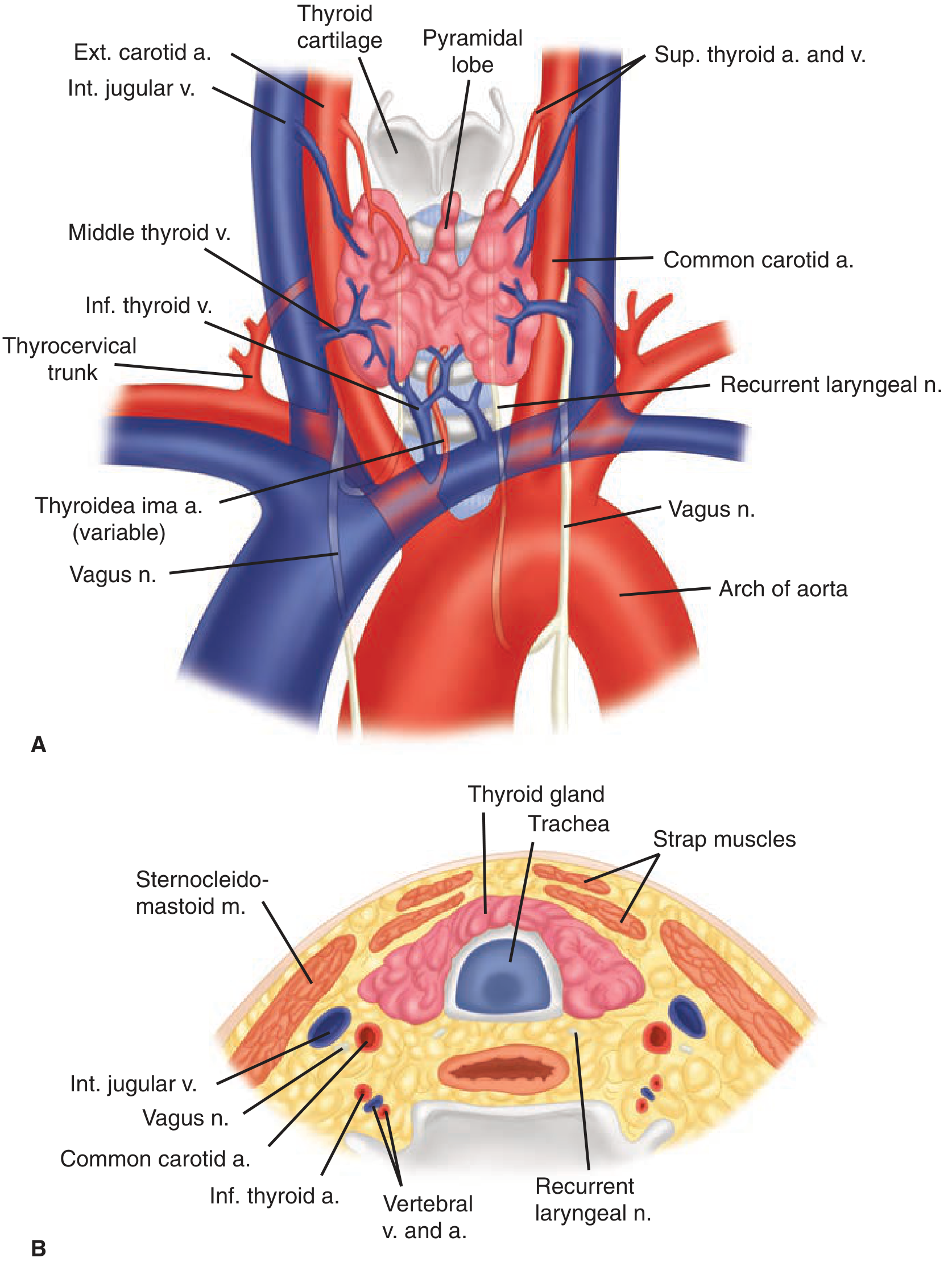
Blood Supply
| Vessel | Origin | Notes |
|---|---|---|
| Superior thyroid artery | External carotid artery | Divides into anterior and posterior branches at apex of each lobe |
| Inferior thyroid artery | Thyrocervical trunk (from subclavian) | Crosses the RLN - identify RLN BEFORE ligating |
| Thyroidea ima artery | Directly from aorta or innominate | Present in 1-4% individuals; enters isthmus |
Venous Drainage: Three sets of veins:
- Superior thyroid vein - drains into internal jugular vein
- Middle thyroid vein - least consistent; drains into internal jugular
- Inferior thyroid veins - form a plexus draining into brachiocephalic veins
Nerve Supply (Surgically Critical)
Recurrent Laryngeal Nerve (RLN):
- Left RLN: arises from vagus at the aortic arch, loops around ligamentum arteriosum, ascends in tracheoesophageal groove
- Right RLN: arises from vagus at the right subclavian artery, usually passes posterior to artery, more oblique course
- Non-recurrent RLN: occurs in 0.5-1% on right (associated with vascular anomaly); extremely rare on left (only with situs inversus)
- Most vulnerable at Ligament of Berry
External Branch of Superior Laryngeal Nerve (EBSLN):
- Approximately 20% of patients are at risk of injury if superior pole vessels are ligated en masse
- Injury causes loss of cricothyroid muscle function → loss of high-pitched voice (singer's nerve)
Lymphatic Drainage
- Central compartment (Level VI) - primary drainage
- Lateral neck (Levels II-V)
- Superior mediastinal nodes
Embryology
- Thyroid arises from median and lateral thyroid anlagen; originates from the floor of the pharynx at the foramen cecum and descends through the neck via the thyroglossal duct to its final position
2. Physiology of Thyroid Hormones and TFTs
Thyroid Hormone Synthesis
Thyroid follicles contain colloid (principally thyroglobulin). Synthesis steps:
- Iodide trapping - Na/I symporter (NIS) on basolateral membrane co-transports 2Na+ and 1I- using energy from Na-K ATPase. Concentrates iodide ~30x (up to 250x when maximally active).
- Transport to apical membrane - via pendrin (chloride-iodide counter-transporter)
- Oxidation of I- to I0 - by thyroid peroxidase (TPO) in presence of H2O2
- Organification - iodination of tyrosyl residues on thyroglobulin → MIT (monoiodotyrosine), DIT (diiodotyrosine)
- Coupling - DIT + DIT → T4; MIT + DIT → T3 (by TPO)
- Pinocytosis and hydrolysis - thyroglobulin endocytosed, lysosomes release T3/T4
- Secretion - T4 and T3 released; MIT/DIT deiodinated and recycled
Hypothalamic-Pituitary-Thyroid Axis
- Hypothalamus → TRH → Anterior pituitary → TSH → Thyroid → T3/T4
- T3 is primarily responsible for inhibition (feedback) at both hypothalamus and pituitary
- TSH stimulates virtually all steps of thyroid hormone synthesis and iodide trapping
Thyroid Function Tests (TFTs)
| Test | Normal Range | Notes |
|---|---|---|
| Serum TSH | 0.5-5 μU/mL (0.27-4.20 mIU/mL) | Most sensitive and specific; ideal first test |
| Total T4 | 55-150 nmol/L | Includes bound + free fractions |
| Total T3 | 1.5-3.5 nmol/L | Better for hyperthyroid states; last to become abnormal in hypothyroidism |
| Free T4 | 12-28 pmol/L | Most clinically useful; unaffected by binding protein changes |
| Free T3 | 3-9 pmol/L | Best for confirming early hyperthyroidism |
Key Principle: There is an inverse logarithmic relationship between free T4 and TSH - small changes in free T4 cause large shifts in TSH.
Pattern Interpretation:
- High TSH + Low fT4 = Primary hypothyroidism
- Suppressed TSH + High fT4 = Hyperthyroidism
- T3 thyrotoxicosis = high T3, normal T4 and TSH
Other TFTs:
- Anti-TPO + Anti-Tg antibodies - elevated in Hashimoto's thyroiditis (~80%)
- TSI (thyroid stimulating immunoglobulin) - elevated in Graves' disease
- Serum Thyroglobulin (Tg) - tumor marker for monitoring differentiated thyroid cancer recurrence post-thyroidectomy; elevated Tg after total thyroidectomy = recurrence
- Serum Calcitonin - marker for Medullary Thyroid Carcinoma (MTC)
- TRH stimulation test - 500 μg TRH IV; normal: TSH rises ≥6 μIU/mL at 30-60 min
3. Thyroiditis
Classification
| Type | Also Known As | Cause | Key Features |
|---|---|---|---|
| Hashimoto's (Chronic Autoimmune) | Struma lymphomatosa | Autoimmune (Anti-TPO, Anti-Tg) | Most common; firm goiter; eventual hypothyroidism |
| Subacute (De Quervain's) | Granulomatous thyroiditis | Likely viral (mumps, influenza, adenovirus) | Painful thyroid, fever, malaise, elevated ESR; transient thyrotoxicosis → hypothyroidism → recovery |
| Painless (Silent) | Subacute lymphocytic | Autoimmune variant | No pain; self-limiting thyrotoxicosis 2-6 weeks; more equal sex distribution than Graves' |
| Riedel's | Fibrous thyroiditis | Unknown (fibrosclerotic) | "Woody hard" thyroid; may mimic carcinoma; associated with retroperitoneal fibrosis |
| Acute Suppurative | Bacterial thyroiditis | Bacterial infection | Rare; pain, fever, abscess; treat with antibiotics ± drainage |
| Radiation-induced | Post-RAI thyroiditis | ¹³¹I therapy | Occurs 1-2 weeks post-RAI; exacerbation of thyrotoxicosis |
| Postpartum | - | Autoimmune | Thyrotoxicosis then hypothyroidism; 50% later develop Hashimoto's |
Subacute Thyroiditis - Key Details
- ~50% have preceding URI
- Thyrotoxicosis due to T4/T3 release from disrupted follicles (not new synthesis) → transient, self-limiting (4-6 weeks)
- Radionuclide scan: LOW uptake (distinguishes from Graves')
- Treatment: NSAIDs/salicylates (2.4-3.6 g/day); severe → Prednisone 40 mg/day x 3-4 weeks, then taper; β-blockers for thyrotoxic symptoms if troublesome
4. Thyrotoxicosis and Its Management (High Yield - QQ 2017)
Definition
Thyrotoxicosis = clinical state resulting from elevated circulating thyroid hormones (regardless of cause). Hyperthyroidism = thyrotoxicosis caused by excess thyroid hormone production.
Causes
- Graves' disease (most common) - diffuse toxic goiter; TSI stimulates TSH receptor
- Toxic multinodular goiter (Plummer's disease)
- Solitary toxic adenoma (Plummer's disease variant)
- Subacute/silent thyroiditis
- Exogenous thyroid hormone intake
- Struma ovarii, TSH-secreting pituitary adenoma (rare)
Clinical Features
- Symptoms: weight loss, heat intolerance, palpitations, tremor, anxiety, diarrhea, oligomenorrhea
- Signs: tachycardia, AF, warm moist skin, fine tremor, exophthalmos (Graves' only), lid lag, lid retraction, pretibial myxedema (Graves' only), thyroid bruit (Graves')
- Graves' specific: exophthalmos, pretibial myxedema, thyroid acropachy (triad)
Three Treatment Modalities
A. Antithyroid Drugs (Thionamides)
- Drugs: Carbimazole (converted to methimazole), Propylthiouracil (PTU)
- Mechanism: Inhibit TPO → block organification and oxidation of iodide → block T3/T4 synthesis; PTU also inhibits peripheral conversion of T4 to T3
- Doses: Carbimazole 20-40 mg/day; PTU 100-150 mg TDS
- Duration: 12-18 months; remission in 30-50% of Graves' patients
- Side effects: Agranulocytosis (0.1-0.5%; most serious - check WBC if sore throat/fever), hepatotoxicity (PTU), rash, arthralgia
- PTU preferred in: pregnancy (1st trimester), thyroid storm, breast-feeding
B. Radioactive Iodine (¹³¹I)
- Definitive, non-invasive treatment
- Taken up by thyroid cells → beta emission → follicular cell destruction
- Contraindicated in pregnancy, children, active severe ophthalmopathy
- Side effects: permanent hypothyroidism (desired endpoint), radiation thyroiditis, worsening ophthalmopathy
- Defer pregnancy for 6-12 months after treatment
C. Surgery (Thyroidectomy)
- Definitive treatment with immediate effect
- Indications: large goiter with compressive symptoms, failed antithyroid drugs, patient preference, significant ophthalmopathy, pregnancy (second trimester), children, suspected malignancy, toxic multinodular goiter
- Preparation: make euthyroid with thionamides first; then Lugol's iodine for 10 days pre-op (reduces vascularity - Wolff-Chaikoff effect)
- Procedure: Total or near-total thyroidectomy
- Complications: RLN injury, hypoparathyroidism, thyroid storm (if inadequately prepared)
D. Additional Medications (Surgical Pharmacology)
| Drug | Class | Mechanism | Use |
|---|---|---|---|
| Beta-blockers (propranolol) | Adrenergic blocker | Block adrenergic symptoms; propranolol also inhibits T4→T3 conversion | Rapid symptom control in all forms |
| Lugol's iodine | Iodine solution | Wolff-Chaikoff effect - inhibits hormone synthesis and release; reduces gland vascularity | Pre-op preparation (10 days) |
| Potassium iodide (SSKI) | Iodine | Same as Lugol's | Thyroid storm |
| Dexamethasone/hydrocortisone | Corticosteroid | Inhibits T4→T3 conversion; blocks hormone release | Thyroid storm |
| Lithium | - | Blocks hormone release | Rarely used, allergy to iodine |
| Cholestyramine | Bile acid sequestrant | Reduces entero-hepatic circulation of T4 | Adjunct in severe thyrotoxicosis |
Treatment Summary Table (Scott-Brown's)
| Antithyroid Drugs | Radioactive Iodine | Surgery | |
|---|---|---|---|
| Graves' disease | ✓ | ✓ | ✓ |
| Toxic nodular goiter | - | ✓ | ✓ |
| Pregnancy | ✓ | ✗ | ✓ (2nd trimester) |
| Children | ✓ | - | ✓ |
| Ophthalmopathy | ✓ | ✗ (worsens) | ✓ |
| Definitive | No | Yes | Yes |
| Non-invasive | Yes | Yes | No |
| Low hypothyroid risk | Yes | No | No |
| Histological diagnosis | No | No | Yes |
5. Pathology of Thyroid Tumors
Classification of Thyroid Tumors
Benign:
- Follicular adenoma (most common benign tumor)
- Toxic adenoma (Plummer's adenoma)
Malignant:
| Type | Frequency | Cell of Origin | Key Features |
|---|---|---|---|
| Papillary carcinoma (PTC) | ~80% (iodine-sufficient areas) | Follicular cell | Best prognosis; lymph node mets common; radiation-associated |
| Follicular carcinoma (FTC) | ~10% | Follicular cell | Iodine-deficient areas; hematogenous spread; FNAC cannot diagnose |
| Hurthle cell (Oncocytic) | ~3-5% | Follicular cell (oxyphilic variant) | Does not take up RAI well |
| Medullary carcinoma (MTC) | ~1-2% | Parafollicular C-cells | Calcitonin marker; RET mutation; associated with MEN2A/2B |
| Anaplastic (Undifferentiated) | ~1-2% | Follicular cell (de-differentiated) | Most aggressive; median survival 6 months; average age 71 years |
| Lymphoma | Rare | Lymphoid | Often in setting of Hashimoto's |
Papillary Thyroid Carcinoma (PTC)
- 80% of all thyroid malignancies; F:M = 2:1; mean age 30-40 years
- Histology: Papillary projections, characteristic nuclear features - pale "ground glass" cytoplasm, nuclear grooves, intranuclear cytoplasmic inclusions ("Orphan Annie" nuclei), psammoma bodies (calcified deposits)
- Molecular: BRAF V600E mutation (most common); RET/PTC rearrangements (especially post-radiation)
- Multifocality in up to 85% on microscopy
- Lymph node mets: common (especially in young); "lateral aberrant thyroid" = nodal metastasis
- Prognosis: Excellent; >95% 10-year survival
- Microcarcinoma: ≤1 cm, non-invasive; often incidental; associated with 25% occult LN mets
- NIFTP (Noninvasive Follicular Thyroid Neoplasm with Papillary-like nuclear features) - encapsulated follicular variant PTC without invasion; indolent behavior
Follicular Carcinoma (FTC)
- 10% of thyroid cancers; F:M = 3:1; mean age 50 years; iodine-deficient areas
- Presents as solitary nodule; FNAC cannot distinguish benign follicular lesion from FTC (need capsular/vascular invasion on histology)
- Spread: hematogenous (lungs, bone, liver, brain) - NOT lymphatic
- Cervical lymphadenopathy at presentation: only ~5%
- Diagnosis confirmed by capsular invasion and/or vascular invasion on histology
- Treatment: Total thyroidectomy + TSH suppression + RAI ablation
Medullary Thyroid Carcinoma (MTC)
- Arises from parafollicular C-cells (at junction of upper 1/3 and lower 2/3 of thyroid)
- 1-2% of thyroid cancers
- Sporadic (75%) vs Hereditary (25%)
- RET proto-oncogene mutations - all hereditary MTC (MEN2A, MEN2B, FMTC); 50% of sporadic MTC
- MEN2A (95% of MEN2): MTC + Primary Hyperparathyroidism + Pheochromocytoma; RET mutations exon 10/11
- MEN2B (5% of MEN2): MTC + Pheochromocytoma + Mucosal neuromas + Marfanoid habitus; RET codon 918 (exon 16) - most aggressive
- Marker: Calcitonin (diagnostic + follow-up); also CEA
- All patients with MTC should undergo genetic testing for RET (even "sporadic" cases - up to 7% may have hereditary form)
- Treatment: Total thyroidectomy + bilateral central neck dissection; screen family members
Anaplastic Carcinoma
- 1-2%; most aggressive thyroid malignancy; average age 71 years
- ~50% survive 6 months; often arise in longstanding goiter/well-differentiated cancer
- Treatment: multimodal (surgery rarely curative); chemoradiation (doxorubicin + radiation); dabrafenib for BRAF V600E-mutated cases
Familial Cancer Syndromes Associated with Thyroid Cancer
| Syndrome | Gene | Thyroid Tumor |
|---|---|---|
| Cowden syndrome | PTEN | FTC, rarely PTC |
| FAP | APC | PTC (cribriform variant) |
| Werner's syndrome | WRN | PTC, FTC, anaplastic |
| Carney complex | PRKAR1α | PTC, FTC |
| MEN2A/2B | RET | MTC |
6. Pathology of Thyroid Malignancy (Summary points)
AMES / MACIS Prognostic Scoring (for PTC/FTC)
AMES Risk Factors (for differentiated thyroid cancer):
- Age (males >40, females >50)
- Metastasis (distant)
- Extent (extrathyroidal invasion)
- Size (>4 cm)
MACIS (Metastasis, Age, Completeness of resection, Invasion, Size) - most validated scoring system for PTC.
7. Thyroglossal Duct Cyst (QQ 2018)
Embryology
The thyroid anlage begins at the foramen cecum at the base of the tongue. As the gland develops, it descends to its definitive midline location via the thyroglossal duct. Failure of this duct to resorb leads to thyroglossal duct cysts.
Features
- Most common congenital neck mass in children
- Location: midline, just below the hyoid bone (most common site); can be at any point along the thyroglossal tract
- Classic sign: Mass moves upward with swallowing AND with tongue protrusion (distinguishes from other neck masses)
- Size: 1-4 cm
- Lining: Stratified squamous epithelium (near tongue base) or pseudostratified columnar epithelium (lower sites); transitional patterns also occur
- Fibrous wall often includes lymphoid aggregates or thyroid remnants
- Malignant transformation: exceedingly rare (<1%)
- Can become infected → painful, red, fluctuant
Diagnosis
- Clinical (characteristic midline mass + tongue protrusion sign)
- Ultrasound/CT scan to confirm and check for normal thyroid tissue below (essential before surgery)
- FNAC if required to exclude malignancy
Treatment
Sistrunk Operation (definitive):
- Excision of the cyst + central portion of hyoid bone + the entire tract up to the base of the tongue
- Removing the hyoid prevents recurrence (thyroglossal duct passes through/near it)
- Recurrence rate without Sistrunk: ~50%; with Sistrunk: ~5%
- Complete excision is mandatory
8. Solitary Thyroid Nodule
Epidemiology
- Present in ~4% of the US population
- Thyroid cancer incidence: ~40 new cases per million
- Therefore, most nodules are benign; key task is identifying which need surgery
Features Suggesting Malignancy
- History of ionizing radiation exposure (40% chance of cancer)
- Age <20 or >60 years; Male sex
- Rapid growth, hard consistency, fixation to adjacent structures
- Hoarseness (RLN involvement) - worrisome sign
- Dysphagia, dyspnea - locally advanced disease
- Cervical lymphadenopathy
- Family history of thyroid cancer/MEN2
- Single firm nodule in MNG
- Pain (suggests hemorrhage, thyroiditis, or rarely malignancy)
Features Suggesting Benign
- Soft, cystic, smooth
- Positive radionuclide uptake ("hot" nodule - rarely malignant)
- History of Hashimoto's thyroiditis
- Rapid regression
- TSH normal or elevated
Workup
- History and examination
- TSH (first test) - if suppressed → radionuclide scan (to identify autonomously functioning "hot" nodule)
- Ultrasound - assess echogenicity, borders, calcifications, lymph nodes; ACR TI-RADS classification
- FNAC (Fine Needle Aspiration Cytology) - most important diagnostic test; Bethesda classification system (I-VI)
- Radionuclide scan - hot nodule (autonomous), cold nodule (higher malignancy risk), warm nodule
- CT scan - for retrosternal extension, airway compression
Bethesda Classification and Management
| Category | Description | Malignancy Risk | Management |
|---|---|---|---|
| I | Non-diagnostic | - | Repeat FNAC |
| II | Benign | <3% | Follow-up |
| III | AUS/FLUS | 10-30% | Repeat FNAC or lobectomy |
| IV | Follicular neoplasm | 25-40% | Lobectomy |
| V | Suspicious for malignancy | 60-75% | Near-total/total thyroidectomy |
| VI | Malignant | 97-99% | Total thyroidectomy |
Features of a Hot Nodule vs Cold Nodule
| Feature | Hot Nodule | Cold Nodule |
|---|---|---|
| Radionuclide uptake | High | Low/absent |
| Cause | Toxic adenoma | Cysts, carcinoma, adenoma, etc. |
| Malignancy risk | <1% | 5-15% |
| TSH | Suppressed | Normal/elevated |
| Treatment | Surgery/RAI | FNAC first; surgery if malignant |
9. Complications of Thyroid Surgery (Mx)
Intraoperative Complications
| Complication | Mechanism | Management |
|---|---|---|
| RLN injury (most feared) | Severance, ligation, traction at Ligament of Berry | Primary reapproximation with non-absorbable sutures if recognized intraoperatively; ≤1% in experienced hands |
| EBSLN injury | Ligation of superior pole vessels en masse (~20%) | Voice change, loss of high pitch; avoid by ligating branches individually close to gland |
| Parathyroid devascularization | Inadvertent removal or devascularization | Autotransplantation into sternocleidomastoid muscle |
| Bleeding | Vessel injury | Ligate; hematoma can cause airway compromise |
Postoperative Complications
1. RLN Injury
- Unilateral: hoarseness (temporary if neuropraxia; permanent if severed); <1% permanent in experienced hands
- Bilateral (catastrophic): acute airway obstruction → immediate reintubation + tracheostomy
- Both vocal cords adduct to midline with bilateral injury
2. Hypoparathyroidism / Hypocalcemia (Most Common Significant Complication)
- Transient hypocalcemia: up to 50% of cases (temporary stunning/devascularization)
- Permanent hypoparathyroidism: <2% of cases
- Higher risk in: Graves' disease, total thyroidectomy + central neck dissection
- Symptoms: perioral tingling, carpopedal spasm (Trousseau's sign), facial spasm (Chvostek's sign), tetany, laryngospasm
- Management: IV calcium gluconate (acute); oral calcium + vitamin D (long-term)
3. Thyroid Storm (Thyrotoxic Crisis)
- Life-threatening complication if patient inadequately prepared for surgery
- Precipitated by: surgery, infection, trauma, emotional stress
- Features: High fever (>38.5°C), tachycardia/AF, agitation, delirium, diarrhea, vomiting → coma
- Burch-Wartofsky Score used for diagnosis
- Management (ABCDE + PTISS):
- Propranolol (IV/oral) + PTU 600 mg stat then 200-250 mg q4h
- Thionamides (PTU preferred - also blocks T4→T3)
- Iodine (Lugol's or SSKI) - 1 hour AFTER thionamides
- Steroids (hydrocortisone 300 mg/day or dexamethasone)
- Supportive: IV fluids, cooling, treat precipitant
4. Hematoma
- Postoperative neck hematoma can cause rapid airway compromise
- Emergency bedside opening of wound to evacuate hematoma if airway threatened
5. Wound Complications
- Seroma (aspiration if symptomatic)
- Wound cellulitis/infection (rare)
- Keloid/hypertrophic scar
6. Horner's Syndrome
- Injury to cervical sympathetic chain
- In invasive cancers or retroesophageal goiters
- Ptosis + miosis + anhidrosis
7. Air Embolism (rare)
- Injury to large neck veins
Complications of Thyroid Surgery - Quick Summary Table
| Complication | Frequency | Key Notes |
|---|---|---|
| Transient hypocalcemia | Up to 50% | Usually resolves in days-weeks |
| Permanent hypoparathyroidism | <2% | Lifelong Ca + Vit D |
| Transient RLN palsy | 1-5% | Resolves usually in 3-6 months |
| Permanent RLN palsy | <1% | Bilateral = tracheostomy |
| EBSLN injury | ~20% | Voice change, loss of high pitch |
| Thyroid storm | Rare | If euthyroid state not achieved pre-op |
| Postoperative hematoma | <1% | Can be life-threatening |
10. Pharmacology of Antithyroid Drugs
Thionamides
| Feature | Carbimazole/Methimazole | PTU |
|---|---|---|
| Mechanism | Inhibits TPO → blocks organification | Same + inhibits T4→T3 (5'-deiodinase) |
| Dose | Carbimazole 20-40 mg/day | PTU 100-150 mg TDS |
| Protein binding | Less | More |
| Placental transfer | More | Less (preferred in 1st trimester) |
| Breast milk | More | Less (preferred in lactation) |
| Half-life | Longer (can dose once daily) | Shorter (TDS dosing) |
| Serious side effects | Agranulocytosis (0.1-0.5%), teratogenicity | Agranulocytosis, hepatotoxicity |
| Best use | Graves' disease, maintenance | Pregnancy (1st trimester), thyroid storm |
Beta-Blockers
- Propranolol (non-selective): blocks adrenergic symptoms + inhibits T4→T3 peripheral conversion
- Atenolol/metoprolol: cardioselective, useful in asthma
- Used in all thyrotoxicosis for rapid symptomatic relief; also pre-operatively
Iodine Preparations
- Lugol's Iodine (5% I2 + 10% KI): 0.5 mL (16 drops) TDS for 10 days pre-op
- SSKI (Saturated Solution Potassium Iodide): thyroid storm
- Effect: Wolff-Chaikoff effect (high iodine transiently inhibits synthesis) + Plummer effect (reduces gland vascularity + hormone release)
- Critical: must give thionamides FIRST; iodine given alone can worsen thyrotoxicosis (iodine load)
Sources
- Schwartz's Principles of Surgery, 11th Ed. - Ch. 38 (Thyroid, Parathyroid, and Adrenal)
- Sabiston Textbook of Surgery - Ch. 36 (Thyroid)
- Mulholland & Greenfield's Surgery, 7th Ed. - Ch. 75
- Fischer's Mastery of Surgery, 8th Ed. - Well-Differentiated Thyroid Carcinoma
- Guyton & Hall Medical Physiology - Ch. 77
- Cummings Otolaryngology, Head & Neck Surgery - Thyroiditis chapter
- Scott-Brown's Otorhinolaryngology - Thyrotoxicosis treatment modalities
---All 13 topics from your notes are covered above. Here is a quick summary of what is included and the weightage assigned based on exam frequency (starred/circled items in your notes):
Topic-wise Weightage Summary
| # | Topic | Exam Weightage | Key Points to Focus |
|---|---|---|---|
| 1 | Surgical Anatomy | ★★★ | Blood supply, RLN, EBSLN, Ligament of Berry, Zuckerkandl tubercle |
| 2 | Physiology & TFTs | ★★★ | Hormone synthesis steps, HPT axis, TFT interpretation table |
| 3 | Thyroiditis | ★★ | De Quervain's features, Hashimoto's, Riedel's, Painless thyroiditis |
| 4 | Thyrotoxicosis & Mx | ★★★★ (QQ 2017) | 3 treatment modalities, pharmacology, indications, thyroid storm |
| 5 | Surgical Pharmacology | ★★★ | PTU vs Carbimazole, Lugol's iodine, beta-blockers, mechanism |
| 6 | Pathology of Thyroid Tumors | ★★★ | Classification, PTC features, FTC vs PTC, MTC/RET/MEN |
| 7 | Pathology of Malignancy | ★★★ | AMES score, FNAC Bethesda, follicular neoplasm challenge |
| 8 | Pharmacology of antithyroid drugs | ★★★ (2018) | Thionamide mechanisms, side effects, PTU vs CMZ comparison |
| 9 | Thyroid tumors (clinical) | ★★★ | Features, staging, surgery extent |
| 10 | Mx of thyroid surgery complications | ★★★★ | RLN injury, hypocalcemia %, thyroid storm management |
| 11 | Complications of thyroid Sx | ★★★ | Same as above - detailed |
| 12 | Thyroglossal Cyst | ★★★★ (QQ 2018) | Sistrunk op, embryology, tongue protrusion sign |
| 13 | Solitary Thyroid Nodule | ★★★ | Bethesda classification, hot/cold nodule, malignant features |
Most important exam topics (based on starred/highlighted items and year markings in your notes): Thyrotoxicosis management (QQ 2017, 30 marks), Thyroglossal cyst (2018), Follicular carcinoma classification + management (2019, 30 marks), and Complications of thyroid surgery.
This is a shared conversation. Sign in to Orris to start your own chat.