
PSVT TREATMENT
I'll start with a quick overview while I pull from the medical library.
PSVT (Paroxysmal Supraventricular Tachycardia) is treated in a stepwise manner: vagal maneuvers first, then IV adenosine, then rate-control or cardioversion if needed. Chronic prevention uses beta-blockers, calcium channel blockers, or catheter ablation.
Searching sources...
Reading File
Now let me search the library and PubMed in parallel.
Finding Sources
Searching PubMed
"supraventricular tachycardia" AND treatment
Excellent results. Let me now read the key sections in parallel - Harrison's PSVT section, Tintinalli's emergency section, and search for more specific treatment content.
Reading File
Reading File
Finding Sources
Great content. Let me fetch the treatment algorithm image and get catheter ablation + long-term management details.
Loading Image
Finding Sources
Finding Sources
Let me get the catheter ablation and long-term management details, plus adenosine dosing.
Reading File
Finding Sources
I now have comprehensive information to deliver a detailed, well-organized answer.
PSVT (Paroxysmal Supraventricular Tachycardia) - Treatment
PSVT encompasses AV nodal reentrant tachycardia (AVNRT, ~60% of cases), AV reentrant tachycardia (AVRT), and atrial tachycardia (AT). Most forms depend on AV nodal conduction, which is the key therapeutic target.
Treatment Algorithm (Hemodynamically Stable)
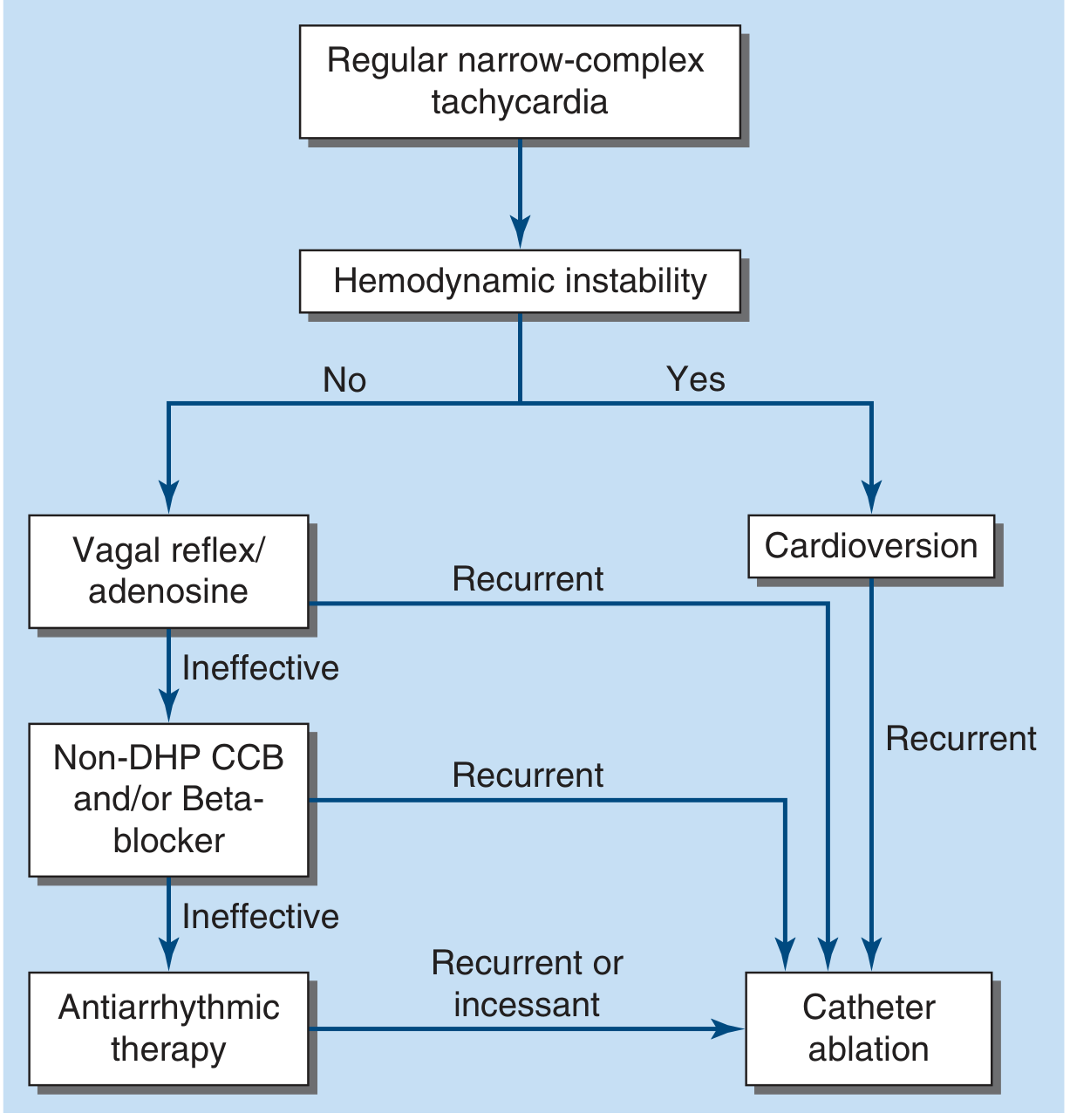
Step 1 - Assess Hemodynamic Status
| Stable | Unstable |
|---|---|
| Proceed stepwise (see below) | Immediate synchronized DC cardioversion |
Hypotension with unconsciousness or respiratory distress = cardiovert without delay. This is rarely needed because IV adenosine works promptly in most cases.
Step 2 - Vagal Maneuvers (Stable patients, first-line)
- Valsalva maneuver - most commonly used; teach patient to self-administer for future episodes
- Carotid sinus massage - reasonable if no carotid bruits and no prior stroke history
- Modified Valsalva (recumbent + leg elevation) - higher conversion rates per recent meta-analysis (PMID: 38235710)
- If effective, record the ECG response - AV block with transient slowing may expose ongoing P waves, revealing AT or atrial flutter as the underlying mechanism
Step 3 - Adenosine (First-line pharmacologic)
- Dose: 6 mg rapid IV bolus through a large-bore IV, followed immediately by NS flush
- If no effect: repeat with 12 mg IV bolus
- Mechanism: transiently blocks AV nodal conduction, terminating the vast majority of PSVT episodes
- Half-life: < 10 seconds (ultra-short acting)
Adverse effects and cautions:
- Transient chest pain, dyspnea, anxiety
- Precipitates AF in up to 15% of patients - use cautiously in WPW (preexcited AF can be hemodynamically catastrophic)
- Contraindicated after cardiac transplantation (hypersensitivity from surgical sympathetic denervation)
- Can theoretically aggravate bronchospasm (use with caution in severe asthma)
A 2025 meta-analysis confirmed adenosine's high efficacy and safety for SVT (PMID: 40055614).
Step 4 - Non-DHP CCB or Beta-Blocker (If adenosine fails)
| Drug | Notes |
|---|---|
| Verapamil IV | Effective; risk of hypotension; longer duration of action than adenosine |
| Diltiazem IV | Effective; also used for rate control in AF/flutter; can be used for stable narrow-complex SVT |
| Beta-blockers IV (metoprolol, esmolol) | Good option; may cause hypotension |
These agents can also be given orally and taken on an as-needed ("pill-in-pocket") basis - patient takes the oral drug when an episode starts, using Valsalva to facilitate termination.
Step 5 - Wide-Complex Tachycardia Special Considerations
- Treat as ventricular tachycardia until proven otherwise
- If regular and patient is stable: a trial of IV adenosine is reasonable
- Very irregular wide-complex tachycardia = likely preexcited AF/flutter - treat with cardioversion, IV procainamide, or ibutilide (NOT adenosine or AV-nodal blockers if WPW)
- If PSVT with aberrancy is unequivocal (prior documented episodes): treat with vagal maneuvers + adenosine
Long-Term / Preventive Management
Pharmacologic Options (for recurrent AVNRT)
| Drug Class | Examples | Classification |
|---|---|---|
| Non-DHP CCB | Verapamil, Diltiazem | Class IIa |
| Beta-blockers | Metoprolol, Atenolol | Class IIa |
| Class Ic | Flecainide, Propafenone | Class IIa |
| Class III | Sotalol, Amiodarone | Class IIa |
- Class Ic agents (flecainide, propafenone) are well-studied and effective but rarely used now given the curative nature of catheter ablation
- Amiodarone/sotalol reserved for patients who are not ablation candidates
Catheter Ablation (Preferred for recurrent PSVT)
- Indications (Class I): Poorly tolerated AVNRT with hemodynamic compromise; recurrent symptomatic AVNRT where patient prefers ablation over drugs
- Success rate: >95% with the posterior (slow-pathway) approach
- Recurrence after ablation: ~3%
- Main complication: AV block (~0.5-1%)
- Cryoablation vs. radiofrequency (RF): Cryo has lower AV block risk but longer procedure times and lower long-term efficacy; RF remains dominant in adults. Cryo preferred by many pediatric electrophysiologists.
- Catheter ablation is considered first-line for recurrent PSVT in most patients given >95% efficacy and low complication rate
Decision Framework for Long-Term Treatment
| Presentation | Recommended Approach |
|---|---|
| Single episode, well-tolerated, self-terminated | Observation; teach Valsalva |
| Minimally symptomatic, self-terminating | Follow clinically, no specific therapy required |
| Symptomatic, recurrent, requires ER visits | Catheter ablation (Class I) or pharmacologic therapy |
| Hemodynamic intolerance | Catheter ablation (Class I) |
| Patient prefers no ablation | Beta-blocker, verapamil, or diltiazem |
| Incessant PSVT | Catheter ablation |
Key Pearls
- Monitor ECG continuously throughout acute management - the response to vagal maneuvers or adenosine can establish the mechanism
- Don't use verapamil/diltiazem in WPW with wide-complex tachycardia - AV-nodal blockade can accelerate conduction via the accessory pathway
- PSVT is not life-threatening in structurally normal hearts; treatment decisions are quality-of-life driven
- Patients can be taught self-management (Valsalva or oral "pill-in-pocket" CCB/beta-blocker)
- Most patients with recurrent episodes are candidates for catheter ablation as definitive cure
Sources: Harrison's Principles of Internal Medicine 22E (2025), Fuster & Hurst's The Heart 15th Ed., Braunwald's Heart Disease, Rosen's Emergency Medicine, Tintinalli's Emergency Medicine; PMID 38235710, 40055614
Verapamil dosage for prophylaxis PSVT
For PSVT prophylaxis, verapamil is typically given orally at 120-480 mg/day in divided doses (immediate-release) or once daily (extended-release).
Searching sources...
Finding Sources
Searching the Web
verapamil oral dose PSVT prophylaxis mg/day guidelines
Good results. Let me also pull the textbook content directly for drug dosing specifics.
Finding Sources
Reading Web Page
https://www.ncbi.nlm.nih.gov/books/NBK538495
Let me search directly in the textbooks for verapamil dosing tables.
Finding Sources
Finding Sources
Finding Sources
Finding Sources
Let me read the most relevant verapamil sections in parallel.
Reading File
Reading File
Reading File
I now have all the information needed for a complete, well-sourced answer.
Verapamil Dosage for PSVT Prophylaxis
Oral Dosing (Prophylaxis / Long-Term Prevention)
Immediate-Release (IR) Tablets (40, 80, 120 mg)
| Indication | Dose | Frequency | Total Daily Dose |
|---|---|---|---|
| PSVT prophylaxis (non-digitalized) | 80-120 mg | TID or QID | 240-480 mg/day |
| Starting dose (elderly or sensitive) | 40-80 mg | TID | 120-240 mg/day |
Sustained/Extended-Release (SR/ER) Formulations (Calan SR, Verelan, Verelan PM)
| Formulation | Available Strengths | Dosing |
|---|---|---|
| Calan SR / generic ER tabs | 120, 180, 240 mg | 120-480 mg once or twice daily |
| Verelan (caps, once-daily) | 120, 180, 240, 360 mg | Once daily |
| Verelan PM (bedtime dosing) | 100, 200, 240, 300, 360 mg | Once daily at bedtime |
- Typical starting SR dose: 120-180 mg once daily, titrate up as needed
- Maximum daily dose: 480 mg/day (400 mg/day for Verelan PM)
- SR/ER formulations are preferred for long-term prophylaxis due to better tolerability and once- or twice-daily dosing convenience
Note: Due to significant first-pass hepatic metabolism, oral verapamil prolongs the PR interval less than IV verapamil at equivalent concentrations. Dose-to-effect response must be assessed individually.
IV Dosing (Acute Termination - for reference)
| Population | Dose | Notes |
|---|---|---|
| Adults (SVT) | 5-10 mg (0.075-0.15 mg/kg) IV over 2-3 min | May repeat 10 mg after 15-30 min |
| Children 1-16 yr (PSVT) | 0.1-0.3 mg/kg/dose IV | Max 5 mg first dose, 10 mg second dose |
| Max total IV dose | 15-20 mg |
Contraindications
- WPW syndrome / accessory bypass tract with AF or atrial flutter - can accelerate antegrade conduction via accessory pathway, potentially causing VF
- Sick sinus syndrome or 2nd/3rd degree AV block (without pacemaker)
- Severe LV dysfunction / cardiogenic shock (SBP < 90 mmHg)
- Congestive heart failure - use with caution due to negative inotropic effects
- Known hypersensitivity
- Infants and neonates - IV verapamil is avoided due to risk of apnea, bradycardia, and hypotension
Key Clinical Points
- Oral verapamil for prophylaxis is classified as Class IIa (reasonable) for recurrent symptomatic AVNRT - Fuster & Hurst's The Heart, 15th Ed.
- It is generally considered second-line to catheter ablation for recurrent, symptomatic PSVT given ablation's >95% cure rate
- "Pill-in-pocket" strategy: Patients can also take a single oral dose (e.g., 80-120 mg IR) at the onset of a PSVT episode, combined with a Valsalva maneuver, to terminate and prevent early recurrence
- Drug interactions: Verapamil inhibits CYP3A4 and P-glycoprotein - raises digoxin levels (monitor), interacts with beta-blockers (additive AV block and negative inotropy), statins, cyclosporine, and many others
- Common side effects: Constipation (most frequent with oral use), hypotension, dizziness, headache, peripheral edema, bradycardia
- Pretreat with calcium gluconate 1 g IV before IV verapamil in hypotensive patients to reduce hypotension without compromising antiarrhythmic effect
Sources: Roberts & Hedges' Clinical Procedures in Emergency Medicine; The Harriet Lane Handbook 23rd Ed.; Goodman & Gilman's Pharmacological Basis of Therapeutics; drugs.com / FDA prescribing information; StatPearls (NIH)
This is a shared conversation. Sign in to Orris to start your own chat.