
What is choronic migraine
Chronic migraine is a neurological condition defined by headaches occurring on 15 or more days per month for more than 3 months, with at least 8 of those days meeting criteria for migraine. It differs from episodic migraine mainly in frequency and associated disability.
Searching sources...
Reading File
Finding Sources
Searching PubMed
"chronic migraine" diagnosis treatment
Reading File
Finding Sources
Reading File
Finding Sources
Reading File
Here is a thorough overview of chronic migraine (CM) based on authoritative neurology textbooks.
Chronic Migraine (CM)
Definition
Chronic migraine (previously called "transformed migraine") is defined by the International Headache Society (IHS, 2018) as:
- Headaches on 15 or more days per month (tension-type and/or migraine character)
- In a patient with a prior history of migraine
- With at least 8 of those days per month meeting migraine criteria
- For at least 3 consecutive months
It falls under the category of Chronic Daily Headache (CDH) - primary headache disorders lasting longer than 4 hours per episode. - Bradley and Daroff's Neurology in Clinical Practice
Epidemiology
- Patients with episodic migraine transition to CM at approximately 2.5% per year.
- On average, people with CM have 22 headache days per month.
- An estimated 7.5% of patients with episodic migraine will meet CM criteria at least once within a 15-month period.
- CM typically begins in the second or third decade of life as episodic migraine, then progresses.
- The evolution from episodic to chronic migraine is gradual in the majority, but abrupt in ~30% of patients. - Bradley and Daroff's Neurology in Clinical Practice
Risk Factors for Developing CM
Population-based and clinic-based prospective studies have identified the following risk factors:
- High baseline attack frequency (the strongest predictor)
- Obesity
- Stressful life events
- Snoring (likely via sleep disruption)
- Cutaneous allodynia (increased skin sensitivity)
- Overuse of opioids or barbiturate combination products (a major modifiable risk factor)
- Coexistent sleep disorders and mood disorders (depression, anxiety) can worsen the underlying condition
Clinical Features
- On some days, headaches retain classic migraine features (throbbing pain, nausea, photophobia, phonophobia).
- On other days, symptoms are indistinguishable from tension-type headache.
- These patients do NOT have "mixed" or "combined tension-vascular headaches" - that is an outdated term.
- CM frequently coexists with Medication Overuse Headache (MOH), which must be identified and managed simultaneously.
Secondary Causes to Exclude ("Red Flags")
Before diagnosing primary CM, secondary causes must be ruled out. Warning features include:
- Progressively worsening headaches over < 3 months
- New neurological symptoms or focal signs
- Papilledema
- Headaches provoked by Valsalva (cough, sneeze)
- Positional headaches (upright or supine relief/worsening)
- Systemic symptoms (fever, weight loss, myalgias)
- Thunderclap/sudden-onset headache
- Onset after age 50
Treatment
Treatment of CM requires both preventive (prophylactic) and acute medication strategies.
Preventive Treatments (Evidence-Based)
| Drug | Evidence |
|---|---|
| Topiramate | Two RCTs showed significant reductions in migraine frequency |
| OnabotulinumtoxinA (Botox) | Only FDA-approved treatment specifically for CM; PREEMPT 1 & 2 trials showed mean decrease of ~8.4 headache days/month vs. 6.6 with placebo; injected every 12 weeks, with 2-3 cycles recommended |
| CGRP monoclonal antibodies: Erenumab, Fremanezumab, Galcanezumab, Eptinezumab | All FDA-approved for migraine prevention; all studied specifically in CM with favorable results |
Mechanism of OnabotulinumtoxinA: It blocks glutamate release from nociceptive terminals, reducing peripheral and central trigeminal sensitization. Its tolerability makes it an attractive option for patients who cannot tolerate oral preventives.
Other Preventives (Less Rigorous Evidence, Frequently Used)
- Gabapentin
- Divalproex sodium (valproate)
- Amitriptyline
- Beta-adrenergic blockers
These are used based on efficacy data from episodic migraine and long clinical experience.
Acute Treatment Caution
- Patients with CM must limit acute medication use to prevent development of Medication Overuse Headache (MOH), which can perpetuate the cycle of chronification.
Recent Evidence (2024-2026)
Recent systematic reviews from 2025 add nuance:
- A network meta-analysis (PMID 40011869) compared strategies for medication-overuse headache (a major CM complication).
- IHS evidence-based guidelines (PMID 41117312) now cover non-invasive neuromodulation devices (e.g., transcranial magnetic stimulation) as acute and preventive migraine treatments.
- A 2025 meta-analysis on migraine-related disability (PMID 41105531) confirms that higher headache frequency (as in CM) is directly associated with greater disability burden.
Sources: Bradley and Daroff's Neurology in Clinical Practice; Kaplan & Sadock's Comprehensive Textbook of Psychiatry; Goldman-Cecil Medicine; PubMed 2025 systematic reviews.
I seen a patient they have a serious chronic migraine last 2 years how can we treat
For a patient with 2 years of serious chronic migraine, treatment involves a combination of preventive medications (to reduce frequency), acute/rescue medications (to abort individual attacks), and non-pharmacological strategies. CGRP monoclonal antibodies and onabotulinumtoxinA are the most evidence-based preventive options for refractory chronic migraine.
Searching sources...
Finding Sources
Searching PubMed
"chronic migraine" treatment management
Finding Sources
Finding Sources
Reading File
Finding Sources
Finding Sources
Reading File
Reading File
Loading Image
Finding Sources
Here is a comprehensive, clinically structured treatment guide for your patient with serious chronic migraine of 2 years duration.
Treatment of Serious Chronic Migraine (2 Years Duration)
For a patient with long-standing CM, treatment must be approached on two parallel fronts simultaneously: preventive (prophylactic) treatment to reduce frequency, and acute (abortive) treatment to manage individual attacks. Non-pharmacological strategies run alongside both.
Step 1: First - Screen and Address Complicating Factors
Before or alongside starting treatment, check for:
- Medication Overuse Headache (MOH) - if the patient is using acute pain medications (especially opioids, triptans, NSAIDs) on >10-15 days/month, MOH is likely perpetuating the cycle and must be addressed by withdrawing the overused drug
- Comorbid depression or anxiety - treat these aggressively; they worsen migraine
- Sleep disorders - obstructive sleep apnea, poor sleep hygiene
- Obesity - a modifiable risk factor for CM progression
- Caffeine overuse
Step 2: Preventive (Prophylactic) Treatment
Preventive therapy is the backbone for CM. The goal is to reduce headache days by ≥50%. Start one drug at a time, titrate slowly, and give each agent at least 2-3 months before judging response.
First-Line Preventives
| Drug | Dose | Notes |
|---|---|---|
| Propranolol (β-blocker) | 40-240 mg/day | Drug of choice; also good for patients with anxiety/hypertension |
| Metoprolol (β-blocker) | 50-200 mg/day | Alternative to propranolol |
| Topiramate (anticonvulsant) | 25-100 mg/day | Start low (25 mg), titrate up; causes weight loss (useful in obese patients) |
| Divalproex / Valproate (anticonvulsant) | 500-1500 mg/day | Avoid in women of childbearing age (teratogenic) |
| Amitriptyline (TCA) | 10-75 mg at night | Especially useful with comorbid depression or insomnia |
| Venlafaxine (SNRI) | 75-150 mg/day | Alternative if TCA not tolerated |
Second-Line / Advanced Preventives (for Refractory CM)
Given that your patient has had CM for 2 years and it is described as serious, these options are especially relevant:
| Drug | Details |
|---|---|
| OnabotulinumtoxinA (Botox) | Only FDA-approved treatment specifically for CM. PREEMPT protocol: ~155 units injected at 31 fixed head/neck sites every 12 weeks. Requires at least 2-3 injection cycles to assess response. Excellent tolerability. Blocks glutamate release from nociceptive terminals - reduces central and peripheral trigeminal sensitization |
| CGRP Monoclonal Antibodies | Newest class; highly effective with minimal side effects. Monthly or quarterly injections/infusions. All FDA-approved for migraine prevention |
CGRP Monoclonal Antibodies - Key Agents:
| Drug | Target | Dosing |
|---|---|---|
| Erenumab | CGRP receptor | 70-140 mg SC monthly |
| Fremanezumab | CGRP ligand | 225 mg SC monthly OR 675 mg quarterly |
| Galcanezumab | CGRP ligand | 240 mg loading, then 120 mg SC monthly |
| Eptinezumab | CGRP ligand | 100-300 mg IV every 3 months |
These are the preferred option after first-line oral agents fail, or can be used earlier in severe/refractory cases like your patient. - Bradley and Daroff's Neurology in Clinical Practice; Kaplan & Sadock's Psychiatry
Also, oral CGRP antagonists (gepants):
- Atogepant and Rimegepant - oral daily use for prevention
Step 3: Acute (Abortive) Treatment
Use these to stop individual attacks. Limit use to prevent MOH (max 2-3 days/week for triptans; max 10-15 days/month for any acute agent).
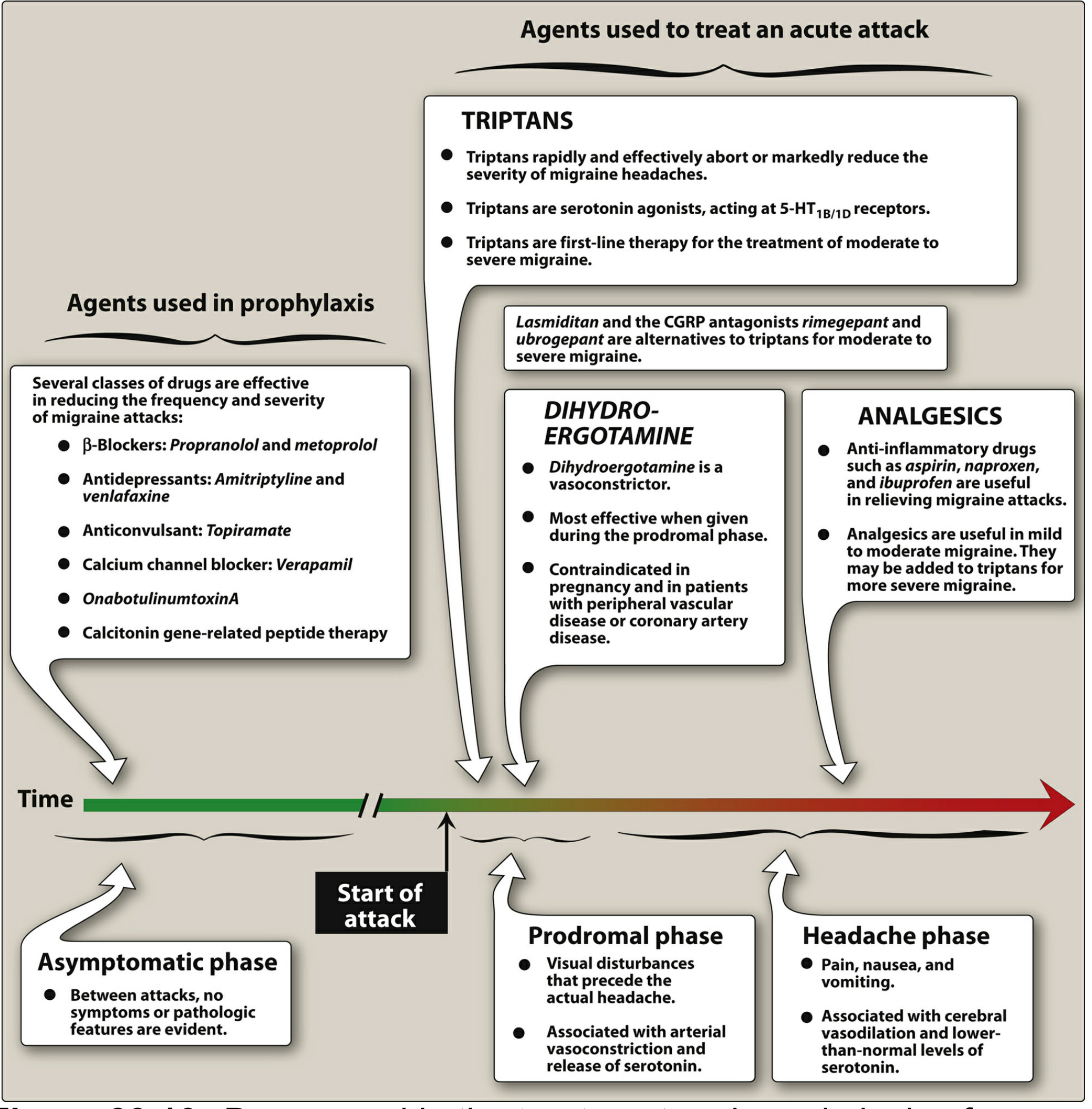
For Moderate-Severe Attacks (First-Line)
-
Triptans (5-HT 1B/1D agonists) - rapid and effective; act at onset of headache (after aura if present)
- Rizatriptan or Eletriptan - most efficacious in the class
- Sumatriptan - widely used; available oral, nasal spray, and SC injection
- Zolmitriptan - similar to sumatriptan; nasal spray useful when nausea is prominent
- Frovatriptan / Naratriptan - slower onset but longer acting, fewer recurrences
- Contraindicated in ischemic heart disease, cerebrovascular disease, uncontrolled hypertension
-
NSAIDs - naproxen 500 mg combined with sumatriptan reduces recurrence rate; useful adjunct
-
Dihydroergotamine (DHE) - very effective; nasal spray or IV/IM injection; avoid in vascular disease or pregnancy
For Patients Who Can't Take Triptans
- Lasmiditan (dittan - 5-HT 1F agonist) - no vasoconstrictive effect; safe in cardiovascular disease
- Rimegepant / Ubrogepant (oral CGRP antagonists) - acute use; low side-effect profile
For Mild-Moderate Attacks
- Aspirin, Ibuprofen, Naproxen, Acetaminophen - first step for milder attacks
For Severe/Refractory Acute Attacks (Emergency)
- IV Valproate
- IV Metoclopramide (also helps nausea)
- IV Ketorolac
- Prochlorperazine
- SC Sumatriptan (fastest-acting triptan)
Step 4: Non-Pharmacological Strategies (Run Alongside Medications)
Evidence-based behavioral and lifestyle interventions include:
- Cognitive Behavioral Therapy (CBT) - reduces migraine frequency and disability; 8-10 sessions
- Biofeedback - one of the most evidence-based non-drug approaches
- Relaxation training
- Regular aerobic exercise - reduces frequency
- Sleep hygiene - consistent sleep/wake schedule
- Migraine trigger diary - identify and avoid personal triggers (certain foods, stress, dehydration, skipped meals, bright lights)
- Smoking cessation
- Acupuncture - used as adjunct in some patients
Step 5: Non-Invasive Neuromodulation (If Available)
Per 2025 IHS evidence-based guidelines (PMID 41117312), several devices now have evidence for both acute and preventive migraine treatment:
- Transcranial magnetic stimulation (TMS)
- Non-invasive vagus nerve stimulation (nVNS)
- Transcutaneous supraorbital stimulation (Cefaly device)
Summary: Suggested Management Plan for This Patient
Given 2 years of serious chronic migraine:
- Rule out MOH - withdraw any overused acute medication
- Start a first-line preventive (propranolol or topiramate) while titrating
- If inadequate response after 3 months → add or switch to onabotulinumtoxinA (every 12 weeks, 2-3 cycles)
- If still refractory → CGRP monoclonal antibody (erenumab, fremanezumab, or galcanezumab)
- Use triptans for acute attacks, with strict frequency limits
- Address comorbidities (depression, sleep, weight)
- Integrate CBT + biofeedback throughout
Sources: Bradley and Daroff's Neurology in Clinical Practice; Lippincott Illustrated Reviews Pharmacology; Harrison's Principles of Internal Medicine 22E; Kaplan & Sadock's Comprehensive Textbook of Psychiatry; Goldman-Cecil Medicine
Rizanet10
Rizanet 10 is a brand name for Rizatriptan 10 mg, a triptan used for acute migraine attacks. It works as a selective 5-HT1B/1D receptor agonist to abort migraine headaches.
Searching sources...
Finding Sources
Searching the Web
Rizanet 10 rizatriptan tablet brand uses dose side effects
Reading File
Reading File
Finding Sources
Reading File
Here is a complete drug profile for Rizanet 10 (Rizatriptan 10 mg):
Rizanet 10 - Drug Profile
What Is It?
Rizanet 10 is a brand name for Rizatriptan 10 mg tablets. Rizatriptan (brand names: Maxalt, Maxalt-MLT internationally) is a selective serotonin 5-HT1B/1D receptor agonist belonging to the triptan class of antimigraine drugs.
Indication
- Acute treatment of migraine attacks (with or without aura) in adults
- It is not a preventive medication - it aborts an attack already in progress
- Not effective for other types of headache (tension, cluster)
Mechanism of Action
Rizatriptan works by:
- Stimulating 5-HT1B receptors on cranial blood vessels → causes vasoconstriction of dilated intracranial vessels
- Stimulating 5-HT1D receptors on trigeminal nerve terminals → inhibits release of pro-inflammatory neuropeptides (including CGRP and substance P)
- Together these actions stop the migraine cascade - reducing perivascular inflammation and blocking pain signal transmission
Dosing
| Parameter | Details |
|---|---|
| Standard dose | 5 mg or 10 mg orally |
| Onset of action | 1 to 2.5 hours |
| Half-life | ~2 hours |
| Maximum dose per day | 30 mg (in 24 hours) |
| Repeat dose | If headache returns, may repeat after 2 hours |
| Maximum frequency | No more than 10 days per month to avoid Medication Overuse Headache |
The 10 mg dose (Rizanet 10) provides greater efficacy than 5 mg but carries slightly higher risk of side effects. Rizatriptan and eletriptan are considered the most efficacious triptans on a population basis. - Harrison's Principles of Internal Medicine 22E
Formulations
- Conventional film-coated tablets (swallow whole)
- Orally disintegrating tablets (MLT/wafer form) - dissolves on tongue, useful when nausea prevents swallowing
Pharmacokinetics
| Parameter | Rizatriptan |
|---|---|
| Route | Oral only |
| Onset | 1-2.5 hours |
| Duration | 2-6 hours |
| Half-life | 2 hours |
| Metabolism | MAO-A (hepatic) |
| Excretion | Urine |
Common Side Effects
- Tingling / paresthesias (most common)
- Dizziness
- Somnolence / drowsiness
- Chest tightness / pressure (sensation, not necessarily cardiac)
- Neck/throat tightness
- Nausea
- Dry mouth
- Asthenia / fatigue
- Warm sensation / flushing
Serious Side Effects (Rare but Important)
- Coronary vasospasm / chest pain - can mimic cardiac ischemia; risk higher in patients with cardiac disease
- Stroke / TIA - rare
- Serotonin syndrome - especially if combined with SSRIs/SNRIs (symptoms: agitation, hyperthermia, tremor, rigidity)
- Severe peripheral ischemia
- Medication Overuse Headache - if used >10 days/month
Contraindications
- Ischemic heart disease (angina, previous MI)
- Coronary artery vasospasm (Prinzmetal angina)
- Cerebrovascular disease (stroke, TIA history)
- Peripheral vascular disease
- Uncontrolled hypertension
- Hemiplegic or basilar migraine
- Recent use of ergotamine or another triptan (within 24 hours)
- MAO inhibitor use (within 2 weeks) - rizatriptan is metabolized by MAO-A; combined use causes dangerous drug levels
- Severe renal or hepatic impairment - use with caution
Important Drug Interactions
| Interaction | Effect |
|---|---|
| MAO inhibitors (phenelzine, selegiline) | Severely increased rizatriptan levels - CONTRAINDICATED |
| SSRIs / SNRIs (fluoxetine, venlafaxine) | Risk of serotonin syndrome |
| Other triptans or ergotamine | Additive vasoconstrictive risk |
| Propranolol | Increases rizatriptan levels by ~70% - use the 5 mg dose instead of 10 mg when patient is also on propranolol |
Clinical Note for Your Migraine Patient: If your patient is on propranolol for CM prevention (as discussed earlier), they should use the 5 mg dose of rizatriptan, not the 10 mg dose, due to this pharmacokinetic interaction. - MedCentral Drug Monograph
How to Counsel Your Patient
- Take as soon as migraine symptoms begin (headache phase - after aura completes if aura is present)
- Can repeat once after 2 hours if headache returns - do not take more than 2 doses in 24 hours
- Do not use for more than 10 days per month - risk of rebound/medication overuse headache
- If using for chronic migraine, this is your acute rescue medication - you still need your preventive medication taken daily
- Avoid if you have heart problems or are taking MAO inhibitors
Sources: Katzung's Basic and Clinical Pharmacology 16E; Lippincott Illustrated Reviews Pharmacology; Harrison's Principles of Internal Medicine 22E; Goodman & Gilman's Pharmacological Basis of Therapeutics; Mayo Clinic; MedlinePlus
She is on headache phase
For a patient currently in the headache phase of a migraine attack, the goal is rapid pain relief. Rizatriptan 10 mg (Rizanet 10) is appropriate NOW - triptans work best when taken at headache onset, not during aura.
Searching sources...
Finding Sources
Finding Sources
Finding Sources
Reading File
Reading File
Here is the focused, practical management for your patient who is currently in the headache phase:
Managing an Active Migraine Attack - Headache Phase
The headache phase is characterized by throbbing/pulsating pain (usually unilateral), nausea, vomiting, photophobia, and phonophobia. This is the ideal window to use abortive (acute) therapy.
Key principle: Combining agents with different mechanisms is more effective than a single drug alone. - Bradley and Daroff's Neurology in Clinical Practice
Step 1: Give Rizanet 10 (Rizatriptan 10 mg) NOW
- Give Rizatriptan 10 mg orally immediately
- Takes effect in 1-2.5 hours
- Acts on 5-HT1B/1D receptors to:
- Constrict dilated cranial vessels
- Inhibit trigeminal neuropeptide (CGRP) release
- Block pain signal transmission at the trigeminal nucleus
- If headache returns after initial relief → repeat dose after 2 hours (max 2 doses in 24 hours)
Important: If patient is on propranolol (for chronic migraine prevention), use 5 mg instead - propranolol increases rizatriptan levels by ~70%.
Step 2: Add an NSAID Alongside the Triptan
Combining a triptan with an NSAID gives better pain relief and reduces headache recurrence:
| Drug | Dose |
|---|---|
| Naproxen sodium | 550 mg orally (best evidence with triptans) |
| Ibuprofen | 400 mg orally |
| Aspirin | 500-1000 mg orally |
| Diclofenac potassium | 50-100 mg orally |
Step 3: Add an Antiemetic if Nausea is Present
Gastric stasis is very common during migraine attacks and slows absorption of oral medications. An antiemetic:
- Relieves nausea/vomiting
- Restores gastric motility → improves triptan absorption
- Has independent antimigraine activity via dopamine D2 blockade
| Drug | Dose | Notes |
|---|---|---|
| Metoclopramide | 10 mg oral/IV | Less sedating; give 20-30 min before oral agents |
| Prochlorperazine | 10 mg oral / 12.5 mg PR | More sedating; highly effective monotherapy for acute migraine |
| Ondansetron | 4-8 mg | If dopamine antagonists are not tolerated |
Watch for extrapyramidal side effects (akathisia, dystonia) with metoclopramide/prochlorperazine. Treat with diphenhydramine 25-50 mg if they occur.
If She Is in the Clinic / Has IV Access - Enhanced Protocol
If the attack is severe, or oral route is impractical due to vomiting:
| Step | Drug | Dose | Route |
|---|---|---|---|
| 1 | IV fluids (normal saline) | 500 ml bolus | IV |
| 2 | Metoclopramide | 10-20 mg | IV over 15 min |
| 3 | Ketorolac | 30 mg | IV/IM |
| 4 | Sumatriptan (if rizatriptan not sufficient) | 6 mg | SC injection (fastest onset) |
If Triptan Fails or is Contraindicated
| Alternative | Details |
|---|---|
| Dihydroergotamine (DHE) | Nasal spray or IM; very effective; avoid in vascular disease |
| Lasmiditan | Safe in cardiac patients; no vasoconstriction |
| Rimegepant / Ubrogepant | Oral CGRP antagonists; if triptans not tolerated |
| IV Valproate | For severe/refractory attacks |
| IV Prochlorperazine | Monotherapy; highly effective even without triptans |
Non-Drug Measures (Right Now)
While waiting for the medication to work:
- Dark, quiet room - reduce light and sound stimulation
- Cold pack / ice on forehead or neck
- Rest - avoid physical activity (worsens pain)
- Hydration - small sips of water if not vomiting
Summary: What to Give Her Right Now
1. Rizatriptan 10 mg (Rizanet 10) orally  ← TAKE IMMEDIATELY
2. Naproxen 550 mg orally                 ← WITH the triptan
3. Metoclopramide 10 mg orally            ← IF nausea present
4. Dark, quiet room + cold pack           ← Immediately
5. Reassess in 2 hours
   → If no relief: repeat triptan OR switch to SC sumatriptan/DHE
Sources: Bradley and Daroff's Neurology in Clinical Practice; Rosen's Emergency Medicine; Harrison's Principles of Internal Medicine 22E; Tintinalli's Emergency Medicine
She is 21 year old
Good point - at 21 years old, she is a young adult female, which brings specific considerations around drug choice, safety, and especially reproductive health.
Searching sources...
Finding Sources
Finding Sources
Finding Sources
Finding Sources
Reading File
Finding Sources
Reading File
Finding Sources
Her age matters significantly. Here is what changes at 21 years old (young woman of reproductive age):
Special Considerations: 21-Year-Old Female with Chronic Migraine
1. Rizanet 10 (Rizatriptan) - Still Appropriate RIGHT NOW
Rizatriptan is safe and appropriate for acute use in a 21-year-old. Give it now as discussed. No age-specific dose adjustment needed.
However, be aware of the concerns below for her ongoing management.
2. Stroke Risk - The Most Important Issue in Young Women
Young women with migraine have a small but measurably increased risk of ischemic stroke. A key study found:
| Risk Factor | Odds Ratio for Ischemic Stroke |
|---|---|
| Migraine alone (young women) | 3.5x increased risk |
| Migraine + oral contraceptives | 13.9x increased risk |
| Migraine + heavy smoking | 10.2x increased risk |
| Migraine with aura alone | 6.2x increased risk |
Estimated incidence of ischemic stroke in young women aged 25-34 with migraine with aura using oral contraceptives: 28 per 100,000 women - Bradley and Daroff's Neurology in Clinical Practice
Action Points:
- Ask: Does she have migraine WITH aura? If yes, this dramatically raises stroke risk
- Ask: Is she on combined oral contraceptives (COC)? If yes - serious risk combination
- Strongly advise: No smoking - if she smokes, smoking cessation is urgent
- Screen for hypertension and hyperlipidemia
3. Oral Contraceptive Guidance (IHS Task Force Recommendations)
If she is on or considering combined oral contraceptives (COCs):
- Migraine with aura + COC = HIGH stroke risk - COC is relatively contraindicated; consider progestogen-only pill or non-hormonal contraception instead
- Migraine without aura + COC - can use low-dose estrogen (<50 µg ethinyl estradiol) with caution; monitor closely
- Stop smoking before starting COC
- If on COC and she develops new aura, increased headache frequency, or unusual/prolonged aura - STOP COC immediately and reassess
Progestogen-only methods (mini-pill, Mirena IUD, Depo-Provera injection) do not significantly increase ischemic stroke risk and are preferred in migraineurs. - Bradley and Daroff's Neurology in Clinical Practice
4. Preventive Drug Choice - Teratogenicity is a Key Concern
At 21 years old, pregnancy is possible. Several standard CM preventives are teratogenic and need careful management:
| Drug | Concern in Young Women |
|---|---|
| Valproate / Divalproex | AVOID - highest teratogenic risk (6.7-10.3% major congenital malformations, neural tube defects); absolutely avoid unless essential and contraception guaranteed |
| Topiramate | AVOID if possible - teratogenic risk (3.9-4.3% major malformations); also reduces effectiveness of COC pills |
| Propranolol | Relatively safe - preferred first-line for young women; monitor |
| Amitriptyline | Use with caution; low doses generally accepted |
| CGRP monoclonal antibodies | Avoid in pregnancy - insufficient safety data; ensure reliable contraception |
| OnabotulinumtoxinA (Botox) | Limited data in pregnancy; generally avoided |
Preferred Preventives for This Patient:
- Propranolol (40-120 mg/day) - first choice; safe profile
- Amitriptyline (10-50 mg at night) - if propranolol not tolerated
- CGRP mAbs (erenumab etc.) - if refractory, with guaranteed contraception
- OnabotulinumtoxinA - if refractory, discuss risks
5. Menstrual Migraine - Very Common at This Age
At 21, ask: "Do your worst migraines come around your period?"
If yes, she likely has Menstrual-Associated Migraine (MAM) or Pure Menstrual Migraine (PMM) - linked to estrogen drop before menstruation.
Perimenstrual short-course prevention:
- Frovatriptan, Naratriptan, or Zolmitriptan - taken 2 days before expected menstrual onset and continued for 5-6 days (perimenstrual prophylaxis)
- NSAIDs (naproxen) - started 2 days before menstruation
- Magnesium supplementation - young women with migraine have low systemic magnesium; useful and safe
6. If She Becomes Pregnant
- Stop most preventive medications
- Acute attacks: Paracetamol (acetaminophen) first line; avoid NSAIDs especially in 3rd trimester
- Severe attacks in pregnancy: IV prochlorperazine + IV magnesium sulfate 1g are safer options
- Triptans in pregnancy: Limited data; generally avoided, but not proven harmful in early pregnancy
- Good news: ~70% of women experience significant improvement or remission of migraine during pregnancy (especially 2nd and 3rd trimester)
Summary: Key Adjustments for Her Being 21 Years Old
| Issue | Action |
|---|---|
| Stroke risk | Screen for aura, smoking, hypertension |
| Oral contraceptives | Avoid COC if migraine with aura; use progestogen-only |
| Smoking | Urge cessation urgently |
| Preventive drugs | Prefer propranolol; avoid valproate and topiramate |
| Menstrual trigger | Ask about cycle-related attacks; consider perimenstrual prophylaxis |
| Future pregnancy planning | Counsel now; adjust meds before conception |
| Right now (acute) | Rizatriptan 10 mg + naproxen + antiemetic - still appropriate |
Sources: Bradley and Daroff's Neurology in Clinical Practice; Creasy & Resnik's Maternal-Fetal Medicine; Kaplan & Sadock's Comprehensive Textbook of Psychiatry
She is 21 yrs old and 48 kg weight with haemoglobin 16
Interesting clinical details. At 21 years old, 48 kg, with a haemoglobin of 16 g/dL - the high Hb in a young woman is a significant finding that needs attention alongside her migraine management.
Reasoning...
Finding Sources
Finding Sources
Finding Sources
Finding Sources
Finding Sources
Finding Sources
Finding Sources
Finding Sources
Reading File
This clinical picture needs careful analysis. Here is a full breakdown:
Clinical Assessment: 21F, 48 kg, Hb 16 g/dL with Chronic Migraine
🚨 The Haemoglobin of 16 g/dL is ABNORMAL in a Young Woman
Normal Hb in adult women: 12.0 - 15.5 g/dL
At 16 g/dL, this young woman is above the upper limit of normal for a female. This is not just a lab number - it is clinically significant and may be directly related to her "migraines" or significantly worsening them.
Why Hb 16 Matters - Elevated Haemoglobin Causes
This is erythrocytosis / polycythaemia. Causes in a 21-year-old woman:
Common / Likely Causes at This Age:
| Cause | Notes |
|---|---|
| Dehydration (relative polycythaemia) | Most common; plasma volume reduced, Hb appears high; check hydration status |
| High altitude living | If she lives at high altitude - physiological response |
| Chronic hypoxia - lung disease, sleep apnoea | Compensatory erythrocytosis |
| Smoking - carboxyhaemoglobin | Stimulates EPO, raises Hb |
| Androgenic steroids | Ask about any supplements/medications |
| Congenital high-affinity haemoglobin | Rare but possible in young patients |
Serious Causes to Exclude:
| Cause | Notes |
|---|---|
| Polycythaemia Vera (PV) | JAK2 mutation myeloproliferative disorder - causes headache, dizziness, thrombosis; usually middle-aged but can occur in young adults |
| Right-to-left cardiac shunt | Congenital heart disease - compensatory erythrocytosis |
| Renal tumour / hepatoma / EPO-secreting tumour | Rare at this age but must exclude |
Critical Link: High Hb → Hyperviscosity → Headaches
High haemoglobin leads to blood hyperviscosity syndrome: headache, vertigo, dizziness, visual disturbances, vascular ischemia, and venous thrombosis. - Yamada's Textbook of Gastroenterology; Rosen's Emergency Medicine
Her "chronic migraines" may actually be hyperviscosity headaches from elevated Hb, or the high Hb is worsening true underlying migraine. This distinction is vital because:
- Hyperviscosity headaches do NOT respond to triptans - you need to treat the cause
- High Hb increases her stroke risk even further (on top of migraine-related stroke risk already elevated in young women)
How Hb 16 + Migraine Together Raise Stroke Risk Dramatically
Her risk profile stacks:
- Young woman with migraine → already 3.5x stroke risk
- Elevated Hb / polycythaemia → increased blood viscosity → thrombotic risk
- If she also has migraine WITH aura → 6.2x stroke risk
- If on combined oral contraceptives → 13.9x stroke risk
This combination makes her a HIGH-RISK patient for cerebrovascular events.
Immediate Investigations Needed
| Investigation | Why |
|---|---|
| Full blood count (FBC/CBC) | WBC, platelets - if raised too → suggests polycythaemia vera |
| Haematocrit / PCV | Confirms polycythaemia |
| Reticulocyte count | Assess bone marrow activity |
| JAK2 V617F mutation | Screen for polycythaemia vera |
| Serum EPO level | Low in PV; high in secondary polycythaemia |
| Renal function + renal ultrasound | Exclude EPO-secreting renal lesion |
| Oxygen saturation (SpO2) | Exclude chronic hypoxia |
| LFTs | Exclude hepatoma |
| Iron studies | Secondary polycythaemia can deplete iron |
| MRI brain | Given 2 years of serious headache with elevated Hb - exclude venous sinus thrombosis or structural cause |
Drug Considerations Given 48 kg Weight
She is low-normal weight (48 kg). This affects drug dosing:
| Drug | Adjustment at 48 kg |
|---|---|
| Rizatriptan (Rizanet 10) | Use 5 mg first in low-weight patients - less risk of side effects; step up to 10 mg if insufficient |
| NSAIDs | Standard doses acceptable but watch GI tolerance in small patients |
| Metoclopramide | 10 mg (standard) - acceptable |
| Propranolol | Start at lower end (20-40 mg/day) given small body size |
| Topiramate | Already avoided (teratogenic); weight loss side effect makes it especially unsuitable at 48 kg |
| Valproate | Already avoided (teratogenic); weight gain side effect would be relatively tolerated, but drug still contraindicated |
Revised Management Plan for This Patient
Immediate (Today):
- Rizatriptan 5 mg (not 10 mg, given 48 kg) for the current headache attack
- Naproxen 250-500 mg (lower dose for 48 kg)
- Metoclopramide 10 mg if nausea present
- IV fluids / oral hydration - if dehydrated, this alone may lower Hb and help headache
Urgent Workup (This Week):
- FBC, haematocrit, JAK2 mutation, serum EPO, SpO2, renal function, MRI brain
- Do NOT prescribe long-term triptans or ergotamines until polycythaemia/cause is investigated - increased thrombotic risk
Preventive Treatment - Put on Hold Until Hb is Explained:
- If Hb cause is benign (dehydration/altitude) → proceed with propranolol
- If polycythaemia vera confirmed → haematology referral + aspirin may be part of PV treatment; headache management changes significantly
- Avoid COC absolutely until cause clarified
Summary Flag for This Patient
| Parameter | Concern |
|---|---|
| Hb 16 g/dL (female) | Abnormal - investigate urgently |
| 21 years, female | Stroke risk from migraine + high Hb stack |
| 48 kg | Use lower doses of medications |
| Chronic migraine 2 years | May be partially driven by hyperviscosity |
| Triptans | Use cautiously - vasoconstriction + elevated Hb = thrombosis risk |
| COC | Do not use until Hb explained |
Bottom line: Hb of 16 in a 21-year-old woman is a red flag. Investigate before fully committing to a chronic migraine treatment plan.
Sources: Rosen's Emergency Medicine; Yamada's Textbook of Gastroenterology; Bradley and Daroff's Neurology in Clinical Practice
She telling me that when she got break up with her bf of 3.5 yrs relationship and she believes deep love. Love like god
This is very important clinical information. A 3.5-year relationship breakup - especially one involving intense emotional attachment - is a major psychological stressor that can directly trigger, worsen, and perpetuate chronic migraine.
Searching sources...
Finding Sources
Finding Sources
Finding Sources
Finding Sources
Reading File
Finding Sources
Finding Sources
Finding Sources
Reading File
This is a very revealing piece of history. Here is the full clinical and human picture:
The Breakup - A Critical Piece of Her History
Connecting the Timeline
Ask her: "When did your headaches start or get significantly worse?"
The answer almost certainly connects to the breakup from her 3.5-year relationship. This is not coincidence - it is well-established neuroscience and psychiatry.
The Science: How Emotional Loss Drives Chronic Migraine
1. Stress is a Direct Migraine Trigger
Stressful life events are one of the strongest identified risk factors for episodic migraine transitioning to chronic migraine. - Bradley and Daroff's Neurology in Clinical Practice
A 3.5-year breakup involving deep attachment is one of the most intense psychological stressors a young person can experience - equivalent in neurobiological impact to bereavement.
2. The Migraine-Depression-Anxiety Triangle
About 60% of people with migraine have a lifetime history of either anxiety or mood disorder. Anxiety precedes migraine, which then leads to depression. - Kaplan & Sadock's Comprehensive Textbook of Psychiatry
Her situation almost certainly involves:
- Acute grief reaction / adjustment disorder - from the breakup
- Depression - loss of a person she equated with God-like devotion
- Anxiety - uncertainty about the future, self-worth, loneliness
- All of these feed directly into migraine chronification
3. About 65% of Migraine Disability is Psychiatric Comorbidity
"About 65% of migraine-associated disabilities can be attributed to comorbid physical and mental disorders." - Kaplan & Sadock's Psychiatry
This means if you only treat the headache and ignore her emotional state, you will fail to control her migraine long-term.
What "Love Like God" Tells You Clinically
This phrase is significant. It tells you:
| Observation | Clinical Meaning |
|---|---|
| 3.5 years of deep attachment | Loss of primary attachment figure - neurobiologically similar to losing a parent |
| "Love like God" - divine/absolute devotion | May suggest limerence, obsessive attachment, or dependency traits |
| Young, 21 years old | First serious long-term relationship - identity and self-worth may be intertwined with this person |
| Chronic physical symptoms for ~2 years | Duration matches likely timeline of relationship stress or breakup |
| Hb 16 (possible dehydration/stress response) | Chronic emotional stress activates HPA axis, affects autonomic nervous system, eating, hydration |
| 48 kg low weight | Could reflect reduced appetite / poor nutrition from depression |
Psychiatric Screening - Do This Now
Before leaving the clinic today, screen her with these quick tools:
PHQ-2 (Depression screen - 2 questions):
- "Over the past 2 weeks, have you felt down, depressed, or hopeless?"
- "Have you had little interest or pleasure in doing things?"
GAD-2 (Anxiety screen):
- "Have you felt nervous, anxious, or on edge?"
- "Have you been unable to stop or control worrying?"
Crucially - Suicide/Self-harm Screening:
- A 21-year-old with intense attachment ("love like God") who has experienced a major loss is at risk for self-harm or suicidal ideation
- Ask directly and compassionately: "Sometimes when people go through a painful loss like this, they have thoughts of hurting themselves or not wanting to be here. Have you had any thoughts like that?"
- This must not be skipped
Revised Diagnosis: What She Likely Has
| Condition | Evidence |
|---|---|
| Chronic migraine | Confirmed - 15+ headache days/month for 2 years |
| Adjustment disorder with depressed mood (or Major Depressive Episode) | Triggered by relationship loss; intense grief |
| Anxiety disorder | Likely co-existing; anxiety precedes migraine onset |
| Possible psychosomatic/central sensitization component | Emotional pain amplifying physical pain via shared neural pathways |
How This Changes Her Treatment Plan
"If patients with anxiety and/or depression suffer from migraine, it is critical to treat the ENTIRE SYNDROME rather than limiting the treatment goal to headache cessation." - Kaplan & Sadock's Psychiatry
Drug Changes - Choose a Preventive That Treats BOTH Migraine AND Depression/Anxiety:
| Drug | Why Ideal for Her |
|---|---|
| Amitriptyline 10-25 mg at night | Treats migraine prevention + depression + helps sleep; 30+ years evidence in migraine-depression comorbidity; suits her 48 kg weight (start low 10 mg) |
| Venlafaxine 37.5-75 mg/day | SNRI; treats depression + anxiety + migraine prevention; good for young women |
| Avoid beta-blockers (propranolol) as sole agent | Can worsen depression - not ideal when depression is present |
| Avoid valproate | Teratogenic; also causes weight gain in an already low-weight patient |
Non-Drug Treatment - ESSENTIAL for Her:
| Intervention | Rationale |
|---|---|
| Cognitive Behavioural Therapy (CBT) | Strongest non-drug evidence for both migraine AND grief/depression; 8-10 sessions |
| Grief counselling / supportive psychotherapy | To process the loss - medication alone will not address the root cause |
| Mindfulness-based stress reduction (MBSR) | Reduces migraine frequency and emotional reactivity |
| Biofeedback | Evidence-based for migraine; addresses stress-tension cycle |
| Regular sleep schedule | Sleep disruption from grief severely worsens migraine |
| Regular meals + hydration | Depression → skipped meals → migraine trigger; important at 48 kg |
| Gentle aerobic exercise | Reduces both migraine frequency AND depression |
How to Talk to Her - Approach as a Clinician
She needs to feel heard, not dismissed. A powerful therapeutic message:
"What you're feeling - this pain in your heart and your head - they are connected. The love you had was real, the loss is real, and your body is responding to it. We are going to help both - the headaches AND how you are feeling inside."
This kind of validation can itself be therapeutic and will increase her engagement with treatment.
Summary - The Complete Picture Now
| Factor | Significance |
|---|---|
| 21F, chronic migraine 2 years | Needs both acute + preventive treatment |
| Hb 16 | Investigate - dehydration, stress, rule out polycythaemia |
| 48 kg low weight | Depression-related poor appetite likely |
| 3.5-year breakup / "love like God" | Root driver of migraine chronification |
| Depression + anxiety likely | 60% of migraine patients have mood disorder |
| Treat the WHOLE person | Amitriptyline + CBT + grief counselling + lifestyle |
The most important prescription you can write today is not just Rizanet 10 - it is compassion, a proper psychiatric screen, and a referral to psychological support alongside her migraine medications.
Sources: Kaplan & Sadock's Comprehensive Textbook of Psychiatry; Bradley and Daroff's Neurology in Clinical Practice; Goldman-Cecil Medicine
This is a shared conversation. Sign in to Orris to start your own chat.