
Uses and side effect of adrenergic blocker drugs
adrenergic receptor blocker classification alpha beta pharmacology diagram
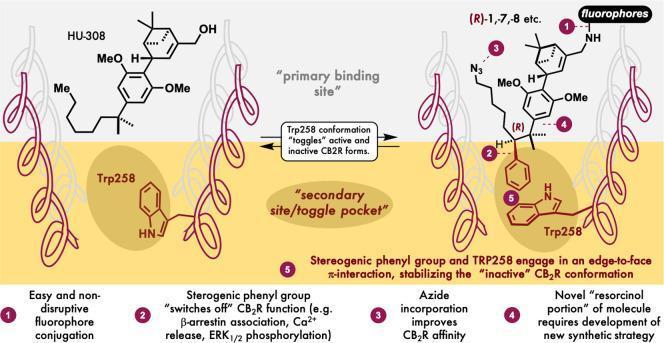
A molecular pharmacology diagram illustrating the conformational switch of the Cannabinoid Receptor 2 (CB2R) between active (left) and inactive (right) states. The visual depicts a G protein-coupled receptor (GPCR) model featuring alpha-helical transmembrane domains. The central mechanism shown is the 'toggle switch' involving the Trp258 residue within a 'secondary site/toggle pocket'. On the left, the agonist HU-308 binds to the primary site, leaving Trp258 in an upright active conformation. On the right, a modified ligand stabilizes the inactive state through a stereogenic phenyl group that engages in an edge-to-face pi-interaction with Trp258, effectively 'switching off' receptor signaling. Key molecular modifications to the ligand for therapeutic development are highlighted: 1) fluorophore conjugation for imaging, 2) stereogenic phenyl group for functional inactivation (e.g., inhibiting beta-arrestin association and ERK1/2 phosphorylation), 3) azide incorporation for improved affinity, and 4) a novel resorcinol moiety. The diagram highlights structural biology concepts in drug design, specifically targeting the active/inactive equilibrium of GPCRs for pain modulation research.
![This pathophysiology diagram illustrates the role of the Beta-2 Adrenergic Receptor (ADRB2) in modulating inflammatory responses during Rhinovirus (RV) infection. The visual is divided into three primary sections: [1] depicts RV particles binding to Intercellular Adhesion Molecule 1 (ICAM-1) on the surface of airway epithelial cells (ECs). [2] demonstrates that ADRB2 activation inhibits the expression of ICAM-1 and the subsequent release of cytokines and chemokines from these epithelial cells. [3] focuses on systemic immune cell modulation, showing that ADRB2 signaling exerts inhibitory effects (indicated by red T-bars) on multiple cell types: in macrophages (Mφ), it suppresses TNF-α, IL-6, IL-1β, and various CCL chemokines; in mast cells (MC), it inhibits TNF-α, histamine, and leukotriene release; in CD4+ T cells, it suppresses IFN-γ production; and in CD8+ T cells, it blocks TNF-α, IFN-γ, and cytolytic activity. The diagram serves as an educational resource for understanding neuro-immune interactions and the therapeutic mechanism of beta-agonists in dampening virus-induced airway inflammation.](https://cdn.orris.care/cdss_images/pmc_clinical_VQA_bdc00632428101dee8d73e300a2b0ae2a72521d5b25266eddbef38d212ed1f84.jpg)
This pathophysiology diagram illustrates the role of the Beta-2 Adrenergic Receptor (ADRB2) in modulating inflammatory responses during Rhinovirus (RV) infection. The visual is divided into three primary sections: [1] depicts RV particles binding to Intercellular Adhesion Molecule 1 (ICAM-1) on the surface of airway epithelial cells (ECs). [2] demonstrates that ADRB2 activation inhibits the expression of ICAM-1 and the subsequent release of cytokines and chemokines from these epithelial cells. [3] focuses on systemic immune cell modulation, showing that ADRB2 signaling exerts inhibitory effects (indicated by red T-bars) on multiple cell types: in macrophages (Mφ), it suppresses TNF-α, IL-6, IL-1β, and various CCL chemokines; in mast cells (MC), it inhibits TNF-α, histamine, and leukotriene release; in CD4+ T cells, it suppresses IFN-γ production; and in CD8+ T cells, it blocks TNF-α, IFN-γ, and cytolytic activity. The diagram serves as an educational resource for understanding neuro-immune interactions and the therapeutic mechanism of beta-agonists in dampening virus-induced airway inflammation.
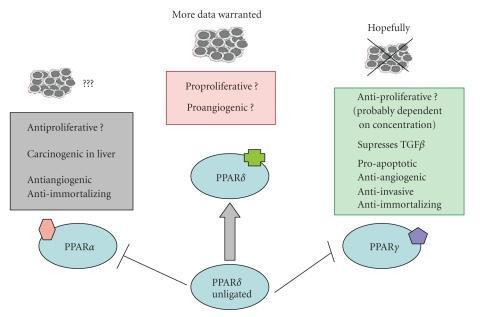
This pathophysiology diagram summarizes the influence of Peroxisome Proliferator-Activated Receptor (PPAR) ligands on breast carcinogenesis. The central mechanism illustrates unligated PPAR-delta inhibiting PPAR-alpha and PPAR-gamma while transitioning to an active ligated PPAR-delta state. The diagram compares the cellular effects of three PPAR isoforms. PPAR-alpha (left, gray box) is linked to potential antiproliferative, antiangiogenic, and anti-immortalizing effects, but is noted as carcinogenic in the liver. PPAR-delta (center, pink box) is associated with proproliferative and proangiogenic activities, labeled with the caveat 'More data warranted.' PPAR-gamma (right, green box) demonstrates predominantly antitumorigenic properties, including pro-apoptotic, anti-invasive, and anti-immortalizing effects, as well as TGF-beta suppression; its antiproliferative action is noted as concentration-dependent. The illustration uses schematic cell clusters to represent tumor progression or regression, with a crossed-out cluster over the PPAR-gamma pathway indicating therapeutic potential. This resource is intended for advanced medical education in oncology and molecular pharmacology.
Adrenergic Blocker Drugs: Uses and Side Effects
Part 1: Alpha-Adrenoceptor Antagonists
Classification
| Drug | Type | Selectivity |
|---|---|---|
| Phentolamine | Reversible | Non-selective (α1 + α2) |
| Phenoxybenzamine | Irreversible (covalent) | Non-selective (α1 + α2) |
| Prazosin, Terazosin, Doxazosin | Reversible | α1-selective |
| Tamsulosin | Reversible | α1A-selective (uroselectivity) |
| Yohimbine | Reversible | α2-selective |
Therapeutic Uses of Alpha-Blockers
Side Effects of Alpha-Blockers
- Orthostatic (postural) hypotension - most common; especially severe with the first dose ("first-dose effect" of prazosin). Dizziness and syncope can result.
- Reflex tachycardia - particularly with non-selective agents like phentolamine; less with α1-selective agents.
- Nasal congestion - due to vasodilation of nasal mucosa.
- Inhibition of ejaculation - tamsulosin can cause retrograde ejaculation.
- Fluid retention / edema - due to increased venous capacitance and reflex sodium retention.
- Intraoperative Floppy Iris Syndrome - tamsulosin is associated with this complication during cataract surgery.
Part 2: Beta-Adrenoceptor Antagonists (Beta-Blockers)
Classification by Selectivity
| Drug | β Selectivity | Special Features |
|---|---|---|
| Propranolol | Non-selective (β1+β2) | Lipophilic, crosses CNS |
| Nadolol | Non-selective | Long half-life |
| Timolol | Non-selective | Used topically for glaucoma |
| Atenolol | β1-selective | Hydrophilic |
| Metoprolol | β1-selective | Moderate lipophilicity |
| Bisoprolol | β1-selective | High oral bioavailability (80%) |
| Esmolol | β1-selective | Very short half-life (10 min), IV use |
| Acebutolol | β1-selective | Has partial agonist activity |
| Pindolol | Non-selective | Has intrinsic sympathomimetic activity (ISA) |
| Carvedilol | Non-selective + α1 block | Used in heart failure |
| Labetalol | Non-selective + α1 block | Used in hypertension, pregnancy |
Therapeutic Uses of Beta-Blockers
- Reduce myocardial oxygen demand by lowering heart rate and contractility.
- In post-myocardial infarction patients, they significantly reduce mortality and reinfarction risk - one of the most evidence-based uses.
- Used in both stable angina (as prophylaxis) and unstable angina.
- Atrial fibrillation and flutter (ventricular rate control)
- Supraventricular tachycardias
- Ventricular arrhythmias (especially exercise-induced)
- Esmolol is used IV for acute rate control in perioperative settings.
Side Effects of Beta-Blockers
Cardiovascular
- Bradycardia and heart block - Slowing of the resting heart rate is the main pharmacological effect. Beta-blockers slow AV node conduction and are contraindicated in symptomatic bradycardia, second/third degree heart block, and sick sinus syndrome.
- Hypotension - Especially on initiation.
- Worsening heart failure - When started in decompensated (acute) heart failure; in stable chronic HF they are beneficial.
- Peripheral vasoconstriction - Cold extremities, worsening claudication, aggravation of Raynaud phenomenon (more with non-selective agents).
Respiratory
- Bronchospasm - Non-selective beta-blockers block β2 receptors in bronchial smooth muscle, causing bronchoconstriction. This is the most dangerous effect in patients with asthma or COPD. β1-selective drugs (atenolol, bisoprolol) are much safer but should still be used cautiously.
Metabolic
- Masking of hypoglycemia symptoms - Beta-blockers blunt the tachycardia that warns diabetic patients of hypoglycemia; non-selective agents also inhibit glycogenolysis, prolonging hypoglycemia. Use cardioselective agents cautiously in insulin-dependent diabetes.
- Dyslipidemia - Non-selective beta-blockers increase plasma triglycerides and decrease HDL cholesterol.
Central Nervous System (Lipophilic agents: propranolol, metoprolol)
- Fatigue and exercise intolerance
- Sleep disturbances, vivid dreams, nightmares
- Depression (debated but reported)
- Sexual dysfunction
Abrupt Withdrawal
- Abrupt discontinuation can cause rebound hypertension, unstable angina, or myocardial infarction - especially dangerous in patients with ischemic heart disease. Doses must be tapered gradually.
Part 3: Combined α + β Blockers
| Drug | Main Uses | Notes |
|---|---|---|
| Labetalol | Hypertensive emergencies, pregnancy-induced hypertension | IV form available; ratio β:α block = ~3:1 oral, ~7:1 IV |
| Carvedilol | Chronic heart failure, hypertension | Antioxidant properties; proven mortality benefit in HFrEF |
Summary of Key Contraindications
| Drug Class | Major Contraindications |
|---|---|
| Alpha-blockers | Hypotension, concurrent PDE5 inhibitor use (profound hypotension risk) |
| Non-selective beta-blockers | Asthma, COPD, bradycardia/AV block, decompensated HF, pheochromocytoma (without prior alpha blockade) |
| Beta-blockers (all) | Symptomatic bradycardia, high-degree AV block, cardiogenic shock |