
Malnutrition SAM PEM FOR paediatrics examination mbbs Final year
Reading File
Now let me search the medical library for SAM/PEM content in paediatrics textbooks.
Finding Sources
Finding Sources
Finding Sources
Finding Sources
Finding Sources
Excellent - I have strong sources. Let me now read the most relevant paediatrics/clinical content in parallel.
Reading File
Reading File
Reading File
Reading File
Reading File
Finding Sources
Reading File
Reading File
Reading File
Finding Sources
Finding Sources
Reading File
Loading Image
Loading Image
I now have comprehensive content from multiple authoritative textbooks. Let me fetch one more image and compile the complete answer.
Loading Image
I now have all the content needed to produce a comprehensive MBBS Final Year paediatrics examination guide. Here is the complete, exam-focused answer:
Malnutrition - SAM & PEM
MBBS Final Year Paediatrics Examination Guide
1. DEFINITIONS & TERMINOLOGY
PEM (Protein-Energy Malnutrition) is a spectrum of clinical disorders resulting from inadequate intake of dietary protein and/or calories to meet the body's needs. Also called protein-energy undernutrition (PEU) or protein-caloric malnutrition.
SAM (Severe Acute Malnutrition) is the modern WHO term that replaced "PEM." The WHO defines SAM as:
- Weight-for-height >3 SD below the median WHO child growth standards (WHZ score < -3), OR
- Mid-upper arm circumference (MUAC) < 115 mm, OR
- Presence of nutritional oedema
SAM affects ~50 million children worldwide. ~45% of deaths in children under 5 in low-resource countries are attributable to undernutrition. Severely wasted children are 9 times more likely to die than well-nourished children.
(Source: Robbins & Kumar Basic Pathology; Park's Textbook of Preventive and Social Medicine)
2. THE SPECTRUM OF SAM - TWO ENDS
SAM manifests as two main clinical syndromes at opposite ends of a spectrum:
| Feature | Marasmus | Kwashiorkor |
|---|---|---|
| Primary deficit | Calories >> Protein | Protein >> Calories |
| Protein compartment depleted | Somatic (skeletal muscle) | Visceral (liver, organs) |
| Age of onset | Usually < 1 year | Usually 1-3 years (post-weaning) |
| Weight for age | < 60% of expected | 60-80% of expected |
| Weight for height | Markedly decreased | Normal or decreased |
| Oedema | Absent | Present (hallmark) |
| Serum albumin | Normal or slightly reduced | Markedly reduced |
| Mood | Alert | Apathetic when alone; irritable when held |
| Appetite | Good | Poor |
| Subcutaneous fat | Markedly depleted | Relatively spared (masked by oedema) |
| Muscle wasting | Severe | Moderate |
| Fatty liver | Absent | Present |
| Skin/hair changes | Absent | Present (see below) |
(Source: Lippincott Biochemistry 8e, Table 27.1; Sleisenger & Fordtran Table 5.17)
Marasmic kwashiorkor = overlap with features of both forms.
3. CLINICAL FEATURES IN DETAIL
MARASMUS ("Dry" PEM)
- Severe growth retardation and arrested development
- Extreme muscle wasting and depletion of subcutaneous fat (emaciation)
- "Wizened old man" / "Monkey facies" - head appears too large for the emaciated body
- Skin hangs in folds ("baggy pants" sign)
- No oedema
- Weakness and anemia
- Cortisol and glucagon elevated (adaptive response); low insulin
- Leptin production is low, stimulating the HPA axis contributing to lipolysis
- Immunity impaired (T cell mediated): concurrent infections common
Biochemical basis of no-oedema: Visceral protein compartment is relatively preserved (serum albumin near normal), so oncotic pressure is maintained.
(Source: Robbins & Kumar, p. 289)
KWASHIORKOR ("Wet" PEM)
The word kwashiorkor comes from the Ga language of Ghana/West Africa and means "disease of the displaced child" (the child displaced from the breast by a new sibling - commonly seen after weaning).
Cardinal features (exam favourite):
- Bilateral pitting oedema (starts in feet, ascends) - due to hypoalbuminaemia
- Protuberant abdomen - due to weakened abdominal muscles + intestinal distension + hepatomegaly (ascites is RARE; if present, think liver disease)
- Fatty liver (hepatomegaly) - due to reduced synthesis of apolipoprotein, impairing VLDL export; fat accumulates
- Skin changes: "Flaky paint dermatosis" / "Crazy pavement dermatosis" - alternating zones of hyperpigmentation, desquamation, and hypopigmentation
- Hair changes: Depigmentation ("flag sign" - alternating bands of pale and dark colour), straightening, fine texture, easy pluckability (Pluck sign positive), loss of attachment to scalp
- Moon face (from oedema)
- Hypoalbuminaemia - albumin typically < 3 g/dL
- Apathy, listlessness, loss of appetite
- Anorexia and misery
Why oedema in kwashiorkor?
- Hypoalbuminaemia → reduced oncotic pressure → fluid moves to extravascular space
- Leaky cell membranes → K+ and other intracellular ions leak out → osmotic water movement
- Often triggered by physiologic stress (infection) superimposed on a malnourished child
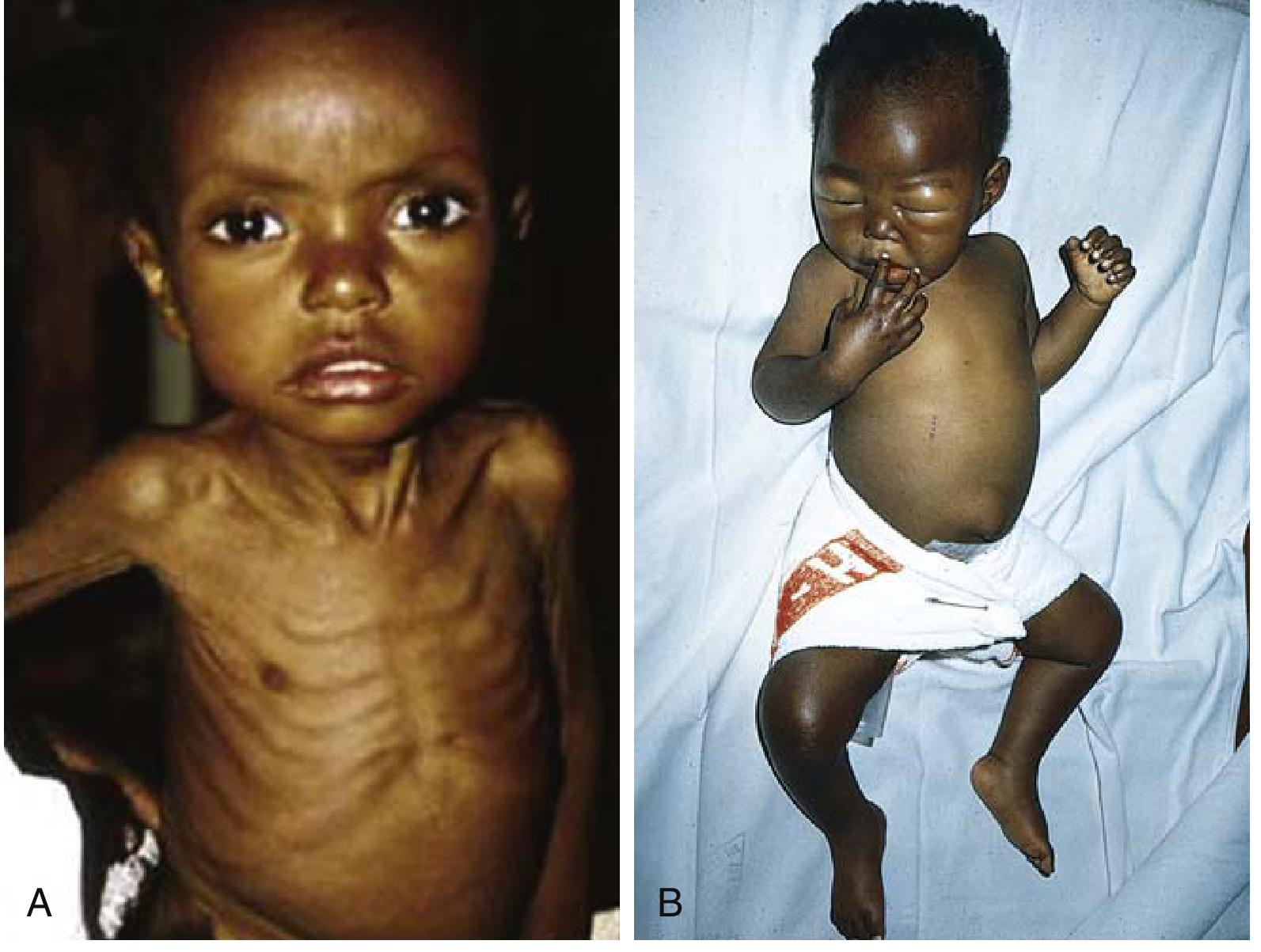
Fig: (A) Marasmus - loss of muscle mass and subcutaneous fat; head appears too large for the emaciated body. (B) Kwashiorkor - generalised oedema, ascites, and puffy face, hands and legs.
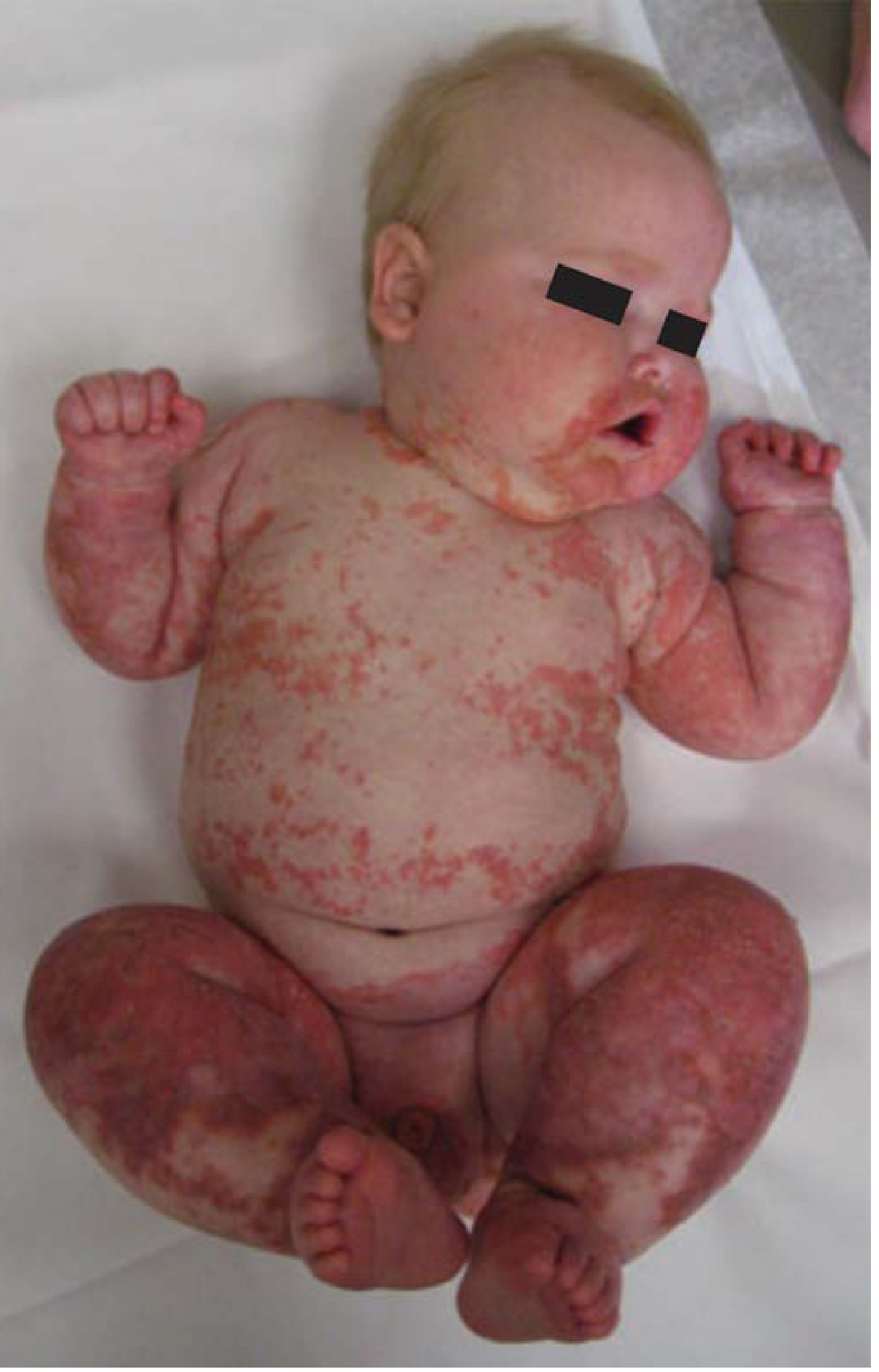
Skin lesions in kwashiorkor: alternating hyperpigmentation and depigmentation giving the "crazy pavement" appearance.
4. CLASSIFICATIONS - EXAM TABLES
Waterlow Classification of PEM in Children
(Based on weight-for-height [wasting] and height-for-age [stunting])
| Grade | Weight-for-Height (% NCHS median) | SD Score | Height-for-Age (% NCHS median) | SD Score |
|---|---|---|---|---|
| Normal | 90-100 | > -1Z | 95-105 | > -1Z |
| Mild | 80-89 | -1.1Z to -2Z | 90-94 | -1.1Z to -2Z |
| Moderate | 70-79 | -2.1Z to -3Z | 85-89 | -2.1Z to -3Z |
| Severe | < 70 | < -3Z | < 85 | < -3Z |
- Wasting = low weight-for-height (acute malnutrition)
- Stunting = low height-for-age (chronic malnutrition)
- Underweight = low weight-for-age (used by ICDS/growth charts)
(Source: Sleisenger & Fordtran, Table 5.16)
WHO Z-score Classification
| SAM | WHZ < -3 SD (or MUAC < 115 mm, or oedema) |
|---|---|
| MAM (Moderate Acute Malnutrition) | WHZ -2 to -3 SD (MUAC 115-125 mm) |
| Normal | WHZ > -2 SD |
IAP (Indian Academy of Pediatrics) / ICMR Grades (Gomez classification - weight-for-age)
| Grade | % of Expected Weight |
|---|---|
| Grade I (mild) | 76-90% |
| Grade II (moderate) | 61-75% |
| Grade III (severe = SAM) | < 60% |
5. CLINICAL ASSESSMENT - MUAC
Mid-Upper Arm Circumference (MUAC)
- Used in children 1-5 years (arm circumference is relatively stable in this age range)
- Cannot be used before 1 year of age
| MUAC | Nutritional Status |
|---|---|
| > 13.5 cm | Normal |
| 12.5 - 13.5 cm | Mild-moderate malnutrition |
| 115-125 mm | MAM |
| < 115 mm (< 11.5 cm) | SAM |
(Source: Park's Textbook of Preventive and Social Medicine)
6. PATHOPHYSIOLOGY
Body Compartments Affected
The body has two protein compartments regulated differently:
- Somatic compartment (skeletal muscle proteins) - depleted in marasmus
- Visceral compartment (liver and organ proteins) - depleted in kwashiorkor
In Marasmus (Calorie deprivation):
- Low insulin → lipolysis and proteolysis (adaptive response)
- Cortisol elevated → muscle catabolism
- Amino acids released from muscle → gluconeogenesis (energy)
- Visceral proteins relatively preserved → albumin near-normal
- This is "adapted starvation" (adaptive malnutrition)
In Kwashiorkor (Protein deprivation, calories relatively adequate):
- Carbohydrate intake adequate → insulin secretion maintained → suppresses lipolysis and proteolysis
- Visceral protein synthesis drops severely
- Reduced apolipoprotein synthesis → fat accumulates in liver (fatty liver)
- Hypoalbuminaemia → oedema
- This is "non-adapted malnutrition" (insulin keeps fat stores intact but visceral protein fails)
Effects on Organ Systems (PEM):
| System | Effect |
|---|---|
| Immune | Most vulnerable; T-cell, PMN, complement impaired; increased infection susceptibility (vicious cycle) |
| GI Tract | Villous blunting, loss of brush border enzymes; reduced pancreatic/gastric secretions; malabsorption of fats, carbohydrates, vitamins |
| Cardiovascular | Myocardial atrophy, reduced stroke volume, bradycardia, low BP |
| Respiratory | Diaphragm/respiratory muscle atrophy; reduced ventilatory drive |
| Endocrine | Low insulin; high cortisol, glucagon, GH; adaptive changes |
| Liver | Fatty infiltration (kwashiorkor); reduced synthetic function |
(Source: Sleisenger & Fordtran, p. 87)
7. MORPHOLOGY (Pathology - Robbins)
Characteristic anatomic changes in SAM:
- Growth failure (universal)
- Peripheral oedema (kwashiorkor)
- Muscle atrophy and loss of body fat (more in marasmus)
- Fatty liver (kwashiorkor, not marasmus)
- Small bowel: decreased mitotic index in mucosal cells, villous shortening; superimposed infections common
- Immune organs: thymus, lymph nodes, spleen may show atrophy
8. INVESTIGATION / DIAGNOSIS
| Investigation | Finding |
|---|---|
| Serum albumin | < 3 g/dL in kwashiorkor; near-normal in marasmus |
| Serum transferrin | Reduced |
| Hemoglobin | Anaemia (often) |
| Blood glucose | Hypoglycaemia (risk in SAM) |
| Electrolytes | Hypokalaemia, hyponatraemia, hypocalcaemia |
| Anthropometry | WHZ, MUAC, skin fold thickness, mid-arm circumference |
| Urine urea nitrogen | Elevated in catabolic states |
| Total lymphocyte count | Reduced (immune impairment marker) |
| Serum phosphate | Hypophosphataemia during refeeding (refeeding syndrome) |
Refeeding Syndrome Warning: When starting nutrition in severely malnourished children, available phosphate is rapidly consumed to phosphorylate carbohydrate intermediates → hypophosphataemia. Milk (phosphate-rich) is preferred for refeeding.
9. WHO 10-STEP MANAGEMENT OF SAM (MBBS Exam Favourite)
The WHO 10-step protocol for inpatient management of SAM:
Phase 1: Stabilisation (Days 1-7) - "Treat/Prevent"
| Step | Action |
|---|---|
| 1 | Treat/prevent hypoglycaemia (10% glucose or F-75 feed) |
| 2 | Treat/prevent hypothermia (keep warm, KMC) |
| 3 | Treat/prevent dehydration (ReSoMal - Rehydration Solution for Malnutrition, not standard ORS) |
| 4 | Correct electrolyte imbalance (K, Mg - avoid Na) |
| 5 | Treat/prevent infection (broad-spectrum antibiotics, even if no overt signs) |
| 6 | Correct micronutrient deficiencies (Vit A, Zn, folate, Cu, Mn - NO iron yet in phase 1) |
| 7 | Start cautious feeding (F-75 formula - 75 kcal/100mL) |
Phase 2: Rehabilitation (Weeks 2-6) - "Rebuild"
| Step | Action |
|---|---|
| 8 | Achieve catch-up growth (F-100 formula - 100 kcal/100mL; RUTF - Ready to Use Therapeutic Food in community) |
| 9 | Provide sensory stimulation and emotional support |
| 10 | Prepare for discharge and follow-up |
Key formulas:
- F-75: Stabilisation phase (75 kcal/100 mL; 0.9 g protein/100 mL)
- F-100: Rehabilitation phase (100 kcal/100 mL; 2.9 g protein/100 mL)
- RUTF: Ready-to-Use Therapeutic Food (Plumpy'nut - peanut paste); 500 kcal/sachet; for community-based management
Why ReSoMal and NOT standard ORS? SAM children have high intracellular Na and low K. Standard ORS has too much Na and can cause fluid overload. ReSoMal has lower Na (45 mEq/L vs. 75 mEq/L) and higher K and Mg.
Why no iron in Phase 1? Free iron promotes bacterial growth and oxidative stress (iron creates free radicals via Fenton reaction). It is given only in Phase 2 (rehabilitation) once infection is controlled.
10. COMMUNITY MANAGEMENT (CMAM)
- RUTF (Ready-to-Use Therapeutic Food): used for community-based management of uncomplicated SAM
- MUAC taping: community workers use MUAC tapes (red/yellow/green zones) for screening
- Indicators for inpatient care: presence of oedema, complications (hypoglycaemia, dehydration, infections), or failure of appetite
11. EARLY DETECTION OF PEM
| Tool | Detail |
|---|---|
| Growth chart (Road-to-health card) | First line; detects underweight-for-age |
| MUAC tape | 1-5 years; simple, field-usable |
| Weight-for-height (WHZ) | Best for acute wasting |
| Height-for-age (HAZ) | Stunting - chronic malnutrition |
| Skinfold thickness | Reflects fat stores (biceps, triceps, subscapular, suprailiac) |
12. PREVENTION (Park's Preventive Paediatrics)
Health Promotion:
- Nutritional support for pregnant and lactating mothers
- Promotion of exclusive breastfeeding (first 6 months)
- Development of low-cost weaning foods (complementary feeding from 6 months)
- Improve family diet and food security
- Nutrition education and correct feeding practices
- Family planning and birth spacing
- Home economics and sanitation
Specific Protection:
- Periodic vitamin A supplementation
- ICDS (Integrated Child Development Services) - India specific
- Mid-day meal programmes
- Prevention and treatment of infections (immunisation, ORS)
13. COMPLICATIONS OF SAM
- Hypoglycaemia (blood glucose < 54 mg/dL)
- Hypothermia (rectal temp < 35.5°C)
- Severe dehydration
- Electrolyte imbalance (hypokalaemia is most dangerous)
- Septicaemia / infections (due to immune impairment)
- Anaemia
- Vitamin A deficiency → xerophthalmia, blindness
- Refeeding syndrome (hypophosphataemia, hypokalaemia on rapid refeeding)
- Long-term: cognitive impairment, growth stunting, developmental delay
14. MUST-KNOW MNEMONICS & ONE-LINERS
- "KWA-shiorkor" = K for Kwashiorkor, K for pottassium loss, K for Kids post-weaning
- "EDIT" - Kwashiorkor = Oedema, Depigmented hair, Irritable, Thin albumin
- Marasmus = "Mad hunger" - Marked wasting, Alert child, Depleted fat, No oedema
- RUTF = "Ready peanut": 500 kcal per sachet, used at HOME
- ReSoMal = Low Na (45), High K, for SAM rehydration
- Flag sign of hair = kwashiorkor (alternating light-dark bands)
- Flaky paint / crazy pavement = skin in kwashiorkor
- Fatty liver = kwashiorkor (NOT marasmus)
- WHO SAM criteria = WHZ < -3 SD, OR MUAC < 115 mm, OR nutritional oedema
15. HIGH-YIELD EXAM ONE-LINERS
- The term "kwashiorkor" means "disease of the displaced child" (Ga language, Ghana)
- In kwashiorkor, insulin is relatively preserved (carbs available) - this is non-adapted malnutrition
- In marasmus, low insulin allows lipolysis + proteolysis - this is adapted malnutrition
- Somatic protein depleted in marasmus; visceral protein depleted in kwashiorkor
- The role of gut microbiome in SAM pathogenesis is an emerging area (Robbins 2024)
- SAM children are 9x more likely to die than well-nourished children
- MUAC is NOT used before 1 year of age
- Iron is NOT given in Phase 1 of SAM management
- Standard ORS is NOT used in SAM - use ReSoMal
- F-75 in stabilization, F-100 in rehabilitation
Sources: Robbins & Kumar Basic Pathology (9e/10e); Sleisenger & Fordtran's Gastrointestinal and Liver Disease; Lippincott Illustrated Reviews Biochemistry 8e; Park's Textbook of Preventive and Social Medicine
This is a shared conversation. Sign in to Orris to start your own chat.