
What is the clinical utility of Pipez circuits
The term "Pipez circuits" doesn't immediately ring a bell as a standard medical or clinical term - it may refer to breathing/anesthesia circuits (like Mapleson circuits), or possibly a niche equipment brand. Let me check the medical library and search for more context.
Searching sources...
Reading File
Searching the Web
Pipez circuit clinical utility anesthesia
You almost certainly mean the Papez circuit (pronounced "pay-pez") - a classic neuroanatomical circuit. Let me pull up the medical library content on this.
Finding Sources
Searching PubMed
Papez circuit clinical significance memory emotion
Good - found rich textbook content. Now let me read the key sections in parallel.
Reading File
Reading File
Reading File
Excellent - I have the circuit diagram URL. Let me now fetch it and read the Kaplan & Sadock psychiatry content on clinical significance, and read more of the Neuroscience textbook on clinical utility.
Loading Image
Reading File
Finding Sources
I now have comprehensive content. Let me read the Bradley & Daroff and Harrison's sections on clinical utility.
Reading File
Reading File
Reading File
I now have all the key material. Let me also read the Neuroscience textbook content on what parts of the Papez circuit are clinically relevant vs. not.
Reading File
I now have all the information needed for a comprehensive answer. Let me compose it.
The Papez Circuit - Clinical Utility
Note: You likely meant the Papez circuit (pronounced "pay-pez"), named after neuroanatomist James Papez (1937) - not "Pipez." This is a foundational neuroanatomical circuit of the limbic system.
What is the Papez Circuit?
The Papez circuit is a closed loop of interconnected limbic structures proposed by James Papez in 1937 as the anatomical basis of emotional experience and, as later established, episodic memory.
The circuit flows as:
Hippocampus (subiculum) → Fornix → Mammillary bodies → Mammillothalamic tract → Anterior nucleus of the thalamus → Internal capsule → Cingulate gyrus → Cingulum → Parahippocampal gyrus → Entorhinal cortex → back to Hippocampus
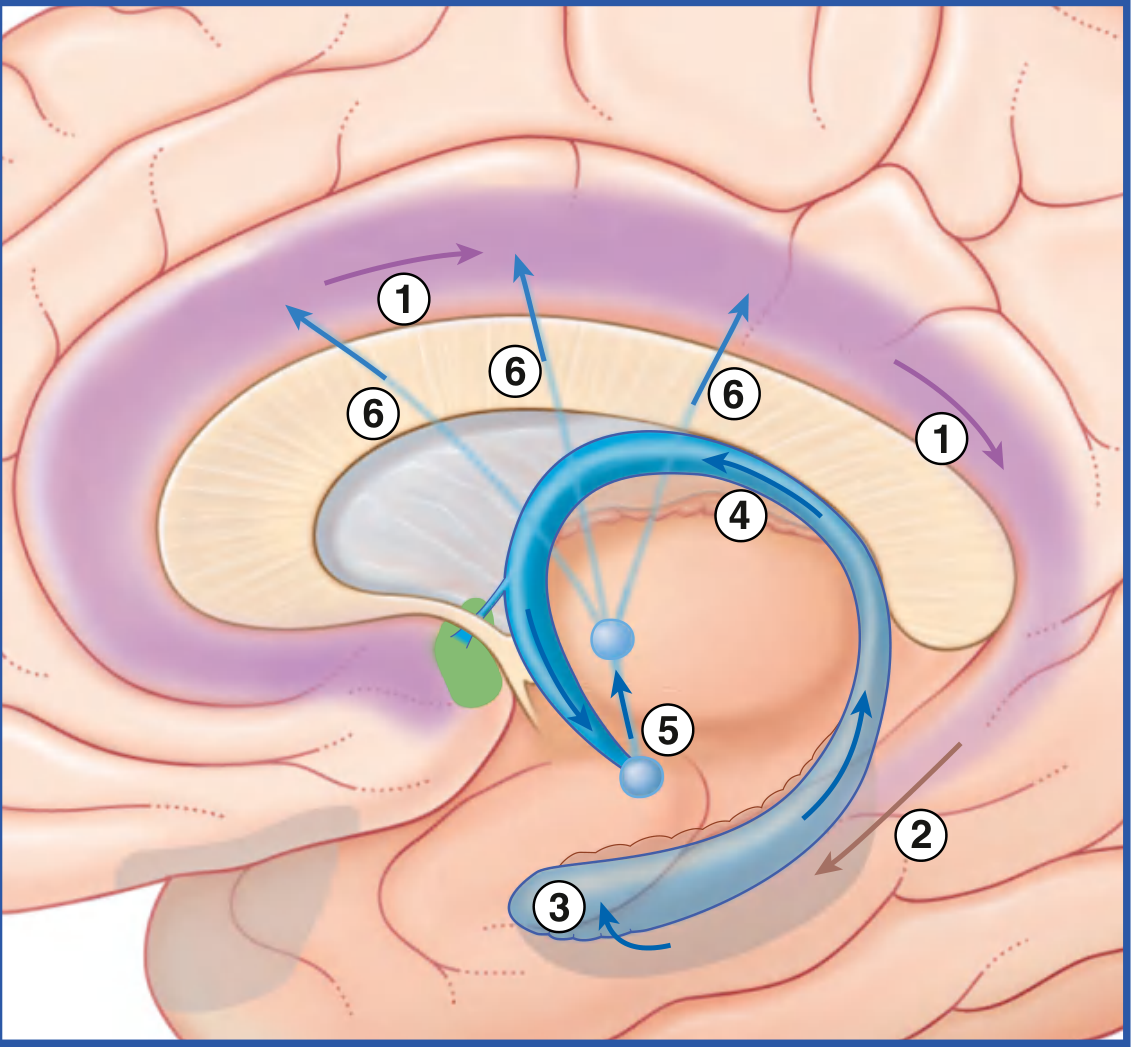
Papez proposed that:
- The hypothalamus governs the behavioral expression of emotion
- The cingulate cortex is responsible for feelings/experience of emotion
- The two are linked bidirectionally, meaning the circuit is compatible with both the James-Lange and Cannon-Bard theories of emotion - Neuroscience: Exploring the Brain, 5th Ed.
Clinical Utility
1. Episodic Memory and the Amnestic Syndrome
The most clinically important role of the Papez circuit is explicit (declarative) memory. As stated in Harrison's Principles of Internal Medicine (2025), the posterior limbic network (the Papez circuit) subserves "declarative memory for recent episodes and experiences." Bilateral damage to any node of the circuit produces an amnestic state characterized by:
- Anterograde amnesia - inability to form new memories
- Retrograde amnesia - loss of recent (less consolidated) memories
- Confabulation - particularly when orbitofrontal/thalamic components are involved
- Patients "forget that they forget" and tend to deny memory problems
According to Localization in Clinical Neurology, 8e: lesions of ANY of the following structures - hippocampus, fornix, mammillary body, mammillothalamic tract, anterior/dorsomedial thalamic nuclei, cingulate gyrus, or cingulum - can produce amnesia, typically requiring bilateral lesions.
2. Wernicke-Korsakoff Syndrome
A classic and well-studied clinical example. Thiamine deficiency (usually from alcoholism) damages the mammillary bodies and dorsomedial thalamic nuclei. This interrupts the Papez circuit and causes:
- Severe anterograde amnesia
- Prominent confabulation
- The amnestic syndrome is less severe in purely cortical (medial temporal) damage compared to diencephalic damage - Bradley & Daroff's Neurology in Clinical Practice
3. Anterior Communicating Artery Aneurysm Rupture
Rupture damages the septal nuclei (deep medial frontal areas), producing:
- Amnestic syndrome with confabulation
- Frontal executive dysfunction
- Memory deficits tied to disruption of the basal forebrain component of the circuit - Bradley & Daroff's Neurology
4. Alzheimer's Disease
The circuit is devastated in Alzheimer's disease. The Forno et al. (2021) review and thalamic pathology studies highlight that Papez circuit degeneration - starting in the entorhinal cortex and hippocampus - underlies the early episodic memory loss. Neuroimaging of circuit integrity (DTI tractography of the fornix and mammillothalamic tract) is now used as a biomarker of disease stage.
5. Transient Global Amnesia (TGA)
Transient disruption of circuit function (possibly via hippocampal spreading depolarization) produces sudden-onset, reversible anterograde amnesia with preserved remote memory and identity - a recognizable clinical syndrome.
6. Temporal Lobe Epilepsy
Seizure activity propagating through hippocampal-parahippocampal-cingulate components of the circuit underlies the clinical features of temporal lobe epilepsy, including ictal amnesia, emotional auras (fear, deja vu), and interictal memory disturbances.
7. Deep Brain Stimulation (DBS)
Current research (Rapaka et al., 2024 - PMID 38726200) is exploring DBS targeting the Papez circuit (particularly the fornix and anterior thalamic nucleus) for cognitive dysfunction in Alzheimer's disease. The anterior thalamic nucleus is already used as a DBS target for refractory temporal lobe epilepsy.
8. Traumatic Brain Injury (TBI)
The frontal and temporal lobes - which contain the main circuit nodes - are the most vulnerable areas in TBI. Papez circuit disruption explains why memory loss is such a prominent feature of TBI. DTI can reconstruct damaged tracts (e.g., the thalamocingulate tract) and correlate with memory outcomes.
Limitations of the Papez Model
While clinically useful, the original Papez circuit is now understood to be an oversimplification:
- The hippocampus plays little role in emotional expression per se - it is more central to memory
- The amygdala, not part of Papez's original circuit, is the key structure for fear and emotional memory
- The Aggleton et al. (2022) review (PMID 35940310) argues the "serial" Papez circuit model should be updated to reflect its parallel, non-serial architecture and roles in spatial navigation and attention, not just memory
- Some structures in the circuit have little proven role in emotion (e.g., anterior thalamus lesions causing emotional disturbance was largely inferred from older, unreliable clinical data)
- The term is now best understood as a heuristic framework for reviewing major limbic pathways rather than a discrete functional unit - Gray's Anatomy for Students; Neuroanatomy through Clinical Cases, 3rd Ed.
Summary Table
| Papez Circuit Node | Clinical Lesion | Syndrome |
|---|---|---|
| Hippocampus (bilateral) | Herpes encephalitis, PCA infarct, Alzheimer's | Amnestic syndrome (cortical type) |
| Mammillary bodies | Thiamine deficiency (Wernicke-Korsakoff) | Korsakoff amnesia + confabulation |
| Anterior thalamus / Dorsomedial thalamus | Thalamic infarct, Korsakoff | Amnestic syndrome (diencephalic type) |
| Fornix | Surgical injury, colloid cyst of 3rd ventricle | Anterograde amnesia |
| Cingulate gyrus (bilateral) | Anterior cerebral artery infarct, tumors | Memory impairment + personality change |
| Septal nuclei | ACA aneurysm rupture | Amnesia + confabulation + frontal signs |
This is a shared conversation. Sign in to Orris to start your own chat.