
I want give a seminar in psychology subject The topic is about cognitive behavioral therapy give me notes of this matter
cognitive behavioral therapy CBT seminar notes psychology overview techniques
"cognitive behavioral therapy"[MeSH Terms] AND efficacy
cognitive behavioral therapy CBT model triangle thoughts feelings behaviors
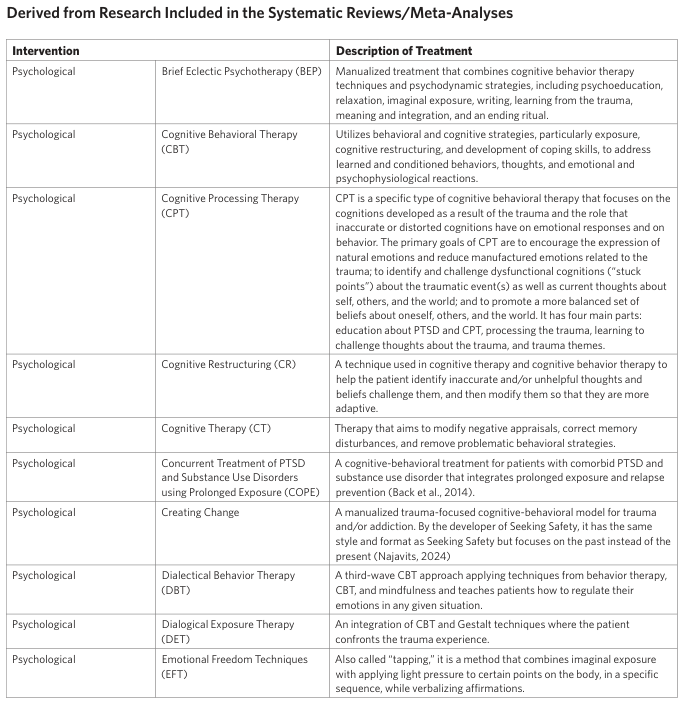
Derived from Research Included in the Systematic Reviews/Meta-Analyses <table><thead><tr><th>Intervention</th><th>Description of Treatment</th></tr></thead><tbody><tr><td>Psychological</td><td>Brief Eclectic Psychotherapy (BEP)</td><td>Manualized treatment that combines cognitive behavior therapy techniques and psychodynamic strategies, including psychoeducation, relaxation, imaginal exposure, writing, learning from the trauma, meaning and integration, and an ending ritual.</td></tr><tr><td>Psychological</td><td>Cognitive Behavioral Therapy (CBT)</td><td>Utilizes behavioral and cognitive strategies, particularly exposure, cognitive restructuring, and development of coping skills, to address learned and conditioned behaviors, thoughts, and emotional and psychophysiological reactions.</td></tr><tr><td>Psychological</td><td>Cognitive Processing Therapy (CPT)</td><td>CPT is a specific type of cognitive behavioral therapy that focuses on the cognitions developed as a result of the trauma and the role that inaccurate or distorted cognitions have on emotional responses and on behavior. The primary goals of CPT are to encourage the expression of natural emotions and reduce manufactured emotions related to the trauma; to identify and challenge dysfunctional cognitions ("stuck points") about the traumatic event(s) as well as current thoughts about self, others, and the world; and to promote a more balanced set of beliefs about oneself, others, and the world. It has four main parts: education about PTSD and CPT, processing the trauma, learning to challenge thoughts about the trauma, and trauma themes.</td></tr><tr><td>Psychological</td><td>Cognitive Restructuring (CR)</td><td>A technique used in cognitive therapy and cognitive behavior therapy to help the patient identify inaccurate and/or unhelpful thoughts and beliefs challenge them, and then modify them so that they are more adaptive.</td></tr><tr><td>Psychological</td><td>Cognitive Therapy (CT)</td><td>Therapy that aims to modify negative appraisals, correct memory disturbances, and remove problematic behavioral strategies.</td></tr><tr><td>Psychological</td><td>Concurrent Treatment of PTSD and Substance Use Disorders using Prolonged Exposure (COPE)</td><td>A cognitive-behavioral treatment for patients with comorbid PTSD and substance use disorder that integrates prolonged exposure and relapse prevention (Back et al., 2014).</td></tr><tr><td>Psychological</td><td>Creating Change</td><td>A manualized trauma-focused cognitive-behavioral model for trauma and/or addiction. By the developer of Seeking Safety, it has the same style and format as Seeking Safety but focuses on the past instead of the present (Najavits, 2024)</td></tr><tr><td>Psychological</td><td>Dialectical Behavior Therapy (DBT)</td><td>A third-wave CBT approach applying techniques from behavior therapy, CBT, and mindfulness and teaches patients how to regulate their emotions in any given situation.</td></tr><tr><td>Psychological</td><td>Dialogical Exposure Therapy (DET)</td><td>An integration of CBT and Gestalt techniques where the patient confronts the trauma experience.</td></tr><tr><td>Psychological</td><td>Emotional Freedom Techniques (EFT)</td><td>Also called "tapping," it is a method that combines imaginal exposure with applying light pressure to certain points on the body, in a specific sequence, while verbalizing affirmations.</td></tr></tbody></table>
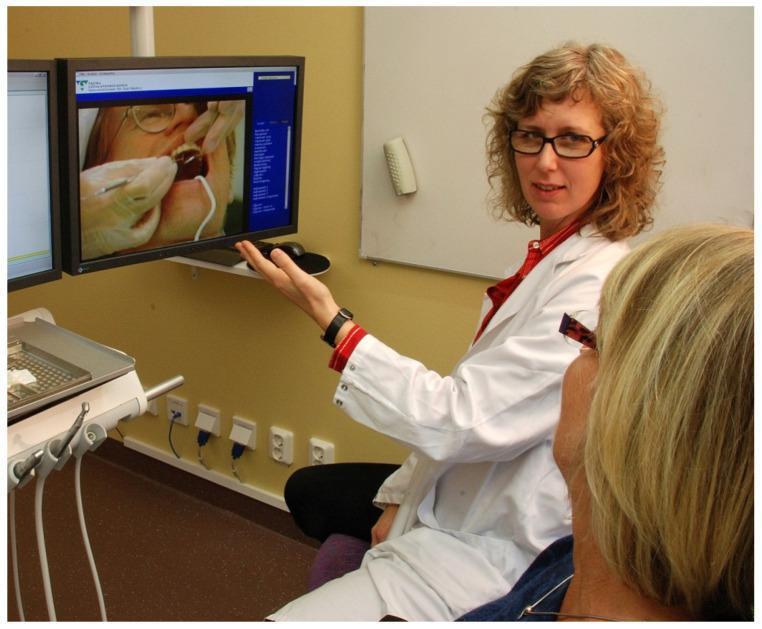
This clinical photograph illustrates a dental phobia treatment setting within a fully equipped dental operating room. A psychologist, identified by a white lab coat, is conducting an exposure-based Cognitive Behavioral Therapy (CBT) session for a patient with severe dental anxiety. The psychologist is gesturing toward a computer monitor that displays high-resolution imagery of a clinical dental procedure, serving as a visual exposure stimulus to desensitize the patient. The environment includes standard dental operatory equipment, such as an instrument console with handpieces and various dental tools, integrating the psychological intervention directly into the clinical space where dental triggers occur. This multidisciplinary approach aims to reduce avoidance behaviors and manage physiological anxiety reactions through gradual exposure and psychoeducation. The target audience for this material includes dental students, psychologists, and clinicians specializing in behavioral medicine or dental public health.
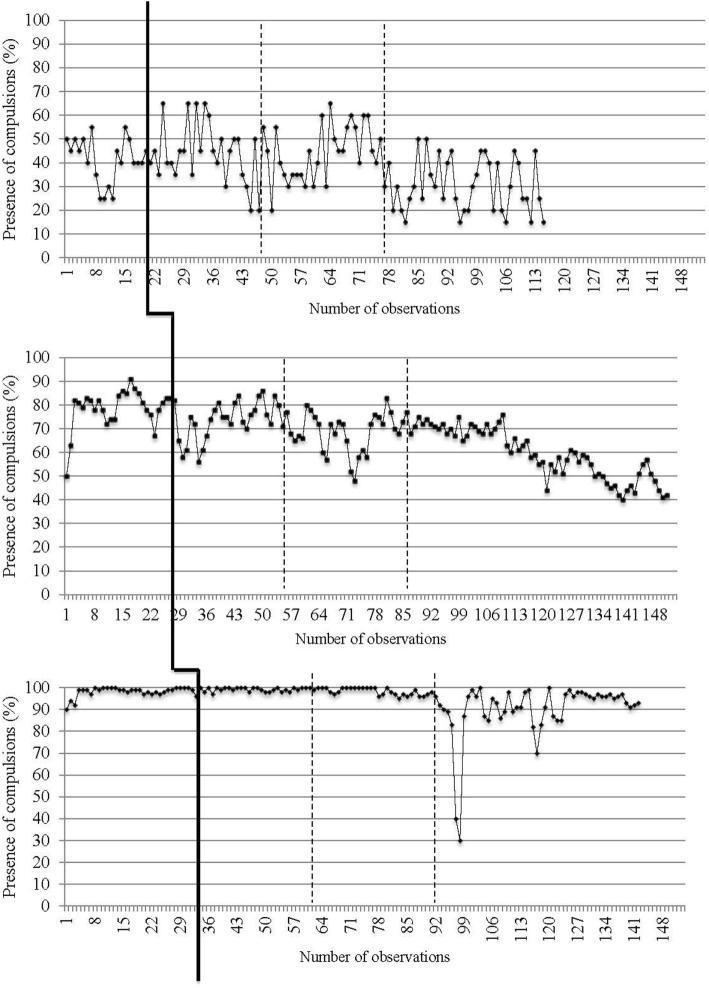
This Comparison Chart displays three vertically stacked line graphs representing a single-case experimental design for three participants with Obsessive-Compulsive Disorder (OCD). The y-axis measures the 'Presence of compulsions (%)' on a scale of 0 to 100, while the x-axis tracks the 'Number of observations' over time (up to 148 points). Each graph is divided into distinct phases by vertical markers: a thick solid line denotes the introduction of Cognitive Behavioral Therapy (CBT), and two subsequent dashed vertical lines mark the implementation of 'in virtuo' exposure using virtual reality. The top plot shows high variability throughout, with a slight downward trend in the final phase. The middle plot demonstrates a more pronounced and steady decline in compulsive behaviors following the introduction of CBT and VR exposure. The bottom plot shows initial stability near 100% with a sharp drop-off and increased fluctuation after the second dashed line. This visualization illustrates the longitudinal clinical progression and therapeutic response to psychiatric interventions in the treatment of OCD.
Seminar Notes: Cognitive Behavioral Therapy (CBT)
Psychology | Comprehensive Study Notes
1. DEFINITION AND OVERVIEW
- Cognitive therapy (Aaron Beck, 1960s) - changing distorted thoughts
- Behavior therapy (B.F. Skinner, Wolpe, etc.) - modifying maladaptive behaviors
"CBT for anxiety might include cognitive restructuring to change irrational fears, relaxation training to reduce physiologic arousal, and exposure to extinguish fear reactions."
- Kaplan & Sadock's Comprehensive Textbook of Psychiatry
2. THEORETICAL FOUNDATIONS
2.1 Beck's Cognitive Triad (Depression Model)
- Negative view of the self ("I am worthless")
- Negative view of the world ("Everything is unfair")
- Negative view of the future ("Nothing will improve")
2.2 The ABC Model (Albert Ellis - REBT)
- A - Adversity (activating event)
- B - Beliefs about the event
- C - Consequences (emotional/behavioral)
2.3 The Core CBT Model
SITUATION/EVENT
       ↓
  AUTOMATIC THOUGHTS  ←→  CORE BELIEFS / SCHEMAS
       ↓
   EMOTIONS / FEELINGS
       ↓
    BEHAVIORS
       ↓
  (Consequences reinforce the cycle)
3. KEY CONCEPTS
3.1 Schemas
- Defines the client's perception of self
- Determines what information the client attends to, remembers, and recalls
- Governs how that information is interpreted
3.2 Automatic Thoughts
3.3 Cognitive Distortions (Common Types)
| Distortion | Description | Example |
|---|---|---|
| All-or-Nothing thinking | Black-and-white, polarized thinking | "If I'm not perfect, I'm a failure" |
| Catastrophizing | Blowing things out of proportion | "This headache means I have a tumor" |
| Mind Reading | Assuming you know what others think | "She hates me" (no evidence) |
| Fortune Telling | Predicting negative outcomes | "I'll fail the exam for sure" |
| Emotional Reasoning | Feelings = facts | "I feel stupid, so I must be stupid" |
| Jumping to Conclusions | Drawing conclusions without evidence | "He didn't reply, he must be angry" |
| Overgeneralization | One event proves a rule | "I failed once, I always fail" |
| Personalization | Taking undue blame | "It rained on my wedding, it's my fault" |
4. CHARACTERISTICS OF CBT
- Structured: Sessions follow an agenda; goals are set collaboratively
- Time-limited: Typically 12-20 sessions (some protocols as few as 6)
- Present-focused: Addresses current problems (unlike psychoanalysis)
- Collaborative: Therapist and patient work as a team, not expert-patient
- Skills-based: Teaches patients tools they can use independently
- Homework-driven: Between-session assignments reinforce learning
- Evidence-based: More extensively studied than any other psychotherapy
5. STAGES OF CBT TREATMENT
Stage 1: Assessment and Initial Treatment
- Define the client's current problems and goals
- Educate the patient about the CBT model
- Establish a collaborative therapeutic relationship
- Develop a case formulation (an explanatory model of the patient's difficulties in terms of schemas and triggers)
- Agree on a treatment plan
- Instill hope through an early exercise or homework assignment
Stage 2: Middle Phase - Skills Acquisition
- The primary goal is for the client to learn to implement CBT interventions independently
- Cognitive techniques (thought challenging, thought records)
- Behavioral techniques (exposure, behavioral activation)
- Homework assignments to practice skills between sessions
Stage 3: Relapse Prevention and Termination
- Consolidation of skills learned
- Problem-solving obstacles to skill use
- Identifying potential risks for symptom return
- Developing a personal "relapse prevention plan"
- Gradual termination
6. TECHNIQUES OF CBT
6.1 Cognitive Techniques
- CATCH IT - Notice and write down the automatic thought ("What was I thinking in this situation?")
- CHECK IT - Examine the evidence for and against the thought; identify any cognitive errors
- CHANGE IT - Generate a more accurate, realistic, and helpful thought
- Patient records: situation → feeling → automatic thought → evidence for/against → balanced thought → outcome
6.2 Behavioral Techniques
- Scheduling pleasurable or meaningful activities to counteract withdrawal/avoidance
- Particularly effective for depression where patients become inactive
- Systematic and graded exposure to feared stimuli/situations
- Counteracts avoidance which maintains anxiety
- Types:
- In vivo exposure (real-life situations)
- Imaginal exposure (mental imagery)
- Interoceptive exposure (bodily sensations - used in panic disorder)
- Progressive Muscle Relaxation (PMR)
- Diaphragmatic/controlled breathing
- Used to reduce physiological arousal
- Practice difficult situations in a safe setting
- Improves social skills, assertiveness, and confidence
- Patient tests beliefs in real life ("If I ask for help, people will think I'm stupid")
- Real-world results challenge distorted beliefs
- Break overwhelming tasks into small achievable steps
- Each step builds confidence
- Social skills training (SST) for patients with social deficits
- Problem-solving therapy (PST) for those with poor coping strategies
7. THE THERAPEUTIC RELATIONSHIP IN CBT
- The relationship is collaborative, not authoritarian
- Therapist must show warmth, empathy, and genuineness (same as other therapies)
- Therapist and patient jointly solve problems
- Sessions begin with a set agenda
- Feedback is regularly sought from the patient
- Homework is always reviewed at the start of each session
8. APPLICATIONS - WHAT CONDITIONS DOES CBT TREAT?
| Condition | Evidence Level |
|---|---|
| Depression | Strong - medium to large effect sizes |
| Anxiety disorders (GAD, panic, phobias, social anxiety) | Strong - consistently medium to large |
| OCD | Strong |
| PTSD | Strong |
| Insomnia (CBT-I) | Strong |
| Bulimia nervosa | Strong |
| Anger management | Strong |
| Substance use disorders | Small-medium (better for cannabis/nicotine) |
| Bipolar disorder | Small-medium (combined with medication) |
| Schizophrenia (CBTp) | Small-medium (combined with medication) |
| Chronic pain | Small-medium |
| Pediatric internalizing disorders | Clear benefit |
"CBT has been the most extensively studied psychological intervention, and there is ample evidence supporting CBT's efficacy and effectiveness with numerous psychiatric disorders."
- Kaplan & Sadock's Comprehensive Textbook of Psychiatry
9. CBT VS. MEDICATION
- Both CBT and psychopharmacology produce medium to large effect sizes for depression
- Combination of both is superior to either alone
- CBT has an added advantage: it teaches lasting skills, reducing risk of relapse after treatment ends
10. THIRD-WAVE CBT APPROACHES
| Approach | Key Features |
|---|---|
| Mindfulness-Based Cognitive Therapy (MBCT) | Adds mindfulness meditation to CBT; prevents depression relapse |
| Dialectical Behavior Therapy (DBT) | Marsha Linehan; combines CBT + mindfulness + distress tolerance; used in BPD |
| Acceptance and Commitment Therapy (ACT) | Accept thoughts rather than fight them; commit to value-based action |
| Schema Therapy | Jeffrey Young; targets deep-rooted schemas from childhood |
| Cognitive Processing Therapy (CPT) | Patricia Resick; specialized for PTSD |
11. CLINICAL CASE ILLUSTRATIONS
Case 1 - Panic Disorder
Case 2 - Anxiety (Cognitive Restructuring)
12. CONTRAINDICATIONS AND LIMITATIONS
- Less effective without medication for severe bipolar disorder and schizophrenia
- May be less suitable for patients with severe cognitive impairment (though adaptations exist)
- Requires patient motivation and engagement with homework
- Access can be limited; therapist expertise varies widely
- Not appropriate for all patients as the primary modality - needs individualized assessment
13. SUMMARY TABLE
| Feature | CBT |
|---|---|
| Founders | Aaron Beck, Albert Ellis |
| Focus | Present-day thoughts, feelings, behaviors |
| Duration | Time-limited (12-20 sessions) |
| Structure | Highly structured, agenda-based |
| Key tools | Thought records, exposure, behavioral activation |
| Homework | Essential component |
| Evidence base | Most researched psychotherapy |
| Best evidence | Depression, anxiety, OCD, PTSD, insomnia |
REFERENCES
- Kaplan & Sadock's Comprehensive Textbook of Psychiatry, 10th ed. (Lippincott Williams & Wilkins)
- Kaplan and Sadock's Synopsis of Psychiatry, 12th ed.
- Beck JS. Cognitive Behavior Therapy: Basics and Beyond. 2nd ed. 2011.
- Mayo Clinic - CBT Overview
- Cleveland Clinic - CBT