
Abg analysis
Reading File
ABG (Arterial Blood Gas) analysis is a systematic interpretation of blood pH, PaCO2, PaO2, and HCO3 to identify acid-base disorders and oxygenation status. The basic steps are: check pH (acidosis vs. alkalosis), identify the primary disorder (respiratory vs. metabolic), assess compensation, and calculate the anion gap if metabolic acidosis is present.
Searching sources...
Finding Sources
Finding Sources
Reading File
Reading File
Reading File
Reading File
Reading File
Reading File
Reading File
Now I have comprehensive data. Let me fetch the acid-base map diagram for visual clarity.
Loading Image
Loading Image
Here is a complete guide to ABG analysis, compiled from Goldman-Cecil Medicine, Costanzo Physiology, and related sources.
Arterial Blood Gas (ABG) Analysis
Normal Values
| Parameter | Normal Range |
|---|---|
| pH | 7.35 - 7.45 |
| PaCO2 | 35 - 45 mm Hg |
| PaO2 | 70 - 95 mm Hg (age-dependent) |
| HCO3- | 22 - 26 mEq/L |
| SaO2 | 95 - 100% |
Step-by-Step Interpretation
Step 1 - Assess pH
- pH < 7.35 = Acidemia
- pH > 7.45 = Alkalemia
- pH 7.35-7.45 = Normal (but a disorder may still exist if compensated)
Step 2 - Identify the Primary Disorder
Look at PaCO2 and HCO3- to find which one explains the pH change:
| Disorder | pH | PaCO2 | HCO3- |
|---|---|---|---|
| Metabolic Acidosis | ↓ | ↓ (compensation) | ↓ (primary) |
| Metabolic Alkalosis | ↑ | ↑ (compensation) | ↑ (primary) |
| Respiratory Acidosis | ↓ | ↑ (primary) | ↑ (compensation) |
| Respiratory Alkalosis | ↑ | ↓ (primary) | ↓ (compensation) |
Key rule: If the primary disturbance is metabolic (HCO3-), compensation is respiratory (CO2 adjusts). If the primary disturbance is respiratory (CO2), compensation is renal (HCO3- adjusts). The compensatory response always moves in the same direction as the primary disturbance.
Step 3 - Assess Compensation (Renal Rules)
Use these formulas to predict expected compensation and check for mixed disorders:
| Disorder | Formula |
|---|---|
| Metabolic Acidosis | For every 1 mEq/L ↓ HCO3- → ↓ PCO2 by 1.3 mm Hg |
| Metabolic Alkalosis | For every 1 mEq/L ↑ HCO3- → ↑ PCO2 by 0.7 mm Hg |
| Respiratory Acidosis (Acute) | 1 mm Hg ↑ PCO2 → ↑ HCO3- by 0.1 mEq/L |
| Respiratory Acidosis (Chronic) | 1 mm Hg ↑ PCO2 → ↑ HCO3- by 0.4 mEq/L |
| Respiratory Alkalosis (Acute) | 1 mm Hg ↓ PCO2 → ↓ HCO3- by 0.2 mEq/L |
| Respiratory Alkalosis (Chronic) | 1 mm Hg ↓ PCO2 → ↓ HCO3- by 0.4 mEq/L |
Winter's Equation (for metabolic acidosis): Expected PaCO2 = (1.5 × HCO3-) + 8 ± 2
- If measured PaCO2 > expected: additional respiratory acidosis
- If measured PaCO2 < expected: additional respiratory alkalosis
If a patient's actual values match predicted compensation = simple disorder. If they deviate = mixed disorder.
Step 4 - Calculate Anion Gap (if metabolic acidosis)
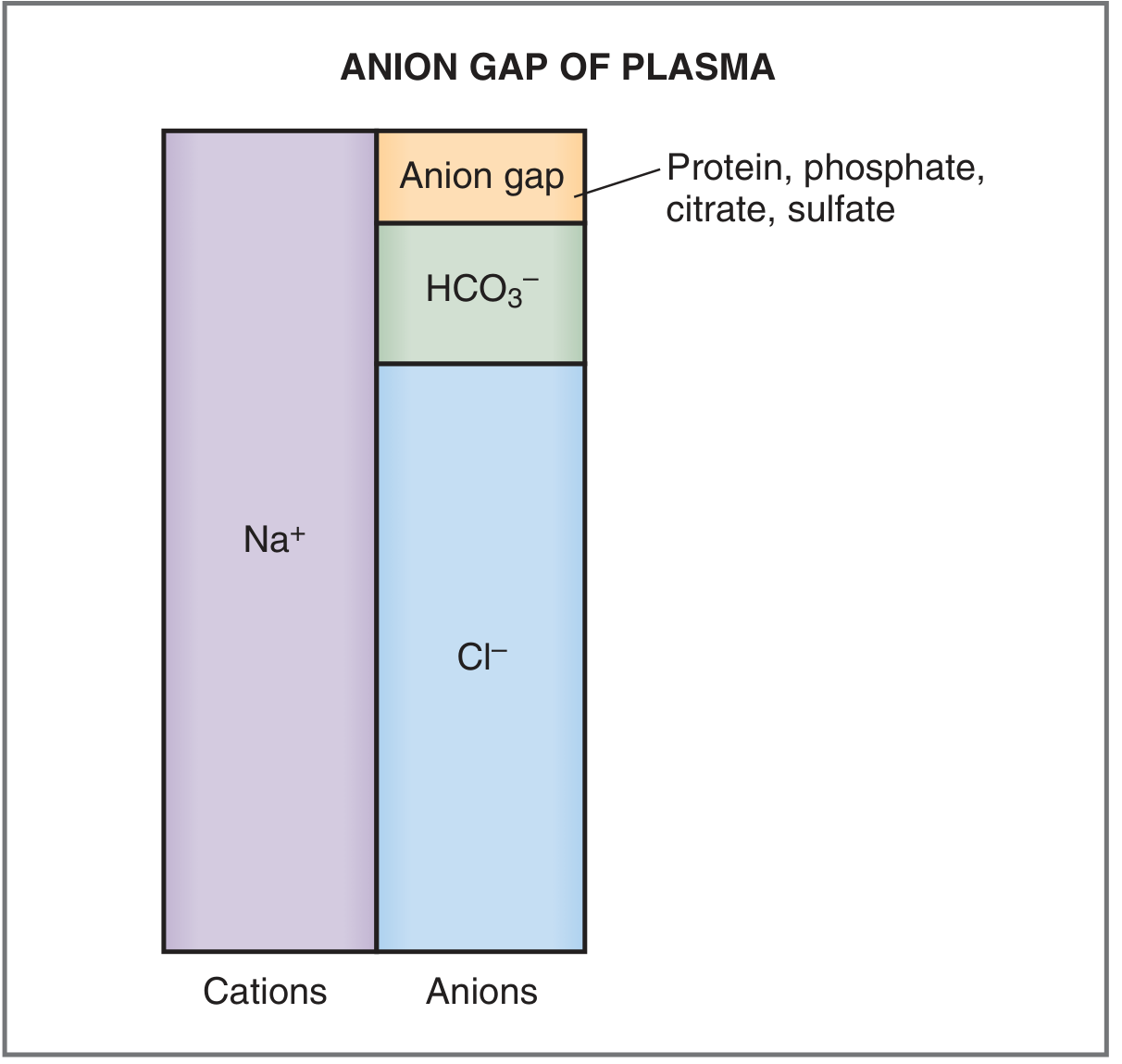
Anion Gap = Na+ - (HCO3- + Cl-)
Normal value: 8-16 mEq/L (unmeasured anions = proteins, phosphate, citrate, sulfate)
| Type | Anion Gap | Examples |
|---|---|---|
| High AG Metabolic Acidosis | Elevated (>16) | Diabetic ketoacidosis, lactic acidosis, salicylate poisoning, methanol, ethylene glycol, chronic renal failure ("MUDPILES" / "KULT") |
| Normal AG Metabolic Acidosis (Hyperchloremic) | Normal (8-16) | Diarrhea, renal tubular acidosis (RTA) |
In normal AG acidosis, lost HCO3- is replaced by Cl- (a measured anion), so the gap doesn't change. In high AG acidosis, HCO3- is replaced by an unmeasured organic anion.
Step 5 - Assess Oxygenation
Alveolar-Arterial (A-a) Gradient = FiO2(PB - PH2O) - (PaO2 + PaCO2/0.8)
Simplified: P(A-a)O2 ≈ Age/4 + 4
| A-a Gradient | Mechanism of Hypoxemia |
|---|---|
| Normal | Hypoventilation, decreased inspired O2 (altitude) |
| Elevated | V/Q mismatch (e.g., pneumonia), diffusion impairment (ILD), anatomic shunt, diffusion-perfusion impairment (hepatopulmonary syndrome) |
Normal PaO2 by age (sitting): PaO2 = 104.2 - (0.27 × age in years)
The Acid-Base Map
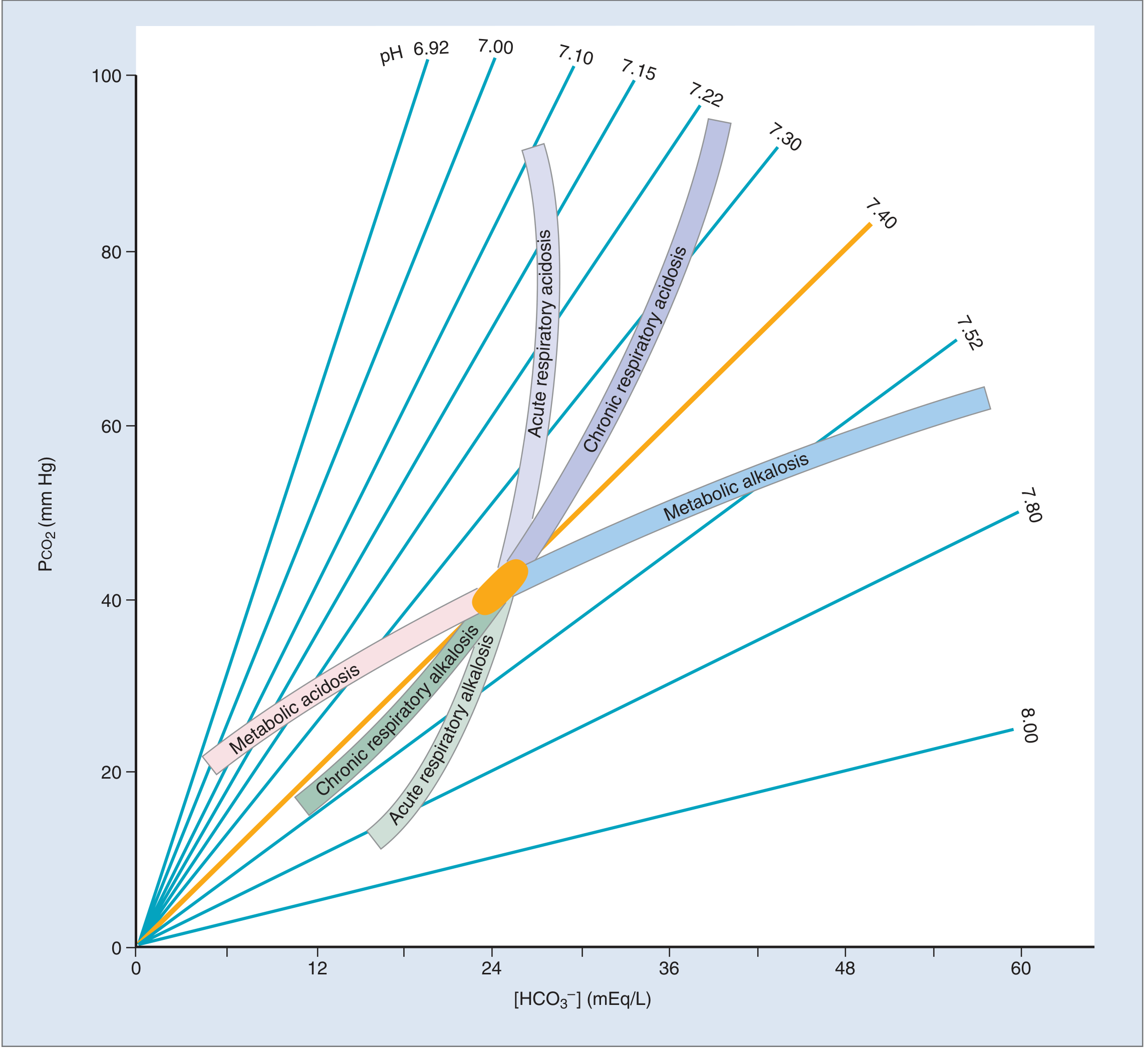
If a patient's pH/PCO2/HCO3- values fall within a shaded band = simple disorder. If they fall between bands = mixed disorder.
Quick Clinical Summary
| Finding | Think of |
|---|---|
| Low pH, low HCO3-, low PCO2 | Metabolic acidosis + respiratory compensation |
| Low pH, high PCO2, high HCO3- | Respiratory acidosis (acute = small HCO3- rise; chronic = larger rise) |
| High pH, high HCO3-, high PCO2 | Metabolic alkalosis + respiratory compensation |
| High pH, low PCO2, low HCO3- | Respiratory alkalosis (acute vs. chronic) |
| Normal pH but both PCO2 and HCO3- abnormal | Mixed disorder (e.g., metabolic acidosis + respiratory alkalosis) |
Venous Blood Gases (VBG) vs ABG
Venous pH averages ~0.03 lower than arterial. PvCO2 is 3-8 mm Hg higher and correlates less reliably with PaCO2. VBGs are unreliable in hypotensive patients or severe hypercapnia, but a normal PvCO2 can be used to exclude hypercapnia in stable patients. - Goldman-Cecil Medicine
Sources: Goldman-Cecil Medicine (International Edition); Costanzo Physiology, 7th Edition
This is a shared conversation. Sign in to Orris to start your own chat.