
NTEp For 3rd Part 1 MBbs in India short note
The query contains medical/clinical education terminology (MBBS, medical curriculum). Let me first read the medical library skill, then research NTEp for 3rd Part 1 MBBS in India.
Quick Answer: NTEp stands for National Tuberculosis Elimination Programme (formerly RNTCP - Revised National Tuberculosis Control Programme). It is a high-yield topic in Community Medicine / Preventive & Social Medicine (PSM) for 3rd Part 1 MBBS in India, covering TB epidemiology, NIKSHAY portal, treatment regimens, and the goal of eliminating TB by 2025.
Searching sources...
Reading File
Searching the Web
NTEp National Tuberculosis Elimination Programme 3rd Part 1 MBBS India PSM short notes
Now let me search the medical library database and extract detailed content simultaneously:
Finding Sources
Reading Web Page
https://ihatepsm.com/blog/ntep-national-tb-elimination-progr…
Finding Sources
Searching the Web
NTEP TB elimination programme India 2025 treatment regimen categories NIKSHAY PMTB exam notes
Finding Sources
Finding Sources
Found it - Park's PSM has a dedicated NTEP section. Let me read it:
Reading File
Finding Sources
Reading File
Reading File
Reading File
I now have comprehensive data from Park's PSM and web sources. Let me compile the complete short note.
Loading Image
I now have all the content needed. Here is the complete short note on NTEP for 3rd Part 1 MBBS:
NTEP - National Tuberculosis Elimination Programme
(Community Medicine / PSM - 3rd Part 1 MBBS)
Definition & Introduction
NTEP (National Tuberculosis Elimination Programme) is the public health initiative of the Government of India (under the Ministry of Health & Family Welfare) that organizes the country's anti-TB efforts. It is a flagship component of the National Health Mission (NHM).
- Previously known as RNTCP (Revised National Tuberculosis Control Programme)
- Renamed to NTEP in January 2020 in view of the "End TB" targets
- India's goal: Eliminate TB by 2025 - five years ahead of the global SDG target of 2030
Historical Evolution
| Programme | Year | Key Features |
|---|---|---|
| NTP (National TB Programme) | 1962 | BCG vaccination, X-ray diagnosis; treatment success unacceptably low |
| RNTCP | 1993 | Adopted DOTS strategy; smear microscopy; WHO/World Bank assisted |
| RNTCP Phase II | 2006 | STOP TB strategy adopted; whole country coverage |
| NTEP | 2020 | End TB goals; elimination by 2025; newer diagnostics & drugs |
(Park's Textbook of Preventive and Social Medicine)
DOTS Strategy - 5 Components (Original under RNTCP)
- Political will and administrative commitment
- Diagnosis by quality-assured sputum smear microscopy
- Adequate supply of quality-assured short-course chemotherapy drugs
- Directly Observed Treatment (DOT)
- Systematic monitoring and accountability
National Strategic Plan (NSP) 2017-2025
Strategic pillars: DTPB - Detect - Treat - Prevent - Build
Goals by 2025:
- 80% reduction in TB incidence
- 90% reduction in TB mortality
- Zero TB patients facing catastrophic expenditure
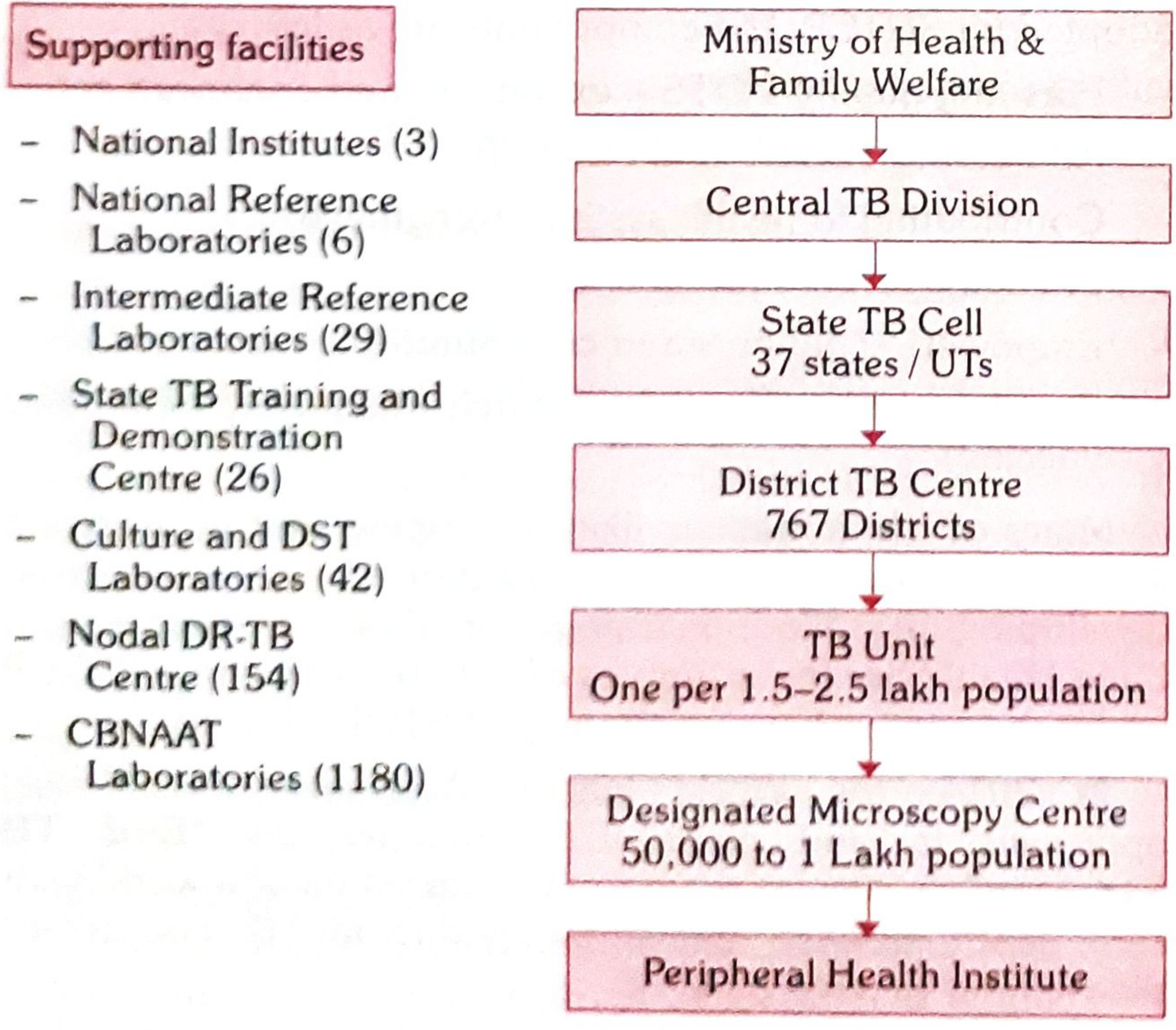
NTEP Organisational Structure
(5 levels - Park's PSM)
| Level | Structure |
|---|---|
| National | Central TB Division (CTD), MoHFW |
| State | State TB Cell (STC), State TB Officer (STO) - 37 states/UTs |
| District | District TB Centre (DTC) - 767 districts |
| Sub-district | TB Unit (TU) - 1 per 1.5-2.5 lakh population |
| Peripheral | Designated Microscopy Centre (DMC) - 1 per 50,000-1 lakh population |
National Supporting Institutions:
- National TB Institute (NTI), Bengaluru
- National Institute for Research in Tuberculosis (NIRT), Chennai
- NITRD, Delhi
- 6 National Reference Laboratories (NRLs)
- 29 Intermediate Reference Laboratories
- 1180 CBNAAT laboratories (covering all districts)
Case Classification (Treatment Categories)
| Category | Patients | Regimen |
|---|---|---|
| Category I | New cases (new sputum +ve, new severe EPTB) | 2HRZE + 4HR |
| Category II | Previously treated (relapse, failure, default) | 2HRZES + 1HRZE + 5HRE |
(Under NTEP, Category 2 has largely been phased out in favour of universal DST before treatment)
NTEP Current Regimens (updated):
| Type | Regimen |
|---|---|
| Drug-sensitive TB (DSTB) | 2HRZE + 4HRE (daily) |
| H mono-resistant / PDR-TB | 6-9 Lfx REZ |
| MDR-TB (shorter oral regimen) | 4-6 Bdq + Lfx + Eto + Cfz + Z + E + H, then 5 Z + E + Lfx + Cfz |
| MDR-TB (longer oral regimen) | 18-20 months: Bdq + Lfx + Lzd + Cfz + Cs |
Drug abbreviations: H=Isoniazid, R=Rifampicin, Z=Pyrazinamide, E=Ethambutol, S=Streptomycin, Lfx=Levofloxacin, Bdq=Bedaquiline, Lzd=Linezolid, Cfz=Clofazimine, Cs=Cycloserine, Eto=Ethionamide
Drug boxes are colour-coded: Red = Category I, Blue = Category II
Key Newer Initiatives under NTEP
- Daily regimen - Replaced thrice-weekly DOTS with daily dosing (better outcomes, less resistance)
- Universal Drug Susceptibility Testing (DST) - All TB cases tested before starting treatment; 1180 CBNAAT labs across all districts
- CBNAAT/TrueNat - Rapid molecular diagnosis for TB and drug resistance
- Bedaquiline - New drug for DR-TB; expanded from 2018; shorter all-oral regimen
- mBPaL regimen (Bedaquiline + Pretomanid + Linezolid) - 6-month regimen for MDR-TB; 80% success
- Active case finding - Systematic screening of high-risk groups (slums, tribal areas, prisons, orphanages, old age homes)
- Paediatric FDCs - Child-friendly fixed-dose combinations in 6 weight bands; daily dosing
NIKSHAY Portal
- NIKSHAY = Web-enabled application for monitoring universal access to TB patient data
- Mandatory TB notification in India since 7th May 2012 (legal backing under IPC 269 & IPC 270)
- Nikshay Aushadhi = logistics/supply chain system for anti-TB drugs (real-time stock visibility)
- All private providers must be registered on NIKSHAY
Patient Support Schemes
| Scheme | Benefit |
|---|---|
| Nikshay Poshan Yojana (NPY) | Rs. 500/month via DBT (Direct Benefit Transfer) for nutrition during treatment |
| Travel support | Rs. 750/- for tribal patients |
| Private practitioner incentive | Rs. 500/- for notification + Rs. 500/- for reporting treatment outcome |
| Treatment supporter honorarium | Rs. 1000/- to Rs. 5000/- |
Pradhan Mantri TB Mukt Bharat Abhiyaan (PMTBMBA)
- Launched in 2022 as part of NTEP
- Community-based initiative for "adoption" of TB patients - providing nutritional support kits monthly
- Crowdsourcing model: businesses, individuals, and organizations adopt TB patients
TB Burden in India (Key Stats for Exam)
- India has the highest TB burden globally (~27% of global cases)
- TB incidence: ~210/lakh population
- One untreated infectious TB patient can infect 10-15 persons/year
- Record TB notifications: 25.5 lakh (2023), 26.07 lakh (2024)
- MDR-TB patients in India: ~1.24 lakh
India vs WHO Targets (End TB Strategy 2030 vs India 2025)
| Indicator | India Target (2025) | SDG Global Target (2030) |
|---|---|---|
| TB incidence reduction | 80% | 80% |
| TB mortality reduction | 90% | 90% |
| Catastrophic costs | 0% | 0% |
High-Yield Points for Exam
- RNTCP renamed NTEP in January 2020
- Goal: TB-free India by 2025 (5 years ahead of SDG 2030 target)
- 4 pillars of NSP: Detect - Treat - Prevent - Build
- DOTS = 5 components (Political will, Microscopy, Drug supply, DOT, Monitoring)
- TB notification is mandatory since May 2012 (IPC 269/270 for violation)
- Nikshay Poshan Yojana: Rs. 500/month nutritional support
- CBNAAT covers all districts (1180 labs)
- Category I box = RED, Category II box = BLUE
- Bedaquiline introduced for DR-TB from 2018
- MDR-TB = resistance to both Isoniazid + Rifampicin
Source: Park's Textbook of Preventive and Social Medicine (PSM) - the standard reference for 3rd Part 1 MBBS Community Medicine; NTEP Wikipedia; ihatepsm.com NTEP notes
This is a shared conversation. Sign in to Orris to start your own chat.