I now have everything needed. Here is the full, detailed explanation of every topic in your CARTILAGE.ppt, organized by section and enriched with textbook content:
🦴 CARTILAGE - Complete Study Guide
Based on your 51-slide PPT, cross-referenced with Histology: A Text and Atlas (Pawlina & Ross, 9th ed.)
PART 1: OVERVIEW - What Is Cartilage?
Cartilage is a specialized connective tissue that gives the body structure and flexibility. It consists of two main components:
1. Cells
| Cell Type | Description |
|---|
| Chondroblasts | Immature, found near the surface / just beneath the perichondrium. Actively secrete matrix. |
| Chondrocytes | Mature cells; sit in small cavities called lacunae inside the matrix. Often grouped in isogenous groups (clusters from one parent cell dividing). |
Exam tip: Isogenous groups = multiple chondrocytes sharing one lacuna territory - they arise by mitotic division of a single progenitor.
2. Extracellular Matrix (ECM) - the bulk of cartilage (>95% of volume)
A. Fibers:
- Type II collagen - found in hyaline AND elastic cartilage (fine, not visible in H&E)
- Type I collagen - found in fibrocartilage (coarse bundles, visible in H&E)
- Elastic fibers - found only in elastic cartilage
B. Ground Substance:
- Rich in proteoglycans (especially aggrecan)
- Contains glycosaminoglycans (GAGs) like chondroitin sulfate and hyaluronic acid
- Highly hydrated → gives cartilage its resistance to compression
3. Fundamental Properties
- Avascular - no blood vessels inside the cartilage itself
- Aneural - no nerves or lymphatics
- Nutrients reach chondrocytes by diffusion through the matrix from:
- Capillaries in the perichondrium (for most cartilage)
- Synovial fluid (for articular cartilage)
- Because it is avascular, repair is very slow in adults
PART 2: THE MATRIX ZONES (3 Regions)
The ECM is NOT uniform. It is organized into three zones based on proximity to chondrocytes:
| Zone | Location | Contents | Staining |
|---|
| Capsular (pericellular) matrix | Ring immediately around each chondrocyte | Highest concentration of sulfated GAGs, type VI collagen, proteoglycans | Most basophilic (darkest) |
| Territorial matrix | Surrounds isogenous groups beyond capsular zone | Type II collagen, moderate proteoglycans | Moderately basophilic |
| Interterritorial matrix | Between groups of chondrocytes; largest zone | Rich in type II collagen fibers, lower proteoglycan concentration | Least basophilic (lightest/eosinophilic) |
Memory rule: Near cells = more proteoglycans = darker staining. Away from cells = more collagen = lighter staining.
PART 3: THE PERICHONDRIUM
Most cartilage (except articular cartilage and fibrocartilage) is surrounded by a perichondrium - a sheath of dense connective tissue.
Two layers:
1. Outer Fibrous Layer
- Contains collagen + fibroblasts
- Provides mechanical support and protection
- Contains blood vessels, nerves, lymphatics (the vascular supply for the avascular cartilage)
2. Inner Chondrogenic Layer
- Contains mesenchymal stem cells that differentiate into chondroblasts
- Responsible for appositional growth (see Part 5)
Exceptions - NO perichondrium:
- Articular cartilage (nourished by synovial fluid instead)
- Fibrocartilage
PART 4: THE THREE TYPES OF CARTILAGE
TYPE 1: HYALINE CARTILAGE
The most common type.
| Feature | Detail |
|---|
| Gross appearance | Bluish-white, translucent, "glassy" (hyalos = Greek for glass) |
| Collagen type | Type II (fine fibrils - NOT visible in H&E) |
| Perichondrium | Present (EXCEPT in articular cartilage and epiphyseal plates) |
| Calcification | Can calcify (especially during bone formation and with aging) |
| Matrix staining | Basophilic / metachromatic (blue-purple in H&E due to sulfated GAGs) |
Locations (memorize this list):
- Fetal skeleton (temporary scaffold)
- Epiphyseal growth plates (responsible for longitudinal bone growth)
- Articular surfaces of synovial joints
- Costal cartilages of ribs
- Cartilages of nasal cavity
- Larynx (thyroid, cricoid, arytenoid cartilages)
- Rings of trachea + bronchial plates
Histological identification - what to say on exams:
- Chondrocytes in lacunae (round cells in clear spaces)
- Isogenous groups visible
- No visible fibers (fibers too fine to see = "glassy" background)
- Matrix appears smooth and homogeneous
- Basophilic matrix (purple-blue in H&E)
- Perichondrium present at border
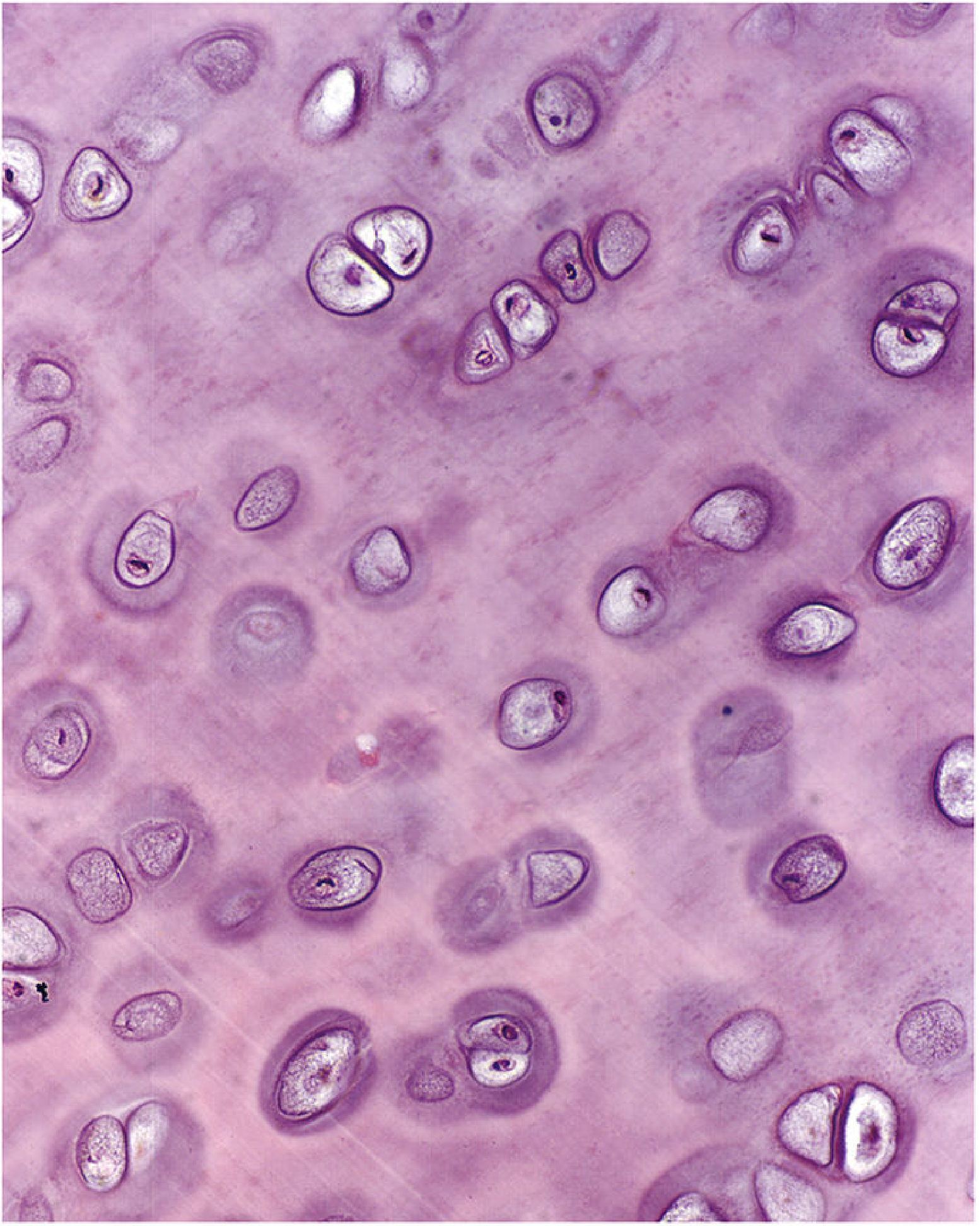
H&E of hyaline cartilage: sparse chondrocytes in lacunae surrounded by extensive basophilic matrix.
TYPE 2: ELASTIC CARTILAGE
Essentially hyaline + elastic fibers added.
| Feature | Detail |
|---|
| Gross appearance | Yellowish (due to elastin in elastic fibers) |
| Collagen type | Type II PLUS abundant elastic fibers |
| Perichondrium | Present |
| Calcification | Does NOT calcify with aging (key difference from hyaline!) |
| Matrix staining | Similar to hyaline but elastic fibers stain dark with special stains (orcein, resorcin-fuchsin) |
Locations (memorize - "EAR EEL"):
- External ear (pinna/auricle)
- Auditory (Eustachian) tube walls
- Respiratory: epiglottis, cuneiform cartilage of larynx
- External auditory canal
- Vocal folds
Histological identification:
- Chondrocytes in lacunae (like hyaline)
- Dense elastic fibers in matrix - appear wavy and dark-staining
- Perichondrium present
- Unlike fibrocartilage: NO thick collagen bundles; cells NOT in rows
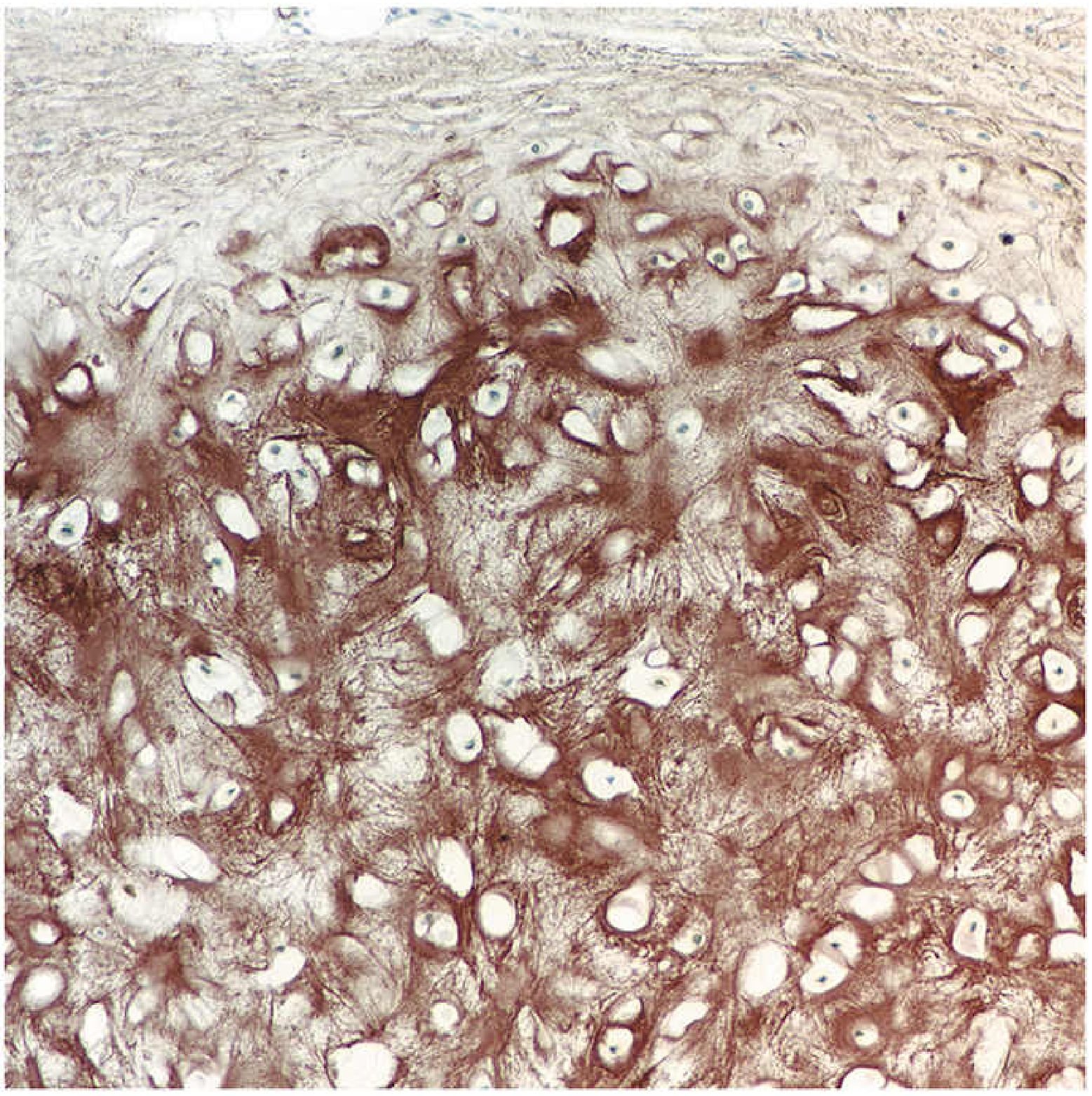
Elastic cartilage (epiglottis), orcein stain: dense brown elastic fibers fill the matrix. Perichondrium is the fibrous band at the top.
TYPE 3: FIBROCARTILAGE
A transition tissue between dense connective tissue and hyaline cartilage.
| Feature | Detail |
|---|
| Gross appearance | White, opaque, dense |
| Collagen type | Type I (coarse, abundant - UNLIKE hyaline/elastic) |
| Perichondrium | ABSENT |
| Calcification | Does not calcify |
| Matrix staining | Acidophilic (pink/eosinophilic in H&E - because of Type I collagen) |
| Cell arrangement | Chondrocytes in rows or small isogenous groups, often scattered among fibers |
Locations (memorize - "PPIMTK"):
- Intervertebral discs (annulus fibrosus)
- Pubic symphysis
- Menisci of the knee joint
- Temporomandibular joint (TMJ) discs
- Sternoclavicular joint discs
- Certain tendon insertions into bone
Why is it there? - In locations subjected to both compression and shearing forces (it acts as a shock absorber).
Histological identification:
- Chondrocytes in lacunae, arranged in rows between parallel collagen bundles
- Dense, wavy collagen bundles visible (unlike hyaline)
- No perichondrium
- Cells fewer and more elongated than in hyaline or elastic
- Matrix is acidophilic (pink, not blue)
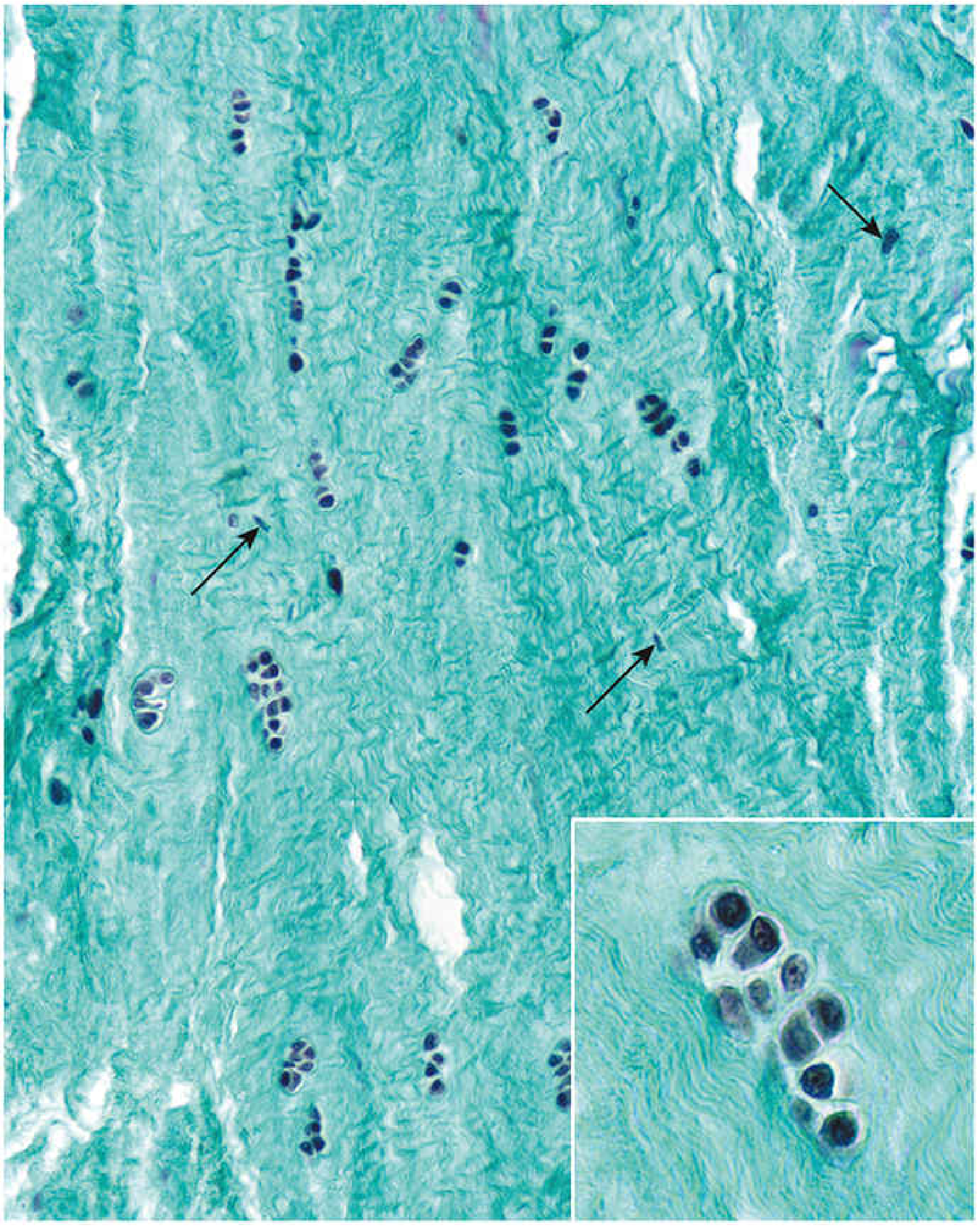
Fibrocartilage (intervertebral disc), Gomori trichrome: coarse collagen fibers (green) dominate; chondrocytes visible in rows and isogenous groups in lacunae.
COMPARISON TABLE - The Big Three (Exam Favorite)
| Feature | Hyaline | Elastic | Fibrocartilage |
|---|
| Collagen type | II | II + elastic fibers | I |
| Perichondrium | Yes | Yes | No |
| Matrix staining | Basophilic | Basophilic | Acidophilic |
| Visible fibers? | No (too fine) | Yes (elastic) | Yes (collagen bundles) |
| Calcifies? | Yes (aging) | No | No |
| Cell arrangement | Isogenous groups | Isogenous groups | Rows |
| Key locations | Joints, trachea, growth plate | Ear, epiglottis | Discs, menisci, symphysis |
PART 5: GROWTH OF CARTILAGE
Two mechanisms - this is a classic exam question:
1. Appositional Growth ("Add on top" = grows from outside)
- Source: Stem cells in the inner chondrogenic layer of the perichondrium
- Stem cells → chondroblasts → secrete matrix → become chondrocytes
- Effect: Increases thickness/width of cartilage
- Requires: Perichondrium
- Occurs in: Most cartilage that has a perichondrium (hyaline, elastic)
2. Interstitial Growth ("Inside expansion" = grows from within)
- Source: Existing chondrocytes divide by mitosis inside the matrix
- Daughter cells form isogenous groups and secrete new matrix pushing them apart
- Effect: Increases length/volume of cartilage
- Does NOT require perichondrium
- Occurs in: Especially important in early development and articular cartilage (which lacks perichondrium)
Comparison Table:
| Feature | Appositional | Interstitial |
|---|
| Source | Perichondrium stem cells | Existing chondrocytes |
| Direction | Outward (surface) | Internal (within) |
| Effect | Thickness ↑ | Length/volume ↑ |
| Requires perichondrium | Yes | No |
Important notes:
- Cartilage growth is limited in adults
- Avascular nature = slow repair
- Damage can lead to degeneration → Osteoarthritis
PART 6: ARTICULAR CARTILAGE - 4 Zones (Exam Frequent)
Articular cartilage is a special form of hyaline cartilage that has NO perichondrium and is organized into 4 zones:
Zone 1: Superficial (Tangential) Zone
- Thinnest, outermost layer
- Flattened chondrocytes
- Collagen fibers run parallel to the surface
- Highest water content
- Function: reduces friction, resists shear stress
Zone 2: Middle (Transitional) Zone
- Thicker than superficial layer
- Round chondrocytes
- Collagen fibers arranged obliquely
- Function: transition between surface and deeper layers, absorbs compressive forces
Zone 3: Deep (Radial) Zone
- Largest zone
- Chondrocytes arranged in columns (perpendicular to surface)
- Collagen fibers run perpendicular to surface
- Function: strongest resistance to compression
Zone 4: Calcified Cartilage Zone
- Deepest layer
- Matrix is calcified (mineralized)
- Anchors cartilage to underlying bone
- Separated from Zone 3 by the "Tidemark" (a basophilic/dark-staining line visible under microscope)
Memory trick: "Flat - Round - Columns - Calcified" (surface → bone)
Tidemark = the histological dividing line between soft and calcified cartilage. Clinically important in osteoarthritis because the tidemark advances as disease progresses.
PART 7: HISTOGENESIS - Where Does Cartilage Come From?
Cartilage derives from mesenchyme (embryonic connective tissue). The sequence:
- Mesenchymal cells proliferate (mitosis) → highly cellular tissue
- Cells round up and begin differentiating into chondroblasts (this is chondrification)
- Chondroblasts secrete matrix, becoming separated from each other
- Chondroblasts become chondrocytes (trapped in their own matrix = lacunae)
- Chondrocytes divide → form isogenous groups each surrounded by territorial (capsular) matrix
PART 8: HISTOLOGICAL STAINS FOR CARTILAGE (Exam!)
| Stain | What it shows |
|---|
| H&E (Hematoxylin & Eosin) | Routine stain: cell nuclei blue-purple; matrix pinkish with bluish areas where proteoglycan content is high |
| Safranin O | Specifically stains cartilage matrix (GAGs) orange-red |
| Orcein / Resorcin-fuchsin | Stains elastic fibers dark (used to identify elastic cartilage) |
| van Gieson / Goldner's trichrome / Gomori trichrome | Stains collagen fibers (for fibrocartilage identification) |
| von Kossa | Used for calcified/mineralized tissues |
Key H&E fact: Hyaline and elastic cartilage matrix appears basophilic (blue-purple) due to sulfated GAGs. Fibrocartilage matrix appears acidophilic (pink) because Type I collagen dominates.
PART 9: QUICK CLINICAL PEARLS
| Condition | Mechanism | Relevant cartilage |
|---|
| Osteoarthritis | Progressive breakdown of articular cartilage; avascular nature = poor repair capacity; tidemark advances | Articular (hyaline) |
| Chondrosarcoma | Malignant tumor of cartilage cells (chondrocytes); produces cartilage matrix | Usually hyaline |
| Poor cartilage healing | Avascular = nutrients only by diffusion = slow cell turnover | All types |
MASTER SUMMARY - The "Must Know" List for Exams
- Cartilage = chondrocytes + ECM (Type II collagen + proteoglycans/GAGs)
- Three types: Hyaline (Type II, most common), Elastic (Type II + elastic fibers, yellowish), Fibrocartilage (Type I, acidophilic, no perichondrium)
- Avascular + aneural → nutrients by diffusion → slow repair
- Perichondrium = fibrous outer + chondrogenic inner layer; ABSENT in articular cartilage and fibrocartilage
- Appositional growth (from perichondrium, increases thickness) vs. Interstitial growth (from within, increases length)
- Articular cartilage zones: Superficial (flat cells, parallel fibers) → Middle (round cells, oblique fibers) → Deep (columnar cells, perpendicular fibers) → Calcified (tidemark marks the boundary)
- ECM zones: Capsular (most basophilic) → Territorial → Interterritorial (least basophilic)
- Stains: H&E (routine), Safranin O (GAGs), Orcein (elastic fibers), Gomori trichrome (collagen)
- Elastic cartilage does NOT calcify with aging (unlike hyaline)
- Fibrocartilage is acidophilic (Type I collagen, matrix stains pink) and has cells in rows
- Histology: A Text and Atlas with Correlated Cell and Molecular Biology (Pawlina & Ross), Ch. 7, pp. 548-570