
Can fentanyl cause urinary retention
Yes, fentanyl can cause urinary retention. Like all opioids, fentanyl acts on mu-opioid receptors in the spinal cord and bladder, reducing detrusor muscle contractility and increasing urethral sphincter tone - both of which can impair normal voiding.
Searching sources...
Reading File
Searching the Web
fentanyl urinary retention mechanism opioid
Finding Sources
Finding Sources
Reading File
Reading File
Reading File
Yes - fentanyl can absolutely cause urinary retention. Here is a thorough breakdown backed by authoritative textbook sources:
Fentanyl and Urinary Retention
Mechanism
Fentanyl, like all mu-opioid receptor (MOR) agonists, interferes with normal bladder function through several pathways:
- Inhibition of the voiding reflex - MOR agonists suppress the spinal and supraspinal circuits that trigger detrusor (bladder wall muscle) contraction during micturition.
- Reduced detrusor contractility - Fentanyl specifically has been shown to decrease detrusor contraction force. One urodynamic study comparing IV morphine, buprenorphine, fentanyl, and nalbuphine found that detrusor contraction decreased only after fentanyl and buprenorphine - not all opioids behave identically here.
- Increased sphincter tone - Therapeutic opioid doses increase ureteral and bladder outlet sphincter tone, making it harder to initiate voiding.
- Blunted sensation of bladder fullness - Opioids raise the threshold for sensing a full bladder, so patients don't feel the urge to void even as the bladder fills.
These effects are mediated by both MOR and delta-opioid receptors in the brain and spinal cord, though peripheral mechanisms (at the bladder itself) also play a role - evidenced by the fact that methylnaltrexone (a peripherally restricted opioid antagonist) can reverse opioid-induced urinary retention.
(Miller's Anesthesia 10e, p. 2785; Firestein & Kelley's Textbook of Rheumatology; Katzung's Basic & Clinical Pharmacology 16e)
When Is It Most Likely?
- Intrathecal/epidural fentanyl carries the highest risk - direct spinal cord exposure produces more pronounced and prolonged urinary retention. This is why bladder catheterization is standard practice for surgeries using intrathecal opioids.
- IV fentanyl infusions (e.g., remifentanil at 0.15 mcg/kg/min) have also been documented to cause urinary retention.
- Postoperative patients are particularly vulnerable - the incidence of opioid-related urinary retention in postoperative adults is approximately 25%.
- Elderly men with BPH and anyone with pre-existing outflow obstruction are at higher risk.
Reversal
- Naloxone (0.01 mg/kg IV) and methylnaltrexone (0.3 mg/kg IV) can reverse fentanyl-induced urinary retention. However, low-dose naloxone must be used carefully - one study found that naloxone used to treat urinary retention during epidural fentanyl caused excessive reversal of analgesia.
- Nalbuphine (a partial opioid antagonist) has also been used at low doses.
- Mechanical catheterization is sometimes necessary if pharmacologic reversal is not feasible.
Clinical Context
Fentanyl-induced urinary retention appears as a listed adverse effect in multiple major references:
- Tintinalli's Emergency Medicine lists urinary retention explicitly among opioid adverse effects, noting it is more common with IV, transmucosal, and epidural routes.
- The Essentials of Forensic Medicine and Toxicology (2026 edition) lists urinary retention among adverse effects of opiates/opioids.
- Campbell-Walsh-Wein Urology describes opioid-related bladder dysfunction as "an important issue well studied in postoperative patients."
In summary: yes, fentanyl causes urinary retention through mu-opioid receptor-mediated suppression of the voiding reflex, reduced detrusor contractility, increased sphincter tone, and impaired sensation of bladder fullness. The risk is highest with neuraxial (spinal/epidural) routes and in postoperative settings.
Ketamine?
Ketamine has a different profile from opioids regarding urinary effects. Acutely, it tends to increase bladder tone (sympathomimetic properties), but chronic/heavy use is strongly associated with severe ketamine-induced uropathy - a distinct and serious condition.
Searching sources...
Finding Sources
Searching the Web
ketamine urinary retention bladder dysfunction mechanism acute vs chronic
Finding Sources
Finding Sources
Reading File
Reading File
Reading File
The ketamine-bladder story is quite different from fentanyl's. Here is the full picture:
Ketamine and Urinary Effects
Acute Use - Does It Cause Urinary Retention?
Ketamine (an NMDA receptor antagonist) has sympathomimetic properties that actually tend to increase bladder and urethral tone acutely - the opposite direction from opioids. Acute urinary retention as a direct pharmacologic effect of ketamine is not well-documented in the same way as opioid-induced retention. However, the far more clinically significant urinary complication of ketamine is chronic:
Chronic Use - Ketamine Cystitis (Ketamine-Induced Uropathy)
This is the major urinary concern with ketamine. Up to 30% of long-term ketamine abusers develop ketamine cystitis - a serious, potentially irreversible condition.
Mechanism:
Ketamine and/or its urinary metabolites (e.g., hydroquinone) appear to directly damage the urothelium. Specific pathologies identified include:
- Bladder barrier dysfunction
- Neurogenic inflammation
- IgE-mediated inflammation
- Overexpression of apoptotic and carcinogenic genes
- Nitric oxide synthase-mediated inflammation
- Microvascular endothelial injury (via NMDA receptor activation in vessel walls)
The severity correlates with duration of abuse.
(Campbell-Walsh-Wein Urology; Bailey & Love's Surgery 28e)
Symptoms (mimic interstitial cystitis/BPS):
- Severe urinary frequency and urgency
- Dysuria and suprapubic/pelvic pain
- Urge incontinence
- Gross hematuria (in advanced cases)
Progression:
- Early: lower urinary tract symptoms (LUTS) only
- Intermediate: dysuria, worsening frequency, hematuria, pelvic pain
- Advanced: irreversible bladder wall fibrosis, bladder contracture (very small bladder capacity), ureteric stricture, bilateral hydronephrosis, and renal dysfunction
A CT image from Bailey & Love's Surgery illustrates exactly this - a thickened, contracted bladder with bilateral hydroureteronephrosis:
(Bailey & Love's Short Practice of Surgery 28e, p. 83.33)
Loading Image
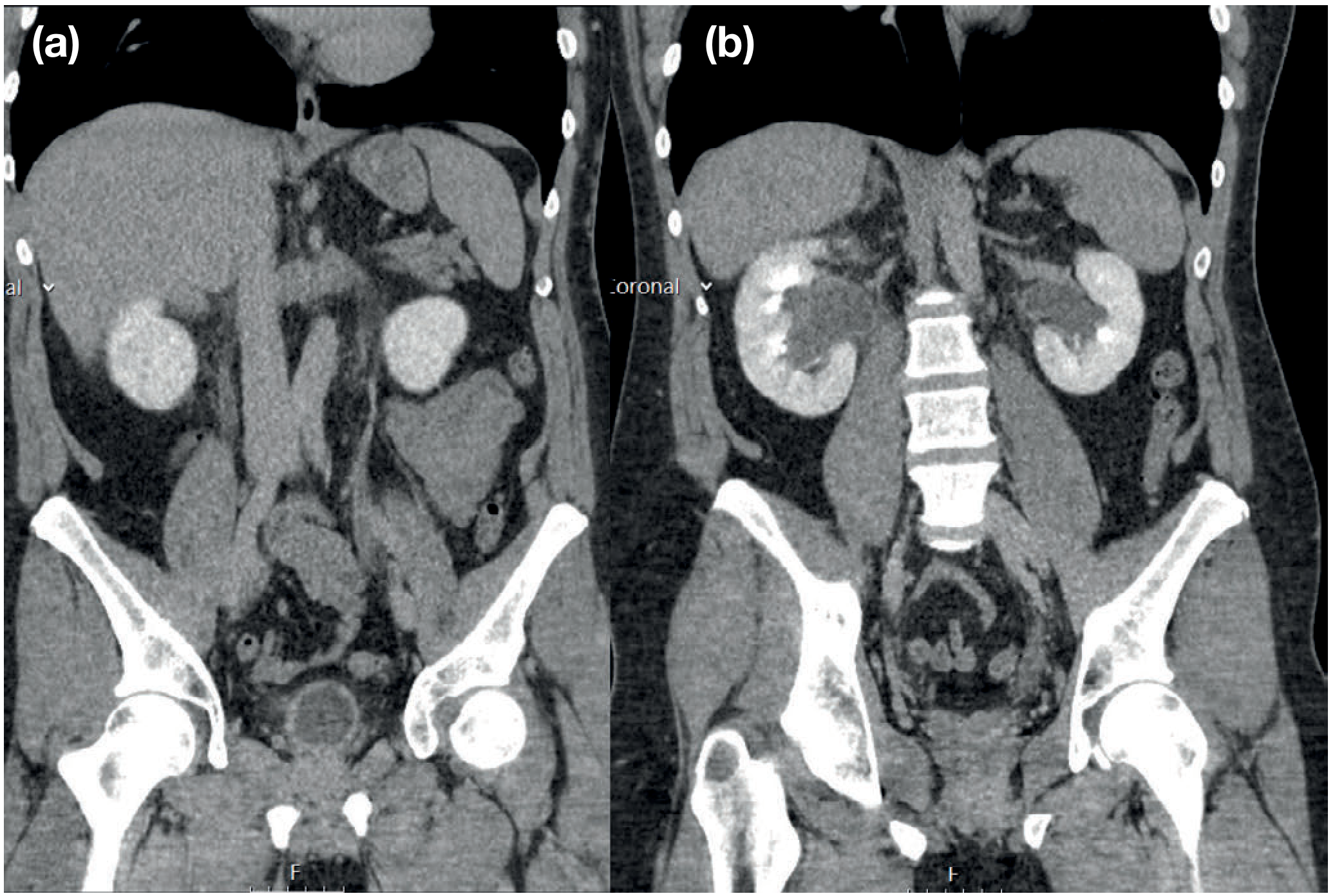
CT showing thickened bladder (a) and bilateral hydroureteronephrosis (b) secondary to ketamine cystitis. - Bailey & Love's Surgery 28e
Management
| Stage | Management |
|---|---|
| All stages | Cessation of ketamine - the single most important step; surgical intervention should not be performed in active users |
| Upper tract obstruction | Ureteric stenting or nephrostomy |
| Persistent LUTS after cessation | Anticholinergics, intravesical treatments |
| Severely contracted bladder (<300 mL) with irreversible changes | Partial cystectomy + augmentation enterocystoplasty |
Key Contrast with Fentanyl
| Feature | Fentanyl | Ketamine |
|---|---|---|
| Mechanism | MOR agonism - reduced detrusor contraction, increased sphincter tone | NMDA receptor blockade - direct urothelial toxicity from metabolites |
| Main urinary problem | Urinary retention (can't void) | Frequency, urgency, pain (can't hold urine) - retention is a late/structural complication |
| Onset | Acute (during/after dosing) | Chronic (weeks to years of use) |
| Reversibility | Fully reversible with naloxone/time | Potentially irreversible if fibrosis has developed |
| Incidence | ~25% postoperative | Up to ~30% of chronic abusers |
So to directly answer your question: ketamine does not typically cause acute urinary retention the way fentanyl does. Instead, chronic ketamine use leads to a destructive cystitis where the dominant symptoms are frequency, urgency, and pain - though in very advanced disease, a contracted fibrotic bladder with ureteric obstruction can ultimately impair the entire urinary tract, including voiding.
This is a shared conversation. Sign in to Orris to start your own chat.