
Describe clinical features, morphology , diagnostic approach in lung tumours
Reading File
Now let me search the medical library for comprehensive coverage of lung tumours across multiple dimensions simultaneously.
Finding Sources
Searching PubMed
lung cancer classification diagnosis morphology
Good. Now let me search for the most relevant pathology sections and read the primary sources in parallel.
Finding Sources
Finding Sources
Excellent. Now let me read the core pathology sections from Robbins and Murray & Nadel in parallel.
Reading File
Reading File
Reading File
Excellent content. Now let me read the detailed morphology sections and diagnostic approach from Robbins (the main Pathologic Basis) and Murray & Nadel in parallel.
Reading File
Reading File
I have very rich content. Let me now fetch the key histopathology images and read more of the Murray & Nadel diagnostic section for the complete diagnostic approach.
Loading Image
Reading File
Reading File
I now have extensive material. Let me also get the clinical features and paraneoplastic sections from Robbins, plus the small cell carcinoma pathology image.
Finding Sources
Finding Sources
Reading File
Reading File
I now have comprehensive material from authoritative textbooks. Let me get the detailed morphology section from Robbins block 7 (the main lung carcinoma morphology) and a second histology image.
Reading File
Loading Image
I now have comprehensive data from multiple authoritative textbooks. Let me compile the complete, well-structured answer.
Lung Tumours: Clinical Features, Morphology, and Diagnostic Approach
1. Epidemiology and Overview
Lung cancer is the most frequently diagnosed major cancer and the leading cause of cancer mortality worldwide. Globally in 2022, an estimated 2.5 million new cases were diagnosed with 1.8 million deaths. It is generally a disease of older adults (peak incidence 65-74 years), and each year kills more people than colon, breast, and prostate cancer combined.
Of all lung tumours:
- 90-95% are carcinomas
- ~5% are carcinoid tumours
- 2-5% are mesenchymal and other miscellaneous neoplasms
2. WHO Classification of Lung Tumours (2015)
| Category | Subtypes |
|---|---|
| Adenocarcinoma | Lepidic, Acinar, Papillary, Micropapillary, Solid, Invasive mucinous, Colloid, Fetal, Enteric, AIS, Minimally invasive |
| Squamous cell carcinoma | Keratinizing, Nonkeratinizing, Basaloid, SCC in situ |
| Neuroendocrine tumours | Small cell carcinoma, Large cell neuroendocrine carcinoma, Carcinoid, DIPNECH |
| Large cell carcinoma | - |
| Other | Adenosquamous, Sarcomatoid, Salivary gland-type, Papillomas, Adenomas, Mesenchymal, Lymphohistiocytic |
The three most common histologic subtypes - adenocarcinoma, squamous cell carcinoma, and small cell carcinoma - together account for approximately 85% of all lung cancer cases.
The historically important clinical distinction is SCLC vs NSCLC, because SCLC almost always presents at advanced (metastatic) stage and is best managed with chemotherapy, rarely surgery. More precise NSCLC subclassification has become critical due to targeted therapies.
3. Etiology and Risk Factors
- Cigarette smoking: ~80% of lung cancers; risk is 60x greater in heavy smokers (2 packs/day for 20 years) vs non-smokers. Almost all SCLCs are smoking-related. Adenocarcinoma is the most common subtype in both smokers and non-smokers.
- Secondhand smoke: ~3,000 non-smoking adult deaths/year in the US
- Industrial hazards: Asbestos (synergistic with smoking for mesothelioma and lung carcinoma), uranium, radon, polycyclic aromatic hydrocarbons, nickel, chromium
- Genetic factors: P-450 monooxygenase variants, DNA repair gene variants, driver mutations (EGFR, ALK, ROS1, KRAS, MET)
- Air pollution: Outdoor and indoor pollution (radon in homes)
4. Clinical Features
Local / Regional Symptoms
| Symptom | Mechanism |
|---|---|
| Cough | Bronchial irritation/obstruction |
| Hemoptysis | Mucosal invasion |
| Wheezing / stridor | Partial airway obstruction |
| Dyspnea | Obstruction, effusion, atelectasis |
| Post-obstructive pneumonia | Impaired drainage, recurrent infections |
| Chest pain | Pleural/chest wall invasion |
Superior Sulcus (Pancoast) Tumour
Apical tumours invading neural structures around the trachea, including the cervical sympathetic plexus, produce:
- Severe pain in the ulnar nerve distribution
- Horner syndrome (enophthalmos, ptosis, miosis, anhidrosis) ipsilaterally
Superior Vena Cava Syndrome
Compression or invasion of the SVC causes:
- Venous congestion and oedema of the head, neck, and arms
- Ultimately, circulatory compromise
Metastatic Spread
Common sites: regional lymph nodes, adrenals, liver, brain, bone, kidney, contralateral lung.
5. Paraneoplastic Syndromes
Particularly common with SCLC (a neuroendocrine tumour). Key syndromes:
| Syndrome | Mediator | Tumour Type |
|---|---|---|
| SIADH (hyponatraemia) | Ectopic ADH/vasopressin | SCLC, squamous |
| Cushing syndrome | Ectopic ACTH (POMC) | SCLC, bronchial carcinoid, adenocarcinoma |
| Hypercalcaemia | PTHrP | Squamous cell carcinoma |
| Lambert-Eaton myasthenic syndrome | Autoantibodies vs. presynaptic Ca²⁺ channels | SCLC |
| Peripheral neuropathy | Paraneoplastic antibodies | SCLC |
| Hypertrophic pulmonary osteoarthropathy | Unknown | Various (clubbing of fingers) |
| Acanthosis nigricans | - | Various |
| Trousseau syndrome | Hypercoagulable state | Various |
| Leukemoid reaction | Haematologic | Various |
In ectopic ACTH production, hormone is unregulated (lacks normal feedback control) and may be incompletely processed (large POMC precursor released).
6. Morphology of Major Subtypes
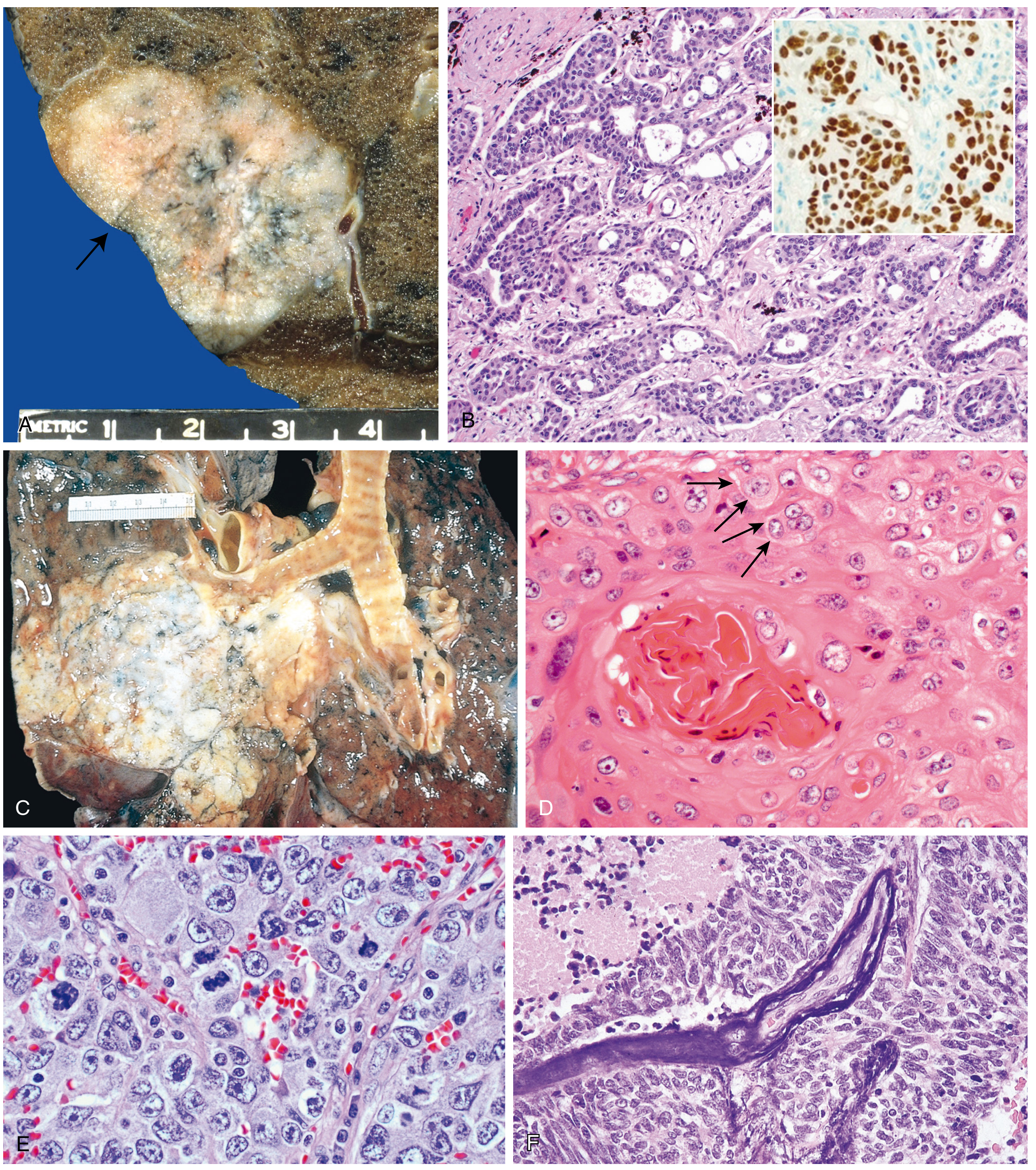
A. Adenocarcinoma (~40% of all lung cancers)
Location: Peripheral lung parenchyma, arises from terminal respiratory unit (acinus).
Precursor lesion: Atypical adenomatous hyperplasia → adenocarcinoma in situ (AIS) → minimally invasive → invasive.
Gross morphology:
- Peripheral grey-white mass, often with pleural puckering due to desmoplastic fibrosis
- Central scar with anthracotic pigments characteristic
Histology:
- Gland-forming (acinar), papillary, micropapillary, solid, or lepidic patterns
- Lepidic growth: tumour cells spread along pre-existing alveolar walls without stromal invasion - the only truly non-invasive pattern
- AIS (formerly bronchioloalveolar carcinoma): ≤3 cm, pure lepidic growth, no stromal, vascular, or pleural invasion
- Mucin production common
Immunohistochemistry (IHC):
- TTF-1 (thyroid transcription factor-1) positive - highly characteristic
- CK7 positive
- Napsin A positive
Molecular markers: EGFR mutations (most common targetable mutation), ALK rearrangements, ROS1, KRAS, MET amplification
B. Squamous Cell Carcinoma (~25-30%)
Location: Central (hilar), arises from large bronchi.
Precursor lesion: Squamous metaplasia → dysplasia → carcinoma in situ → invasive (best-documented sequence).
Gross morphology:
- Central / hilar mass, often bulky
- Cavitation common (central necrosis)
- Extends into bronchial lumen, causing obstruction
Histology:
- Keratinization: keratin pearls (whorls of eosinophilic keratin), individual cell keratinization
- Intercellular bridges (desmosomes) between cells
- Basaloid variant: smaller cells, peripheral palisading
- Nonkeratinizing variant: lacks obvious keratin but shows squamoid cytology
IHC:
- p40 / p63 positive (squamous markers)
- CK5/6 positive
- TTF-1 negative
Molecular: PTHrP production (hypercalcaemia), FGFR1 amplification, DDR2 mutations
C. Small Cell Carcinoma (SCLC, ~15%)
Location: Usually central, arising near large bronchi.
Gross morphology:
- Soft, white-grey perihilar/central mass
- Extensive mediastinal involvement is characteristic
- Areas of haemorrhage and necrosis
Histology - highly distinctive:
- Small cells (slightly larger than lymphocytes), scant cytoplasm
- "Oat cell" appearance: oval/fusiform, moulded cells
- Finely granular "salt-and-pepper" chromatin (neuroendocrine chromatin pattern)
- Absent or inconspicuous nucleoli
- Nuclear moulding
- Extensive necrosis
- Azzopardi effect: basophilic encrustation of vascular walls by DNA from necrotic tumour cells (pathognomonic finding)
- High mitotic rate
- Combined SCLC: SCLC mixed with NSCLC elements (large cell neuroendocrine carcinoma or spindle cell morphology)
IHC:
- Synaptophysin, chromogranin, CD56 positive (neuroendocrine markers)
- TTF-1 positive (~90%)
- Ki-67 very high (>50-80%)
- Dot-like perinuclear CAM5.2 staining
D. Large Cell Carcinoma (~5-10%)
A diagnosis of exclusion - undifferentiated carcinoma without squamous, glandular, or neuroendocrine features on light microscopy.
Histology:
- Sheets of large, pleomorphic cells
- Prominent nucleoli
- Abundant cytoplasm
- No gland formation, keratinization, or neuroendocrine features
Large Cell Neuroendocrine Carcinoma (LCNEC):
- Large cell morphology WITH neuroendocrine architecture (organoid nesting, palisading, rosettes, trabeculae)
- IHC: neuroendocrine markers positive
- High mitotic rate (>10/2mm²)
- Behaves aggressively, similar to SCLC
E. Carcinoid Tumours (1-5%)
- Occur in younger patients (<60 years), equal sex incidence
- Not associated with smoking
- Arise from neuroendocrine cells (Kulchitsky cells)
- Typical carcinoid: low-grade, central, uniform round cells with stippled chromatin, organoid pattern
- Atypical carcinoid: intermediate grade, 2-10 mitoses/2mm², necrosis
- May produce carcinoid syndrome (serotonin, bradykinin)
- IHC: synaptophysin, chromogranin, CD56 positive
7. Secondary Pathology of Lung Carcinoma
- Partial obstruction: focal emphysema
- Total obstruction: atelectasis
- Impaired drainage: bronchitis, bronchiectasis, pulmonary abscess
- Pleural extension: pleuritis, malignant effusions
- Pericardial extension: pericarditis, tamponade
- Lymphatic blockage: lymphangitis carcinomatosis
8. Staging
TNM staging (AJCC/UICC 8th edition) applies to lung carcinomas:
| Stage | Description |
|---|---|
| Stage I | Localised tumour, no nodal involvement |
| Stage II | Nodal involvement (hilar/ipsilateral) |
| Stage III | Extensive nodal/mediastinal involvement (unresectable) |
| Stage IV | Distant metastases |
Note: SCLC is traditionally staged as limited disease (confined to one hemithorax, treatable within a single radiation port) vs extensive disease (spread beyond one hemithorax, including malignant pleural/pericardial effusion).
9. Diagnostic Approach
Step 1 - Clinical Assessment
- Symptoms (cough, haemoptysis, weight loss, dyspnoea, pain)
- Risk factors (smoking history in pack-years, occupational/environmental exposure)
- Signs of local invasion (SVC syndrome, Horner's, Pancoast)
- Paraneoplastic manifestations
Step 2 - Imaging
| Modality | Use |
|---|---|
| Chest X-ray | Initial screen; central mass, hilar enlargement, atelectasis, pleural effusion |
| CT chest/abdomen/pelvis | Tumour size, location, mediastinal and nodal involvement, adrenal/liver mets |
| PET-CT | Metabolic staging, detects occult metastases, guides biopsy |
| MRI brain | Brain metastases (especially SCLC, adenocarcinoma) |
| CT-guided needle biopsy | Peripheral lesions |
Step 3 - Tissue Sampling
| Method | Best For |
|---|---|
| Bronchoscopy + BAL/brushings/biopsy | Central tumours, endobronchial disease |
| EBUS-TBNA (Endobronchial ultrasound-guided transbronchial needle aspiration) | Mediastinal/hilar lymph nodes, central masses |
| CT-guided core needle biopsy | Peripheral lesions |
| Sputum cytology | Squamous cell carcinoma (orange-staining keratinised cells) |
| Thoracentesis / pleural biopsy | Malignant effusions |
| Surgical resection / VATS wedge | Peripheral nodules, definitive staging |
Rapid on-site evaluation (ROSE) of FNA samples is standard practice to ensure adequacy and guide real-time sample handling.
Step 4 - Histopathological Evaluation
The main objective is histologic and molecular classification:
- H&E morphology: Identify gland formation (adenocarcinoma), keratinisation (SCC), small cell features, or undifferentiated large cells
- IHC panel for NSCLC subtyping:
| Marker | Positive in | Negative in |
|---|---|---|
| TTF-1 | Adenocarcinoma, SCLC | SCC |
| p40 / p63 | Squamous cell carcinoma | Adenocarcinoma |
| CK7 | Adenocarcinoma | SCC (usually) |
| CK5/6 | Squamous | Adenocarcinoma |
| Synaptophysin / Chromogranin / CD56 | SCLC, LCNEC, Carcinoid | Non-neuroendocrine |
| Ki-67 | High in SCLC (>50%) | Low in typical carcinoid (<5%) |
| Napsin A | Adenocarcinoma | - |
- Molecular/Biomarker testing (mandatory in NSCLC):
| Biomarker | Significance | Targeted Therapy |
|---|---|---|
| EGFR mutation | Mostly adenocarcinoma | Erlotinib, Osimertinib |
| ALK rearrangement | Adenocarcinoma, non-smokers | Crizotinib, Alectinib |
| ROS1 rearrangement | Adenocarcinoma | Crizotinib |
| KRAS G12C | Adenocarcinoma | Sotorasib, Adagrasib |
| MET exon 14 skipping | Adenocarcinoma | Tepotinib, Capmatinib |
| PD-L1 expression | All NSCLC | Pembrolizumab (immunotherapy) |
| BRAF V600E | Adenocarcinoma | Dabrafenib + Trametinib |
- Liquid biopsy (ctDNA): Used when tissue is insufficient, for monitoring, and resistance mutation detection
Step 5 - Final Integrated Diagnosis
A modern lung cancer diagnosis includes:
- Histologic subtype (e.g., adenocarcinoma, lepidic-predominant)
- Pathologic stage (pTNM)
- Molecular profile (EGFR/ALK/ROS1/KRAS/PD-L1 status)
- Resection margin status (if surgical specimen)
- Treatment response assessment (if post-neoadjuvant)
10. Key Differentiating Features at a Glance
| Feature | Adenocarcinoma | SCC | SCLC | Carcinoid |
|---|---|---|---|---|
| Location | Peripheral | Central | Central | Central |
| Smoking link | Both (highest in non-smokers) | Strong | Almost all | None |
| Gross | Grey-white peripheral mass, scar | Central cavitating mass | Central, necrotic | Polypoid bronchial |
| Histology | Glands, lepidic, TTF-1+ | Keratin pearls, bridges, p40+ | Oat cells, Azzopardi, synaptophysin+ | Uniform cells, organoid |
| Paraneoplastic | PTHrP (rare) | PTHrP, hypercalcaemia | ACTH, SIADH, Lambert-Eaton | Carcinoid syndrome |
| Prognosis | Variable (stage/mutation) | Better if early, central | Worst overall | Best (typical) |
Sources:
- Robbins, Cotran & Kumar - Pathologic Basis of Disease, pp. 667-674
- Murray & Nadel's Textbook of Respiratory Medicine, Chapter 22
- Harrison's Principles of Internal Medicine, 22e - Chapter 98 (Paraneoplastic Syndromes)
- Robbins & Kumar Basic Pathology
This is a shared conversation. Sign in to Orris to start your own chat.