
Flexor retinaculum
Reading File
Finding Sources
Searching the Web
flexor retinaculum anatomy wrist hand
Reading File
Reading File
Reading File
Finding Sources
Reading File
Reading File
Reading File
Reading File
Loading Image
Loading Image
Here is a complete overview of the flexor retinaculum, covering both its locations in the body - the wrist (hand) and the ankle (foot).
Flexor Retinaculum
The term "flexor retinaculum" refers to two distinct fibrous bands - one at the wrist and one at the ankle - each forming an osteofibrous tunnel that retains flexor tendons and neurovascular structures.
1. Flexor Retinaculum of the Wrist (Hand)
Structure and Components
The flexor retinaculum (also called the transverse carpal ligament) is a thick, strong fibrous band on the palmar (volar) aspect of the wrist. It is actually composed of three parts:
- Proximal portion - a thin layer continuous with the deep antebrachial (forearm) fascia, with longitudinally oriented fibers
- Middle portion (transverse carpal ligament proper) - the main part, with transversely and obliquely oriented fibers; this is the most clinically significant component
- Distal portion - an aponeurosis extending between the thenar and hypothenar eminences, with transversely oriented fibers that blend into the thenar and hypothenar musculature
(Imaging Anatomy: Bones, Joints, Vessels and Nerves, Vol. 3)
Attachments
The flexor retinaculum bridges the concave palmar arch of the carpal bones, attaching to four bony points:
| Side | Attachment |
|---|---|
| Lateral (radial) | Tubercle of the scaphoid + ridge of the trapezium |
| Medial (ulnar) | Pisiform + hook of the hamate |
On the radial side, the retinaculum splits: its deeper lamina attaches to the medial aspect of the trapezial groove, converting it into a synovial-lined tunnel for the flexor carpi radialis (FCR) tendon.
Surface Landmarks
- Proximal margin - an imaginary line between the pisiform (palpable at the distal end of the flexor carpi ulnaris tendon) and the tubercle of the scaphoid (palpable at the distal end of the FCR tendon)
- Distal margin - approximately deep to the point where the anterior margin of the thenar eminence meets the hypothenar eminence near the base of the palm
(Gray's Anatomy for Students)
The Carpal Tunnel
By bridging the carpal arch, the flexor retinaculum forms the anterior wall (roof) of the carpal tunnel; the carpal bones form the floor and sides. The tunnel's narrowest cross-sectional area is approximately 1.6 cm².
Contents of the carpal tunnel (9 tendons + 1 nerve):
- 4 tendons of flexor digitorum superficialis (FDS)
- 4 tendons of flexor digitorum profundus (FDP)
- 1 tendon of flexor pollicis longus (FPL)
- Median nerve (anterior to the tendons)
The FDS and FDP tendons share a single common synovial sheath; FPL has its own separate synovial sheath.
Structures Passing Anterior to the Retinaculum (NOT through the tunnel)
- Ulnar artery and nerve (pass through Guyon's canal, formed between the superficial and deep fascial layers on the ulnar side)
- Tendon of palmaris longus
- Palmar cutaneous branch of the median nerve
(Gray's Anatomy for Students)
Function
The flexor retinaculum holds the flexor tendons against the wrist, preventing tendon bowstringing during wrist flexion.
Clinical Relevance: Carpal Tunnel Syndrome (CTS)
CTS is an entrapment neuropathy caused by compression of the median nerve within the carpal tunnel. The cross-sectional area of the tunnel is very small, so any swelling, tenosynovitis, or structural change compresses the nerve.
- Symptoms: pain, paresthesia (classic distribution - thumb, index, middle, and radial half of ring finger), nocturnal waking, weakness
- Signs: Thenar muscle wasting (especially abductor pollicis brevis), positive Tinel's and Phalen's signs
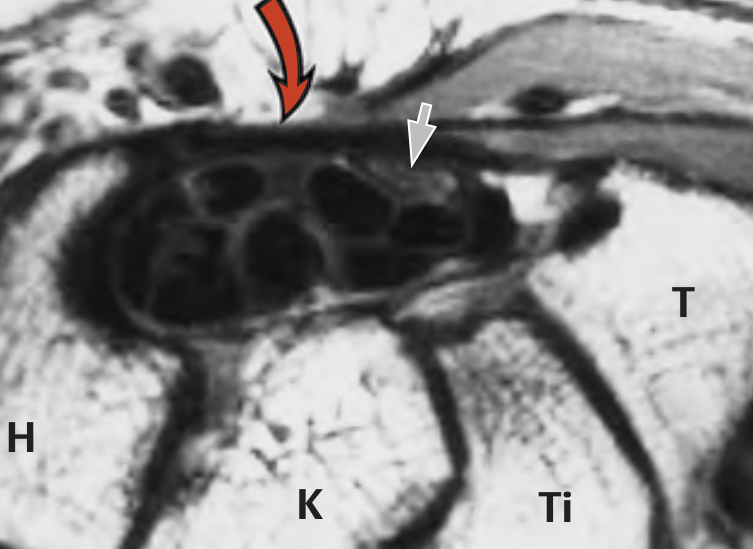
- MRI shows the retinaculum as a band of low signal intensity on T1-weighted images, and can reveal soft-tissue causes of CTS (edema, fibrosis, neuroma)
- Treatment: Carpal tunnel release involves longitudinal division of the transverse carpal ligament (flexor retinaculum)
The recurrent (thenar) branch of the median nerve exits just distal to the retinaculum and lies deep to the skin overlying the anterior margin of the thenar eminence - it is at risk during carpal tunnel release surgery.
(Gray's Anatomy for Students; General Anatomy and Musculoskeletal System, THIEME Atlas)
MRI of the carpal tunnel (axial T1) - the flexor retinaculum appears as a band of low signal intensity (red arrow), with the median nerve (small arrow) just radial to it showing slightly higher signal:
(THIEME Atlas of General Anatomy and Musculoskeletal System)
2. Flexor Retinaculum of the Ankle (Foot)
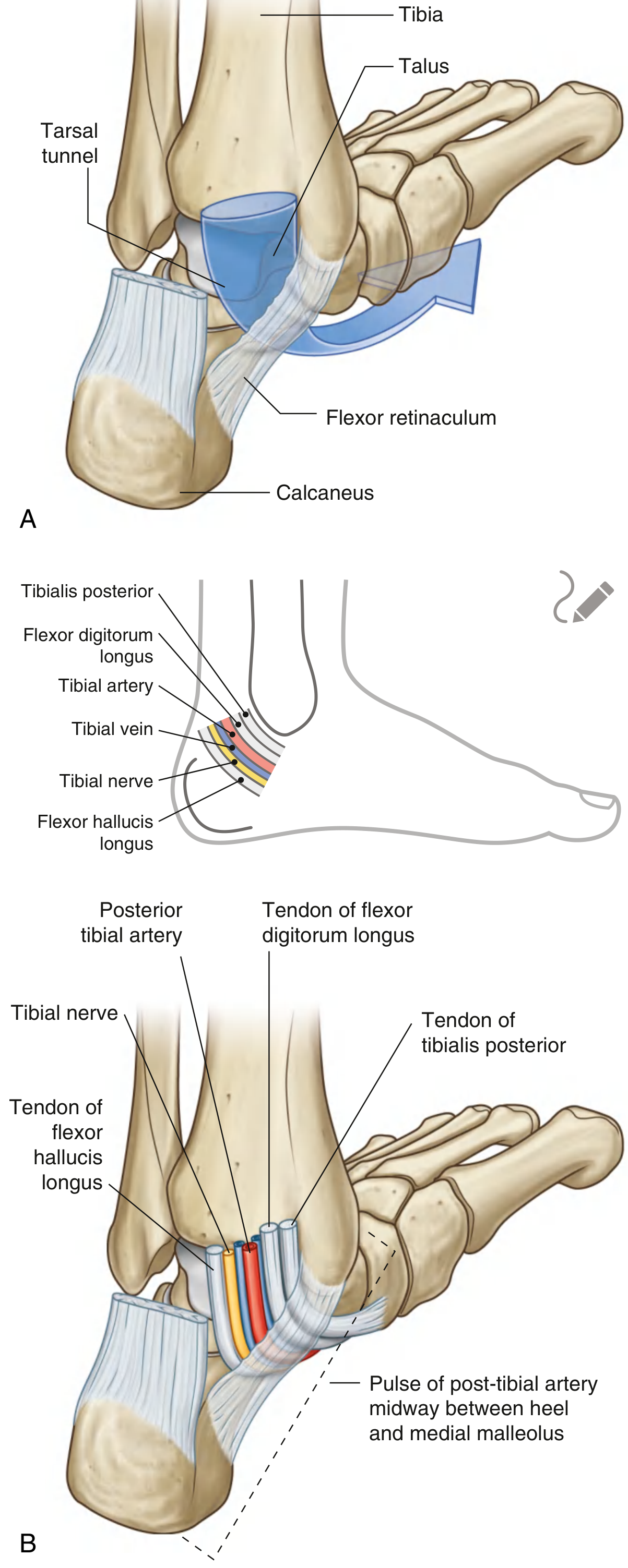
The flexor retinaculum at the ankle is a thickening of the crural (leg) fascia forming the roof of the tarsal tunnel on the medial aspect of the ankle. It is triangular in shape.
Attachments
- Anteriorly - medial malleolus
- Posteriorly/inferiorly - medial process of the calcaneus and plantar aponeurosis
Fibrous septa extend from its deep surface to the underlying bones, dividing it into separate osseofibrous canals.
Contents of the Tarsal Tunnel (Tom, Dick, And Very Nervous Harry)
Passing from anterior to posterior through the tarsal tunnel:
| Order | Structure |
|---|---|
| Tom | Tibialis posterior tendon (most medial/anterior) |
| Dick | Flexor digitorum longus tendon |
| And | Posterior tibial artery + accompanying veins |
| Very Nervous | Tibial nerve (divides into medial and lateral plantar nerves) |
| Harry | Flexor hallucis longus tendon (most lateral/posterior) |
The pulse of the posterior tibial artery can be felt through the retinaculum, midway between the medial malleolus and the calcaneus.
Clinical Relevance: Tarsal Tunnel Syndrome
Compression of the posterior tibial nerve or its branches within the tarsal tunnel produces tarsal tunnel syndrome - the foot's analog of CTS. Causes include trauma, ganglion cysts, tumors, congenital foot deformities, accessory muscles, and old fractures; ~20% of cases are idiopathic.
(Imaging Anatomy: Bones, Joints, Vessels and Nerves, Vol. 3; Gray's Anatomy for Students)
Anatomy of the tarsal tunnel and ankle flexor retinaculum:
(Gray's Anatomy for Students)
Summary Comparison
| Feature | Wrist | Ankle |
|---|---|---|
| Location | Palmar wrist | Medial ankle |
| Tunnel formed | Carpal tunnel | Tarsal tunnel |
| Bony attachments | Scaphoid, trapezium, pisiform, hamate | Medial malleolus, calcaneus |
| Key nerve at risk | Median nerve | Tibial nerve |
| Entrapment syndrome | Carpal tunnel syndrome | Tarsal tunnel syndrome |
| Continuity | Deep antebrachial fascia | Deep crural fascia |
This is a shared conversation. Sign in to Orris to start your own chat.