
Health hazard's of health care waste
health hazards of healthcare waste WHO classification
healthcare waste health hazards classification infectious sharps chemical radioactive
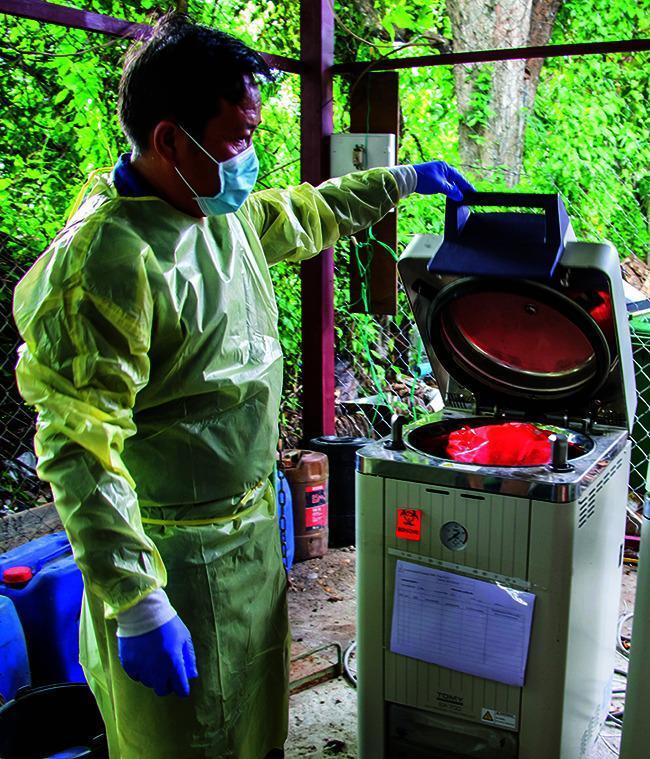
This clinical photograph depicts a health worker engaged in medical waste management, specifically the sterilization of infectious materials. The worker is outfitted in essential Personal Protective Equipment (PPE), including a long-sleeved, light yellow fluid-resistant gown, blue nitrile gloves, and a standard light blue surgical face mask. The healthcare professional is operating a vertical autoclave (steam sterilizer) used for decontamination. Inside the metallic chamber of the autoclave, a red biohazard bag is visible, signifying regulated medical waste such as COVID-19 related materials. The autoclave unit features a front panel with a pressure gauge, a biohazard warning label, and an attached log sheet for tracking sterilization cycles and compliance. This image illustrates critical infection control protocols, biosafety standards, and the procedural steps for medical waste disposal in a clinical or laboratory setting.
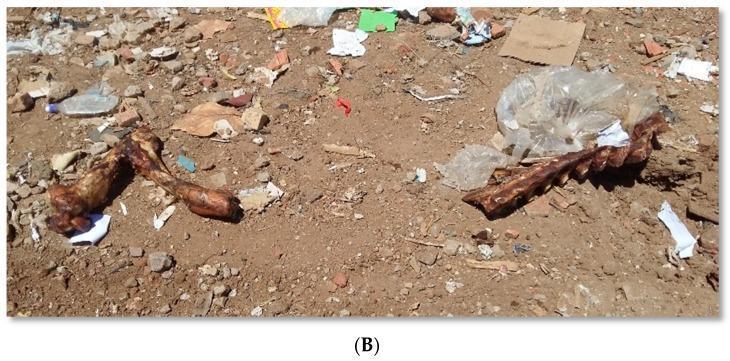
A clinical photograph illustrating biological and environmental health hazards at a landfill site. The image displays discarded beef carcasses in a state of advanced decomposition, characterized by dark brown discoloration and exposure of skeletal elements, including ribs and vertebrae. One specimen is partially wrapped in transparent plastic. The carcasses are surrounded by uncontrolled municipal solid waste, including plastic bottles, paper, and debris. This visual demonstrates critical public health risks related to food safety and environmental hygiene, specifically focusing on potential biological contaminants and zoonotic risks for vulnerable populations, such as waste pickers who may consume scavenged animal remains. The image serves as educational material for community health, environmental medicine, and infectious disease modules, highlighting the interplay between poverty, sanitation infrastructure, and health outcomes.
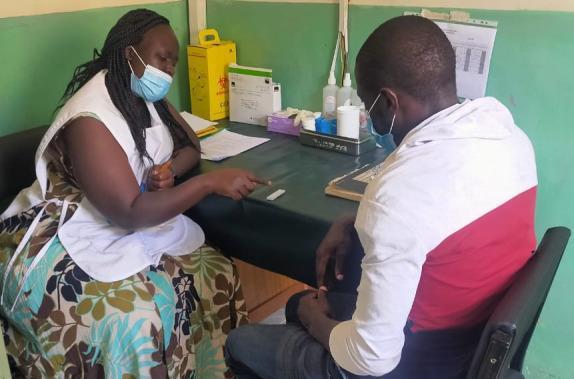
A clinical photograph depicting a post-test counseling session for a COVID-19 Rapid Diagnostic Test (RDT) in a community health setting. The image shows a healthcare worker or counselor and a client seated at an examination table, both wearing blue surgical face masks as personal protective equipment (PPE). The counselor points toward a lateral flow assay RDT cassette positioned on the table surface. The clinical workspace is organized with essential diagnostic supplies, including a yellow sharps disposal container for biohazardous waste, a box of test kits, bottles of hand sanitizer or reagent, swabs, and patient documentation on a clipboard. The image illustrates point-of-care testing protocols, infectious disease management, and the clinical communication process between health providers and patients regarding diagnostic results in a resource-limited setting.
A clinical photograph depicting the maintenance and disinfection protocol in a healthcare setting. A healthcare worker, wearing appropriate personal protective equipment (PPE) including a face mask, white clinical coat, and surgical gloves, is seen rinsing a blue glutaraldehyde soaking tray in a stainless steel laboratory sink. The person is emptying residual high-level disinfectant solution under a running faucet. The background illustrates a controlled medical environment containing a yellow sharps disposal container for biohazardous waste, bottles of chemical disinfectants, and cleaning supplies. This image illustrates occupational safety practices and the procedural steps for the manual decontamination and cleaning of medical equipment used in sterilization or high-level disinfection processes. Key educational concepts include chemical safety, PPE compliance, and medical device reprocessing workflows.
Health Hazards of Health Care Waste
- Park's Textbook of Preventive and Social Medicine, p. 3241
Composition of Hazardous Health-Care Waste (Approximate)
| Type | Proportion |
|---|---|
| General (non-hazardous) waste | ~80% |
| Pathological and infectious waste | ~15% |
| Sharps waste | ~1% |
| Chemical and pharmacological waste | ~3% |
| Special waste (radioactive, cytotoxic, pressurized containers) | <1% |
Characteristics That Make Waste Hazardous
-
Contains infectious agents
-
Contains toxic or hazardous chemicals, pathological waste or pharmaceuticals
-
Contains sharps
-
Is genotoxic
-
Is radioactive
-
Park's Textbook, p. 3310-3313
Groups Most at Risk
- Medical doctors, nurses, health-care auxiliaries, and hospital maintenance personnel
- Patients in health-care establishments
- Visitors to health-care establishments
- Workers in support services allied to health care - laundries, waste handling, transportation
- Workers in waste disposal facilities (landfills, incinerators) including scavengers
1. Hazards from Infectious Waste and Sharps
- A puncture, abrasion, or cut in the skin
- Mucous membranes
- Inhalation
- Ingestion
- HBV: 6-30% (some sources cite up to 30%)
- HCV: ~1.8%
- HIV: ~0.3%
- Park's Textbook, p. 3329-3331 | WHO Safe Management of Health-Care Waste
2. Hazards from Chemical and Pharmaceutical Waste
- Toxic, genotoxic, corrosive, flammable, reactive, explosive, or shock-sensitive
- Intoxication (acute or chronic)
- Burns and injuries
- Respiratory damage from inhalation of fumes or vapors
- Park's Textbook, p. 3334-3337
3. Hazards from Genotoxic Waste
- The intrinsic toxicity of the substance
- The extent and duration of exposure
- Inhalation of dust or aerosols
- Absorption through the skin
- Ingestion of food accidentally contaminated with cytotoxic drugs or chemicals
- Park's Textbook, p. 3340-3342
4. Hazards from Radioactive Waste
-
Mild exposure: Headache, dizziness, nausea, vomiting
-
Moderate to severe exposure: Serious tissue injury, severe burns
-
Chronic/genetic effects: Genotoxic damage affecting genetic material (mutagenesis, carcinogenesis)
-
Park's Textbook, p. 3345-3351
5. Environmental and Public Health Impact
- Antibiotic-resistant bacteria can develop and spread from improperly disposed health-care waste into the wider environment.
- Scavenging at disposal sites puts waste pickers at extreme risk of injury and infection.
- Groundwater contamination from leaching of toxic chemical waste (heavy metals, pharmaceuticals) is a major environmental concern.
- Air pollution from open burning or inadequate incineration releases dioxins, furans, and particulate matter.
- Public sensitivity: The general public is especially sensitive to the visual impact of anatomical waste.
Summary Table
| Hazard Category | Source | Key Health Effects |
|---|---|---|
| Infectious/Sharps | Needles, blood, body fluids, cultures | HIV, HBV, HCV, TB, drug-resistant infections |
| Chemical/Pharmaceutical | Disinfectants, solvents, expired drugs | Burns, intoxication, respiratory damage |
| Genotoxic/Cytotoxic | Chemotherapy agents, hormones | Cancer, teratogenicity, mutagenicity |
| Radioactive | Radiotherapy/diagnostic radioisotopes | Burns, tissue damage, genetic damage, nausea |
| General/Physical | Broken glass, sharp objects | Cuts, puncture wounds, secondary infections |
Define cafeteria approach discuss advantages and disadvantages of this approach for 5 marks
cafeteria approach employee benefits definition advantages disadvantages HRM
Cafeteria Approach
Definition
"The cafeteria approach recognizes that employees have different needs at different stages of life, and that a one-size-fits-all benefits package fails to address this diversity."
Advantages of the Cafeteria Approach
Disadvantages of the Cafeteria Approach
Summary (for 5 marks)
| Aspect | Key Point |
|---|---|
| Definition | Employee selects from a menu of benefits up to a fixed monetary allowance |
| Core Principle | Individual choice vs. uniform package |
| Main Advantage | Addresses diverse employee needs; increases satisfaction |
| Main Disadvantage | Administrative complexity; adverse selection risk |
| Best suited for | Large, diverse workforces with varying demographic needs |
Comes in which chapter if park textbook
Context in Park's Textbook
"The present approach in family planning programmes is to provide a 'cafeteria choice' - that is, to offer all methods from which an individual can choose according to his needs and wishes, and to promote family planning as a way of life."
- Park's Textbook, Chapter on Demography and Family Planning, under CONTRACEPTIVE METHODS (p. 581)
Why the Cafeteria Approach in Family Planning?
- There is no single ideal contraceptive that is safe, effective, acceptable, inexpensive, reversible, and simple for everyone.
- A method suitable for one group may be unsuitable for another due to different cultural patterns, religious beliefs, and socio-economic backgrounds.
- Therefore, the search for one "ideal contraceptive" has been given up.
- Instead, all methods are offered and the individual chooses based on personal needs and wishes.
Define cafeteria approach discuss advantages and disadvantages of this approach for 5 marks according to psm park textbook chapter of family planning
Cafeteria Approach in Family Planning
Definition
"The present approach in family planning programmes is to provide a 'cafeteria choice' - that is, to offer all methods from which an individual can choose according to his needs and wishes and to promote family planning as a way of life."
Rationale / Why Cafeteria Approach was Adopted
- It is now generally recognized that there can never be an ideal contraceptive - one that is simultaneously safe, effective, acceptable, inexpensive, reversible, simple to administer, independent of coitus, long-lasting, and requiring little or no medical supervision.
- A method that is suitable for one group may be unsuitable for another due to differences in cultural patterns, religious beliefs, and socio-economic background.
- As no single method can meet the social, cultural, aesthetic, and service needs of all individuals and communities, the search for an "ideal contraceptive" has been given up.
- The success of any contraceptive method depends not only on its effectiveness but also on the rate of continuation of its proper use.
Advantages of the Cafeteria Approach
Disadvantages of the Cafeteria Approach
Summary Table
| Aspect | Key Point |
|---|---|
| Definition | All contraceptive methods offered; individual freely chooses |
| Basis | No single ideal contraceptive exists for all |
| Core advantage | Meets diverse individual needs; improves acceptance |
| Core disadvantage | Needs trained counselors; risk of uninformed choices |
| Chapter | Demography and Family Planning - Contraceptive Methods |
Make this a document for me
mkdir -p /tmp/workspace/cafeteria-approach && ls /tmp/workspace/cafeteria-approach/
~/cafeteria-approach/create_doc.py
from docx import Document
from docx.shared import Pt, RGBColor, Inches
from docx.enum.text import WD_ALIGN_PARAGRAPH
from docx.oxml.ns import qn
from docx.oxml import OxmlElement

doc = Document()

# --- Page margins ---
section = doc.sections[0]
section.top_margin = Inches(1)
section.bottom_margin = Inches(1)
section.left_margin = Inches(1.2)
section.right_margin = Inches(1.2)

# --- Default Normal style ---
normal = doc.styles['Normal']
normal.font.name = 'Arial'
normal.font.size = Pt(11)

# ── Helper: add a coloured heading ──────────────────────────────────────────
def add_heading(doc, text, level=1, color=RGBColor(0x1F, 0x49, 0x7D)):
    h = doc.add_heading(text, level=level)
    h.alignment = WD_ALIGN_PARAGRAPH.LEFT
    for run in h.runs:
        run.font.color.rgb = color
        run.font.name = 'Arial'
    return h

# ── Helper: add body paragraph ───────────────────────────────────────────────
def add_body(doc, text, bold=False, italic=False, indent=False):
    p = doc.add_paragraph()
    p.paragraph_format.space_after = Pt(4)
    if indent:
        p.paragraph_format.left_indent = Inches(0.3)
    run = p.add_run(text)
    run.bold = bold
    run.italic = italic
    run.font.name = 'Arial'
    run.font.size = Pt(11)
    return p

# ── Helper: add bullet ────────────────────────────────────────────────────────
def add_bullet(doc, text, bold_part=None):
    p = doc.add_paragraph(style='List Bullet')
    p.paragraph_format.space_after = Pt(3)
    if bold_part and text.startswith(bold_part):
        r1 = p.add_run(bold_part)
        r1.bold = True
        r1.font.name = 'Arial'
        r1.font.size = Pt(11)
        r2 = p.add_run(text[len(bold_part):])
        r2.font.name = 'Arial'
        r2.font.size = Pt(11)
    else:
        run = p.add_run(text)
        run.font.name = 'Arial'
        run.font.size = Pt(11)
    return p

# ── Helper: add table ────────────────────────────────────────────────────────
def add_table(doc, headers, rows):
    table = doc.add_table(rows=1 + len(rows), cols=len(headers))
    table.style = 'Table Grid'
    # Header row
    hdr = table.rows[0].cells
    for i, h in enumerate(headers):
        hdr[i].text = h
        for para in hdr[i].paragraphs:
            for run in para.runs:
                run.bold = True
                run.font.name = 'Arial'
                run.font.size = Pt(10)
        # Header background colour (navy)
        tc = hdr[i]._tc
        tcPr = tc.get_or_add_tcPr()
        shd = OxmlElement('w:shd')
        shd.set(qn('w:val'), 'clear')
        shd.set(qn('w:color'), 'auto')
        shd.set(qn('w:fill'), '1F497D')
        tcPr.append(shd)
        for para in hdr[i].paragraphs:
            for run in para.runs:
                run.font.color.rgb = RGBColor(0xFF, 0xFF, 0xFF)
    # Data rows
    for ri, row_data in enumerate(rows):
        cells = table.rows[ri + 1].cells
        for ci, val in enumerate(row_data):
            cells[ci].text = val
            for para in cells[ci].paragraphs:
                for run in para.runs:
                    run.font.name = 'Arial'
                    run.font.size = Pt(10)
    return table

# ════════════════════════════════════════════════════════════════════════════
#  DOCUMENT CONTENT
# ════════════════════════════════════════════════════════════════════════════

# Title
title = doc.add_heading('Cafeteria Approach in Family Planning', level=1)
title.alignment = WD_ALIGN_PARAGRAPH.CENTER
for run in title.runs:
    run.font.color.rgb = RGBColor(0x1F, 0x49, 0x7D)
    run.font.name = 'Arial'
    run.font.size = Pt(16)
    run.bold = True

sub = doc.add_paragraph()
sub.alignment = WD_ALIGN_PARAGRAPH.CENTER
sr = sub.add_run('Park\'s Textbook of Preventive and Social Medicine\nChapter: Demography and Family Planning | Contraceptive Methods')
sr.italic = True
sr.font.name = 'Arial'
sr.font.size = Pt(10)
sr.font.color.rgb = RGBColor(0x44, 0x44, 0x44)

doc.add_paragraph()  # spacer

# ── 1. Definition ────────────────────────────────────────────────────────────
add_heading(doc, '1. Definition', level=2)

add_body(doc,
    'The cafeteria approach (also called "cafeteria choice") in family planning is the current '
    'approach in which all available contraceptive methods are offered to individuals, allowing '
    'each person to freely choose the method that best suits their own needs and wishes - just as '
    'one selects food of their choice from a cafeteria.')

# Park verbatim quote
quote_p = doc.add_paragraph()
quote_p.paragraph_format.left_indent = Inches(0.4)
quote_p.paragraph_format.right_indent = Inches(0.4)
quote_p.paragraph_format.space_before = Pt(4)
quote_p.paragraph_format.space_after = Pt(8)
qr = quote_p.add_run(
    '"The present approach in family planning programmes is to provide a \'cafeteria choice\' - '
    'that is, to offer all methods from which an individual can choose according to his needs and '
    'wishes and to promote family planning as a way of life."')
qr.italic = True
qr.font.name = 'Arial'
qr.font.size = Pt(11)
qr.font.color.rgb = RGBColor(0x33, 0x33, 0x33)
src = quote_p.add_run('\n- Park\'s Textbook of PSM, p. 581')
src.font.name = 'Arial'
src.font.size = Pt(9)
src.bold = True
src.font.color.rgb = RGBColor(0x1F, 0x49, 0x7D)

# ── 2. Rationale ─────────────────────────────────────────────────────────────
add_heading(doc, '2. Rationale / Why the Cafeteria Approach Was Adopted', level=2)

add_body(doc, 'Park explains the following reasons for adopting this approach:')

rationale = [
    ('No ideal contraceptive exists: ', 'It is now generally recognized that no single contraceptive can be simultaneously safe, effective, acceptable, inexpensive, reversible, simple to administer, independent of coitus, long-lasting, and requiring little or no medical supervision.'),
    ('Individual variation: ', 'A method suitable for one group may be unsuitable for another due to differences in cultural patterns, religious beliefs, and socio-economic background.'),
    ('Diverse population needs: ', 'No single method can meet the social, cultural, aesthetic, and service needs of all individuals and communities.'),
    ('Continuation matters: ', 'The success of a contraceptive method depends not only on its effectiveness but also on the rate of continuation of its proper use.'),
]
for bold, rest in rationale:
    add_bullet(doc, bold + rest, bold_part=bold)

doc.add_paragraph()

# ── 3. Advantages ────────────────────────────────────────────────────────────
add_heading(doc, '3. Advantages of the Cafeteria Approach', level=2)

advantages = [
    ('1. Addresses Diversity of Needs: ',
     'Different individuals have different medical, social, religious, and personal needs. Offering all methods ensures everyone finds a compatible option.'),
    ('2. Improves Acceptability and Continuation: ',
     'When individuals freely choose a method suited to them, they are more likely to use it consistently and correctly, improving overall contraceptive effectiveness.'),
    ('3. Respects Individual Autonomy and Reproductive Rights: ',
     'The approach upholds the individual\'s right to choose, in line with the principles of reproductive rights and informed consent central to modern family welfare programmes.'),
    ('4. Promotes Family Planning as a Way of Life: ',
     'By making family planning a personal, voluntary choice rather than a top-down directive, the approach integrates it naturally into people\'s lives.'),
    ('5. Suitable for a Diverse Population: ',
     'India\'s vast diversity in culture, religion, literacy, and socioeconomic status requires a wide menu of methods to ensure the programme reaches all sections of society.'),
    ('6. Eliminates Coercion and Target-based Approach: ',
     'Moves away from the older numerical target-driven approach toward a client-centred, need-based approach, reducing coercion and improving trust.'),
]
for bold, rest in advantages:
    add_bullet(doc, bold + rest, bold_part=bold)

doc.add_paragraph()

# ── 4. Disadvantages ─────────────────────────────────────────────────────────
add_heading(doc, '4. Disadvantages of the Cafeteria Approach', level=2)

disadvantages = [
    ('1. Requires Well-trained Counselors: ',
     'Health workers must be trained to counsel about all available methods - their efficacy, side effects, and suitability. This demands significant training and resources.'),
    ('2. Risk of Uninformed Choice: ',
     'In populations with low literacy or limited health awareness, individuals may choose a method without fully understanding its proper use, leading to method failure.'),
    ('3. Logistical and Supply Chain Complexity: ',
     'Maintaining adequate stocks of all contraceptive methods at every service delivery point is challenging, especially in resource-limited or remote settings.'),
    ('4. Risk of Choosing Less Effective Methods: ',
     'Without proper guidance, individuals may select less effective methods (e.g., rhythm method, spermicides alone) over more effective ones (e.g., IUD, hormonal methods), resulting in unintended pregnancies.'),
    ('5. Unequal Access in Practice: ',
     'Not all methods may be equally available in all areas. In rural or underserved regions, the "menu" may be limited in practice, making cafeteria choice more theoretical than real.'),
]
for bold, rest in disadvantages:
    add_bullet(doc, bold + rest, bold_part=bold)

doc.add_paragraph()

# ── 5. Summary Table ──────────────────────────────────────────────────────────
add_heading(doc, '5. Summary', level=2)

headers = ['Aspect', 'Key Point']
rows = [
    ['Definition', 'All contraceptive methods offered; individual freely chooses'],
    ['Basis', 'No single ideal contraceptive exists for all individuals'],
    ['Core Advantage', 'Meets diverse individual needs; improves acceptability & continuation'],
    ['Core Disadvantage', 'Needs trained counselors; risk of uninformed or less effective choices'],
    ['Chapter (Park\'s)', 'Demography and Family Planning - Contraceptive Methods, p. 581'],
]
add_table(doc, headers, rows)

doc.add_paragraph()

# Footer note
fn = doc.add_paragraph()
fn.alignment = WD_ALIGN_PARAGRAPH.CENTER
fnr = fn.add_run('Source: Park\'s Textbook of Preventive and Social Medicine | Chapter: Demography and Family Planning')
fnr.font.name = 'Arial'
fnr.font.size = Pt(9)
fnr.italic = True
fnr.font.color.rgb = RGBColor(0x88, 0x88, 0x88)

# ── Save ──────────────────────────────────────────────────────────────────────
out = '/tmp/workspace/cafeteria-approach/Cafeteria_Approach_Family_Planning.docx'
doc.save(out)
print(f'Saved: {out}')
python3 /tmp/workspace/cafeteria-approach/create_doc.py
Cafeteria Approach Family Planning
Word Document · DOCX
- Title page with source reference (Park's PSM, p. 581)
- Park's verbatim definition quoted in a styled block
- Rationale section (why the cafeteria approach was adopted)
- 6 Advantages with bold headings
- 5 Disadvantages with bold headings
- Summary table with all key points
- Professionally formatted with navy blue headings and a clean Arial font
Make me a document
What should the document be about?
Write briefly about effects of urbanization on health (problems of increase in urban population in india) according to psm park textbook for 5 marks
Effects of Urbanization on Health
Definition of Urban Population (Park's)
Causes of Urbanization (Park's)
- Natural growth (through births)
- Rural-to-urban migration - driven by employment opportunities, attraction of better living conditions, and availability of social services such as education, health, transport, and entertainment
"The continuous migration of people from the countryside to urban areas in India constitutes a social crisis, the ramification of which may eventually impair the quality of life."
- Park's Textbook, p. 572
Problems / Health Effects of Urbanization in India
1. Overcrowding and Slum Development
- Inadequate ventilation and poor housing
- Rapid spread of airborne diseases (tuberculosis, influenza, measles)
- Increased mental stress and social tension
2. Environmental Sanitation Problems
- Unsafe drinking water - contaminated water sources leading to waterborne diseases (cholera, typhoid, hepatitis A, diarrhoea)
- Inadequate sewage disposal - open drains, faecal contamination of environment
- Solid waste accumulation - breeding grounds for vectors (flies, mosquitoes, rodents)
3. Air Pollution
- Respiratory diseases (asthma, chronic bronchitis, COPD)
- Increased risk of lung cancer
- Cardiovascular disease from particulate matter exposure
4. Rise in Non-Communicable Diseases (NCDs)
- Hypertension, coronary artery disease
- Type 2 diabetes mellitus
- Obesity
- Cancer
5. Communicable Disease Burden
- Unplanned urbanization as a key factor for emerging infectious diseases
- Overcrowding, poor sanitation, and inadequate public health infrastructure compound this
- Vector-borne diseases (malaria, dengue) thrive in stagnant water in urban settings
6. Occupational Health Hazards
- Chemical toxins, heavy metals, dust
- Industrial accidents and injuries
- Noise-induced hearing loss
7. Mental Health Problems
- Stress, anxiety, and depression due to fast-paced lifestyle, unemployment, poverty, and social isolation
- Substance abuse (alcohol, tobacco, drugs) is higher in urban populations
- Crime and violence are more prevalent in overcrowded urban settings
8. Nutritional Problems
- Urban poor face food insecurity despite being in cities
- Paradox of over-nutrition (obesity) in the affluent and under-nutrition in slum dwellers existing simultaneously
- Micronutrient deficiencies remain common in urban poor
9. Inadequate Health and Civic Services
10. Social Problems
- Breakdown of traditional family structure and social support systems
- Juvenile delinquency, prostitution, and crime increase
- Loss of cultural identity and social cohesion
Summary Table
| Problem | Key Health Impact |
|---|---|
| Overcrowding / Slums | Airborne infections, TB, stress |
| Poor water & sanitation | Waterborne diseases - cholera, typhoid |
| Air pollution | Respiratory and cardiovascular disease |
| Lifestyle changes | NCDs - diabetes, hypertension, obesity |
| Vector breeding | Malaria, dengue |
| Occupational hazards | Injuries, toxin exposure |
| Mental health | Stress, depression, substance abuse |
| Social breakdown | Crime, juvenile delinquency |
Create a Word document on urbanization health effects
~/urbanization/create_doc.py
from docx import Document
from docx.shared import Pt, RGBColor, Inches
from docx.enum.text import WD_ALIGN_PARAGRAPH
from docx.oxml.ns import qn
from docx.oxml import OxmlElement

doc = Document()

# --- Page margins ---
section = doc.sections[0]
section.top_margin = Inches(1)
section.bottom_margin = Inches(1)
section.left_margin = Inches(1.2)
section.right_margin = Inches(1.2)

# --- Default Normal style ---
normal = doc.styles['Normal']
normal.font.name = 'Arial'
normal.font.size = Pt(11)

# ── Helpers ──────────────────────────────────────────────────────────────────
def add_heading(doc, text, level=1, color=RGBColor(0x1F, 0x49, 0x7D)):
    h = doc.add_heading(text, level=level)
    h.alignment = WD_ALIGN_PARAGRAPH.LEFT
    for run in h.runs:
        run.font.color.rgb = color
        run.font.name = 'Arial'
    return h

def add_body(doc, text, bold=False, italic=False, space_after=4):
    p = doc.add_paragraph()
    p.paragraph_format.space_after = Pt(space_after)
    run = p.add_run(text)
    run.bold = bold
    run.italic = italic
    run.font.name = 'Arial'
    run.font.size = Pt(11)
    return p

def add_quote(doc, text, source=None):
    p = doc.add_paragraph()
    p.paragraph_format.left_indent = Inches(0.4)
    p.paragraph_format.right_indent = Inches(0.4)
    p.paragraph_format.space_before = Pt(4)
    p.paragraph_format.space_after = Pt(8)
    r = p.add_run(f'"{text}"')
    r.italic = True
    r.font.name = 'Arial'
    r.font.size = Pt(11)
    r.font.color.rgb = RGBColor(0x33, 0x33, 0x33)
    if source:
        sr = p.add_run(f'\n— {source}')
        sr.font.name = 'Arial'
        sr.font.size = Pt(9)
        sr.bold = True
        sr.font.color.rgb = RGBColor(0x1F, 0x49, 0x7D)
    return p

def add_bullet(doc, text, bold_part=None):
    p = doc.add_paragraph(style='List Bullet')
    p.paragraph_format.space_after = Pt(3)
    if bold_part and text.startswith(bold_part):
        r1 = p.add_run(bold_part)
        r1.bold = True
        r1.font.name = 'Arial'
        r1.font.size = Pt(11)
        r2 = p.add_run(text[len(bold_part):])
        r2.font.name = 'Arial'
        r2.font.size = Pt(11)
    else:
        run = p.add_run(text)
        run.font.name = 'Arial'
        run.font.size = Pt(11)
    return p

def add_table(doc, headers, rows, header_color='1F497D'):
    table = doc.add_table(rows=1 + len(rows), cols=len(headers))
    table.style = 'Table Grid'
    hdr = table.rows[0].cells
    for i, h in enumerate(headers):
        hdr[i].text = h
        for para in hdr[i].paragraphs:
            for run in para.runs:
                run.bold = True
                run.font.name = 'Arial'
                run.font.size = Pt(10)
                run.font.color.rgb = RGBColor(0xFF, 0xFF, 0xFF)
        tc = hdr[i]._tc
        tcPr = tc.get_or_add_tcPr()
        shd = OxmlElement('w:shd')
        shd.set(qn('w:val'), 'clear')
        shd.set(qn('w:color'), 'auto')
        shd.set(qn('w:fill'), header_color)
        tcPr.append(shd)
    for ri, row_data in enumerate(rows):
        cells = table.rows[ri + 1].cells
        # Alternate row shading
        fill = 'EBF0F8' if ri % 2 == 0 else 'FFFFFF'
        for ci, val in enumerate(row_data):
            cells[ci].text = val
            for para in cells[ci].paragraphs:
                for run in para.runs:
                    run.font.name = 'Arial'
                    run.font.size = Pt(10)
            tc = cells[ci]._tc
            tcPr = tc.get_or_add_tcPr()
            shd = OxmlElement('w:shd')
            shd.set(qn('w:val'), 'clear')
            shd.set(qn('w:color'), 'auto')
            shd.set(qn('w:fill'), fill)
            tcPr.append(shd)
    return table

def spacer(doc):
    p = doc.add_paragraph()
    p.paragraph_format.space_after = Pt(2)

# ════════════════════════════════════════════════════════════════════════════
#  TITLE PAGE BLOCK
# ════════════════════════════════════════════════════════════════════════════
title = doc.add_heading('Effects of Urbanization on Health', level=1)
title.alignment = WD_ALIGN_PARAGRAPH.CENTER
for run in title.runs:
    run.font.color.rgb = RGBColor(0x1F, 0x49, 0x7D)
    run.font.name = 'Arial'
    run.font.size = Pt(18)
    run.bold = True

sub = doc.add_paragraph()
sub.alignment = WD_ALIGN_PARAGRAPH.CENTER
sr = sub.add_run(
    'Problems of Increase in Urban Population in India\n'
    'Park\'s Textbook of Preventive and Social Medicine\n'
    'Chapter: Demography and Family Planning'
)
sr.italic = True
sr.font.name = 'Arial'
sr.font.size = Pt(11)
sr.font.color.rgb = RGBColor(0x55, 0x55, 0x55)

spacer(doc)

# Divider line
p_div = doc.add_paragraph()
p_div.paragraph_format.space_after = Pt(8)
pPr = p_div._p.get_or_add_pPr()
pBdr = OxmlElement('w:pBdr')
bottom = OxmlElement('w:bottom')
bottom.set(qn('w:val'), 'single')
bottom.set(qn('w:sz'), '6')
bottom.set(qn('w:space'), '1')
bottom.set(qn('w:color'), '1F497D')
pBdr.append(bottom)
pPr.append(pBdr)

# ════════════════════════════════════════════════════════════════════════════
#  SECTION 1 — DEFINITION
# ════════════════════════════════════════════════════════════════════════════
add_heading(doc, '1. Definition of Urban Population', level=2)
add_body(doc,
    'Urban areas in India are defined as towns with municipal corporations or committees; '
    'also places having 5,000 or more inhabitants, a density of not less than 390 persons per '
    'sq. km, pronounced urban characteristics, and at least three-fourths of the adult male '
    'population employed in pursuits other than agriculture.')
add_body(doc,
    'As per 2019 data, India\'s urban population stands at 471.828 million (34.5%). '
    'Mumbai is the most populous city (12.69 million), followed by Delhi (10.927 million), '
    'Bengaluru (5.104 million), Kolkata (4.631 million), and Chennai (4.328 million).',
    italic=False)
spacer(doc)

# ════════════════════════════════════════════════════════════════════════════
#  SECTION 2 — CAUSES
# ════════════════════════════════════════════════════════════════════════════
add_heading(doc, '2. Causes of Urbanization', level=2)
add_body(doc, 'The increase in urban population has been attributed to:')
add_bullet(doc, 'Natural growth through births')
add_bullet(doc, 'Rural-to-urban migration driven by:')

sub_items = [
    'Employment opportunities',
    'Attraction of better living conditions',
    'Availability of social services - education, health, transport, entertainment',
]
for item in sub_items:
    p = doc.add_paragraph(style='List Bullet 2')
    p.paragraph_format.space_after = Pt(2)
    run = p.add_run(item)
    run.font.name = 'Arial'
    run.font.size = Pt(11)

spacer(doc)
add_quote(doc,
    'The continuous migration of people from the countryside to urban areas in India '
    'constitutes a social crisis, the ramification of which may eventually impair the quality of life.',
    source='Park\'s Textbook of PSM, p. 572')

# ════════════════════════════════════════════════════════════════════════════
#  SECTION 3 — HEALTH EFFECTS / PROBLEMS
# ════════════════════════════════════════════════════════════════════════════
add_heading(doc, '3. Health Effects / Problems of Urbanization', level=2)

problems = [
    (
        '3.1  Overcrowding and Slum Development',
        'Rapid, unplanned urbanization leads to growth of slums and squatter settlements:',
        [
            'Inadequate ventilation and poor housing conditions',
            'Rapid spread of airborne diseases - tuberculosis, influenza, measles',
            'Increased mental stress and social tension',
            'Unplanned urbanization is a key factor in emergence of infectious diseases (Park\'s)',
        ]
    ),
    (
        '3.2  Environmental Sanitation Problems',
        'Urban areas, particularly slums, suffer from:',
        [
            'Unsafe drinking water - contaminated sources leading to cholera, typhoid, hepatitis A, diarrhoea',
            'Inadequate sewage disposal - open drains, faecal contamination of the environment',
            'Solid waste accumulation - breeding grounds for vectors (flies, mosquitoes, rodents)',
        ]
    ),
    (
        '3.3  Air Pollution',
        'Industrial growth and vehicular traffic associated with urbanization cause severe air pollution:',
        [
            'Respiratory diseases - asthma, chronic bronchitis, COPD',
            'Increased risk of lung cancer',
            'Cardiovascular diseases from particulate matter and toxic gas exposure',
            'Environmental health problems connected with toxic, carcinogenic, and mutagenic material are assuming growing importance (Park\'s)',
        ]
    ),
    (
        '3.4  Rise in Non-Communicable Diseases (NCDs)',
        'Urbanization promotes sedentary lifestyles, dietary changes (processed foods), and psychosocial stress:',
        [
            'Hypertension and coronary artery disease',
            'Type 2 diabetes mellitus',
            'Obesity',
            'Cancer',
            'Park\'s notes: "Rapid urbanization, environmental distress, and changing lifestyles have resulted in a rise in NCDs like cancer, hypertension, and diabetes."',
        ]
    ),
    (
        '3.5  Communicable Disease Burden',
        'Overcrowding and poor sanitation maintain a high communicable disease burden:',
        [
            'Vector-borne diseases - malaria, dengue, chikungunya thrive in urban stagnant water',
            'Waterborne disease outbreaks due to faecal-oral contamination',
            'Resistance to antibiotics is facilitated by overcrowding and misuse',
            'Emerging and re-emerging infections flourish in unplanned urban settings',
        ]
    ),
    (
        '3.6  Occupational Health Hazards',
        'Urbanization brings industrial and construction work, exposing large populations to:',
        [
            'Chemical toxins, heavy metals, silica dust, asbestos',
            'Industrial accidents and physical injuries',
            'Noise-induced hearing loss from machinery',
        ]
    ),
    (
        '3.7  Mental Health Problems',
        'Urban life is associated with significant mental health burden:',
        [
            'Stress, anxiety, and depression due to fast-paced lifestyle and social isolation',
            'Unemployment and poverty contribute to psychological distress',
            'Substance abuse (alcohol, tobacco, drugs) is higher in urban populations',
            'Crime and violence are more prevalent in overcrowded urban settings',
        ]
    ),
    (
        '3.8  Nutritional Problems',
        'Urban populations face a paradoxical nutritional situation:',
        [
            'Urban poor face food insecurity despite proximity to food markets',
            'Over-nutrition (obesity) in the affluent and under-nutrition in slum dwellers coexist',
            'Micronutrient deficiencies remain common in the urban poor',
            'High consumption of processed, calorie-dense, nutrient-poor food',
        ]
    ),
    (
        '3.9  Inadequate Health and Civic Services',
        'Rapid urban growth outpaces infrastructure development:',
        [
            'Hospitals, schools, roads, and utilities become overburdened',
            'Urban peripheral and slum populations often have worse healthcare access than rural areas',
            'Water supply and sanitation services are insufficient for the growing population',
        ]
    ),
    (
        '3.10  Social Problems and Breakdown of Family Structure',
        'Urbanization disrupts traditional social structures:',
        [
            'Breakdown of joint family system and social support networks',
            'Juvenile delinquency, prostitution, and crime rates increase',
            'Loss of cultural identity and social cohesion',
            'Industrialization, urbanization, and acculturation have affected family structure and life (Park\'s)',
        ]
    ),
]

for heading_text, intro_text, bullets in problems:
    add_heading(doc, heading_text, level=3, color=RGBColor(0x2E, 0x74, 0xB5))
    add_body(doc, intro_text)
    for b in bullets:
        add_bullet(doc, b)
    spacer(doc)

# ════════════════════════════════════════════════════════════════════════════
#  SECTION 4 — SUMMARY TABLE
# ════════════════════════════════════════════════════════════════════════════
add_heading(doc, '4. Summary Table', level=2)

headers = ['Problem Area', 'Key Health Impact']
rows = [
    ['Overcrowding / Slums', 'Airborne infections - TB, influenza, measles; stress'],
    ['Poor water & sanitation', 'Waterborne diseases - cholera, typhoid, hepatitis A'],
    ['Air pollution', 'Respiratory diseases, cardiovascular disease, lung cancer'],
    ['Lifestyle changes (NCDs)', 'Diabetes, hypertension, obesity, coronary artery disease'],
    ['Vector breeding sites', 'Malaria, dengue, chikungunya'],
    ['Occupational hazards', 'Injuries, chemical/toxin exposure, noise-induced hearing loss'],
    ['Mental health', 'Stress, depression, substance abuse'],
    ['Nutritional problems', 'Dual burden: over-nutrition & under-nutrition'],
    ['Inadequate services', 'Overburdened hospitals; poor access for urban poor'],
    ['Social breakdown', 'Crime, juvenile delinquency, family disintegration'],
]
add_table(doc, headers, rows)

spacer(doc)

# ════════════════════════════════════════════════════════════════════════════
#  SECTION 5 — KEY POINT
# ════════════════════════════════════════════════════════════════════════════
add_heading(doc, '5. Key Point', level=2)
add_body(doc,
    'Park emphasizes that urbanization creates a dual burden of disease - communicable diseases '
    'persist in the poor urban population while non-communicable diseases rise due to lifestyle '
    'changes - making urban health one of the most complex public health challenges in India.',
    bold=False)

spacer(doc)

# Footer note
fn = doc.add_paragraph()
fn.alignment = WD_ALIGN_PARAGRAPH.CENTER
p_div2 = doc.add_paragraph()
pPr2 = p_div2._p.get_or_add_pPr()
pBdr2 = OxmlElement('w:pBdr')
top2 = OxmlElement('w:top')
top2.set(qn('w:val'), 'single')
top2.set(qn('w:sz'), '4')
top2.set(qn('w:space'), '1')
top2.set(qn('w:color'), '1F497D')
pBdr2.append(top2)
pPr2.append(pBdr2)

fnr = fn.add_run(
    'Source: Park\'s Textbook of Preventive and Social Medicine | '
    'Chapter: Demography and Family Planning, Urbanization section, p. 572'
)
fnr.font.name = 'Arial'
fnr.font.size = Pt(9)
fnr.italic = True
fnr.font.color.rgb = RGBColor(0x88, 0x88, 0x88)

# ── Save ──────────────────────────────────────────────────────────────────────
import os
os.makedirs('/tmp/workspace/urbanization', exist_ok=True)
out = '/tmp/workspace/urbanization/Urbanization_Health_Effects.docx'
doc.save(out)
print(f'Saved: {out}')
python3 /tmp/workspace/urbanization/create_doc.py
Urbanization Health Effects
Word Document · DOCX
- Title block with source reference (Park's PSM, p. 572)
- Definition of urban population (Indian context)
- Causes of urbanization (natural growth + migration)
- Park's verbatim quote on urban migration as a "social crisis"
- 10 detailed problem sections - overcrowding, sanitation, air pollution, NCDs, communicable diseases, occupational hazards, mental health, nutrition, inadequate services, social breakdown
- Color-coded summary table with alternating row shading
- Key exam point on the "dual burden of disease"
- Professional navy blue headings and clean Arial formatting