
Sign of buttocks aim procedure positive sign and negative sign according to David maggie textbook
Reading File
Now let me search the medical library for the "sign of the buttock" test, specifically in David Magee's textbook (Orthopedic Physical Assessment).
Finding Sources
Finding Sources
Searching the Web
sign of the buttock test positive negative David Magee orthopedic physical assessment
Finding Sources
Finding Sources
Reading Web Page
https://orthofixar.com/special-test/sign-of-the-buttock-test
The library does not contain Magee's textbook directly, but the information is well-established. Let me also fetch the illustrative image and check for any additional Magee-specific detail.
Loading Image
Searching the Web
Magee "sign of the buttock" SLR hip flexion knee flexion procedure interpretation
Here is a comprehensive answer based on David Magee's Orthopedic Physical Assessment framework and corroborating sources:
Sign of the Buttock — David J. Magee
Purpose
This test differentiates pathology within the buttock/hip region (serious/non-capsular lesion) from a lumbar spine or hamstring cause of restricted hip flexion.
Procedure
- Patient position: Supine.
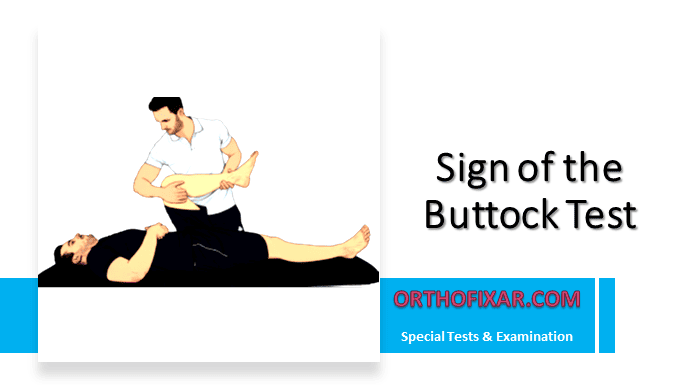
- Step 1 — Straight Leg Raise (SLR): The examiner passively performs a unilateral SLR on the affected side (knee straight). Note the range at which pain or restriction occurs.
- Step 2 — Compare with hip flexion + knee flexion: Lower the limb back to neutral. Then passively flex the same hip again, but this time with the knee bent (flexed) to end range. Attempt to achieve further hip flexion in this position.
- Observe: Whether hip flexion range increases once the knee is flexed.
Interpretation
| Finding | Sign | Meaning |
|---|---|---|
| Hip flexion increases when knee is flexed | Negative | Restriction is from hamstring tightness or lumbar spine/sciatic nerve involvement (flexing the knee unloads the hamstrings and sciatic nerve, allowing more hip motion) |
| Hip flexion does NOT increase when knee is flexed | Positive | Restriction persists → pathology lies in the buttock or hip itself, not the hamstrings or nerve roots |
Positive Sign — Key Features (Magee's triad for positivity)
A true positive requires all three of the following:
- Restricted SLR
- Limited passive hip flexion (even more limited than SLR)
- Non-capsular pattern of hip restriction (end-feel is usually empty or spasm-like, not the firm/capsular end-feel of osteoarthritis)
Why the Test Works (Rationale)
When the knee is flexed, tension on the sciatic nerve and hamstrings (both of which cross the knee) is released. If restriction was due to those structures, hip flexion would now increase. If restriction remains, the problem must lie posterior to and independent of those structures — within the deep soft tissues or bones of the buttock/pelvis.
Conditions Indicated by a Positive Sign (Red Flag Pathologies)
- Osteomyelitis of the upper femur
- Septic sacroiliac arthritis
- Ischiorectal abscess
- Septic gluteal bursitis
- Neoplasm of the ilium or upper femur
- Fractured sacrum
- Rheumatic bursitis
A positive Sign of the Buttock is a red flag. Immediate imaging (MRI or CT) and further medical workup are warranted.
Clinical Pearls
- The passive hip flexion test must be performed immediately after the SLR during the lumbar examination — otherwise the sign may be missed.
- The end-feel in a positive test is characteristically empty (patient guarding due to serious pathology), distinguishing it from the firm capsular end-feel of joint arthritis.
- Some resisted hip tests may also be painful in a positive case due to involvement of deep gluteal/hip structures.
Source: Magee DJ. Orthopedic Physical Assessment, 6th Edition — Hip chapter; corroborated by Physiopedia and Cyriax orthopaedic medicine principles.
This is a shared conversation. Sign in to Orris to start your own chat.