
Pterigyum
Reading File
A pterygium is a wing-shaped fibrovascular growth of conjunctival tissue that invades the cornea, typically from the nasal side. It is associated with UV exposure, dry/dusty environments, and chronic irritation. Mild cases are managed conservatively; significant cases require surgical excision.
Searching sources...
Finding Sources
Searching PubMed
pterygium
Good results. Let me pull the most comprehensive ophthalmology sources simultaneously.
Reading File
Reading File
Reading File
Now let me get the treatment section from Kanski and the Wills Eye Manual (which was truncated).
Reading File
Reading File
Now let me fetch the clinical image of pterygium from Kanski and the Wills Eye Manual image.
Loading Image
Loading Image
Excellent clinical images. I now have comprehensive information from multiple authoritative sources. Here is the full answer:
Pterygium
Definition
A pterygium (plural: pterygia) is a triangular fibrovascular sub-epithelial ingrowth of degenerative bulbar conjunctival tissue that grows over the limbus onto the cornea. The name comes from the Greek word for "wing" - it has a characteristic wing-shaped appearance.
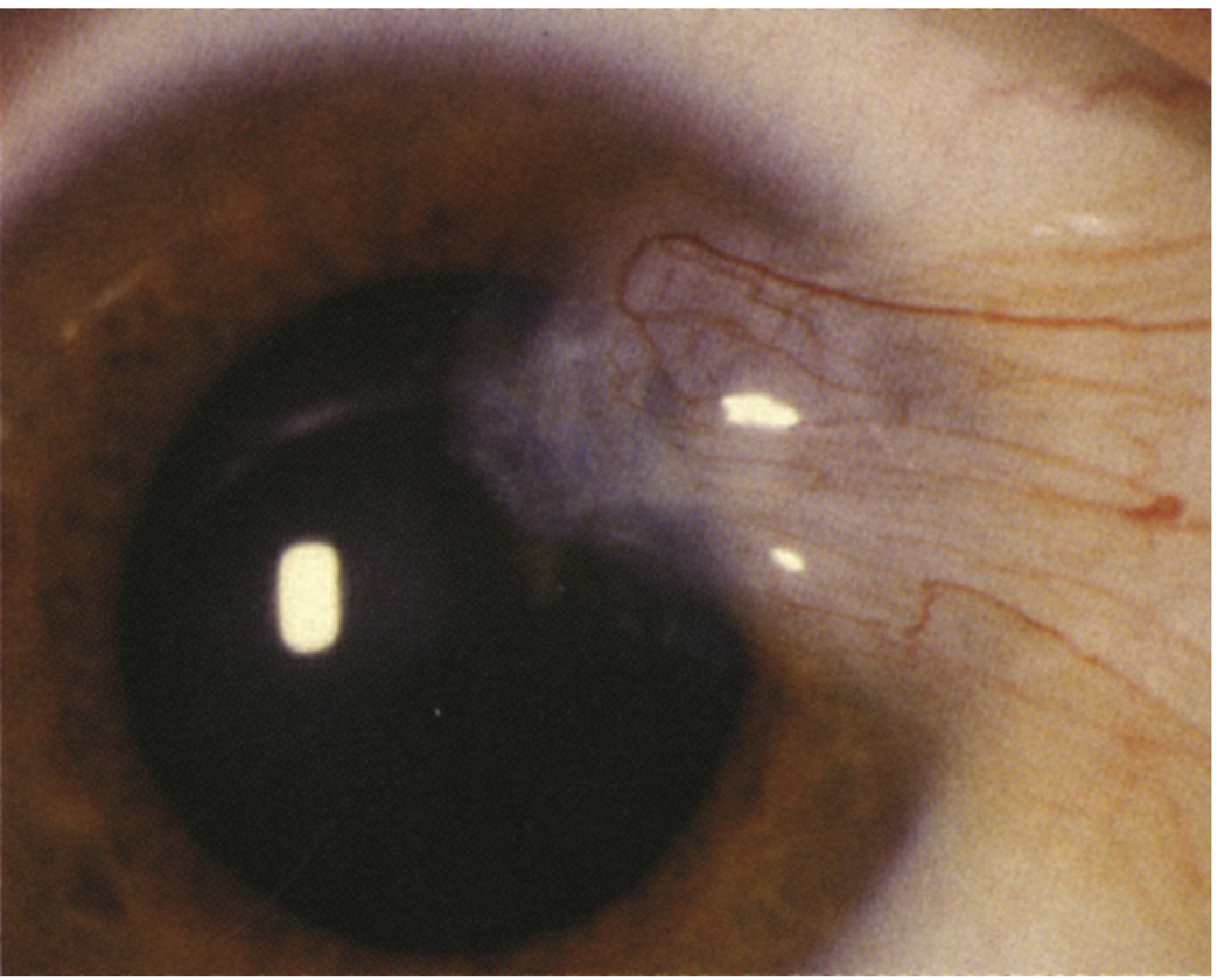
Fig. 4.9.1 - Pterygium (Wills Eye Manual)
Pathophysiology
- Results from elastotic degeneration of deep conjunctival layers, leading to fibrovascular tissue proliferation
- Caused primarily by actinic (UV) damage and chronic irritation - located in the sun-exposed interpalpebral fissure
- Histologically similar to pinguecula: shows elastotic degenerative changes in vascularized subepithelial stromal collagen
- Unlike pinguecula, it invades the Bowman layer of the cornea
- The fibrovascular tissue dissects into the plane normally occupied by Bowman layer
- Tends to run in families; more common in individuals from equatorial regions
Clinical Features
Anatomy of the Lesion
A pterygium has three parts (see Fig. 6.28B below):
- Cap - an avascular halo-like zone at the advancing edge
- Head - the point of corneal invasion
- Body - the fleshy vascularized part on the sclera/conjunctiva
Associated Signs
| Sign | Description |
|---|---|
| Stocker line | Linear epithelial iron deposition in corneal epithelium anterior to the head |
| Fuchs islets | Small discrete whitish flecks of pterygial epithelial cells at the advancing edge |
| Delle | Localized drying/thinning at the advancing edge due to tear film disruption |
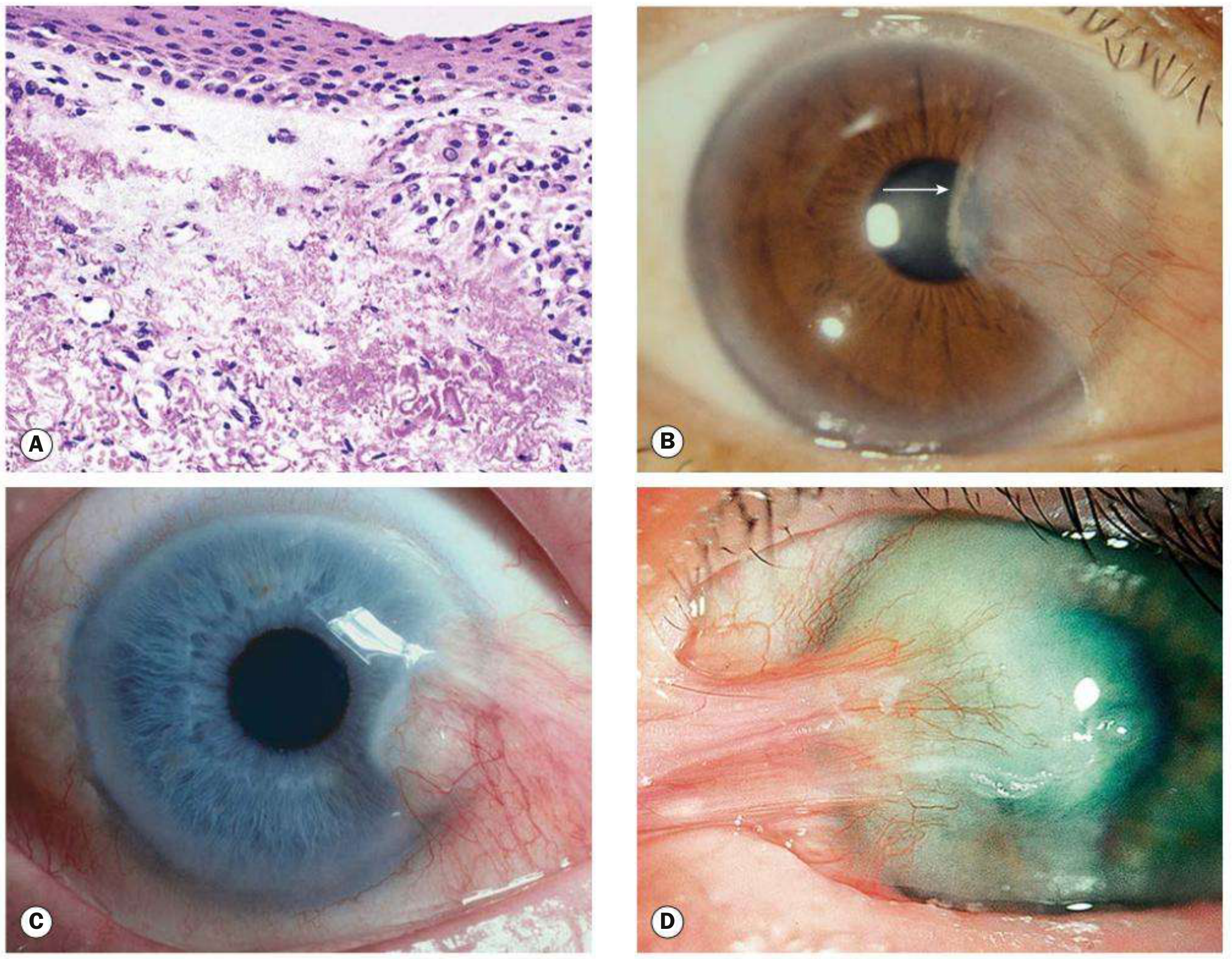
Fig. 6.28 - Pterygium: (A) Histology; (B) classic pterygium with Stocker line (arrow); (C) inflamed pterygium; (D) pseudopterygium from chemical burn (Kanski's Clinical Ophthalmology)
Symptoms
- Most small lesions are asymptomatic
- Irritation and grittiness (from dellen effect at the advancing edge)
- Decreased vision - by obscuring the visual axis or inducing irregular astigmatism
- Cosmetic concern (common reason for seeking treatment)
- Intermittent inflammation (pingueculitis-like episodes)
- Contact lens intolerance due to edge lift
- Extensive or recurrent lesions may cause subconjunctival fibrosis restricting ocular excursion
Location
- Almost always at the 3 or 9 o'clock perilimbal position (interpalpebral fissure)
- Most commonly nasal in location
Differential Diagnosis
| Condition | Key Distinguishing Feature |
|---|---|
| Pinguecula | Yellow-white elevation adjacent to limbus - does NOT invade cornea |
| Pseudopterygium | Conjunctival band adherent to cornea only at apex; associated with prior trauma/burn/ulcer; may be at any clock position |
| Conjunctival intraepithelial neoplasia (CIN) | Papillomatous, jelly-like, or leukoplakic; may not be wing-shaped or in typical 3/9 o'clock location |
| Limbal dermoid | Congenital rounded white lesion, usually inferotemporal |
| Pannus | Vessels only, minimal elevation; associated with contact lens wear, trachoma, rosacea |
Important: Atypical pterygia require biopsy to rule out CIN or ocular surface squamous neoplasia (OSSN). Submitted excised tissue occasionally reveals precursors of squamous cell carcinoma or melanoma.
Distinguishing pseudopterygium: Located away from the horizontal axis; has firm attachment only at its apex (can pass a probe under the body); associated with a prior causative episode (burn, ulcer, trauma).
Workup
- Slit lamp examination to identify the lesion, evaluate corneal integrity and thickness
- Check for corneal astigmatism (often irregular, may be with-the-rule)
- Measure pterygium size and distance from visual axis; repeat every 3-12 months to assess growth rate
- Biopsy for atypical appearances
Treatment
Conservative (Observation + Symptom Control)
- UV protection - UV-blocking sunglasses or goggles (prevention and slowing progression)
- Artificial tears (preservative-free, q.i.d. to q8h) to reduce irritation
- For inflamed pterygium:
- Mild: Artificial tears q.i.d.
- Moderate-severe: Mild topical steroid (fluorometholone 0.1%, loteprednol 0.2-0.5% q.i.d.) or topical NSAID (ketorolac 0.4-0.5% q.i.d.) or topical antihistamine/mast cell stabilizer (bepotastine, olopatadine)
- For delle: Artificial tear ointment q2h
Surgical Indications
Surgery is indicated when:
- Pterygium threatens the visual axis or induces significant astigmatism
- Excessive irritation not relieved by conservative treatment
- Interference with contact lens wear
- Significant cosmetic concern
- Consider removal prior to cataract or refractive surgery
Surgical Techniques
| Technique | Notes |
|---|---|
| Bare sclera excision alone | ~80% recurrence rate - not recommended alone |
| Conjunctival autograft | Gold standard; donor from superior/upper-temporal para-limbal region; secured with 10-0 nylon or fibrin tissue glue (e.g., TISSEEL) - shorter OR time, less postoperative irritation |
| Amniotic membrane graft | Alternative to conjunctival autograft |
| Mitomycin C (MMC) adjuvant | Reduces recurrence; more commonly reserved for recurrent pterygia due to risk of corneoscleral thinning/necrosis |
| Beta-irradiation | Alternative adjuvant to patching techniques |
| Peripheral lamellar keratoplasty | For deep lesions |
Tip: The risk of recurrence is significantly reduced by using a conjunctival autograft or intraoperative mitomycin C application.
Follow-Up
- Asymptomatic, stable: check every 1-2 years
- Measure size every 3-12 months to track progression toward visual axis
- If on topical steroids: check IOP after a few weeks; taper and discontinue once inflammation resolves
Recent Evidence (2025)
A 2025 systematic review and meta-analysis (PMID: 40562088) found that adjuvant topical 0.05% cyclosporine A reduces primary pterygium recurrence rates post-excision, adding to the options alongside MMC. A separate 2025 systematic review (PMID: 40235101) addressed the impact of pterygium on refractive errors, confirming significant irregular astigmatism induction that can be partially reversed by excision.
Sources: Kanski's Clinical Ophthalmology (10th ed.), p. 215-216 | The Wills Eye Manual, p. 191-194 | Robbins, Cotran & Kumar Pathologic Basis of Disease, p. 1207
This is a shared conversation. Sign in to Orris to start your own chat.